- java.lang.Object
-
- rx.Observable
<R> -
- rx.subjects.Subject
<T ,T> -
- rx
.subjects .BehaviorSubject<T>
- rx
- rx.subjects.Subject
- rx.Observable
-
- Type Parameters:
-
T- the type of item expected to be observed by the Subject
- All Implemented Interfaces:
-
Observer
<T>
public final class BehaviorSubject<T> extends Subject
<T ,T> Subject that emits the most recent item it has observed and all subsequent observed items to each subscribedObserver.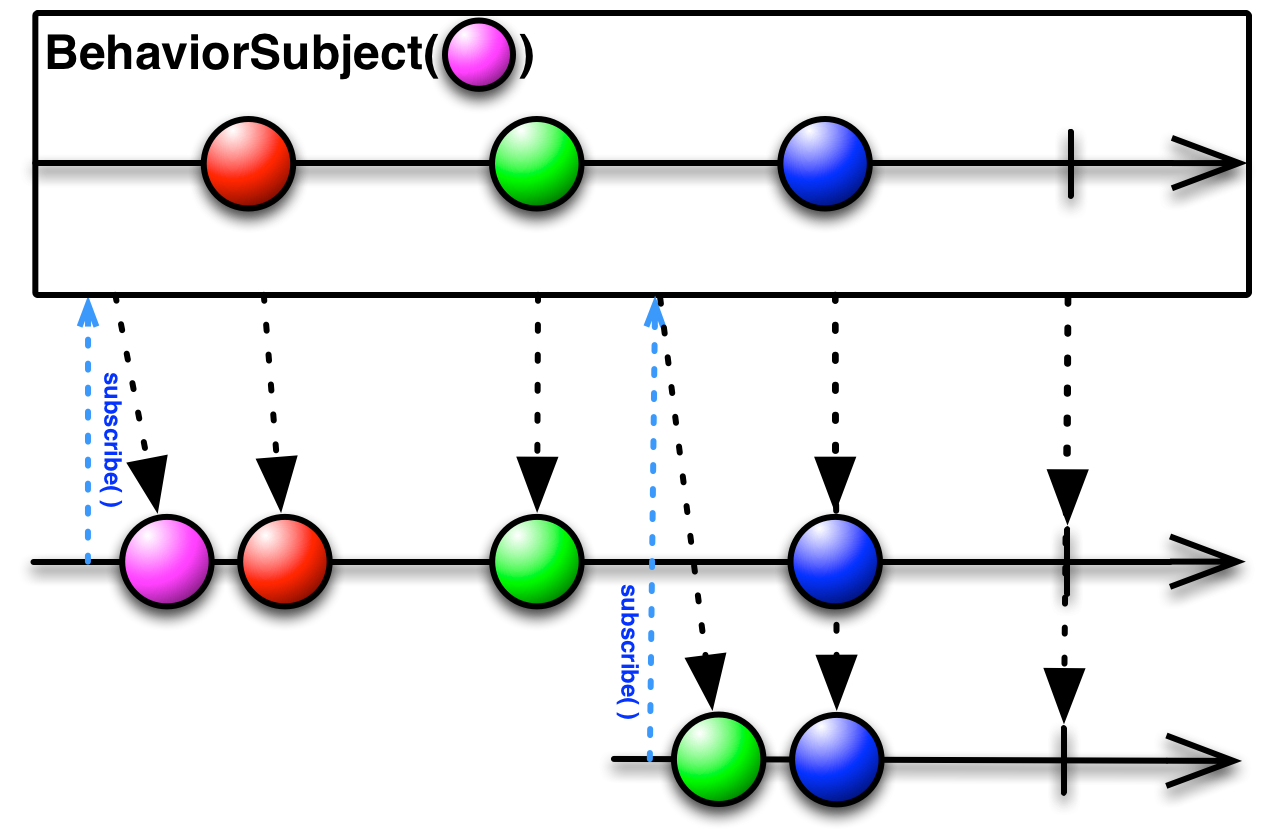
Example usage:
// observer will receive all events. BehaviorSubject<Object> subject = BehaviorSubject.create("default"); subject.subscribe(observer); subject.onNext("one"); subject.onNext("two"); subject.onNext("three"); // observer will receive the "one", "two" and "three" events, but not "zero" BehaviorSubject<Object> subject = BehaviorSubject.create("default"); subject.onNext("zero"); subject.onNext("one"); subject.subscribe(observer); subject.onNext("two"); subject.onNext("three"); // observer will receive only onCompleted BehaviorSubject<Object> subject = BehaviorSubject.create("default"); subject.onNext("zero"); subject.onNext("one"); subject.onCompleted(); subject.subscribe(observer); // observer will receive only onError BehaviorSubject<Object> subject = BehaviorSubject.create("default"); subject.onNext("zero"); subject.onNext("one"); subject.onError(new RuntimeException("error")); subject.subscribe(observer);
-
-
Nested Class Summary
-
Nested classes/interfaces inherited from class rx
.Observable Observable.OnSubscribe <T>, Observable .Operator <R ,T>, Observable .Transformer <T ,R>
-
-
Constructor Summary
Constructors
Modifier Constructor and Description protectedBehaviorSubject(Observable.OnSubscribe <T> onSubscribe, rx .subjects .SubjectSubscriptionManager <T> state)
-
Method Summary
Modifier and Type Method and Description static <T> BehaviorSubject<T> create()Creates aBehaviorSubjectwithout a default item.static <T> BehaviorSubject<T> create(T defaultValue)Creates aBehaviorSubjectthat emits the last item it observed and all subsequent items to eachObserverthat subscribes to it.ThrowablegetThrowable()Returns the Throwable that terminated the Subject.TgetValue()Returns the current value of the Subject if there is such a value and the subject hasn't terminated yet.Object[] getValues()Returns a snapshot of the currently buffered non-terminal events.T[]getValues(T[] a)Returns a snapshot of the currently buffered non-terminal events into the providedaarray or creates a new array if it has not enough capacity.booleanhasCompleted()Check if the Subject has terminated normally.booleanhasObservers()booleanhasThrowable()Check if the Subject has terminated with an exception.booleanhasValue()Check if the Subject has a value.voidonCompleted()Notifies the Observer that theObservablehas finished sending push-based notifications.voidonError(Throwablee) Notifies the Observer that theObservablehas experienced an error condition.voidonNext(T v)Provides the Observer with a new item to observe.-
Methods inherited from class rx
.subjects .Subject toSerialized
-
Methods inherited from class rx
.Observable all, amb, amb, amb, amb, amb, amb, amb, amb, amb, ambWith, asObservable, buffer, buffer, buffer, buffer, buffer, buffer, buffer, buffer, buffer, buffer, buffer, buffer, cache, cache, cast, collect, combineLatest, combineLatest, combineLatest, combineLatest, combineLatest, combineLatest, combineLatest, combineLatest, combineLatest, compose, concat, concat, concat, concat, concat, concat, concat, concat, concat, concatEager, concatEager, concatEager, concatEager, concatEager, concatEager, concatEager, concatEager, concatEager, concatEager, concatEager, concatEager, concatMap, concatMapEager, concatMapEager, concatWith, contains, count, countLong, debounce, debounce, debounce, defaultIfEmpty, defer, delay, delay, delay, delay, delaySubscription, delaySubscription, delaySubscription, dematerialize, distinct, distinct, distinctUntilChanged, distinctUntilChanged, doOnCompleted, doOnEach, doOnEach, doOnError, doOnNext, doOnRequest, doOnSubscribe, doOnTerminate, doOnUnsubscribe, elementAt, elementAtOrDefault, empty, error, exists, extend, filter, finallyDo, first, first, firstOrDefault, firstOrDefault, flatMap, flatMap, flatMap, flatMap, flatMap, flatMap, flatMapIterable, flatMapIterable, forEach, forEach, forEach, from, from, from, from, from, fromCallable, groupBy, groupBy, groupJoin, ignoreElements, interval, interval, interval, interval, isEmpty, join, just, just, just, just, just, just, just, just, just, just, last, last, lastOrDefault, lastOrDefault, lift, limit, map, materialize, merge, merge, merge, merge, merge, merge, merge, merge, merge, merge, merge, merge, merge, merge, mergeDelayError, mergeDelayError, mergeDelayError, mergeDelayError, mergeDelayError, mergeDelayError, mergeDelayError, mergeDelayError, mergeDelayError, mergeDelayError, mergeWith, nest, never, observeOn, ofType, onBackpressureBuffer, onBackpressureBuffer, onBackpressureBuffer, onBackpressureDrop, onBackpressureDrop, onBackpressureLatest, onErrorResumeNext, onErrorResumeNext, onErrorReturn, onExceptionResumeNext, publish, publish, range, range, reduce, reduce, repeat, repeat, repeat, repeat, repeatWhen, repeatWhen, replay, replay, replay, replay, replay, replay, replay, replay, replay, replay, replay, replay, replay, replay, replay, replay, retry, retry, retry, retryWhen, retryWhen, sample, sample, sample, scan, scan, sequenceEqual, sequenceEqual, serialize, share, single, single, singleOrDefault, singleOrDefault, skip, skip, skip, skipLast, skipLast, skipLast, skipUntil, skipWhile, startWith, startWith, startWith, startWith, startWith, startWith, startWith, startWith, startWith, startWith, startWith, subscribe, subscribe, subscribe, subscribe, subscribe, subscribe, subscribeOn, switchIfEmpty, switchMap, switchOnNext, take, take, take, takeFirst, takeLast, takeLast, takeLast, takeLast, takeLast, takeLastBuffer, takeLastBuffer, takeLastBuffer, takeLastBuffer, takeLastBuffer, takeUntil, takeUntil, takeWhile, throttleFirst, throttleFirst, throttleLast, throttleLast, throttleWithTimeout, throttleWithTimeout, timeInterval, timeInterval, timeout, timeout, timeout, timeout, timeout, timeout, timeout, timeout, timer, timer, timer, timer, timestamp, timestamp, toBlocking, toList, toMap, toMap, toMap, toMultimap, toMultimap, toMultimap, toMultimap, toSingle, toSortedList, toSortedList, toSortedList, toSortedList, unsafeSubscribe, unsubscribeOn, using, using, window, window, window, window, window, window, window, window, window, window, window, window, withLatestFrom, zip, zip, zip, zip, zip, zip, zip, zip, zip, zip, zipWith, zipWith
-
-
-
-
Constructor Detail
BehaviorSubject
protected BehaviorSubject(Observable
.OnSubscribe <T> onSubscribe, rx .subjects .SubjectSubscriptionManager <T> state)
-
Method Detail
create
public static <T> BehaviorSubject
<T> create() Creates aBehaviorSubjectwithout a default item.- Type Parameters:
-
T- the type of item the Subject will emit - Returns:
-
the constructed
BehaviorSubject
create
public static <T> BehaviorSubject
<T> create(T defaultValue) Creates aBehaviorSubjectthat emits the last item it observed and all subsequent items to eachObserverthat subscribes to it.- Type Parameters:
-
T- the type of item the Subject will emit - Parameters:
-
defaultValue- the item that will be emitted first to anyObserveras long as theBehaviorSubjecthas not yet observed any items from its sourceObservable - Returns:
-
the constructed
BehaviorSubject
onCompleted
public void onCompleted()
Description copied from interface:ObserverNotifies the Observer that theObservablehas finished sending push-based notifications.The
Observablewill not call this method if it callsObserver..onError(java.lang.Throwable)
onError
public void onError(Throwable
e) Description copied from interface:ObserverNotifies the Observer that theObservablehas experienced an error condition.If the
Observablecalls this method, it will not thereafter callObserveror.onNext(T) Observer..onCompleted() - Parameters:
-
e- the exception encountered by the Observable
onNext
public void onNext(T v)
Description copied from interface:ObserverProvides the Observer with a new item to observe.The
Observablemay call this method 0 or more times.The
Observablewill not call this method again after it calls eitherObserveror.onCompleted() Observer..onError(java.lang.Throwable) - Parameters:
-
v- the item emitted by the Observable
hasObservers
public boolean hasObservers()
Description copied from class:Subject- Specified by:
-
hasObserversin classSubject<T ,T> - Returns:
- true if there is at least one Observer subscribed to this Subject, false otherwise
hasValue
@Beta
public boolean hasValue()
Check if the Subject has a value.Use the
getValue()method to retrieve such a value.Note that unless
hasCompleted()orhasThrowable()returns true, the value retrieved bygetValue()may get outdated.- Returns:
- true if and only if the subject has some value and hasn't terminated yet.
hasThrowable
@Beta
public boolean hasThrowable()
Check if the Subject has terminated with an exception.- Returns:
-
true if the subject has received a throwable through
onError.
hasCompleted
@Beta
public boolean hasCompleted()
Check if the Subject has terminated normally.- Returns:
-
true if the subject completed normally via
onCompleted()
getValue
@Beta
public T getValue()
Returns the current value of the Subject if there is such a value and the subject hasn't terminated yet.The method can return
nullfor various reasons. UsehasValue(),hasThrowable()andhasCompleted()to determine if suchnullis a valid value, there was an exception or the Subject terminated (with or without receiving any value).- Returns:
-
the current value or
nullif the Subject doesn't have a value, has terminated or has an actualnullas a valid value.
getThrowable
@Beta
public Throwable getThrowable()
Returns the Throwable that terminated the Subject.- Returns:
-
the Throwable that terminated the Subject or
nullif the subject hasn't terminated yet or it terminated normally.
getValues
@Beta
public T[] getValues(T[] a)
Returns a snapshot of the currently buffered non-terminal events into the providedaarray or creates a new array if it has not enough capacity.- Parameters:
-
a- the array to fill in - Returns:
-
the array
aif it had enough capacity or a new array containing the available values
getValues
@Beta public Object
[] getValues() Returns a snapshot of the currently buffered non-terminal events.The operation is threadsafe.
- Returns:
- a snapshot of the currently buffered non-terminal events.
- Since:
- (If this graduates from being an Experimental class method, replace this parenthetical with the release number)
-