- java.lang.Object
-
- rx
.internal .operators .OperatorMerge<T>
- rx
-
- Type Parameters:
-
T- the type of the items emitted by both the source and mergedObservables
- All Implemented Interfaces:
-
Func1
<Subscriber <? super T> ,Subscriber <? super Observable <? extends T>>>, Function, Observable .Operator <T ,Observable <? extends T>>
public final class OperatorMerge<T> extends Object
implements Observable .Operator <T ,Observable <? extends T>> Flattens a list ofObservables into oneObservable, without any transformation.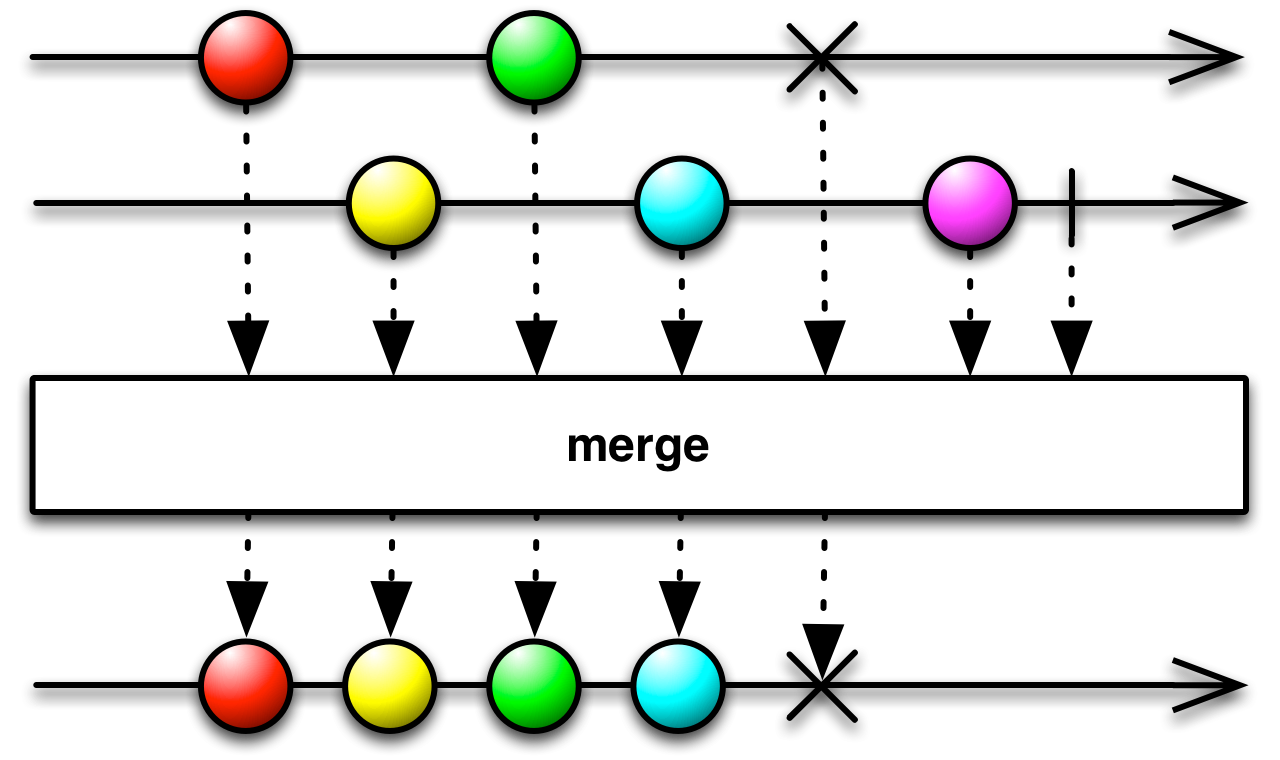
You can combine the items emitted by multiple
Observables so that they act like a singleObservable, by using the merge operation.The
instance(true)call behaves likeOperatorMergeexcept that if any of the merged Observables notify of an error viaonError,mergeDelayErrorwill refrain from propagating that error notification until all of the merged Observables have finished emitting items.
Even if multiple merged Observables send
onErrornotifications,mergeDelayErrorwill only invoke theonErrormethod of its Observers once.This operation allows an Observer to receive all successfully emitted items from all of the source Observables without being interrupted by an error notification from one of them.
Note: If this is used on an Observable that never completes, it will never call
onErrorand will effectively swallow errors.
-
-
Method Summary
Modifier and Type Method and Description Subscriber<Observable <? extends T>> call(Subscriber<? super T> child) static <T> OperatorMerge<T> instance(boolean delayErrors)static <T> OperatorMerge<T> instance(boolean delayErrors, int maxConcurrent)Creates a new instance of the operator with the given delayError and maxConcurrency settings.
-
-
-
Method Detail
instance
public static <T> OperatorMerge
<T> instance(boolean delayErrors) - Parameters:
-
delayErrors- should the merge delay errors? - Returns:
- a singleton instance of this stateless operator.
instance
public static <T> OperatorMerge
<T> instance(boolean delayErrors, int maxConcurrent) Creates a new instance of the operator with the given delayError and maxConcurrency settings.- Parameters:
-
delayErrors- -
maxConcurrent- the maximum number of concurrent subscriptions or Integer.MAX_VALUE for unlimited - Returns:
call
public Subscriber
<Observable <? extends T>> call(Subscriber <? super T> child)
-