Class Observable<T>
- java.lang.Object
-
- rx
.Observable<T>
- rx
-
- Type Parameters:
-
T- the type of the items emitted by the Observable
- Direct Known Subclasses:
-
ConnectableObservable
, GroupedObservable , ScalarSynchronousObservable , Subject
public class Observable<T>
extends Object
The Observable class that implements the Reactive Pattern.This class provides methods for subscribing to the Observable as well as delegate methods to the various Observers.
The documentation for this class makes use of marble diagrams. The following legend explains these diagrams:
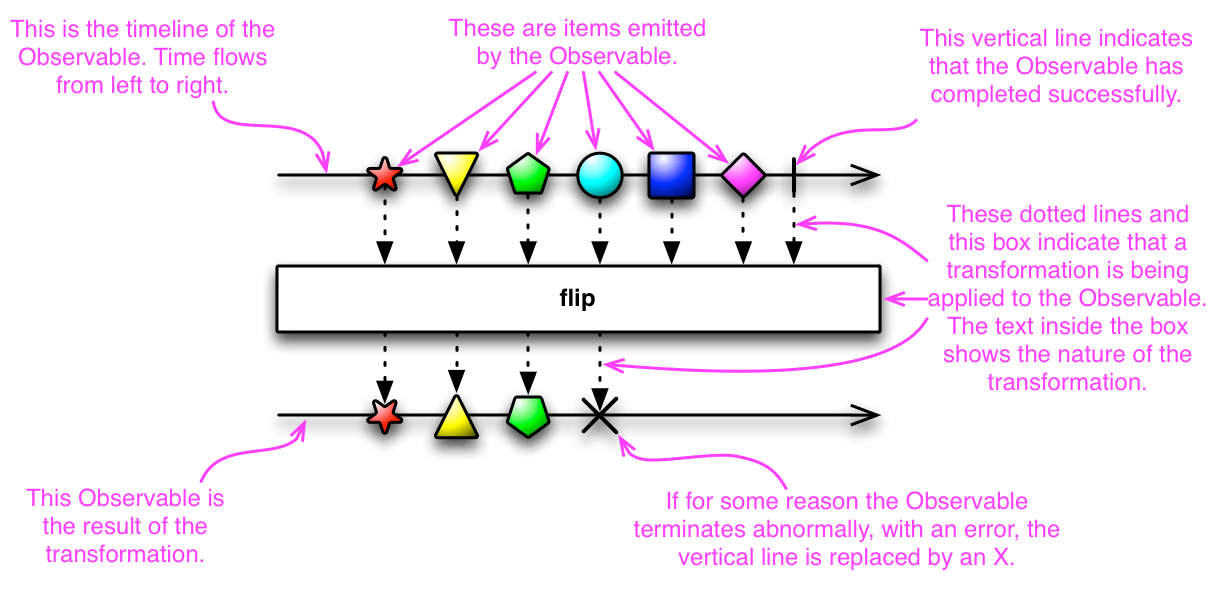
For more information see the RxJava wiki
-
-
Nested Class Summary
Nested Classes
Modifier and Type Class and Description static interfaceObservable.OnSubscribe <T> Invoked when Obserable.subscribe is called.static interfaceObservable.Operator <R ,T> Operator function for lifting into an Observable.static interfaceObservable.Transformer <T ,R> Transformer function used bycompose(rx.Observable.Transformer<? super T, ? extends R>).
-
Constructor Summary
Constructors
Modifier Constructor and Description protectedObservable(Observable.OnSubscribe <T> f) Creates an Observable with a Function to execute when it is subscribed to.
-
Method Summary
Modifier and Type Method and Description Observable<Boolean > all(Func1<? super T ,Boolean > predicate) Returns an Observable that emits a Boolean that indicates whether all of the items emitted by the source Observable satisfy a condition.static <T> Observable<T> amb(Iterable<? extends Observable <? extends T>> sources) Mirrors the one Observable in an Iterable of several Observables that first emits an item.static <T> Observable<T> amb(Observable<? extends T> o1, Observable <? extends T> o2) Given two Observables, mirrors the one that first emits an item.static <T> Observable<T> amb(Observable<? extends T> o1, Observable <? extends T> o2, Observable <? extends T> o3) Given three Observables, mirrors the one that first emits an item.static <T> Observable<T> amb(Observable<? extends T> o1, Observable <? extends T> o2, Observable <? extends T> o3, Observable <? extends T> o4) Given four Observables, mirrors the one that first emits an item.static <T> Observable<T> amb(Observable<? extends T> o1, Observable <? extends T> o2, Observable <? extends T> o3, Observable <? extends T> o4, Observable <? extends T> o5) Given five Observables, mirrors the one that first emits an item.static <T> Observable<T> amb(Observable<? extends T> o1, Observable <? extends T> o2, Observable <? extends T> o3, Observable <? extends T> o4, Observable <? extends T> o5, Observable <? extends T> o6) Given six Observables, mirrors the one that first emits an item.static <T> Observable<T> amb(Observable<? extends T> o1, Observable <? extends T> o2, Observable <? extends T> o3, Observable <? extends T> o4, Observable <? extends T> o5, Observable <? extends T> o6, Observable <? extends T> o7) Given seven Observables, mirrors the one that first emits an item.static <T> Observable<T> amb(Observable<? extends T> o1, Observable <? extends T> o2, Observable <? extends T> o3, Observable <? extends T> o4, Observable <? extends T> o5, Observable <? extends T> o6, Observable <? extends T> o7, Observable <? extends T> o8) Given eight Observables, mirrors the one that first emits an item.static <T> Observable<T> amb(Observable<? extends T> o1, Observable <? extends T> o2, Observable <? extends T> o3, Observable <? extends T> o4, Observable <? extends T> o5, Observable <? extends T> o6, Observable <? extends T> o7, Observable <? extends T> o8, Observable <? extends T> o9) Given nine Observables, mirrors the one that first emits an item.Observable<T> ambWith(Observable<? extends T> t1) Mirrors the first Observable (current or provided) that emits an item.Observable<T> asObservable()Portrays a object of an Observable subclass as a simple Observable object.<TClosing> Observable<List <T>> buffer(Func0<? extends Observable <? extends TClosing>> bufferClosingSelector) Returns an Observable that emits buffers of items it collects from the source Observable.Observable<List <T>> buffer(int count)Returns an Observable that emits buffers of items it collects from the source Observable.Observable<List <T>> buffer(int count, int skip)Returns an Observable that emits buffers of items it collects from the source Observable.Observable<List <T>> buffer(long timespan, long timeshift, TimeUnitunit) Returns an Observable that emits buffers of items it collects from the source Observable.Observable<List <T>> buffer(long timespan, long timeshift, TimeUnitunit, Scheduler scheduler) Returns an Observable that emits buffers of items it collects from the source Observable.Observable<List <T>> buffer(long timespan, TimeUnitunit) Returns an Observable that emits buffers of items it collects from the source Observable.Observable<List <T>> buffer(long timespan, TimeUnitunit, int count) Returns an Observable that emits buffers of items it collects from the source Observable.Observable<List <T>> buffer(long timespan, TimeUnitunit, int count, Scheduler scheduler) Returns an Observable that emits buffers of items it collects from the source Observable.Observable<List <T>> buffer(long timespan, TimeUnitunit, Scheduler scheduler) Returns an Observable that emits buffers of items it collects from the source Observable.<TOpening,TClosing> Observable <List <T>> buffer(Observable<? extends TOpening> bufferOpenings, Func1 <? super TOpening ,? extends Observable <? extends TClosing>> bufferClosingSelector) Returns an Observable that emits buffers of items it collects from the source Observable.<B> Observable<List <T>> buffer(Observable<B> boundary) Returns an Observable that emits non-overlapping buffered items from the source Observable each time the specified boundary Observable emits an item.<B> Observable<List <T>> buffer(Observable<B> boundary, int initialCapacity) Returns an Observable that emits non-overlapping buffered items from the source Observable each time the specified boundary Observable emits an item.Observable<T> cache()Caches the emissions from the source Observable and replays them in order to any subsequent Subscribers.Observable<T> cache(int capacity)Caches emissions from the source Observable and replays them in order to any subsequent Subscribers.<R> Observable<R> cast(Class<R> klass) Returns an Observable that emits the items emitted by the source Observable, converted to the specified type.<R> Observable<R> collect(Func0<R> stateFactory, Action2 <R ,? super T> collector) Collects items emitted by the source Observable into a single mutable data structure and returns an Observable that emits this structure.static <T,R> Observable <R> combineLatest(List<? extends Observable <? extends T>> sources, FuncN <? extends R> combineFunction) Combines a list of source Observables by emitting an item that aggregates the latest values of each of the source Observables each time an item is received from any of the source Observables, where this aggregation is defined by a specified function.static <T1,T2 ,R> Observable <R> combineLatest(Observable<? extends T1> o1, Observable <? extends T2> o2, Func2 <? super T1 ,? super T2 ,? extends R> combineFunction) Combines two source Observables by emitting an item that aggregates the latest values of each of the source Observables each time an item is received from either of the source Observables, where this aggregation is defined by a specified function.static <T1,T2 ,T3 ,R> Observable <R> combineLatest(Observable<? extends T1> o1, Observable <? extends T2> o2, Observable <? extends T3> o3, Func3 <? super T1 ,? super T2 ,? super T3 ,? extends R> combineFunction) Combines three source Observables by emitting an item that aggregates the latest values of each of the source Observables each time an item is received from any of the source Observables, where this aggregation is defined by a specified function.static <T1,T2 ,T3 ,T4 ,R> Observable <R> combineLatest(Observable<? extends T1> o1, Observable <? extends T2> o2, Observable <? extends T3> o3, Observable <? extends T4> o4, Func4 <? super T1 ,? super T2 ,? super T3 ,? super T4 ,? extends R> combineFunction) Combines four source Observables by emitting an item that aggregates the latest values of each of the source Observables each time an item is received from any of the source Observables, where this aggregation is defined by a specified function.static <T1,T2 ,T3 ,T4 ,T5 ,R> Observable <R> combineLatest(Observable<? extends T1> o1, Observable <? extends T2> o2, Observable <? extends T3> o3, Observable <? extends T4> o4, Observable <? extends T5> o5, Func5 <? super T1 ,? super T2 ,? super T3 ,? super T4 ,? super T5 ,? extends R> combineFunction) Combines five source Observables by emitting an item that aggregates the latest values of each of the source Observables each time an item is received from any of the source Observables, where this aggregation is defined by a specified function.static <T1,T2 ,T3 ,T4 ,T5 ,T6 ,R> Observable <R> combineLatest(Observable<? extends T1> o1, Observable <? extends T2> o2, Observable <? extends T3> o3, Observable <? extends T4> o4, Observable <? extends T5> o5, Observable <? extends T6> o6, Func6 <? super T1 ,? super T2 ,? super T3 ,? super T4 ,? super T5 ,? super T6 ,? extends R> combineFunction) Combines six source Observables by emitting an item that aggregates the latest values of each of the source Observables each time an item is received from any of the source Observables, where this aggregation is defined by a specified function.static <T1,T2 ,T3 ,T4 ,T5 ,T6 ,T7 ,R> Observable <R> combineLatest(Observable<? extends T1> o1, Observable <? extends T2> o2, Observable <? extends T3> o3, Observable <? extends T4> o4, Observable <? extends T5> o5, Observable <? extends T6> o6, Observable <? extends T7> o7, Func7 <? super T1 ,? super T2 ,? super T3 ,? super T4 ,? super T5 ,? super T6 ,? super T7 ,? extends R> combineFunction) Combines seven source Observables by emitting an item that aggregates the latest values of each of the source Observables each time an item is received from any of the source Observables, where this aggregation is defined by a specified function.static <T1,T2 ,T3 ,T4 ,T5 ,T6 ,T7 ,T8 ,R> Observable <R> combineLatest(Observable<? extends T1> o1, Observable <? extends T2> o2, Observable <? extends T3> o3, Observable <? extends T4> o4, Observable <? extends T5> o5, Observable <? extends T6> o6, Observable <? extends T7> o7, Observable <? extends T8> o8, Func8 <? super T1 ,? super T2 ,? super T3 ,? super T4 ,? super T5 ,? super T6 ,? super T7 ,? super T8 ,? extends R> combineFunction) Combines eight source Observables by emitting an item that aggregates the latest values of each of the source Observables each time an item is received from any of the source Observables, where this aggregation is defined by a specified function.static <T1,T2 ,T3 ,T4 ,T5 ,T6 ,T7 ,T8 ,T9 ,R> Observable <R> combineLatest(Observable<? extends T1> o1, Observable <? extends T2> o2, Observable <? extends T3> o3, Observable <? extends T4> o4, Observable <? extends T5> o5, Observable <? extends T6> o6, Observable <? extends T7> o7, Observable <? extends T8> o8, Observable <? extends T9> o9, Func9 <? super T1 ,? super T2 ,? super T3 ,? super T4 ,? super T5 ,? super T6 ,? super T7 ,? super T8 ,? super T9 ,? extends R> combineFunction) Combines nine source Observables by emitting an item that aggregates the latest values of each of the source Observables each time an item is received from any of the source Observables, where this aggregation is defined by a specified function.<R> Observable<R> compose(Observable.Transformer <? super T ,? extends R> transformer) Transform an Observable by applying a particular Transformer function to it.static <T> Observable<T> concat(Observable<? extends Observable <? extends T>> observables) Returns an Observable that emits the items emitted by each of the Observables emitted by the source Observable, one after the other, without interleaving them.static <T> Observable<T> concat(Observable<? extends T> t1, Observable <? extends T> t2) Returns an Observable that emits the items emitted by two Observables, one after the other, without interleaving them.static <T> Observable<T> concat(Observable<? extends T> t1, Observable <? extends T> t2, Observable <? extends T> t3) Returns an Observable that emits the items emitted by three Observables, one after the other, without interleaving them.static <T> Observable<T> concat(Observable<? extends T> t1, Observable <? extends T> t2, Observable <? extends T> t3, Observable <? extends T> t4) Returns an Observable that emits the items emitted by four Observables, one after the other, without interleaving them.static <T> Observable<T> concat(Observable<? extends T> t1, Observable <? extends T> t2, Observable <? extends T> t3, Observable <? extends T> t4, Observable <? extends T> t5) Returns an Observable that emits the items emitted by five Observables, one after the other, without interleaving them.static <T> Observable<T> concat(Observable<? extends T> t1, Observable <? extends T> t2, Observable <? extends T> t3, Observable <? extends T> t4, Observable <? extends T> t5, Observable <? extends T> t6) Returns an Observable that emits the items emitted by six Observables, one after the other, without interleaving them.static <T> Observable<T> concat(Observable<? extends T> t1, Observable <? extends T> t2, Observable <? extends T> t3, Observable <? extends T> t4, Observable <? extends T> t5, Observable <? extends T> t6, Observable <? extends T> t7) Returns an Observable that emits the items emitted by seven Observables, one after the other, without interleaving them.static <T> Observable<T> concat(Observable<? extends T> t1, Observable <? extends T> t2, Observable <? extends T> t3, Observable <? extends T> t4, Observable <? extends T> t5, Observable <? extends T> t6, Observable <? extends T> t7, Observable <? extends T> t8) Returns an Observable that emits the items emitted by eight Observables, one after the other, without interleaving them.static <T> Observable<T> concat(Observable<? extends T> t1, Observable <? extends T> t2, Observable <? extends T> t3, Observable <? extends T> t4, Observable <? extends T> t5, Observable <? extends T> t6, Observable <? extends T> t7, Observable <? extends T> t8, Observable <? extends T> t9) Returns an Observable that emits the items emitted by nine Observables, one after the other, without interleaving them.<R> Observable<R> concatMap(Func1<? super T ,? extends Observable <? extends R>> func) Returns a new Observable that emits items resulting from applying a function that you supply to each item emitted by the source Observable, where that function returns an Observable, and then emitting the items that result from concatinating those resulting Observables.Observable<T> concatWith(Observable<? extends T> t1) Returns an Observable that emits the items emitted from the current Observable, then the next, one after the other, without interleaving them.Observable<Boolean > contains(Objectelement) Returns an Observable that emits a Boolean that indicates whether the source Observable emitted a specified item.Observable<Integer > count()Returns an Observable that emits the count of the total number of items emitted by the source Observable.Observable<Long > countLong()Returns an Observable that counts the total number of items emitted by the source Observable and emits this count as a 64-bit Long.static <T> Observable<T> create(Observable.OnSubscribe <T> f) Returns an Observable that will execute the specified function when aSubscribersubscribes to it.<U> Observable<T> debounce(Func1<? super T ,? extends Observable <U>> debounceSelector) Returns an Observable that mirrors the source Observable, except that it drops items emitted by the source Observable that are followed by another item within a computed debounce duration.Observable<T> debounce(long timeout, TimeUnitunit) Returns an Observable that mirrors the source Observable, except that it drops items emitted by the source Observable that are followed by newer items before a timeout value expires.Observable<T> debounce(long timeout, TimeUnitunit, Scheduler scheduler) Returns an Observable that mirrors the source Observable, except that it drops items emitted by the source Observable that are followed by newer items before a timeout value expires on a specified Scheduler.Observable<T> defaultIfEmpty(T defaultValue)Returns an Observable that emits the items emitted by the source Observable or a specified default item if the source Observable is empty.static <T> Observable<T> defer(Func0<Observable <T>> observableFactory) Returns an Observable that calls an Observable factory to create an Observable for each new Observer that subscribes.<U,V> Observable <T> delay(Func0<? extends Observable <U>> subscriptionDelay, Func1 <? super T ,? extends Observable <V>> itemDelay) Returns an Observable that delays the subscription to and emissions from the souce Observable via another Observable on a per-item basis.<U> Observable<T> delay(Func1<? super T ,? extends Observable <U>> itemDelay) Returns an Observable that delays the emissions of the source Observable via another Observable on a per-item basis.Observable<T> delay(long delay, TimeUnitunit) Returns an Observable that emits the items emitted by the source Observable shifted forward in time by a specified delay.Observable<T> delay(long delay, TimeUnitunit, Scheduler scheduler) Returns an Observable that emits the items emitted by the source Observable shifted forward in time by a specified delay.<U> Observable<T> delaySubscription(Func0<? extends Observable <U>> subscriptionDelay) Returns an Observable that delays the subscription to the source Observable until a second Observable emits an item.Observable<T> delaySubscription(long delay, TimeUnitunit) Returns an Observable that delays the subscription to the source Observable by a given amount of time.Observable<T> delaySubscription(long delay, TimeUnitunit, Scheduler scheduler) Returns an Observable that delays the subscription to the source Observable by a given amount of time, both waiting and subscribing on a given Scheduler.<T2> Observable<T2> dematerialize()Returns an Observable that reverses the effect ofmaterializeby transforming theNotificationobjects emitted by the source Observable into the items or notifications they represent.Observable<T> distinct()Returns an Observable that emits all items emitted by the source Observable that are distinct.<U> Observable<T> distinct(Func1<? super T ,? extends U> keySelector) Returns an Observable that emits all items emitted by the source Observable that are distinct according to a key selector function.Observable<T> distinctUntilChanged()Returns an Observable that emits all items emitted by the source Observable that are distinct from their immediate predecessors.<U> Observable<T> distinctUntilChanged(Func1<? super T ,? extends U> keySelector) Returns an Observable that emits all items emitted by the source Observable that are distinct from their immediate predecessors, according to a key selector function.Observable<T> doOnCompleted(Action0onCompleted) Modifies the source Observable so that it invokes an action when it callsonCompleted.Observable<T> doOnEach(Action1<Notification <? super T>> onNotification) Modifies the source Observable so that it invokes an action for each item it emits.Observable<T> doOnEach(Observer<? super T> observer) Modifies the source Observable so that it notifies an Observer for each item it emits.Observable<T> doOnError(Action1<Throwable > onError) Modifies the source Observable so that it invokes an action if it callsonError.Observable<T> doOnNext(Action1<? super T> onNext) Modifies the source Observable so that it invokes an action when it callsonNext.Observable<T> doOnSubscribe(Action0subscribe) Modifies the sourceObservableso that it invokes the given action when it is subscribed from its subscribers.Observable<T> doOnTerminate(Action0onTerminate) Modifies the source Observable so that it invokes an action when it callsonCompletedoronError.Observable<T> doOnUnsubscribe(Action0unsubscribe) Modifies the sourceObservableso that it invokes the given action when it is unsubscribed from its subscribers.Observable<T> elementAt(int index)Returns an Observable that emits the single item at a specified index in a sequence of emissions from a source Observbable.Observable<T> elementAtOrDefault(int index, T defaultValue)Returns an Observable that emits the item found at a specified index in a sequence of emissions from a source Observable, or a default item if that index is out of range.static <T> Observable<T> empty()Returns an Observable that emits no items to theObserverand immediately invokes itsonCompletedmethod.static <T> Observable<T> error(Throwableexception) Observable<Boolean > exists(Func1<? super T ,Boolean > predicate) Returns an Observable that emitstrueif any item emitted by the source Observable satisfies a specified condition, otherwisefalse.Observable<T> filter(Func1<? super T ,Boolean > predicate) Filters items emitted by an Observable by only emitting those that satisfy a specified predicate.Observable<T> finallyDo(Action0action) Observable<T> first()Returns an Observable that emits only the very first item emitted by the source Observable, or notifies of anNoSuchElementExceptionif the source Observable is empty.Observable<T> first(Func1<? super T ,Boolean > predicate) Returns an Observable that emits only the very first item emitted by the source Observable that satisfies a specified condition, or notifies of anNoSuchElementExceptionif no such items are emitted.Observable<T> firstOrDefault(T defaultValue)Returns an Observable that emits only the very first item emitted by the source Observable, or a default item if the source Observable completes without emitting anything.Observable<T> firstOrDefault(T defaultValue, Func1<? super T ,Boolean > predicate) Returns an Observable that emits only the very first item emitted by the source Observable that satisfies a specified condition, or a default item if the source Observable emits no such items.<R> Observable<R> flatMap(Func1<? super T ,? extends Observable <? extends R>> func) Returns an Observable that emits items based on applying a function that you supply to each item emitted by the source Observable, where that function returns an Observable, and then merging those resulting Observables and emitting the results of this merger.<R> Observable<R> flatMap(Func1<? super T ,? extends Observable <? extends R>> onNext, Func1 <? super Throwable ,? extends Observable <? extends R>> onError, Func0 <? extends Observable <? extends R>> onCompleted) Returns an Observable that applies a function to each item emitted or notification raised by the source Observable and then flattens the Observables returned from these functions and emits the resulting items.<U,R> Observable <R> flatMap(Func1<? super T ,? extends Observable <? extends U>> collectionSelector, Func2 <? super T ,? super U ,? extends R> resultSelector) Returns an Observable that emits the results of a specified function to the pair of values emitted by the source Observable and a specified collection Observable.<R> Observable<R> flatMapIterable(Func1<? super T ,? extends Iterable <? extends R>> collectionSelector) Returns an Observable that merges each item emitted by the source Observable with the values in an Iterable corresponding to that item that is generated by a selector.<U,R> Observable <R> flatMapIterable(Func1<? super T ,? extends Iterable <? extends U>> collectionSelector, Func2 <? super T ,? super U ,? extends R> resultSelector) Returns an Observable that emits the results of applying a function to the pair of values from the source Observable and an Iterable corresponding to that item that is generated by a selector.voidforEach(Action1<? super T> onNext) Subscribes to theObservableand receives notifications for each element.voidforEach(Action1<? super T> onNext, Action1 <Throwable > onError) Subscribes to theObservableand receives notifications for each element and error events.voidforEach(Action1<? super T> onNext, Action1 <Throwable > onError, Action0 onComplete) Subscribes to theObservableand receives notifications for each element and the terminal events.static <T> Observable<T> from(Future<? extends T> future) Converts aFutureinto an Observable.static <T> Observable<T> from(Future<? extends T> future, long timeout, TimeUnit unit) Converts aFutureinto an Observable, with a timeout on the Future.static <T> Observable<T> from(Future<? extends T> future, Scheduler scheduler) static <T> Observable<T> from(Iterable<? extends T> iterable) Converts anIterablesequence into an Observable that emits the items in the sequence.static <T> Observable<T> from(T[] array)Converts an Array into an Observable that emits the items in the Array.<K> Observable<GroupedObservable <K ,T>> groupBy(Func1<? super T ,? extends K> keySelector) Groups the items emitted by anObservableaccording to a specified criterion, and emits these grouped items asGroupedObservables, oneGroupedObservableper group.<K,R> Observable <GroupedObservable <K ,R>> groupBy(Func1<? super T ,? extends K> keySelector, Func1 <? super T ,? extends R> elementSelector) Groups the items emitted by anObservableaccording to a specified criterion, and emits these grouped items asGroupedObservables, oneGroupedObservableper group.<T2,D1 ,D2 ,R> Observable <R> groupJoin(Observable<T2> right, Func1 <? super T ,? extends Observable <D1>> leftDuration, Func1 <? super T2 ,? extends Observable <D2>> rightDuration, Func2 <? super T ,? super Observable <T2> ,? extends R> resultSelector) Returns an Observable that correlates two Observables when they overlap in time and groups the results.Observable<T> ignoreElements()Ignores all items emitted by the source Observable and only callsonCompletedoronError.static Observable<Long > interval(long interval, TimeUnitunit) Returns an Observable that emits a sequential number every specified interval of time.static Observable<Long > interval(long interval, TimeUnitunit, Scheduler scheduler) Returns an Observable that emits a sequential number every specified interval of time, on a specified Scheduler.Observable<Boolean > isEmpty()Returns an Observable that emitstrueif the source Observable is empty, otherwisefalse.<TRight,TLeftDuration ,TRightDuration ,R> Observable <R> join(Observable<TRight> right, Func1 <T ,Observable <TLeftDuration>> leftDurationSelector, Func1 <TRight ,Observable <TRightDuration>> rightDurationSelector, Func2 <T ,TRight ,R> resultSelector) Correlates the items emitted by two Observables based on overlapping durations.static <T> Observable<T> just(T value)Returns an Observable that emits a single item and then completes.static <T> Observable<T> just(T t1, T t2)Converts two items into an Observable that emits those items.static <T> Observable<T> just(T t1, T t2, T t3)Converts three items into an Observable that emits those items.static <T> Observable<T> just(T t1, T t2, T t3, T t4)Converts four items into an Observable that emits those items.static <T> Observable<T> just(T t1, T t2, T t3, T t4, T t5)Converts five items into an Observable that emits those items.static <T> Observable<T> just(T t1, T t2, T t3, T t4, T t5, T t6)Converts six items into an Observable that emits those items.static <T> Observable<T> just(T t1, T t2, T t3, T t4, T t5, T t6, T t7)Converts seven items into an Observable that emits those items.static <T> Observable<T> just(T t1, T t2, T t3, T t4, T t5, T t6, T t7, T t8)Converts eight items into an Observable that emits those items.static <T> Observable<T> just(T t1, T t2, T t3, T t4, T t5, T t6, T t7, T t8, T t9)Converts nine items into an Observable that emits those items.static <T> Observable<T> just(T t1, T t2, T t3, T t4, T t5, T t6, T t7, T t8, T t9, T t10)Converts ten items into an Observable that emits those items.Observable<T> last()Returns an Observable that emits the last item emitted by the source Observable or notifies observers of aNoSuchElementExceptionif the source Observable is empty.Observable<T> last(Func1<? super T ,Boolean > predicate) Returns an Observable that emits only the last item emitted by the source Observable that satisfies a given condition, or notifies of aNoSuchElementExceptionif no such items are emitted.Observable<T> lastOrDefault(T defaultValue)Returns an Observable that emits only the last item emitted by the source Observable, or a default item if the source Observable completes without emitting any items.Observable<T> lastOrDefault(T defaultValue, Func1<? super T ,Boolean > predicate) Returns an Observable that emits only the last item emitted by the source Observable that satisfies a specified condition, or a default item if no such item is emitted by the source Observable.<R> Observable<R> lift(Observable.Operator <? extends R ,? super T> lift) Lifts a function to the current Observable and returns a new Observable that when subscribed to will pass the values of the current Observable through the Operator function.Observable<T> limit(int num)Returns an Observable that emits only the firstnumitems emitted by the source Observable.<R> Observable<R> map(Func1<? super T ,? extends R> func) Returns an Observable that applies a specified function to each item emitted by the source Observable and emits the results of these function applications.Observable<Notification <T>> materialize()Returns an Observable that represents all of the emissions and notifications from the source Observable into emissions marked with their original types withinNotificationobjects.static <T> Observable<T> merge(Iterable<? extends Observable <? extends T>> sequences) Flattens an Iterable of Observables into one Observable, without any transformation.static <T> Observable<T> merge(Iterable<? extends Observable <? extends T>> sequences, int maxConcurrent) Flattens an Iterable of Observables into one Observable, without any transformation, while limiting the number of concurrent subscriptions to these Observables.static <T> Observable<T> merge(Observable<? extends Observable <? extends T>> source) Flattens an Observable that emits Observables into a single Observable that emits the items emitted by those Observables, without any transformation.static <T> Observable<T> merge(Observable<? extends Observable <? extends T>> source, int maxConcurrent) Flattens an Observable that emits Observables into a single Observable that emits the items emitted by those Observables, without any transformation, while limiting the maximum number of concurrent subscriptions to these Observables.static <T> Observable<T> merge(Observable<? extends T>[] sequences) Flattens an Array of Observables into one Observable, without any transformation.static <T> Observable<T> merge(Observable<? extends T> t1, Observable <? extends T> t2) Flattens two Observables into a single Observable, without any transformation.static <T> Observable<T> merge(Observable<? extends T> t1, Observable <? extends T> t2, Observable <? extends T> t3) Flattens three Observables into a single Observable, without any transformation.static <T> Observable<T> merge(Observable<? extends T> t1, Observable <? extends T> t2, Observable <? extends T> t3, Observable <? extends T> t4) Flattens four Observables into a single Observable, without any transformation.static <T> Observable<T> merge(Observable<? extends T> t1, Observable <? extends T> t2, Observable <? extends T> t3, Observable <? extends T> t4, Observable <? extends T> t5) Flattens five Observables into a single Observable, without any transformation.static <T> Observable<T> merge(Observable<? extends T> t1, Observable <? extends T> t2, Observable <? extends T> t3, Observable <? extends T> t4, Observable <? extends T> t5, Observable <? extends T> t6) Flattens six Observables into a single Observable, without any transformation.static <T> Observable<T> merge(Observable<? extends T> t1, Observable <? extends T> t2, Observable <? extends T> t3, Observable <? extends T> t4, Observable <? extends T> t5, Observable <? extends T> t6, Observable <? extends T> t7) Flattens seven Observables into a single Observable, without any transformation.static <T> Observable<T> merge(Observable<? extends T> t1, Observable <? extends T> t2, Observable <? extends T> t3, Observable <? extends T> t4, Observable <? extends T> t5, Observable <? extends T> t6, Observable <? extends T> t7, Observable <? extends T> t8) Flattens eight Observables into a single Observable, without any transformation.static <T> Observable<T> merge(Observable<? extends T> t1, Observable <? extends T> t2, Observable <? extends T> t3, Observable <? extends T> t4, Observable <? extends T> t5, Observable <? extends T> t6, Observable <? extends T> t7, Observable <? extends T> t8, Observable <? extends T> t9) Flattens nine Observables into a single Observable, without any transformation.static <T> Observable<T> mergeDelayError(Observable<? extends Observable <? extends T>> source) Flattens an Observable that emits Observables into one Observable, in a way that allows an Observer to receive all successfully emitted items from all of the source Observables without being interrupted by an error notification from one of them.static <T> Observable<T> mergeDelayError(Observable<? extends T> t1, Observable <? extends T> t2) Flattens two Observables into one Observable, in a way that allows an Observer to receive all successfully emitted items from each of the source Observables without being interrupted by an error notification from one of them.static <T> Observable<T> mergeDelayError(Observable<? extends T> t1, Observable <? extends T> t2, Observable <? extends T> t3) Flattens three Observables into one Observable, in a way that allows an Observer to receive all successfully emitted items from all of the source Observables without being interrupted by an error notification from one of them.static <T> Observable<T> mergeDelayError(Observable<? extends T> t1, Observable <? extends T> t2, Observable <? extends T> t3, Observable <? extends T> t4) Flattens four Observables into one Observable, in a way that allows an Observer to receive all successfully emitted items from all of the source Observables without being interrupted by an error notification from one of them.static <T> Observable<T> mergeDelayError(Observable<? extends T> t1, Observable <? extends T> t2, Observable <? extends T> t3, Observable <? extends T> t4, Observable <? extends T> t5) Flattens five Observables into one Observable, in a way that allows an Observer to receive all successfully emitted items from all of the source Observables without being interrupted by an error notification from one of them.static <T> Observable<T> mergeDelayError(Observable<? extends T> t1, Observable <? extends T> t2, Observable <? extends T> t3, Observable <? extends T> t4, Observable <? extends T> t5, Observable <? extends T> t6) Flattens six Observables into one Observable, in a way that allows an Observer to receive all successfully emitted items from all of the source Observables without being interrupted by an error notification from one of them.static <T> Observable<T> mergeDelayError(Observable<? extends T> t1, Observable <? extends T> t2, Observable <? extends T> t3, Observable <? extends T> t4, Observable <? extends T> t5, Observable <? extends T> t6, Observable <? extends T> t7) Flattens seven Observables into one Observable, in a way that allows an Observer to receive all successfully emitted items from all of the source Observables without being interrupted by an error notification from one of them.static <T> Observable<T> mergeDelayError(Observable<? extends T> t1, Observable <? extends T> t2, Observable <? extends T> t3, Observable <? extends T> t4, Observable <? extends T> t5, Observable <? extends T> t6, Observable <? extends T> t7, Observable <? extends T> t8) Flattens eight Observables into one Observable, in a way that allows an Observer to receive all successfully emitted items from all of the source Observables without being interrupted by an error notification from one of them.static <T> Observable<T> mergeDelayError(Observable<? extends T> t1, Observable <? extends T> t2, Observable <? extends T> t3, Observable <? extends T> t4, Observable <? extends T> t5, Observable <? extends T> t6, Observable <? extends T> t7, Observable <? extends T> t8, Observable <? extends T> t9) Flattens nine Observables into one Observable, in a way that allows an Observer to receive all successfully emitted items from all of the source Observables without being interrupted by an error notification from one of them.Observable<T> mergeWith(Observable<? extends T> t1) Flattens this and another Observable into a single Observable, without any transformation.Observable<Observable <T>> nest()Converts the sourceObservable<T>into anObservable<Observable<T>>that emits the source Observable as its single emission.static <T> Observable<T> never()Returns an Observable that never sends any items or notifications to anObserver.Observable<T> observeOn(Schedulerscheduler) Modifies an Observable to perform its emissions and notifications on a specifiedScheduler, asynchronously with an unbounded buffer.<R> Observable<R> ofType(Class<R> klass) Filters the items emitted by an Observable, only emitting those of the specified type.Observable<T> onBackpressureBuffer()Instructs an Observable that is emitting items faster than its observer can consume them to buffer these items indefinitely until they can be emitted.Observable<T> onBackpressureDrop()Instructs an Observable that is emitting items faster than its observer can consume them to discard, rather than emit, those items that its observer is not prepared to observe.Observable<T> onErrorResumeNext(Func1<Throwable ,? extends Observable <? extends T>> resumeFunction) Instructs an Observable to pass control to another Observable rather than invokingonErrorif it encounters an error.Observable<T> onErrorResumeNext(Observable<? extends T> resumeSequence) Instructs an Observable to pass control to another Observable rather than invokingonErrorif it encounters an error.Observable<T> onErrorReturn(Func1<Throwable ,? extends T> resumeFunction) Instructs an Observable to emit an item (returned by a specified function) rather than invokingonErrorif it encounters an error.Observable<T> onExceptionResumeNext(Observable<? extends T> resumeSequence) ConnectableObservable<T> publish()Returns aConnectableObservable, which is a variety of Observable that waits until itsconnectmethod is called before it begins emitting items to thoseObservers that have subscribed to it.<R> Observable<R> publish(Func1<? super Observable <T> ,? extends Observable <R>> selector) Returns an Observable that emits the results of invoking a specified selector on items emitted by aConnectableObservablethat shares a single subscription to the underlying sequence.static Observable<Integer > range(int start, int count)Returns an Observable that emits a sequence of Integers within a specified range.static Observable<Integer > range(int start, int count, Schedulerscheduler) Returns an Observable that emits a sequence of Integers within a specified range, on a specified Scheduler.Observable<T> reduce(Func2<T ,T ,T> accumulator) Returns an Observable that applies a specified accumulator function to the first item emitted by a source Observable, then feeds the result of that function along with the second item emitted by the source Observable into the same function, and so on until all items have been emitted by the source Observable, and emits the final result from the final call to your function as its sole item.<R> Observable<R> reduce(R initialValue, Func2<R ,? super T ,R> accumulator) Returns an Observable that applies a specified accumulator function to the first item emitted by a source Observable and a specified seed value, then feeds the result of that function along with the second item emitted by an Observable into the same function, and so on until all items have been emitted by the source Observable, emitting the final result from the final call to your function as its sole item.Observable<T> repeat()Returns an Observable that repeats the sequence of items emitted by the source Observable indefinitely.Observable<T> repeat(long count)Returns an Observable that repeats the sequence of items emitted by the source Observable at mostcounttimes.Observable<T> repeat(long count, Schedulerscheduler) Returns an Observable that repeats the sequence of items emitted by the source Observable at mostcounttimes, on a particular Scheduler.Observable<T> repeat(Schedulerscheduler) Returns an Observable that repeats the sequence of items emitted by the source Observable indefinitely, on a particular Scheduler.Observable<T> repeatWhen(Func1<? super Observable <? extends Void > ,? extends Observable <?>> notificationHandler) Returns an Observable that emits the same values as the source Observable with the exception of anonCompleted.Observable<T> repeatWhen(Func1<? super Observable <? extends Void > ,? extends Observable <?>> notificationHandler, Scheduler scheduler) Returns an Observable that emits the same values as the source Observable with the exception of anonCompleted.ConnectableObservable<T> replay()Returns aConnectableObservablethat shares a single subscription to the underlying Observable that will replay all of its items and notifications to any futureObserver.<R> Observable<R> replay(Func1<? super Observable <T> ,? extends Observable <R>> selector) Returns an Observable that emits items that are the results of invoking a specified selector on the items emitted by aConnectableObservablethat shares a single subscription to the source Observable.<R> Observable<R> replay(Func1<? super Observable <T> ,? extends Observable <R>> selector, int bufferSize) Returns an Observable that emits items that are the results of invoking a specified selector on items emitted by aConnectableObservablethat shares a single subscription to the source Observable, replayingbufferSizenotifications.<R> Observable<R> replay(Func1<? super Observable <T> ,? extends Observable <R>> selector, int bufferSize, long time, TimeUnit unit) Returns an Observable that emits items that are the results of invoking a specified selector on items emitted by aConnectableObservablethat shares a single subscription to the source Observable, replaying no more thanbufferSizeitems that were emitted within a specified time window.<R> Observable<R> replay(Func1<? super Observable <T> ,? extends Observable <R>> selector, int bufferSize, long time, TimeUnit unit, Scheduler scheduler) Returns an Observable that emits items that are the results of invoking a specified selector on items emitted by aConnectableObservablethat shares a single subscription to the source Observable, replaying no more thanbufferSizeitems that were emitted within a specified time window.<R> Observable<R> replay(Func1<? super Observable <T> ,? extends Observable <R>> selector, int bufferSize, Scheduler scheduler) Returns an Observable that emits items that are the results of invoking a specified selector on items emitted by aConnectableObservablethat shares a single subscription to the source Observable, replaying a maximum ofbufferSizeitems.<R> Observable<R> replay(Func1<? super Observable <T> ,? extends Observable <R>> selector, long time, TimeUnit unit) Returns an Observable that emits items that are the results of invoking a specified selector on items emitted by aConnectableObservablethat shares a single subscription to the source Observable, replaying all items that were emitted within a specified time window.<R> Observable<R> replay(Func1<? super Observable <T> ,? extends Observable <R>> selector, long time, TimeUnit unit, Scheduler scheduler) Returns an Observable that emits items that are the results of invoking a specified selector on items emitted by aConnectableObservablethat shares a single subscription to the source Observable, replaying all items that were emitted within a specified time window.<R> Observable<R> replay(Func1<? super Observable <T> ,? extends Observable <R>> selector, Scheduler scheduler) Returns an Observable that emits items that are the results of invoking a specified selector on items emitted by aConnectableObservablethat shares a single subscription to the source Observable.ConnectableObservable<T> replay(int bufferSize)Returns aConnectableObservablethat shares a single subscription to the source Observable that replays at mostbufferSizeitems emitted by that Observable.ConnectableObservable<T> replay(int bufferSize, long time, TimeUnitunit) Returns aConnectableObservablethat shares a single subscription to the source Observable and replays at mostbufferSizeitems that were emitted during a specified time window.ConnectableObservable<T> replay(int bufferSize, long time, TimeUnitunit, Scheduler scheduler) Returns aConnectableObservablethat shares a single subscription to the source Observable and that replays a maximum ofbufferSizeitems that are emitted within a specified time window.ConnectableObservable<T> replay(int bufferSize, Schedulerscheduler) Returns aConnectableObservablethat shares a single subscription to the source Observable and replays at mostbufferSizeitems emitted by that Observable.ConnectableObservable<T> replay(long time, TimeUnitunit) Returns aConnectableObservablethat shares a single subscription to the source Observable and replays all items emitted by that Observable within a specified time window.ConnectableObservable<T> replay(long time, TimeUnitunit, Scheduler scheduler) Returns aConnectableObservablethat shares a single subscription to the source Observable and replays all items emitted by that Observable within a specified time window.ConnectableObservable<T> replay(Schedulerscheduler) Returns aConnectableObservablethat shares a single subscription to the source Observable that will replay all of its items and notifications to any futureObserveron the givenScheduler.Observable<T> retry()Returns an Observable that mirrors the source Observable, resubscribing to it if it callsonError(infinite retry count).Observable<T> retry(Func2<Integer ,Throwable ,Boolean > predicate) Returns an Observable that mirrors the source Observable, resubscribing to it if it callsonErrorand the predicate returns true for that specific exception and retry count.Observable<T> retry(long count)Returns an Observable that mirrors the source Observable, resubscribing to it if it callsonErrorup to a specified number of retries.Observable<T> retryWhen(Func1<? super Observable <? extends Throwable > ,? extends Observable <?>> notificationHandler) Returns an Observable that emits the same values as the source observable with the exception of anonError.Observable<T> retryWhen(Func1<? super Observable <? extends Throwable > ,? extends Observable <?>> notificationHandler, Scheduler scheduler) Returns an Observable that emits the same values as the source observable with the exception of anonError.Observable<T> sample(long period, TimeUnitunit) Returns an Observable that emits the most recently emitted item (if any) emitted by the source Observable within periodic time intervals.Observable<T> sample(long period, TimeUnitunit, Scheduler scheduler) Returns an Observable that emits the most recently emitted item (if any) emitted by the source Observable within periodic time intervals, where the intervals are defined on a particular Scheduler.<U> Observable<T> sample(Observable<U> sampler) Returns an Observable that, when the specifiedsamplerObservable emits an item or completes, emits the most recently emitted item (if any) emitted by the source Observable since the previous emission from thesamplerObservable.Observable<T> scan(Func2<T ,T ,T> accumulator) Returns an Observable that applies a specified accumulator function to the first item emitted by a source Observable, then feeds the result of that function along with the second item emitted by the source Observable into the same function, and so on until all items have been emitted by the source Observable, emitting the result of each of these iterations.<R> Observable<R> scan(R initialValue, Func2<R ,? super T ,R> accumulator) Returns an Observable that applies a specified accumulator function to the first item emitted by a source Observable and a seed value, then feeds the result of that function along with the second item emitted by the source Observable into the same function, and so on until all items have been emitted by the source Observable, emitting the result of each of these iterations.static <T> Observable<Boolean > sequenceEqual(Observable<? extends T> first, Observable <? extends T> second) Returns an Observable that emits a Boolean value that indicates whether two Observable sequences are the same by comparing the items emitted by each Observable pairwise.static <T> Observable<Boolean > sequenceEqual(Observable<? extends T> first, Observable <? extends T> second, Func2 <? super T ,? super T ,Boolean > equality) Returns an Observable that emits a Boolean value that indicates whether two Observable sequences are the same by comparing the items emitted by each Observable pairwise based on the results of a specified equality function.Observable<T> serialize()Forces an Observable's emissions and notifications to be serialized and for it to obey the Rx contract in other ways.Observable<T> share()Returns a newObservablethat multicasts (shares) the originalObservable.Observable<T> single()Returns an Observable that emits the single item emitted by the source Observable, if that Observable emits only a single item.Observable<T> single(Func1<? super T ,Boolean > predicate) Returns an Observable that emits the single item emitted by the source Observable that matches a specified predicate, if that Observable emits one such item.Observable<T> singleOrDefault(T defaultValue)Returns an Observable that emits the single item emitted by the source Observable, if that Observable emits only a single item, or a default item if the source Observable emits no items.Observable<T> singleOrDefault(T defaultValue, Func1<? super T ,Boolean > predicate) Returns an Observable that emits the single item emitted by the source Observable that matches a predicate, if that Observable emits only one such item, or a default item if the source Observable emits no such items.Observable<T> skip(int num)Returns an Observable that skips the firstnumitems emitted by the source Observable and emits the remainder.Observable<T> skip(long time, TimeUnitunit) Returns an Observable that skips values emitted by the source Observable before a specified time window elapses.Observable<T> skip(long time, TimeUnitunit, Scheduler scheduler) Returns an Observable that skips values emitted by the source Observable before a specified time window on a specifiedSchedulerelapses.Observable<T> skipLast(int count)Returns an Observable that drops a specified number of items from the end of the sequence emitted by the source Observable.Observable<T> skipLast(long time, TimeUnitunit) Returns an Observable that drops items emitted by the source Observable during a specified time window before the source completes.Observable<T> skipLast(long time, TimeUnitunit, Scheduler scheduler) Returns an Observable that drops items emitted by the source Observable during a specified time window (defined on a specified scheduler) before the source completes.<U> Observable<T> skipUntil(Observable<U> other) Returns an Observable that skips items emitted by the source Observable until a second Observable emits an item.Observable<T> skipWhile(Func1<? super T ,Boolean > predicate) Returns an Observable that skips all items emitted by the source Observable as long as a specified condition holds true, but emits all further source items as soon as the condition becomes false.Observable<T> startWith(Iterable<T> values) Returns an Observable that emits the items in a specifiedIterablebefore it begins to emit items emitted by the source Observable.Observable<T> startWith(Observable<T> values) Returns an Observable that emits the items in a specifiedObservablebefore it begins to emit items emitted by the source Observable.Observable<T> startWith(T t1)Returns an Observable that emits a specified item before it begins to emit items emitted by the source Observable.Observable<T> startWith(T t1, T t2)Returns an Observable that emits the specified items before it begins to emit items emitted by the source Observable.Observable<T> startWith(T t1, T t2, T t3)Returns an Observable that emits the specified items before it begins to emit items emitted by the source Observable.Observable<T> startWith(T t1, T t2, T t3, T t4)Returns an Observable that emits the specified items before it begins to emit items emitted by the source Observable.Observable<T> startWith(T t1, T t2, T t3, T t4, T t5)Returns an Observable that emits the specified items before it begins to emit items emitted by the source Observable.Observable<T> startWith(T t1, T t2, T t3, T t4, T t5, T t6)Returns an Observable that emits the specified items before it begins to emit items emitted by the source Observable.Observable<T> startWith(T t1, T t2, T t3, T t4, T t5, T t6, T t7)Returns an Observable that emits the specified items before it begins to emit items emitted by the source Observable.Observable<T> startWith(T t1, T t2, T t3, T t4, T t5, T t6, T t7, T t8)Returns an Observable that emits the specified items before it begins to emit items emitted by the source Observable.Observable<T> startWith(T t1, T t2, T t3, T t4, T t5, T t6, T t7, T t8, T t9)Returns an Observable that emits the specified items before it begins to emit items emitted by the source Observable.Subscriptionsubscribe()Subscribes to an Observable but ignore its emissions and notifications.Subscriptionsubscribe(Action1<? super T> onNext) Subscribes to an Observable and provides a callback to handle the items it emits.Subscriptionsubscribe(Action1<? super T> onNext, Action1 <Throwable > onError) Subscribes to an Observable and provides callbacks to handle the items it emits and any error notification it issues.Subscriptionsubscribe(Action1<? super T> onNext, Action1 <Throwable > onError, Action0 onComplete) Subscribes to an Observable and provides callbacks to handle the items it emits and any error or completion notification it issues.Subscriptionsubscribe(Observer<? super T> observer) Subscribes to an Observable and provides an Observer that implements functions to handle the items the Observable emits and any error or completion notification it issues.Subscriptionsubscribe(Subscriber<? super T> subscriber) Subscribes to an Observable and provides a Subscriber that implements functions to handle the items the Observable emits and any error or completion notification it issues.Observable<T> subscribeOn(Schedulerscheduler) Asynchronously subscribes Observers to this Observable on the specifiedScheduler.<R> Observable<R> switchMap(Func1<? super T ,? extends Observable <? extends R>> func) Returns a new Observable by applying a function that you supply to each item emitted by the source Observable that returns an Observable, and then emitting the items emitted by the most recently emitted of these Observables.static <T> Observable<T> switchOnNext(Observable<? extends Observable <? extends T>> sequenceOfSequences) Converts an Observable that emits Observables into an Observable that emits the items emitted by the most recently emitted of those Observables.Observable<T> take(int num)Returns an Observable that emits only the firstnumitems emitted by the source Observable.Observable<T> take(long time, TimeUnitunit) Returns an Observable that emits those items emitted by source Observable before a specified time runs out.Observable<T> take(long time, TimeUnitunit, Scheduler scheduler) Returns an Observable that emits those items emitted by source Observable before a specified time (on a specified Scheduler) runs out.Observable<T> takeFirst(Func1<? super T ,Boolean > predicate) Returns an Observable that emits only the very first item emitted by the source Observable that satisfies a specified condition.Observable<T> takeLast(int count)Returns an Observable that emits only the lastcountitems emitted by the source Observable.Observable<T> takeLast(int count, long time, TimeUnitunit) Returns an Observable that emits at most a specified number of items from the source Observable that were emitted in a specified window of time before the Observable completed.Observable<T> takeLast(int count, long time, TimeUnitunit, Scheduler scheduler) Returns an Observable that emits at most a specified number of items from the source Observable that were emitted in a specified window of time before the Observable completed, where the timing information is provided by a given Scheduler.Observable<T> takeLast(long time, TimeUnitunit) Returns an Observable that emits the items from the source Observable that were emitted in a specified window of time before the Observable completed.Observable<T> takeLast(long time, TimeUnitunit, Scheduler scheduler) Returns an Observable that emits the items from the source Observable that were emitted in a specified window of time before the Observable completed, where the timing information is provided by a specified Scheduler.Observable<List <T>> takeLastBuffer(int count)Returns an Observable that emits a single List containing the lastcountelements emitted by the source Observable.Observable<List <T>> takeLastBuffer(int count, long time, TimeUnitunit) Returns an Observable that emits a single List containing at mostcountitems from the source Observable that were emitted during a specified window of time before the source Observable completed.Observable<List <T>> takeLastBuffer(int count, long time, TimeUnitunit, Scheduler scheduler) Returns an Observable that emits a single List containing at mostcountitems from the source Observable that were emitted during a specified window of time (on a specified Scheduler) before the source Observable completed.Observable<List <T>> takeLastBuffer(long time, TimeUnitunit) Returns an Observable that emits a single List containing those items from the source Observable that were emitted during a specified window of time before the source Observable completed.Observable<List <T>> takeLastBuffer(long time, TimeUnitunit, Scheduler scheduler) Returns an Observable that emits a single List containing those items from the source Observable that were emitted during a specified window of time before the source Observable completed, where the timing information is provided by the given Scheduler.<E> Observable<T> takeUntil(Observable<? extends E> other) Returns an Observable that emits the items emitted by the source Observable until a second Observable emits an item.Observable<T> takeWhile(Func1<? super T ,Boolean > predicate) Returns an Observable that emits items emitted by the source Observable so long as each item satisfied a specified condition, and then completes as soon as this condition is not satisfied.Observable<T> throttleFirst(long windowDuration, TimeUnitunit) Returns an Observable that emits only the first item emitted by the source Observable during sequential time windows of a specified duration.Observable<T> throttleFirst(long skipDuration, TimeUnitunit, Scheduler scheduler) Returns an Observable that emits only the first item emitted by the source Observable during sequential time windows of a specified duration, where the windows are managed by a specified Scheduler.Observable<T> throttleLast(long intervalDuration, TimeUnitunit) Returns an Observable that emits only the last item emitted by the source Observable during sequential time windows of a specified duration.Observable<T> throttleLast(long intervalDuration, TimeUnitunit, Scheduler scheduler) Returns an Observable that emits only the last item emitted by the source Observable during sequential time windows of a specified duration, where the duration is governed by a specified Scheduler.Observable<T> throttleWithTimeout(long timeout, TimeUnitunit) Returns an Observable that only emits those items emitted by the source Observable that are not followed by another emitted item within a specified time window.Observable<T> throttleWithTimeout(long timeout, TimeUnitunit, Scheduler scheduler) Returns an Observable that only emits those items emitted by the source Observable that are not followed by another emitted item within a specified time window, where the time window is governed by a specified Scheduler.Observable<TimeInterval <T>> timeInterval()Returns an Observable that emits records of the time interval between consecutive items emitted by the source Observable.Observable<TimeInterval <T>> timeInterval(Schedulerscheduler) Returns an Observable that emits records of the time interval between consecutive items emitted by the source Observable, where this interval is computed on a specified Scheduler.<U,V> Observable <T> timeout(Func0<? extends Observable <U>> firstTimeoutSelector, Func1 <? super T ,? extends Observable <V>> timeoutSelector) Returns an Observable that mirrors the source Observable, but notifies observers of aTimeoutExceptionif either the first item emitted by the source Observable or any subsequent item doesn't arrive within time windows defined by other Observables.<U,V> Observable <T> timeout(Func0<? extends Observable <U>> firstTimeoutSelector, Func1 <? super T ,? extends Observable <V>> timeoutSelector, Observable <? extends T> other) Returns an Observable that mirrors the source Observable, but switches to a fallback Observable if either the first item emitted by the source Observable or any subsequent item doesn't arrive within time windows defined by other Observables.<V> Observable<T> timeout(Func1<? super T ,? extends Observable <V>> timeoutSelector) Returns an Observable that mirrors the source Observable, but notifies observers of aTimeoutExceptionif an item emitted by the source Observable doesn't arrive within a window of time after the emission of the previous item, where that period of time is measured by an Observable that is a function of the previous item.<V> Observable<T> timeout(Func1<? super T ,? extends Observable <V>> timeoutSelector, Observable <? extends T> other) Returns an Observable that mirrors the source Observable, but that switches to a fallback Observable if an item emitted by the source Observable doesn't arrive within a window of time after the emission of the previous item, where that period of time is measured by an Observable that is a function of the previous item.Observable<T> timeout(long timeout, TimeUnittimeUnit) Returns an Observable that mirrors the source Observable but applies a timeout policy for each emitted item.Observable<T> timeout(long timeout, TimeUnittimeUnit, Observable <? extends T> other) Returns an Observable that mirrors the source Observable but applies a timeout policy for each emitted item.Observable<T> timeout(long timeout, TimeUnittimeUnit, Observable <? extends T> other, Scheduler scheduler) Returns an Observable that mirrors the source Observable but applies a timeout policy for each emitted item using a specified Scheduler.Observable<T> timeout(long timeout, TimeUnittimeUnit, Scheduler scheduler) Returns an Observable that mirrors the source Observable but applies a timeout policy for each emitted item, where this policy is governed on a specified Scheduler.static Observable<Long > timer(long initialDelay, long period, TimeUnitunit) Returns an Observable that emits a0Lafter theinitialDelayand ever increasing numbers after eachperiodof time thereafter.static Observable<Long > timer(long initialDelay, long period, TimeUnitunit, Scheduler scheduler) Returns an Observable that emits a0Lafter theinitialDelayand ever increasing numbers after eachperiodof time thereafter, on a specifiedScheduler.static Observable<Long > timer(long delay, TimeUnitunit) Returns an Observable that emits one item after a specified delay, and then completes.static Observable<Long > timer(long delay, TimeUnitunit, Scheduler scheduler) Returns an Observable that emits one item after a specified delay, on a specified Scheduler, and then completes.Observable<Timestamped <T>> timestamp()Returns an Observable that emits each item emitted by the source Observable, wrapped in aTimestampedobject.Observable<Timestamped <T>> timestamp(Schedulerscheduler) Returns an Observable that emits each item emitted by the source Observable, wrapped in aTimestampedobject whose timestamps are provided by a specified Scheduler.BlockingObservable<T> toBlocking()Converts an Observable into aBlockingObservable(an Observable with blocking operators).Observable<List <T>> toList()Returns an Observable that emits a single item, a list composed of all the items emitted by the source Observable.<K> Observable<Map <K ,T>> toMap(Func1<? super T ,? extends K> keySelector) Returns an Observable that emits a single HashMap containing all items emitted by the source Observable, mapped by the keys returned by a specifiedkeySelectorfunction.<K,V> Observable <Map <K ,V>> toMap(Func1<? super T ,? extends K> keySelector, Func1 <? super T ,? extends V> valueSelector) Returns an Observable that emits a single HashMap containing values corresponding to items emitted by the source Observable, mapped by the keys returned by a specifiedkeySelectorfunction.<K,V> Observable <Map <K ,V>> toMap(Func1<? super T ,? extends K> keySelector, Func1 <? super T ,? extends V> valueSelector, Func0 <? extends Map <K ,V>> mapFactory) Returns an Observable that emits a single Map, returned by a specifiedmapFactoryfunction, that contains keys and values extracted from the items emitted by the source Observable.<K> Observable<Map <K ,Collection <T>>> toMultimap(Func1<? super T ,? extends K> keySelector) Returns an Observable that emits a single HashMap that contains an ArrayList of items emitted by the source Observable keyed by a specifiedkeySelectorfunction.<K,V> Observable <Map <K ,Collection <V>>> toMultimap(Func1<? super T ,? extends K> keySelector, Func1 <? super T ,? extends V> valueSelector) Returns an Observable that emits a single HashMap that contains an ArrayList of values extracted by a specifiedvalueSelectorfunction from items emitted by the source Observable, keyed by a specifiedkeySelectorfunction.<K,V> Observable <Map <K ,Collection <V>>> toMultimap(Func1<? super T ,? extends K> keySelector, Func1 <? super T ,? extends V> valueSelector, Func0 <? extends Map <K ,Collection <V>>> mapFactory) Returns an Observable that emits a single Map, returned by a specifiedmapFactoryfunction, that contains an ArrayList of values, extracted by a specifiedvalueSelectorfunction from items emitted by the source Observable and keyed by thekeySelectorfunction.<K,V> Observable <Map <K ,Collection <V>>> toMultimap(Func1<? super T ,? extends K> keySelector, Func1 <? super T ,? extends V> valueSelector, Func0 <? extends Map <K ,Collection <V>>> mapFactory, Func1 <? super K ,? extends Collection <V>> collectionFactory) Returns an Observable that emits a single Map, returned by a specifiedmapFactoryfunction, that contains a custom collection of values, extracted by a specifiedvalueSelectorfunction from items emitted by the source Observable, and keyed by thekeySelectorfunction.Observable<List <T>> toSortedList()Returns an Observable that emits a list that contains the items emitted by the source Observable, in a sorted order.Observable<List <T>> toSortedList(Func2<? super T ,? super T ,Integer > sortFunction) Returns an Observable that emits a list that contains the items emitted by the source Observable, in a sorted order based on a specified comparison function.SubscriptionunsafeSubscribe(Subscriber<? super T> subscriber) Subscribes to an Observable and invokesObservable.OnSubscribefunction without any contract protection, error handling, unsubscribe, or execution hooks.Observable<T> unsubscribeOn(Schedulerscheduler) Modifies the source Observable so that subscribers will unsubscribe from it on a specifiedScheduler.static <T,Resource> Observable <T> using(Func0<Resource> resourceFactory, Func1 <? super Resource ,? extends Observable <? extends T>> observableFactory, Action1 <? super Resource> disposeAction) Constructs an Observable that creates a dependent resource object.<TClosing> Observable<Observable <T>> window(Func0<? extends Observable <? extends TClosing>> closingSelector) Returns an Observable that emits windows of items it collects from the source Observable.Observable<Observable <T>> window(int count)Returns an Observable that emits windows of items it collects from the source Observable.Observable<Observable <T>> window(int count, int skip)Returns an Observable that emits windows of items it collects from the source Observable.Observable<Observable <T>> window(long timespan, long timeshift, TimeUnitunit) Returns an Observable that emits windows of items it collects from the source Observable.Observable<Observable <T>> window(long timespan, long timeshift, TimeUnitunit, int count, Scheduler scheduler) Returns an Observable that emits windows of items it collects from the source Observable.Observable<Observable <T>> window(long timespan, long timeshift, TimeUnitunit, Scheduler scheduler) Returns an Observable that emits windows of items it collects from the source Observable.Observable<Observable <T>> window(long timespan, TimeUnitunit) Returns an Observable that emits windows of items it collects from the source Observable.Observable<Observable <T>> window(long timespan, TimeUnitunit, int count) Returns an Observable that emits windows of items it collects from the source Observable.Observable<Observable <T>> window(long timespan, TimeUnitunit, int count, Scheduler scheduler) Returns an Observable that emits windows of items it collects from the source Observable.Observable<Observable <T>> window(long timespan, TimeUnitunit, Scheduler scheduler) Returns an Observable that emits windows of items it collects from the source Observable.<TOpening,TClosing> Observable <Observable <T>> window(Observable<? extends TOpening> windowOpenings, Func1 <? super TOpening ,? extends Observable <? extends TClosing>> closingSelector) Returns an Observable that emits windows of items it collects from the source Observable.<U> Observable<Observable <T>> window(Observable<U> boundary) Returns an Observable that emits non-overlapping windows of items it collects from the source Observable where the boundary of each window is determined by the items emitted from a specified boundary-governing Observable.static <R> Observable<R> zip(Iterable<? extends Observable <?>> ws, FuncN <? extends R> zipFunction) Returns an Observable that emits the results of a specified combiner function applied to combinations of items emitted, in sequence, by an Iterable of other Observables.static <R> Observable<R> zip(Observable<? extends Observable <?>> ws, FuncN <? extends R> zipFunction) Returns an Observable that emits the results of a specified combiner function applied to combinations of n items emitted, in sequence, by the n Observables emitted by a specified Observable.static <T1,T2 ,R> Observable <R> zip(Observable<? extends T1> o1, Observable <? extends T2> o2, Func2 <? super T1 ,? super T2 ,? extends R> zipFunction) Returns an Observable that emits the results of a specified combiner function applied to combinations of two items emitted, in sequence, by two other Observables.static <T1,T2 ,T3 ,R> Observable <R> zip(Observable<? extends T1> o1, Observable <? extends T2> o2, Observable <? extends T3> o3, Func3 <? super T1 ,? super T2 ,? super T3 ,? extends R> zipFunction) Returns an Observable that emits the results of a specified combiner function applied to combinations of three items emitted, in sequence, by three other Observables.static <T1,T2 ,T3 ,T4 ,R> Observable <R> zip(Observable<? extends T1> o1, Observable <? extends T2> o2, Observable <? extends T3> o3, Observable <? extends T4> o4, Func4 <? super T1 ,? super T2 ,? super T3 ,? super T4 ,? extends R> zipFunction) Returns an Observable that emits the results of a specified combiner function applied to combinations of four items emitted, in sequence, by four other Observables.static <T1,T2 ,T3 ,T4 ,T5 ,R> Observable <R> zip(Observable<? extends T1> o1, Observable <? extends T2> o2, Observable <? extends T3> o3, Observable <? extends T4> o4, Observable <? extends T5> o5, Func5 <? super T1 ,? super T2 ,? super T3 ,? super T4 ,? super T5 ,? extends R> zipFunction) Returns an Observable that emits the results of a specified combiner function applied to combinations of five items emitted, in sequence, by five other Observables.static <T1,T2 ,T3 ,T4 ,T5 ,T6 ,R> Observable <R> zip(Observable<? extends T1> o1, Observable <? extends T2> o2, Observable <? extends T3> o3, Observable <? extends T4> o4, Observable <? extends T5> o5, Observable <? extends T6> o6, Func6 <? super T1 ,? super T2 ,? super T3 ,? super T4 ,? super T5 ,? super T6 ,? extends R> zipFunction) Returns an Observable that emits the results of a specified combiner function applied to combinations of six items emitted, in sequence, by six other Observables.static <T1,T2 ,T3 ,T4 ,T5 ,T6 ,T7 ,R> Observable <R> zip(Observable<? extends T1> o1, Observable <? extends T2> o2, Observable <? extends T3> o3, Observable <? extends T4> o4, Observable <? extends T5> o5, Observable <? extends T6> o6, Observable <? extends T7> o7, Func7 <? super T1 ,? super T2 ,? super T3 ,? super T4 ,? super T5 ,? super T6 ,? super T7 ,? extends R> zipFunction) Returns an Observable that emits the results of a specified combiner function applied to combinations of seven items emitted, in sequence, by seven other Observables.static <T1,T2 ,T3 ,T4 ,T5 ,T6 ,T7 ,T8 ,R> Observable <R> zip(Observable<? extends T1> o1, Observable <? extends T2> o2, Observable <? extends T3> o3, Observable <? extends T4> o4, Observable <? extends T5> o5, Observable <? extends T6> o6, Observable <? extends T7> o7, Observable <? extends T8> o8, Func8 <? super T1 ,? super T2 ,? super T3 ,? super T4 ,? super T5 ,? super T6 ,? super T7 ,? super T8 ,? extends R> zipFunction) Returns an Observable that emits the results of a specified combiner function applied to combinations of eight items emitted, in sequence, by eight other Observables.static <T1,T2 ,T3 ,T4 ,T5 ,T6 ,T7 ,T8 ,T9 ,R> Observable <R> zip(Observable<? extends T1> o1, Observable <? extends T2> o2, Observable <? extends T3> o3, Observable <? extends T4> o4, Observable <? extends T5> o5, Observable <? extends T6> o6, Observable <? extends T7> o7, Observable <? extends T8> o8, Observable <? extends T9> o9, Func9 <? super T1 ,? super T2 ,? super T3 ,? super T4 ,? super T5 ,? super T6 ,? super T7 ,? super T8 ,? super T9 ,? extends R> zipFunction) Returns an Observable that emits the results of a specified combiner function applied to combinations of nine items emitted, in sequence, by nine other Observables.<T2,R> Observable <R> zipWith(Iterable<? extends T2> other, Func2 <? super T ,? super T2 ,? extends R> zipFunction) Returns an Observable that emits items that are the result of applying a specified function to pairs of values, one each from the source Observable and a specified Iterable sequence.<T2,R> Observable <R> zipWith(Observable<? extends T2> other, Func2 <? super T ,? super T2 ,? extends R> zipFunction) Returns an Observable that emits items that are the result of applying a specified function to pairs of values, one each from the source Observable and another specified Observable.
-
-
-
Constructor Detail
Observable
protected Observable(Observable
.OnSubscribe <T> f) Creates an Observable with a Function to execute when it is subscribed to.Note: Use
create(OnSubscribe)to create an Observable, instead of this constructor, unless you specifically have a need for inheritance.- Parameters:
-
f-Observable.OnSubscribeto be executed whensubscribe(Subscriber)is called
-
Method Detail
create
public static final <T> Observable
<T> create(Observable .OnSubscribe <T> f) Returns an Observable that will execute the specified function when aSubscribersubscribes to it.
Write the function you pass to
createso that it behaves as an Observable: It should invoke the Subscriber'sonNext,onError, andonCompletedmethods appropriately.A well-formed Observable must invoke either the Subscriber's
onCompletedmethod exactly once or itsonErrormethod exactly once.See Rx Design Guidelines (PDF) for detailed information.
- Scheduler:
-
createdoes not operate by default on a particularScheduler.
- Type Parameters:
-
T- the type of the items that this Observable emits - Parameters:
-
f- a function that accepts anSubscriber<T>, and invokes itsonNext,onError, andonCompletedmethods as appropriate - Returns:
-
an Observable that, when a
Subscribersubscribes to it, will execute the specified function - See Also:
- RxJava wiki: create
lift
public final <R> Observable
<R> lift(Observable .Operator <? extends R ,? super T> lift) Lifts a function to the current Observable and returns a new Observable that when subscribed to will pass the values of the current Observable through the Operator function.In other words, this allows chaining Observers together on an Observable for acting on the values within the Observable.
observable.map(...).filter(...).take(5).lift(new OperatorA()).lift(new OperatorB(...)).subscribe()If the operator you are creating is designed to act on the individual items emitted by a source Observable, use
lift. If your operator is designed to transform the source Observable as a whole (for instance, by applying a particular set of existing RxJava operators to it) usecompose(rx.Observable.Transformer<? super T, ? extends R>).- Scheduler:
-
liftdoes not operate by default on a particularScheduler.
- Parameters:
-
lift- the Operator that implements the Observable-operating function to be applied to the source Observable - Returns:
- an Observable that is the result of applying the lifted Operator to the source Observable
- See Also:
- RxJava wiki: Implementing Your Own Operators
compose
public <R> Observable
<R> compose(Observable .Transformer <? super T ,? extends R> transformer) Transform an Observable by applying a particular Transformer function to it.This method operates on the Observable itself whereas
lift(rx.Observable.Operator<? extends R, ? super T>)operates on the Observable's Subscribers or Observers.If the operator you are creating is designed to act on the individual items emitted by a source Observable, use
lift(rx.Observable.Operator<? extends R, ? super T>). If your operator is designed to transform the source Observable as a whole (for instance, by applying a particular set of existing RxJava operators to it) usecompose.- Scheduler:
-
composedoes not operate by default on a particularScheduler.
- Parameters:
-
transformer- implements the function that transforms the source Observable - Returns:
- the source Observable, transformed by the transformer function
- See Also:
- RxJava wiki: Implementing Your Own Operators
amb
public static final <T> Observable
<T> amb(Iterable <? extends Observable <? extends T>> sources) Mirrors the one Observable in an Iterable of several Observables that first emits an item.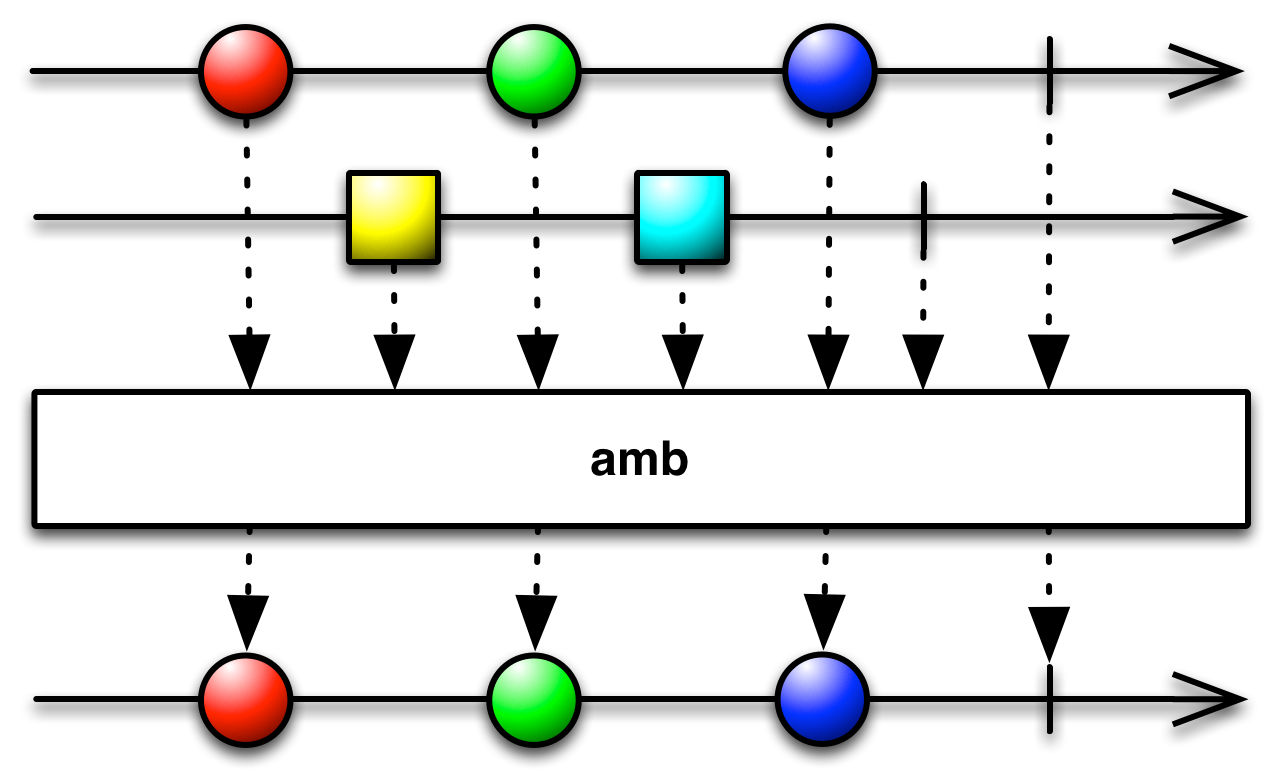
- Scheduler:
-
ambdoes not operate by default on a particularScheduler.
- Parameters:
-
sources- an Iterable of Observable sources competing to react first - Returns:
- an Observable that emits the same sequence of items as whichever of the source Observables first emitted an item
- See Also:
- RxJava wiki: amb
amb
public static final <T> Observable
<T> amb(Observable <? extends T> o1, Observable <? extends T> o2) Given two Observables, mirrors the one that first emits an item. - Scheduler:
-
ambdoes not operate by default on a particularScheduler.
- Parameters:
-
o1- an Observable competing to react first -
o2- an Observable competing to react first - Returns:
- an Observable that emits the same sequence of items as whichever of the source Observables first emitted an item
- See Also:
- RxJava wiki: amb
amb
public static final <T> Observable
<T> amb(Observable <? extends T> o1, Observable <? extends T> o2, Observable <? extends T> o3) Given three Observables, mirrors the one that first emits an item. - Scheduler:
-
ambdoes not operate by default on a particularScheduler.
- Parameters:
-
o1- an Observable competing to react first -
o2- an Observable competing to react first -
o3- an Observable competing to react first - Returns:
- an Observable that emits the same sequence of items as whichever of the source Observables first emitted an item
- See Also:
- RxJava wiki: amb
amb
public static final <T> Observable
<T> amb(Observable <? extends T> o1, Observable <? extends T> o2, Observable <? extends T> o3, Observable <? extends T> o4) Given four Observables, mirrors the one that first emits an item. - Scheduler:
-
ambdoes not operate by default on a particularScheduler.
- Parameters:
-
o1- an Observable competing to react first -
o2- an Observable competing to react first -
o3- an Observable competing to react first -
o4- an Observable competing to react first - Returns:
- an Observable that emits the same sequence of items as whichever of the source Observables first emitted an item
- See Also:
- RxJava wiki: amb
amb
public static final <T> Observable
<T> amb(Observable <? extends T> o1, Observable <? extends T> o2, Observable <? extends T> o3, Observable <? extends T> o4, Observable <? extends T> o5) Given five Observables, mirrors the one that first emits an item. - Scheduler:
-
ambdoes not operate by default on a particularScheduler.
- Parameters:
-
o1- an Observable competing to react first -
o2- an Observable competing to react first -
o3- an Observable competing to react first -
o4- an Observable competing to react first -
o5- an Observable competing to react first - Returns:
- an Observable that emits the same sequence of items as whichever of the source Observables first emitted an item
- See Also:
- RxJava wiki: amb
amb
public static final <T> Observable
<T> amb(Observable <? extends T> o1, Observable <? extends T> o2, Observable <? extends T> o3, Observable <? extends T> o4, Observable <? extends T> o5, Observable <? extends T> o6) Given six Observables, mirrors the one that first emits an item. - Scheduler:
-
ambdoes not operate by default on a particularScheduler.
- Parameters:
-
o1- an Observable competing to react first -
o2- an Observable competing to react first -
o3- an Observable competing to react first -
o4- an Observable competing to react first -
o5- an Observable competing to react first -
o6- an Observable competing to react first - Returns:
- an Observable that emits the same sequence of items as whichever of the source Observables first emitted an item
- See Also:
- RxJava wiki: amb
amb
public static final <T> Observable
<T> amb(Observable <? extends T> o1, Observable <? extends T> o2, Observable <? extends T> o3, Observable <? extends T> o4, Observable <? extends T> o5, Observable <? extends T> o6, Observable <? extends T> o7) Given seven Observables, mirrors the one that first emits an item. - Scheduler:
-
ambdoes not operate by default on a particularScheduler.
- Parameters:
-
o1- an Observable competing to react first -
o2- an Observable competing to react first -
o3- an Observable competing to react first -
o4- an Observable competing to react first -
o5- an Observable competing to react first -
o6- an Observable competing to react first -
o7- an Observable competing to react first - Returns:
- an Observable that emits the same sequence of items as whichever of the source Observables first emitted an item
- See Also:
- RxJava wiki: amb
amb
public static final <T> Observable
<T> amb(Observable <? extends T> o1, Observable <? extends T> o2, Observable <? extends T> o3, Observable <? extends T> o4, Observable <? extends T> o5, Observable <? extends T> o6, Observable <? extends T> o7, Observable <? extends T> o8) Given eight Observables, mirrors the one that first emits an item. - Scheduler:
-
ambdoes not operate by default on a particularScheduler.
- Parameters:
-
o1- an Observable competing to react first -
o2- an Observable competing to react first -
o3- an Observable competing to react first -
o4- an Observable competing to react first -
o5- an Observable competing to react first -
o6- an Observable competing to react first -
o7- an Observable competing to react first -
o8- an observable competing to react first - Returns:
- an Observable that emits the same sequence of items as whichever of the source Observables first emitted an item
- See Also:
- RxJava wiki: amb
amb
public static final <T> Observable
<T> amb(Observable <? extends T> o1, Observable <? extends T> o2, Observable <? extends T> o3, Observable <? extends T> o4, Observable <? extends T> o5, Observable <? extends T> o6, Observable <? extends T> o7, Observable <? extends T> o8, Observable <? extends T> o9) Given nine Observables, mirrors the one that first emits an item. - Scheduler:
-
ambdoes not operate by default on a particularScheduler.
- Parameters:
-
o1- an Observable competing to react first -
o2- an Observable competing to react first -
o3- an Observable competing to react first -
o4- an Observable competing to react first -
o5- an Observable competing to react first -
o6- an Observable competing to react first -
o7- an Observable competing to react first -
o8- an Observable competing to react first -
o9- an Observable competing to react first - Returns:
- an Observable that emits the same sequence of items as whichever of the source Observables first emitted an item
- See Also:
- RxJava wiki: amb
combineLatest
public static final <T1
,T2 ,R> Observable <R> combineLatest(Observable <? extends T1> o1, Observable <? extends T2> o2, Func2 <? super T1 ,? super T2 ,? extends R> combineFunction) Combines two source Observables by emitting an item that aggregates the latest values of each of the source Observables each time an item is received from either of the source Observables, where this aggregation is defined by a specified function.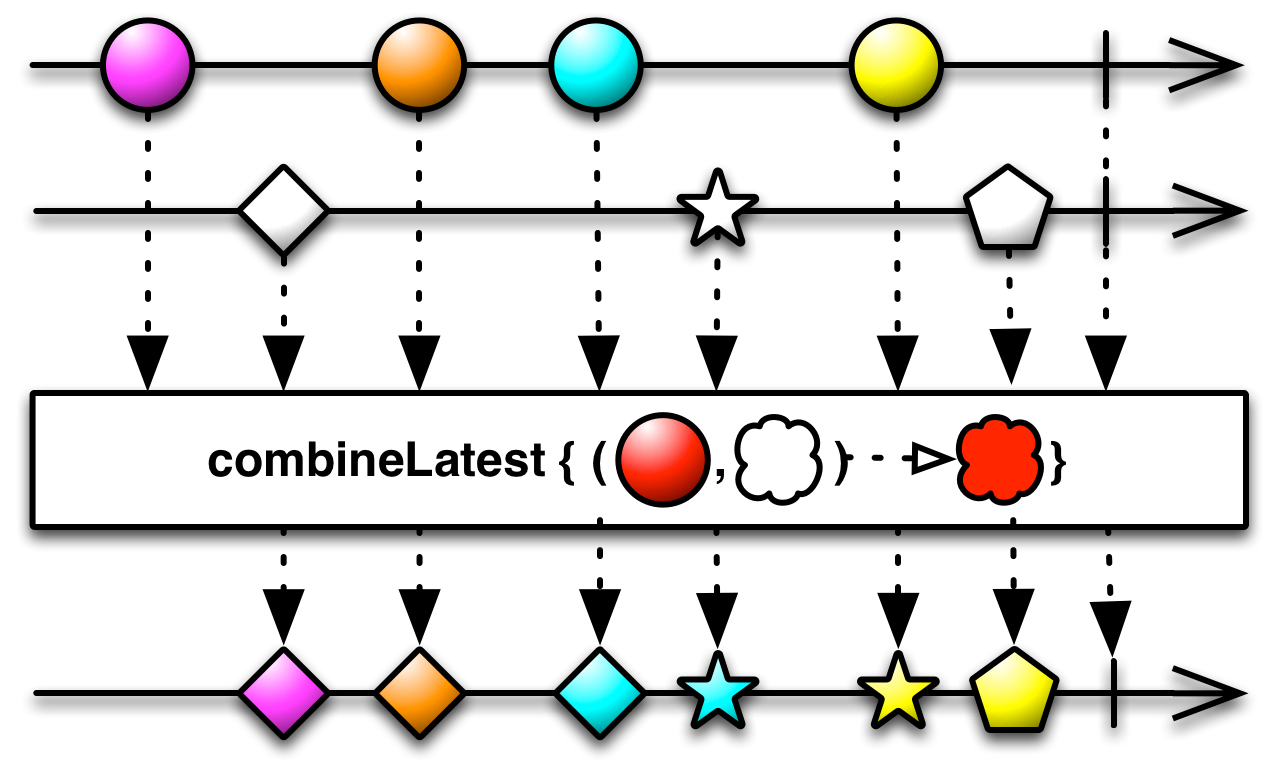
- Scheduler:
-
combineLatestdoes not operate by default on a particularScheduler.
- Parameters:
-
o1- the first source Observable -
o2- the second source Observable -
combineFunction- the aggregation function used to combine the items emitted by the source Observables - Returns:
- an Observable that emits items that are the result of combining the items emitted by the source Observables by means of the given aggregation function
- See Also:
- RxJava wiki: combineLatest
combineLatest
public static final <T1
,T2 ,T3 ,R> Observable <R> combineLatest(Observable <? extends T1> o1, Observable <? extends T2> o2, Observable <? extends T3> o3, Func3 <? super T1 ,? super T2 ,? super T3 ,? extends R> combineFunction) Combines three source Observables by emitting an item that aggregates the latest values of each of the source Observables each time an item is received from any of the source Observables, where this aggregation is defined by a specified function. - Scheduler:
-
combineLatestdoes not operate by default on a particularScheduler.
- Parameters:
-
o1- the first source Observable -
o2- the second source Observable -
o3- the third source Observable -
combineFunction- the aggregation function used to combine the items emitted by the source Observables - Returns:
- an Observable that emits items that are the result of combining the items emitted by the source Observables by means of the given aggregation function
- See Also:
- RxJava wiki: combineLatest
combineLatest
public static final <T1
,T2 ,T3 ,T4 ,R> Observable <R> combineLatest(Observable <? extends T1> o1, Observable <? extends T2> o2, Observable <? extends T3> o3, Observable <? extends T4> o4, Func4 <? super T1 ,? super T2 ,? super T3 ,? super T4 ,? extends R> combineFunction) Combines four source Observables by emitting an item that aggregates the latest values of each of the source Observables each time an item is received from any of the source Observables, where this aggregation is defined by a specified function. - Scheduler:
-
combineLatestdoes not operate by default on a particularScheduler.
- Parameters:
-
o1- the first source Observable -
o2- the second source Observable -
o3- the third source Observable -
o4- the fourth source Observable -
combineFunction- the aggregation function used to combine the items emitted by the source Observables - Returns:
- an Observable that emits items that are the result of combining the items emitted by the source Observables by means of the given aggregation function
- See Also:
- RxJava wiki: combineLatest
combineLatest
public static final <T1
,T2 ,T3 ,T4 ,T5 ,R> Observable <R> combineLatest(Observable <? extends T1> o1, Observable <? extends T2> o2, Observable <? extends T3> o3, Observable <? extends T4> o4, Observable <? extends T5> o5, Func5 <? super T1 ,? super T2 ,? super T3 ,? super T4 ,? super T5 ,? extends R> combineFunction) Combines five source Observables by emitting an item that aggregates the latest values of each of the source Observables each time an item is received from any of the source Observables, where this aggregation is defined by a specified function. - Scheduler:
-
combineLatestdoes not operate by default on a particularScheduler.
- Parameters:
-
o1- the first source Observable -
o2- the second source Observable -
o3- the third source Observable -
o4- the fourth source Observable -
o5- the fifth source Observable -
combineFunction- the aggregation function used to combine the items emitted by the source Observables - Returns:
- an Observable that emits items that are the result of combining the items emitted by the source Observables by means of the given aggregation function
- See Also:
- RxJava wiki: combineLatest
combineLatest
public static final <T1
,T2 ,T3 ,T4 ,T5 ,T6 ,R> Observable <R> combineLatest(Observable <? extends T1> o1, Observable <? extends T2> o2, Observable <? extends T3> o3, Observable <? extends T4> o4, Observable <? extends T5> o5, Observable <? extends T6> o6, Func6 <? super T1 ,? super T2 ,? super T3 ,? super T4 ,? super T5 ,? super T6 ,? extends R> combineFunction) Combines six source Observables by emitting an item that aggregates the latest values of each of the source Observables each time an item is received from any of the source Observables, where this aggregation is defined by a specified function. - Scheduler:
-
combineLatestdoes not operate by default on a particularScheduler.
- Parameters:
-
o1- the first source Observable -
o2- the second source Observable -
o3- the third source Observable -
o4- the fourth source Observable -
o5- the fifth source Observable -
o6- the sixth source Observable -
combineFunction- the aggregation function used to combine the items emitted by the source Observables - Returns:
- an Observable that emits items that are the result of combining the items emitted by the source Observables by means of the given aggregation function
- See Also:
- RxJava wiki: combineLatest
combineLatest
public static final <T1
,T2 ,T3 ,T4 ,T5 ,T6 ,T7 ,R> Observable <R> combineLatest(Observable <? extends T1> o1, Observable <? extends T2> o2, Observable <? extends T3> o3, Observable <? extends T4> o4, Observable <? extends T5> o5, Observable <? extends T6> o6, Observable <? extends T7> o7, Func7 <? super T1 ,? super T2 ,? super T3 ,? super T4 ,? super T5 ,? super T6 ,? super T7 ,? extends R> combineFunction) Combines seven source Observables by emitting an item that aggregates the latest values of each of the source Observables each time an item is received from any of the source Observables, where this aggregation is defined by a specified function. - Scheduler:
-
combineLatestdoes not operate by default on a particularScheduler.
- Parameters:
-
o1- the first source Observable -
o2- the second source Observable -
o3- the third source Observable -
o4- the fourth source Observable -
o5- the fifth source Observable -
o6- the sixth source Observable -
o7- the seventh source Observable -
combineFunction- the aggregation function used to combine the items emitted by the source Observables - Returns:
- an Observable that emits items that are the result of combining the items emitted by the source Observables by means of the given aggregation function
- See Also:
- RxJava wiki: combineLatest
combineLatest
public static final <T1
,T2 ,T3 ,T4 ,T5 ,T6 ,T7 ,T8 ,R> Observable <R> combineLatest(Observable <? extends T1> o1, Observable <? extends T2> o2, Observable <? extends T3> o3, Observable <? extends T4> o4, Observable <? extends T5> o5, Observable <? extends T6> o6, Observable <? extends T7> o7, Observable <? extends T8> o8, Func8 <? super T1 ,? super T2 ,? super T3 ,? super T4 ,? super T5 ,? super T6 ,? super T7 ,? super T8 ,? extends R> combineFunction) Combines eight source Observables by emitting an item that aggregates the latest values of each of the source Observables each time an item is received from any of the source Observables, where this aggregation is defined by a specified function. - Scheduler:
-
combineLatestdoes not operate by default on a particularScheduler.
- Parameters:
-
o1- the first source Observable -
o2- the second source Observable -
o3- the third source Observable -
o4- the fourth source Observable -
o5- the fifth source Observable -
o6- the sixth source Observable -
o7- the seventh source Observable -
o8- the eighth source Observable -
combineFunction- the aggregation function used to combine the items emitted by the source Observables - Returns:
- an Observable that emits items that are the result of combining the items emitted by the source Observables by means of the given aggregation function
- See Also:
- RxJava wiki: combineLatest
combineLatest
public static final <T1
,T2 ,T3 ,T4 ,T5 ,T6 ,T7 ,T8 ,T9 ,R> Observable <R> combineLatest(Observable <? extends T1> o1, Observable <? extends T2> o2, Observable <? extends T3> o3, Observable <? extends T4> o4, Observable <? extends T5> o5, Observable <? extends T6> o6, Observable <? extends T7> o7, Observable <? extends T8> o8, Observable <? extends T9> o9, Func9 <? super T1 ,? super T2 ,? super T3 ,? super T4 ,? super T5 ,? super T6 ,? super T7 ,? super T8 ,? super T9 ,? extends R> combineFunction) Combines nine source Observables by emitting an item that aggregates the latest values of each of the source Observables each time an item is received from any of the source Observables, where this aggregation is defined by a specified function. - Scheduler:
-
combineLatestdoes not operate by default on a particularScheduler.
- Parameters:
-
o1- the first source Observable -
o2- the second source Observable -
o3- the third source Observable -
o4- the fourth source Observable -
o5- the fifth source Observable -
o6- the sixth source Observable -
o7- the seventh source Observable -
o8- the eighth source Observable -
o9- the ninth source Observable -
combineFunction- the aggregation function used to combine the items emitted by the source Observables - Returns:
- an Observable that emits items that are the result of combining the items emitted by the source Observables by means of the given aggregation function
- See Also:
- RxJava wiki: combineLatest
combineLatest
public static final <T
,R> Observable <R> combineLatest(List <? extends Observable <? extends T>> sources, FuncN <? extends R> combineFunction) Combines a list of source Observables by emitting an item that aggregates the latest values of each of the source Observables each time an item is received from any of the source Observables, where this aggregation is defined by a specified function.- Scheduler:
-
combineLatestdoes not operate by default on a particularScheduler.
- Type Parameters:
-
T- the common base type of source values -
R- the result type - Parameters:
-
sources- the list of source Observables -
combineFunction- the aggregation function used to combine the items emitted by the source Observables - Returns:
- an Observable that emits items that are the result of combining the items emitted by the source Observables by means of the given aggregation function
- See Also:
- RxJava wiki: combineLatest
concat
public static final <T> Observable
<T> concat(Observable <? extends Observable <? extends T>> observables) Returns an Observable that emits the items emitted by each of the Observables emitted by the source Observable, one after the other, without interleaving them.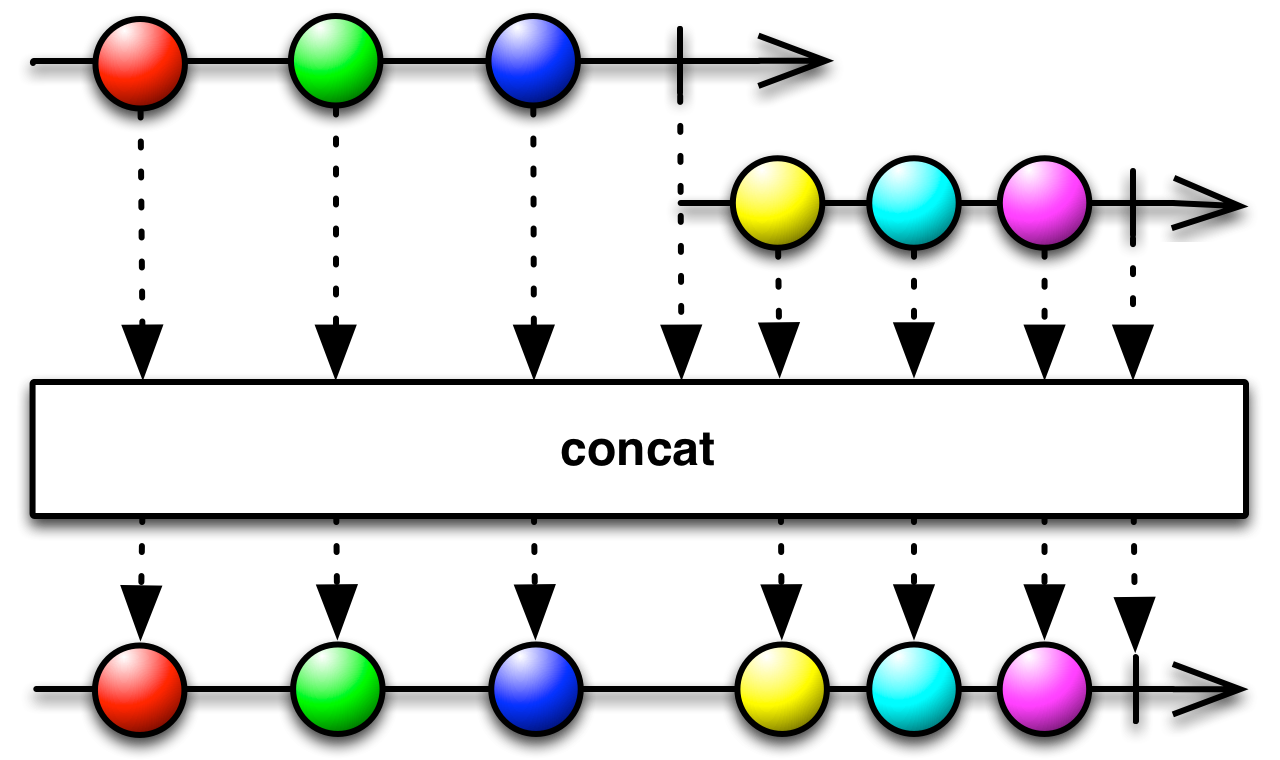
- Scheduler:
-
concatdoes not operate by default on a particularScheduler.
- Parameters:
-
observables- an Observable that emits Observables - Returns:
-
an Observable that emits items all of the items emitted by the Observables emitted by
observables, one after the other, without interleaving them - See Also:
- RxJava wiki: concat
concat
public static final <T> Observable
<T> concat(Observable <? extends T> t1, Observable <? extends T> t2) Returns an Observable that emits the items emitted by two Observables, one after the other, without interleaving them. - Scheduler:
-
concatdoes not operate by default on a particularScheduler.
- Parameters:
-
t1- an Observable to be concatenated -
t2- an Observable to be concatenated - Returns:
- an Observable that emits items emitted by the two source Observables, one after the other, without interleaving them
- See Also:
- RxJava wiki: concat
concat
public static final <T> Observable
<T> concat(Observable <? extends T> t1, Observable <? extends T> t2, Observable <? extends T> t3) Returns an Observable that emits the items emitted by three Observables, one after the other, without interleaving them. - Scheduler:
-
concatdoes not operate by default on a particularScheduler.
- Parameters:
-
t1- an Observable to be concatenated -
t2- an Observable to be concatenated -
t3- an Observable to be concatenated - Returns:
- an Observable that emits items emitted by the three source Observables, one after the other, without interleaving them
- See Also:
- RxJava wiki: concat
concat
public static final <T> Observable
<T> concat(Observable <? extends T> t1, Observable <? extends T> t2, Observable <? extends T> t3, Observable <? extends T> t4) Returns an Observable that emits the items emitted by four Observables, one after the other, without interleaving them. - Scheduler:
-
concatdoes not operate by default on a particularScheduler.
- Parameters:
-
t1- an Observable to be concatenated -
t2- an Observable to be concatenated -
t3- an Observable to be concatenated -
t4- an Observable to be concatenated - Returns:
- an Observable that emits items emitted by the four source Observables, one after the other, without interleaving them
- See Also:
- RxJava wiki: concat
concat
public static final <T> Observable
<T> concat(Observable <? extends T> t1, Observable <? extends T> t2, Observable <? extends T> t3, Observable <? extends T> t4, Observable <? extends T> t5) Returns an Observable that emits the items emitted by five Observables, one after the other, without interleaving them. - Scheduler:
-
concatdoes not operate by default on a particularScheduler.
- Parameters:
-
t1- an Observable to be concatenated -
t2- an Observable to be concatenated -
t3- an Observable to be concatenated -
t4- an Observable to be concatenated -
t5- an Observable to be concatenated - Returns:
- an Observable that emits items emitted by the five source Observables, one after the other, without interleaving them
- See Also:
- RxJava wiki: concat
concat
public static final <T> Observable
<T> concat(Observable <? extends T> t1, Observable <? extends T> t2, Observable <? extends T> t3, Observable <? extends T> t4, Observable <? extends T> t5, Observable <? extends T> t6) Returns an Observable that emits the items emitted by six Observables, one after the other, without interleaving them. - Scheduler:
-
concatdoes not operate by default on a particularScheduler.
- Parameters:
-
t1- an Observable to be concatenated -
t2- an Observable to be concatenated -
t3- an Observable to be concatenated -
t4- an Observable to be concatenated -
t5- an Observable to be concatenated -
t6- an Observable to be concatenated - Returns:
- an Observable that emits items emitted by the six source Observables, one after the other, without interleaving them
- See Also:
- RxJava wiki: concat
concat
public static final <T> Observable
<T> concat(Observable <? extends T> t1, Observable <? extends T> t2, Observable <? extends T> t3, Observable <? extends T> t4, Observable <? extends T> t5, Observable <? extends T> t6, Observable <? extends T> t7) Returns an Observable that emits the items emitted by seven Observables, one after the other, without interleaving them. - Scheduler:
-
concatdoes not operate by default on a particularScheduler.
- Parameters:
-
t1- an Observable to be concatenated -
t2- an Observable to be concatenated -
t3- an Observable to be concatenated -
t4- an Observable to be concatenated -
t5- an Observable to be concatenated -
t6- an Observable to be concatenated -
t7- an Observable to be concatenated - Returns:
- an Observable that emits items emitted by the seven source Observables, one after the other, without interleaving them
- See Also:
- RxJava wiki: concat
concat
public static final <T> Observable
<T> concat(Observable <? extends T> t1, Observable <? extends T> t2, Observable <? extends T> t3, Observable <? extends T> t4, Observable <? extends T> t5, Observable <? extends T> t6, Observable <? extends T> t7, Observable <? extends T> t8) Returns an Observable that emits the items emitted by eight Observables, one after the other, without interleaving them. - Scheduler:
-
concatdoes not operate by default on a particularScheduler.
- Parameters:
-
t1- an Observable to be concatenated -
t2- an Observable to be concatenated -
t3- an Observable to be concatenated -
t4- an Observable to be concatenated -
t5- an Observable to be concatenated -
t6- an Observable to be concatenated -
t7- an Observable to be concatenated -
t8- an Observable to be concatenated - Returns:
- an Observable that emits items emitted by the eight source Observables, one after the other, without interleaving them
- See Also:
- RxJava wiki: concat
concat
public static final <T> Observable
<T> concat(Observable <? extends T> t1, Observable <? extends T> t2, Observable <? extends T> t3, Observable <? extends T> t4, Observable <? extends T> t5, Observable <? extends T> t6, Observable <? extends T> t7, Observable <? extends T> t8, Observable <? extends T> t9) Returns an Observable that emits the items emitted by nine Observables, one after the other, without interleaving them. - Scheduler:
-
concatdoes not operate by default on a particularScheduler.
- Parameters:
-
t1- an Observable to be concatenated -
t2- an Observable to be concatenated -
t3- an Observable to be concatenated -
t4- an Observable to be concatenated -
t5- an Observable to be concatenated -
t6- an Observable to be concatenated -
t7- an Observable to be concatenated -
t8- an Observable to be concatenated -
t9- an Observable to be concatenated - Returns:
- an Observable that emits items emitted by the nine source Observables, one after the other, without interleaving them
- See Also:
- RxJava wiki: concat
defer
public static final <T> Observable
<T> defer(Func0 <Observable <T>> observableFactory) Returns an Observable that calls an Observable factory to create an Observable for each new Observer that subscribes. That is, for each subscriber, the actual Observable that subscriber observes is determined by the factory function.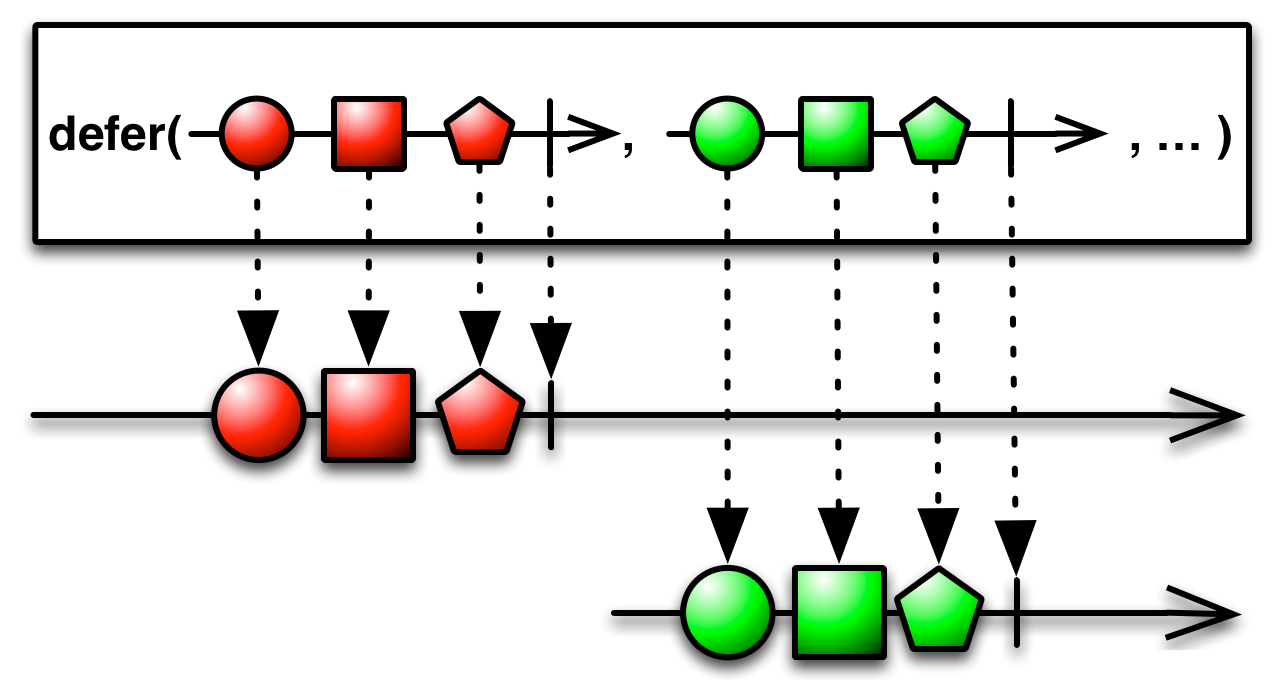
The defer Observer allows you to defer or delay emitting items from an Observable until such time as an Observer subscribes to the Observable. This allows an
Observerto easily obtain updates or a refreshed version of the sequence.- Scheduler:
-
deferdoes not operate by default on a particularScheduler.
- Type Parameters:
-
T- the type of the items emitted by the Observable - Parameters:
-
observableFactory- the Observable factory function to invoke for eachObserverthat subscribes to the resulting Observable - Returns:
-
an Observable whose
Observers' subscriptions trigger an invocation of the given Observable factory function - See Also:
- RxJava wiki: defer
empty
public static final <T> Observable
<T> empty() Returns an Observable that emits no items to theObserverand immediately invokes itsonCompletedmethod.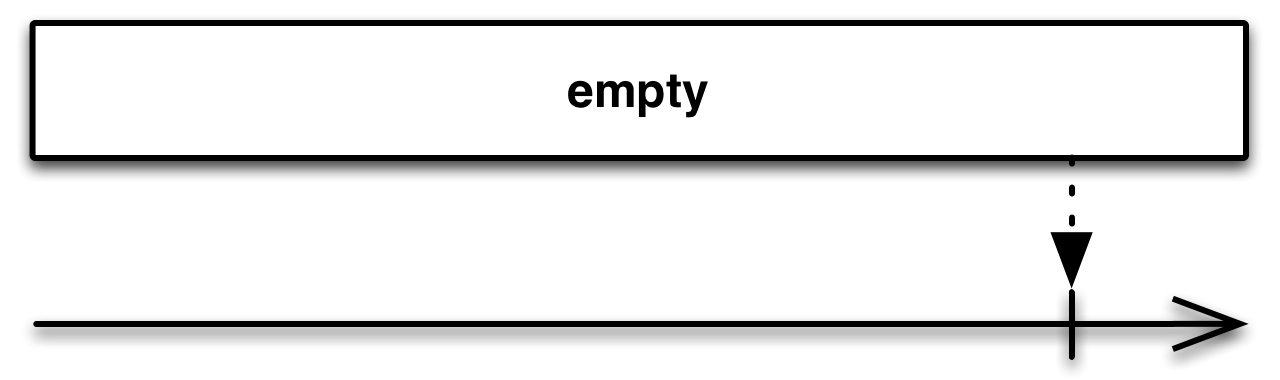
- Scheduler:
-
emptydoes not operate by default on a particularScheduler.
- Type Parameters:
-
T- the type of the items (ostensibly) emitted by the Observable - Returns:
-
an Observable that emits no items to the
Observerbut immediately invokes theObserver'sonCompletedmethod - See Also:
- RxJava wiki: empty
error
public static final <T> Observable
<T> error(Throwable exception) Returns an Observable that invokes anObserver'sonErrormethod when the Observer subscribes to it.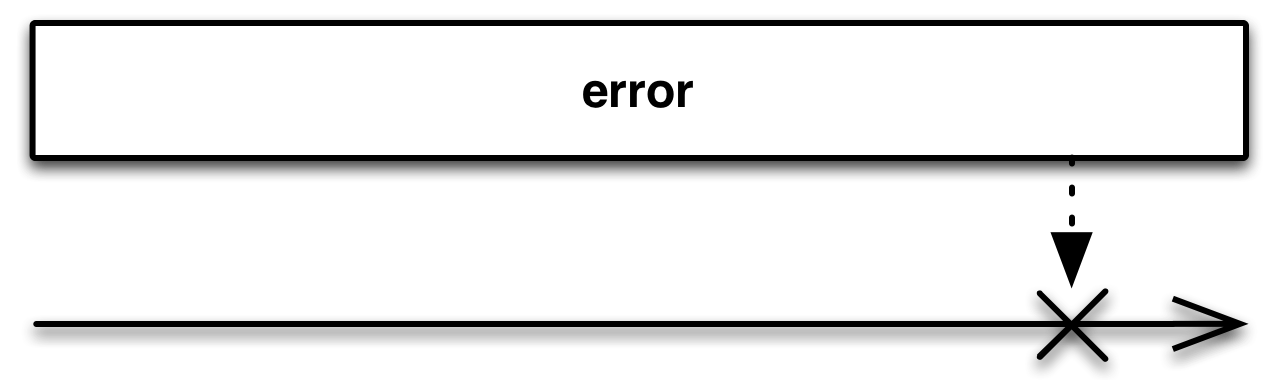
- Scheduler:
-
errordoes not operate by default on a particularScheduler.
- Type Parameters:
-
T- the type of the items (ostensibly) emitted by the Observable - Parameters:
-
exception- the particular Throwable to pass toonError - Returns:
-
an Observable that invokes the
Observer'sonErrormethod when the Observer subscribes to it - See Also:
- RxJava wiki: error
from
public static final <T> Observable
<T> from(Future <? extends T> future) Converts aFutureinto an Observable.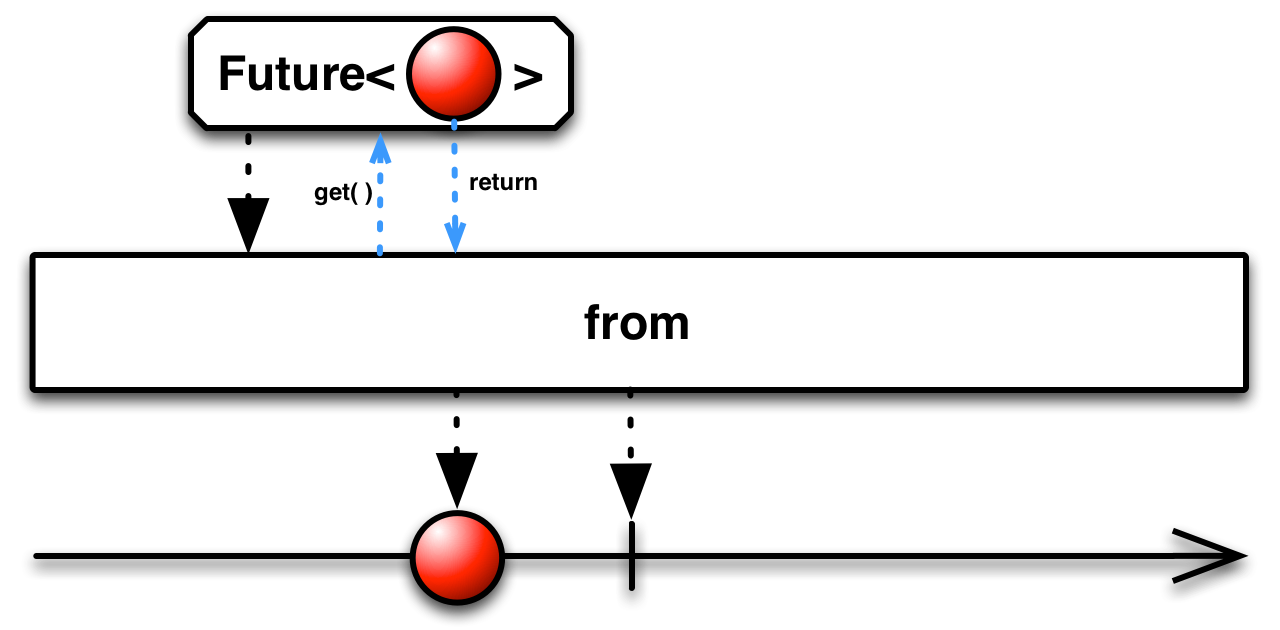
You can convert any object that supports the
Futureinterface into an Observable that emits the return value of theFuturemethod of that object, by passing the object into the.get() frommethod.Important note: This Observable is blocking; you cannot unsubscribe from it.
- Scheduler:
-
fromdoes not operate by default on a particularScheduler.
- Type Parameters:
-
T- the type of object that theFuturereturns, and also the type of item to be emitted by the resulting Observable - Parameters:
-
future- the sourceFuture - Returns:
-
an Observable that emits the item from the source
Future - See Also:
- RxJava wiki: from
from
public static final <T> Observable
<T> from(Future <? extends T> future, long timeout, TimeUnit unit) Converts aFutureinto an Observable, with a timeout on the Future. You can convert any object that supports the
Futureinterface into an Observable that emits the return value of theFuturemethod of that object, by passing the object into the.get() frommethod.Important note: This Observable is blocking; you cannot unsubscribe from it.
- Scheduler:
-
fromdoes not operate by default on a particularScheduler.
- Type Parameters:
-
T- the type of object that theFuturereturns, and also the type of item to be emitted by the resulting Observable - Parameters:
-
future- the sourceFuture -
timeout- the maximum time to wait before callingget -
unit- theTimeUnitof thetimeoutargument - Returns:
-
an Observable that emits the item from the source
Future - See Also:
- RxJava wiki: from
from
public static final <T> Observable
<T> from(Future <? extends T> future, Scheduler scheduler) Converts aFuture, operating on a specifiedScheduler, into an Observable.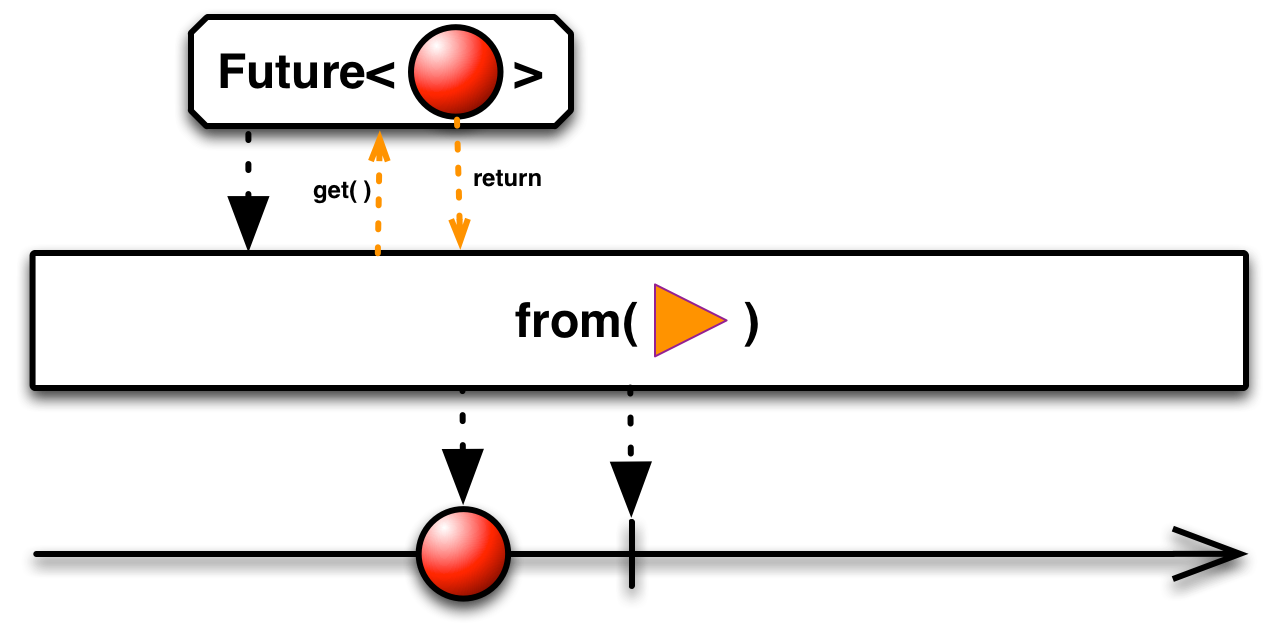
You can convert any object that supports the
Futureinterface into an Observable that emits the return value of theFuturemethod of that object, by passing the object into the.get() frommethod.- Scheduler:
-
you specify which
Schedulerthis operator will use
- Type Parameters:
-
T- the type of object that theFuturereturns, and also the type of item to be emitted by the resulting Observable - Parameters:
-
future- the sourceFuture -
scheduler- theSchedulerto wait for the Future on. Use a Scheduler such asSchedulersthat can block and wait on the Future.io() - Returns:
-
an Observable that emits the item from the source
Future - See Also:
- RxJava wiki: from
from
public static final <T> Observable
<T> from(Iterable <? extends T> iterable) Converts anIterablesequence into an Observable that emits the items in the sequence.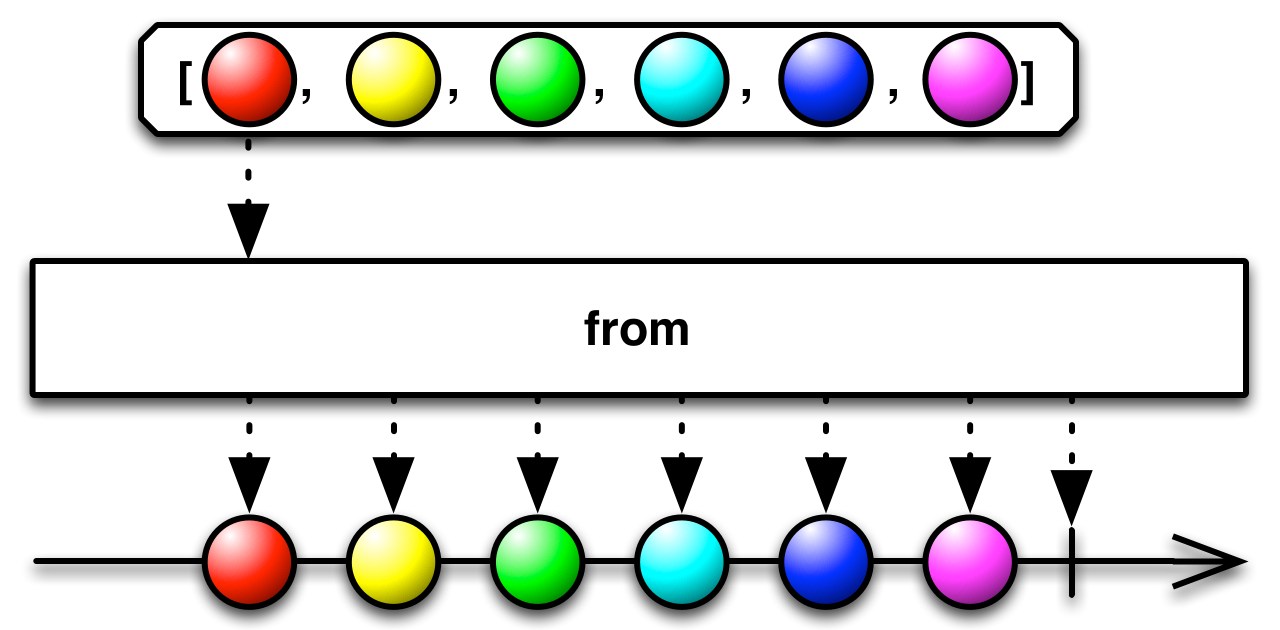
- Scheduler:
-
fromdoes not operate by default on a particularScheduler.
- Type Parameters:
-
T- the type of items in theIterablesequence and the type of items to be emitted by the resulting Observable - Parameters:
-
iterable- the sourceIterablesequence - Returns:
-
an Observable that emits each item in the source
Iterablesequence - See Also:
- RxJava wiki: from
from
public static final <T> Observable
<T> from(T[] array) Converts an Array into an Observable that emits the items in the Array. - Scheduler:
-
fromdoes not operate by default on a particularScheduler.
- Type Parameters:
-
T- the type of items in the Array and the type of items to be emitted by the resulting Observable - Parameters:
-
array- the source Array - Returns:
- an Observable that emits each item in the source Array
- See Also:
- RxJava wiki: from
interval
public static final Observable
<Long > interval(long interval, TimeUnit unit) Returns an Observable that emits a sequential number every specified interval of time.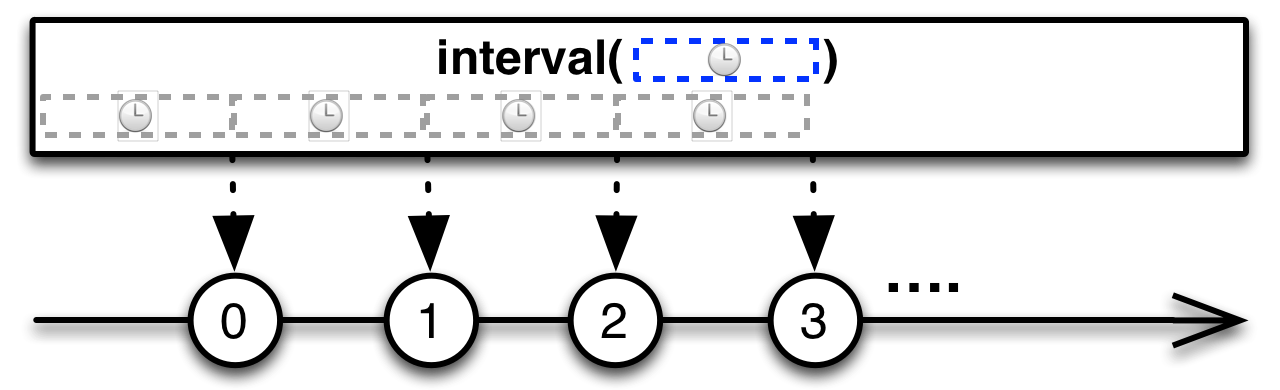
- Scheduler:
-
intervaloperates by default on thecomputationScheduler.
- Parameters:
-
interval- interval size in time units (see below) -
unit- time units to use for the interval size - Returns:
- an Observable that emits a sequential number each time interval
- See Also:
- RxJava wiki: interval
interval
public static final Observable
<Long > interval(long interval, TimeUnit unit, Scheduler scheduler) Returns an Observable that emits a sequential number every specified interval of time, on a specified Scheduler.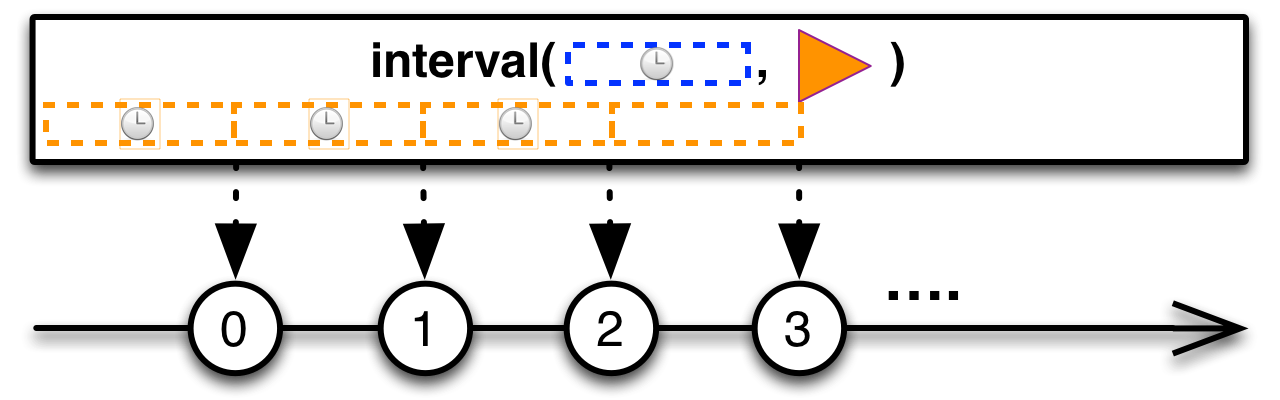
- Scheduler:
-
you specify which
Schedulerthis operator will use
- Parameters:
-
interval- interval size in time units (see below) -
unit- time units to use for the interval size -
scheduler- the Scheduler to use for scheduling the items - Returns:
- an Observable that emits a sequential number each time interval
- See Also:
- RxJava wiki: interval
just
public static final <T> Observable
<T> just(T value) Returns an Observable that emits a single item and then completes.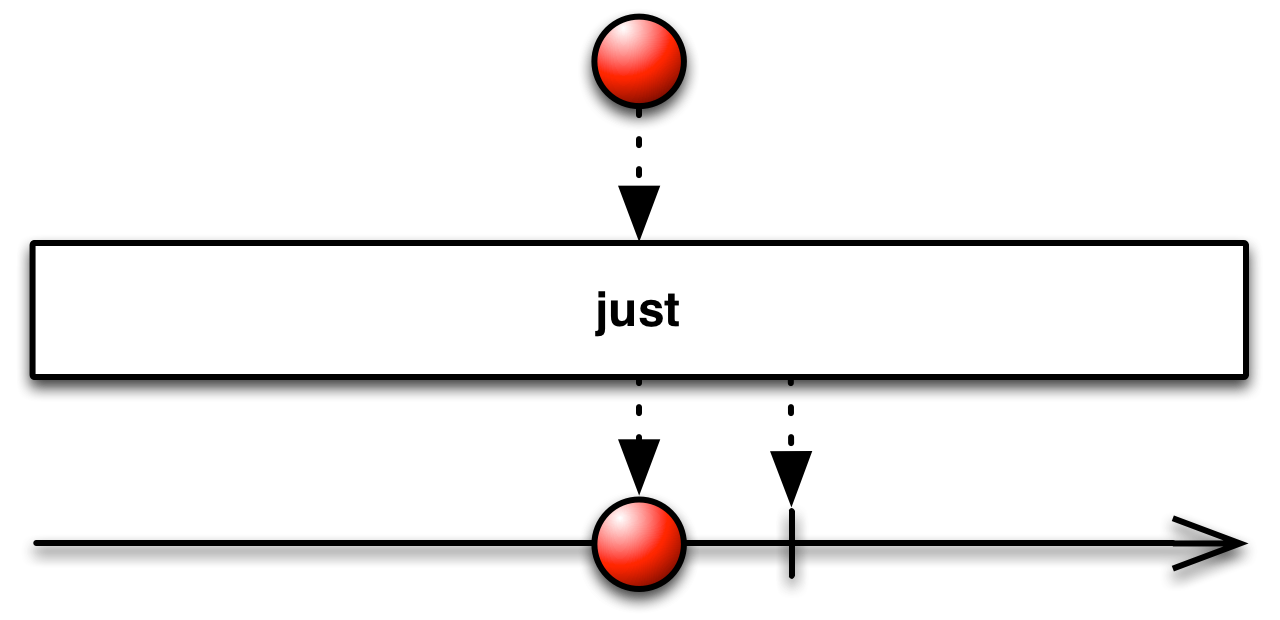
To convert any object into an Observable that emits that object, pass that object into the
justmethod.This is similar to the
from(java.lang.Object[])method, except thatfromwill convert anIterableobject into an Observable that emits each of the items in the Iterable, one at a time, while thejustmethod converts an Iterable into an Observable that emits the entire Iterable as a single item.- Scheduler:
-
justdoes not operate by default on a particularScheduler.
- Type Parameters:
-
T- the type of that item - Parameters:
-
value- the item to emit - Returns:
-
an Observable that emits
valueas a single item and then completes - See Also:
- RxJava wiki: just
just
public static final <T> Observable
<T> just(T t1, T t2) Converts two items into an Observable that emits those items.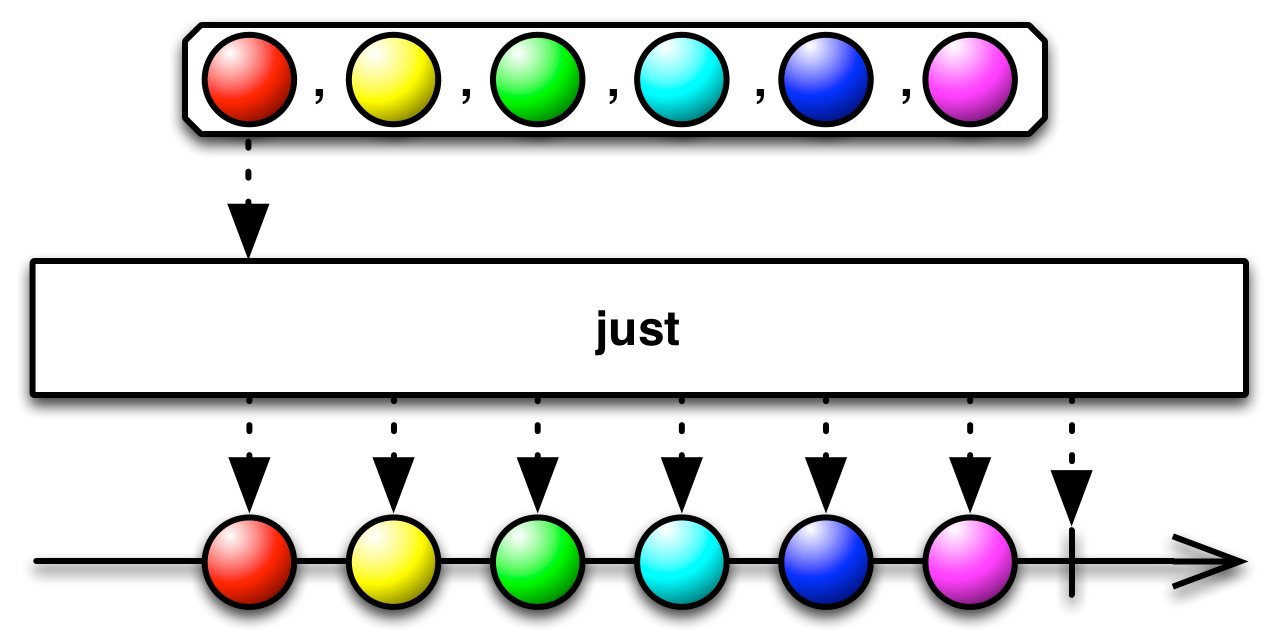
- Scheduler:
-
justdoes not operate by default on a particularScheduler.
- Type Parameters:
-
T- the type of these items - Parameters:
-
t1- first item -
t2- second item - Returns:
- an Observable that emits each item
- See Also:
- RxJava wiki: just
just
public static final <T> Observable
<T> just(T t1, T t2, T t3) Converts three items into an Observable that emits those items. - Scheduler:
-
justdoes not operate by default on a particularScheduler.
- Type Parameters:
-
T- the type of these items - Parameters:
-
t1- first item -
t2- second item -
t3- third item - Returns:
- an Observable that emits each item
- See Also:
- RxJava wiki: just
just
public static final <T> Observable
<T> just(T t1, T t2, T t3, T t4) Converts four items into an Observable that emits those items. - Scheduler:
-
justdoes not operate by default on a particularScheduler.
- Type Parameters:
-
T- the type of these items - Parameters:
-
t1- first item -
t2- second item -
t3- third item -
t4- fourth item - Returns:
- an Observable that emits each item
- See Also:
- RxJava wiki: just
just
public static final <T> Observable
<T> just(T t1, T t2, T t3, T t4, T t5) Converts five items into an Observable that emits those items. - Scheduler:
-
justdoes not operate by default on a particularScheduler.
- Type Parameters:
-
T- the type of these items - Parameters:
-
t1- first item -
t2- second item -
t3- third item -
t4- fourth item -
t5- fifth item - Returns:
- an Observable that emits each item
- See Also:
- RxJava wiki: just
just
public static final <T> Observable
<T> just(T t1, T t2, T t3, T t4, T t5, T t6) Converts six items into an Observable that emits those items. - Scheduler:
-
justdoes not operate by default on a particularScheduler.
- Type Parameters:
-
T- the type of these items - Parameters:
-
t1- first item -
t2- second item -
t3- third item -
t4- fourth item -
t5- fifth item -
t6- sixth item - Returns:
- an Observable that emits each item
- See Also:
- RxJava wiki: just
just
public static final <T> Observable
<T> just(T t1, T t2, T t3, T t4, T t5, T t6, T t7) Converts seven items into an Observable that emits those items. - Scheduler:
-
justdoes not operate by default on a particularScheduler.
- Type Parameters:
-
T- the type of these items - Parameters:
-
t1- first item -
t2- second item -
t3- third item -
t4- fourth item -
t5- fifth item -
t6- sixth item -
t7- seventh item - Returns:
- an Observable that emits each item
- See Also:
- RxJava wiki: just
just
public static final <T> Observable
<T> just(T t1, T t2, T t3, T t4, T t5, T t6, T t7, T t8) Converts eight items into an Observable that emits those items. - Scheduler:
-
justdoes not operate by default on a particularScheduler.
- Type Parameters:
-
T- the type of these items - Parameters:
-
t1- first item -
t2- second item -
t3- third item -
t4- fourth item -
t5- fifth item -
t6- sixth item -
t7- seventh item -
t8- eighth item - Returns:
- an Observable that emits each item
- See Also:
- RxJava wiki: just
just
public static final <T> Observable
<T> just(T t1, T t2, T t3, T t4, T t5, T t6, T t7, T t8, T t9) Converts nine items into an Observable that emits those items. - Scheduler:
-
justdoes not operate by default on a particularScheduler.
- Type Parameters:
-
T- the type of these items - Parameters:
-
t1- first item -
t2- second item -
t3- third item -
t4- fourth item -
t5- fifth item -
t6- sixth item -
t7- seventh item -
t8- eighth item -
t9- ninth item - Returns:
- an Observable that emits each item
- See Also:
- RxJava wiki: just
just
public static final <T> Observable
<T> just(T t1, T t2, T t3, T t4, T t5, T t6, T t7, T t8, T t9, T t10) Converts ten items into an Observable that emits those items. - Scheduler:
-
justdoes not operate by default on a particularScheduler.
- Type Parameters:
-
T- the type of these items - Parameters:
-
t1- first item -
t2- second item -
t3- third item -
t4- fourth item -
t5- fifth item -
t6- sixth item -
t7- seventh item -
t8- eighth item -
t9- ninth item -
t10- tenth item - Returns:
- an Observable that emits each item
- See Also:
- RxJava wiki: just
merge
public static final <T> Observable
<T> merge(Iterable <? extends Observable <? extends T>> sequences) Flattens an Iterable of Observables into one Observable, without any transformation.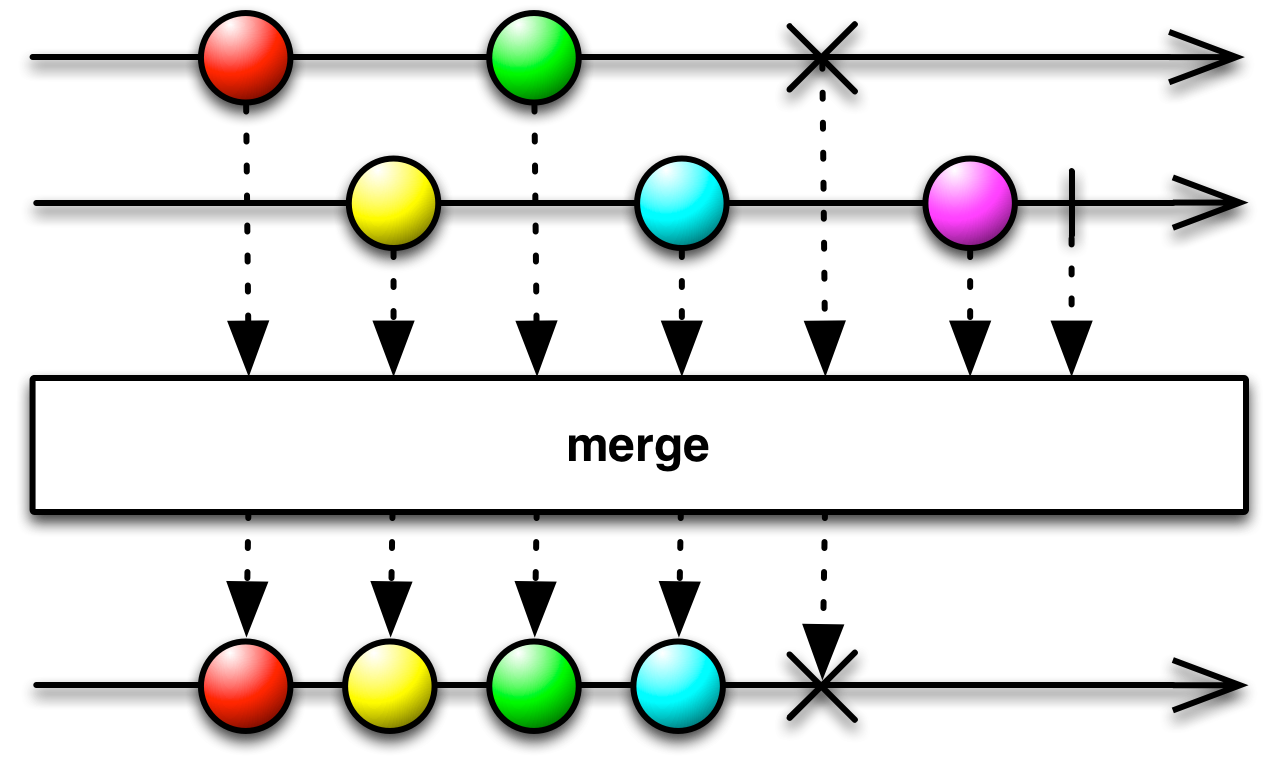
You can combine the items emitted by multiple Observables so that they appear as a single Observable, by using the
mergemethod.- Scheduler:
-
mergedoes not operate by default on a particularScheduler.
- Parameters:
-
sequences- the Iterable of Observables - Returns:
- an Observable that emits items that are the result of flattening the items emitted by the Observables in the Iterable
- See Also:
- RxJava wiki: merge
merge
public static final <T> Observable
<T> merge(Iterable <? extends Observable <? extends T>> sequences, int maxConcurrent) Flattens an Iterable of Observables into one Observable, without any transformation, while limiting the number of concurrent subscriptions to these Observables. You can combine the items emitted by multiple Observables so that they appear as a single Observable, by using the
mergemethod.- Scheduler:
-
mergedoes not operate by default on a particularScheduler.
- Parameters:
-
sequences- the Iterable of Observables -
maxConcurrent- the maximum number of Observables that may be subscribed to concurrently - Returns:
- an Observable that emits items that are the result of flattening the items emitted by the Observables in the Iterable
- Throws:
-
IllegalArgumentException- ifmaxConcurrentis less than or equal to 0 - See Also:
- RxJava wiki: merge
merge
public static final <T> Observable
<T> merge(Observable <? extends Observable <? extends T>> source) Flattens an Observable that emits Observables into a single Observable that emits the items emitted by those Observables, without any transformation.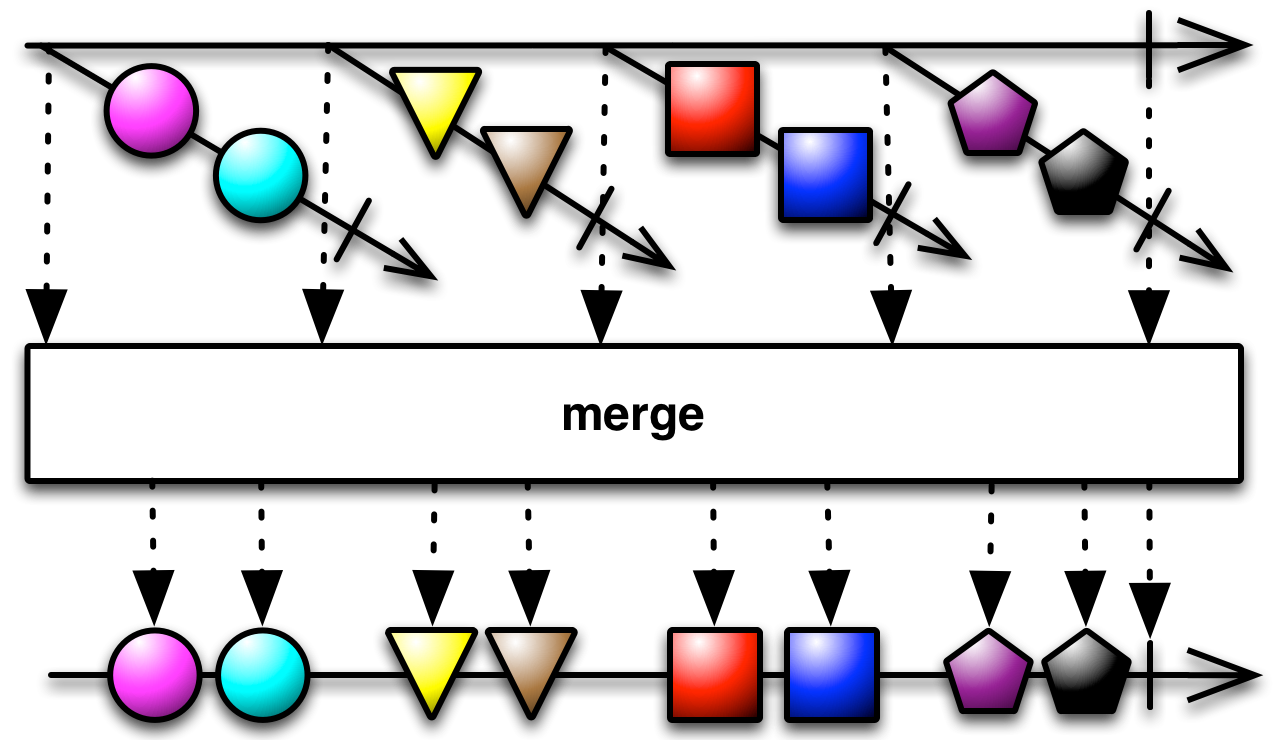
You can combine the items emitted by multiple Observables so that they appear as a single Observable, by using the
mergemethod.- Scheduler:
-
mergedoes not operate by default on a particularScheduler.
- Parameters:
-
source- an Observable that emits Observables - Returns:
-
an Observable that emits items that are the result of flattening the Observables emitted by the
sourceObservable - See Also:
- RxJava wiki: merge
merge
public static final <T> Observable
<T> merge(Observable <? extends Observable <? extends T>> source, int maxConcurrent) Flattens an Observable that emits Observables into a single Observable that emits the items emitted by those Observables, without any transformation, while limiting the maximum number of concurrent subscriptions to these Observables. You can combine the items emitted by multiple Observables so that they appear as a single Observable, by using the
mergemethod.- Scheduler:
-
mergedoes not operate by default on a particularScheduler.
- Parameters:
-
source- an Observable that emits Observables -
maxConcurrent- the maximum number of Observables that may be subscribed to concurrently - Returns:
-
an Observable that emits items that are the result of flattening the Observables emitted by the
sourceObservable - Throws:
-
IllegalArgumentException- ifmaxConcurrentis less than or equal to 0 - See Also:
- RxJava wiki: merge
merge
public static final <T> Observable
<T> merge(Observable <? extends T> t1, Observable <? extends T> t2) Flattens two Observables into a single Observable, without any transformation. You can combine items emitted by multiple Observables so that they appear as a single Observable, by using the
mergemethod.- Scheduler:
-
mergedoes not operate by default on a particularScheduler.
- Parameters:
-
t1- an Observable to be merged -
t2- an Observable to be merged - Returns:
- an Observable that emits all of the items emitted by the source Observables
- See Also:
- RxJava wiki: merge
merge
public static final <T> Observable
<T> merge(Observable <? extends T> t1, Observable <? extends T> t2, Observable <? extends T> t3) Flattens three Observables into a single Observable, without any transformation. You can combine items emitted by multiple Observables so that they appear as a single Observable, by using the
mergemethod.- Scheduler:
-
mergedoes not operate by default on a particularScheduler.
- Parameters:
-
t1- an Observable to be merged -
t2- an Observable to be merged -
t3- an Observable to be merged - Returns:
- an Observable that emits all of the items emitted by the source Observables
- See Also:
- RxJava wiki: merge
merge
public static final <T> Observable
<T> merge(Observable <? extends T> t1, Observable <? extends T> t2, Observable <? extends T> t3, Observable <? extends T> t4) Flattens four Observables into a single Observable, without any transformation. You can combine items emitted by multiple Observables so that they appear as a single Observable, by using the
mergemethod.- Scheduler:
-
mergedoes not operate by default on a particularScheduler.
- Parameters:
-
t1- an Observable to be merged -
t2- an Observable to be merged -
t3- an Observable to be merged -
t4- an Observable to be merged - Returns:
- an Observable that emits all of the items emitted by the source Observables
- See Also:
- RxJava wiki: merge
merge
public static final <T> Observable
<T> merge(Observable <? extends T> t1, Observable <? extends T> t2, Observable <? extends T> t3, Observable <? extends T> t4, Observable <? extends T> t5) Flattens five Observables into a single Observable, without any transformation. You can combine items emitted by multiple Observables so that they appear as a single Observable, by using the
mergemethod.- Scheduler:
-
mergedoes not operate by default on a particularScheduler.
- Parameters:
-
t1- an Observable to be merged -
t2- an Observable to be merged -
t3- an Observable to be merged -
t4- an Observable to be merged -
t5- an Observable to be merged - Returns:
- an Observable that emits all of the items emitted by the source Observables
- See Also:
- RxJava wiki: merge
merge
public static final <T> Observable
<T> merge(Observable <? extends T> t1, Observable <? extends T> t2, Observable <? extends T> t3, Observable <? extends T> t4, Observable <? extends T> t5, Observable <? extends T> t6) Flattens six Observables into a single Observable, without any transformation. You can combine items emitted by multiple Observables so that they appear as a single Observable, by using the
mergemethod.- Scheduler:
-
mergedoes not operate by default on a particularScheduler.
- Parameters:
-
t1- an Observable to be merged -
t2- an Observable to be merged -
t3- an Observable to be merged -
t4- an Observable to be merged -
t5- an Observable to be merged -
t6- an Observable to be merged - Returns:
- an Observable that emits all of the items emitted by the source Observables
- See Also:
- RxJava wiki: merge
merge
public static final <T> Observable
<T> merge(Observable <? extends T> t1, Observable <? extends T> t2, Observable <? extends T> t3, Observable <? extends T> t4, Observable <? extends T> t5, Observable <? extends T> t6, Observable <? extends T> t7) Flattens seven Observables into a single Observable, without any transformation. You can combine items emitted by multiple Observables so that they appear as a single Observable, by using the
mergemethod.- Scheduler:
-
mergedoes not operate by default on a particularScheduler.
- Parameters:
-
t1- an Observable to be merged -
t2- an Observable to be merged -
t3- an Observable to be merged -
t4- an Observable to be merged -
t5- an Observable to be merged -
t6- an Observable to be merged -
t7- an Observable to be merged - Returns:
- an Observable that emits all of the items emitted by the source Observables
- See Also:
- RxJava wiki: merge
merge
public static final <T> Observable
<T> merge(Observable <? extends T> t1, Observable <? extends T> t2, Observable <? extends T> t3, Observable <? extends T> t4, Observable <? extends T> t5, Observable <? extends T> t6, Observable <? extends T> t7, Observable <? extends T> t8) Flattens eight Observables into a single Observable, without any transformation. You can combine items emitted by multiple Observables so that they appear as a single Observable, by using the
mergemethod.- Scheduler:
-
mergedoes not operate by default on a particularScheduler.
- Parameters:
-
t1- an Observable to be merged -
t2- an Observable to be merged -
t3- an Observable to be merged -
t4- an Observable to be merged -
t5- an Observable to be merged -
t6- an Observable to be merged -
t7- an Observable to be merged -
t8- an Observable to be merged - Returns:
- an Observable that emits all of the items emitted by the source Observables
- See Also:
- RxJava wiki: merge
merge
public static final <T> Observable
<T> merge(Observable <? extends T> t1, Observable <? extends T> t2, Observable <? extends T> t3, Observable <? extends T> t4, Observable <? extends T> t5, Observable <? extends T> t6, Observable <? extends T> t7, Observable <? extends T> t8, Observable <? extends T> t9) Flattens nine Observables into a single Observable, without any transformation. You can combine items emitted by multiple Observables so that they appear as a single Observable, by using the
mergemethod.- Scheduler:
-
mergedoes not operate by default on a particularScheduler.
- Parameters:
-
t1- an Observable to be merged -
t2- an Observable to be merged -
t3- an Observable to be merged -
t4- an Observable to be merged -
t5- an Observable to be merged -
t6- an Observable to be merged -
t7- an Observable to be merged -
t8- an Observable to be merged -
t9- an Observable to be merged - Returns:
- an Observable that emits all of the items emitted by the source Observables
- See Also:
- RxJava wiki: merge
merge
public static final <T> Observable
<T> merge(Observable <? extends T>[] sequences) Flattens an Array of Observables into one Observable, without any transformation.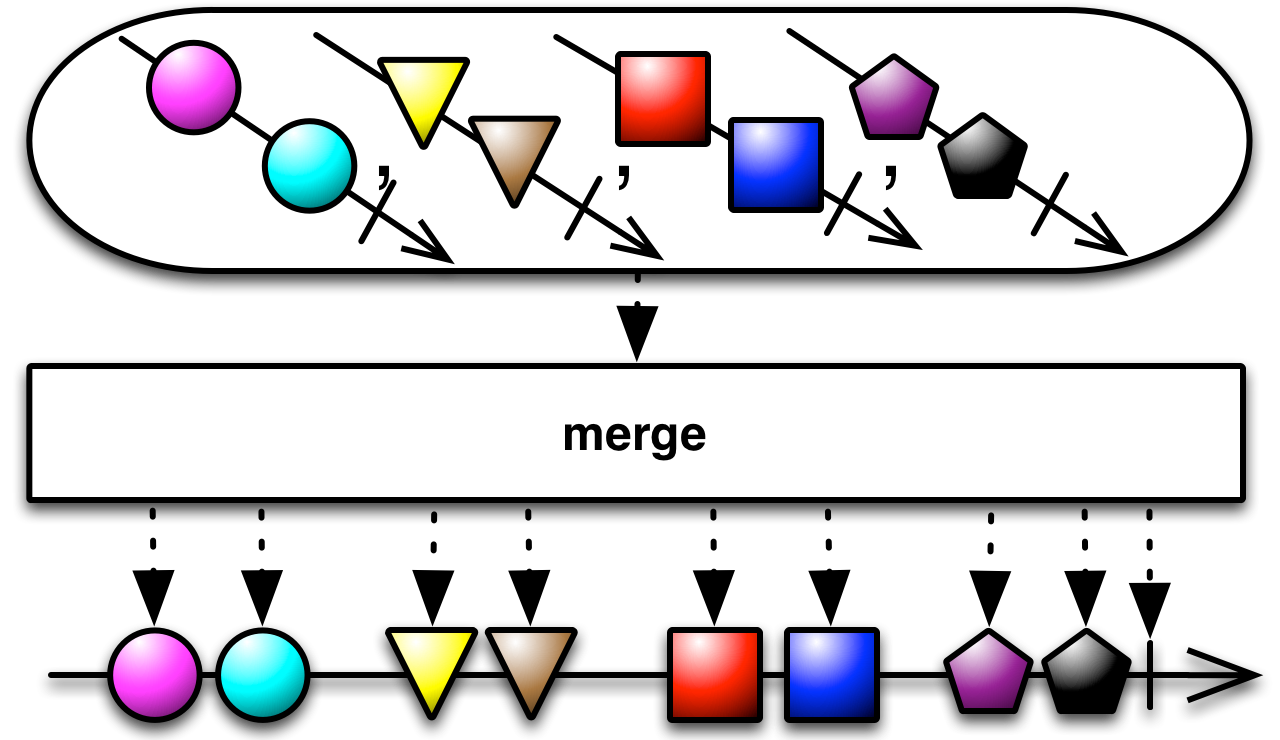
You can combine items emitted by multiple Observables so that they appear as a single Observable, by using the
mergemethod.- Scheduler:
-
mergedoes not operate by default on a particularScheduler.
- Parameters:
-
sequences- the Array of Observables - Returns:
- an Observable that emits all of the items emitted by the Observables in the Array
- See Also:
- RxJava wiki: merge
mergeDelayError
public static final <T> Observable
<T> mergeDelayError(Observable <? extends Observable <? extends T>> source) Flattens an Observable that emits Observables into one Observable, in a way that allows an Observer to receive all successfully emitted items from all of the source Observables without being interrupted by an error notification from one of them.This behaves like
merge(Observable)except that if any of the merged Observables notify of an error viaonError,mergeDelayErrorwill refrain from propagating that error notification until all of the merged Observables have finished emitting items.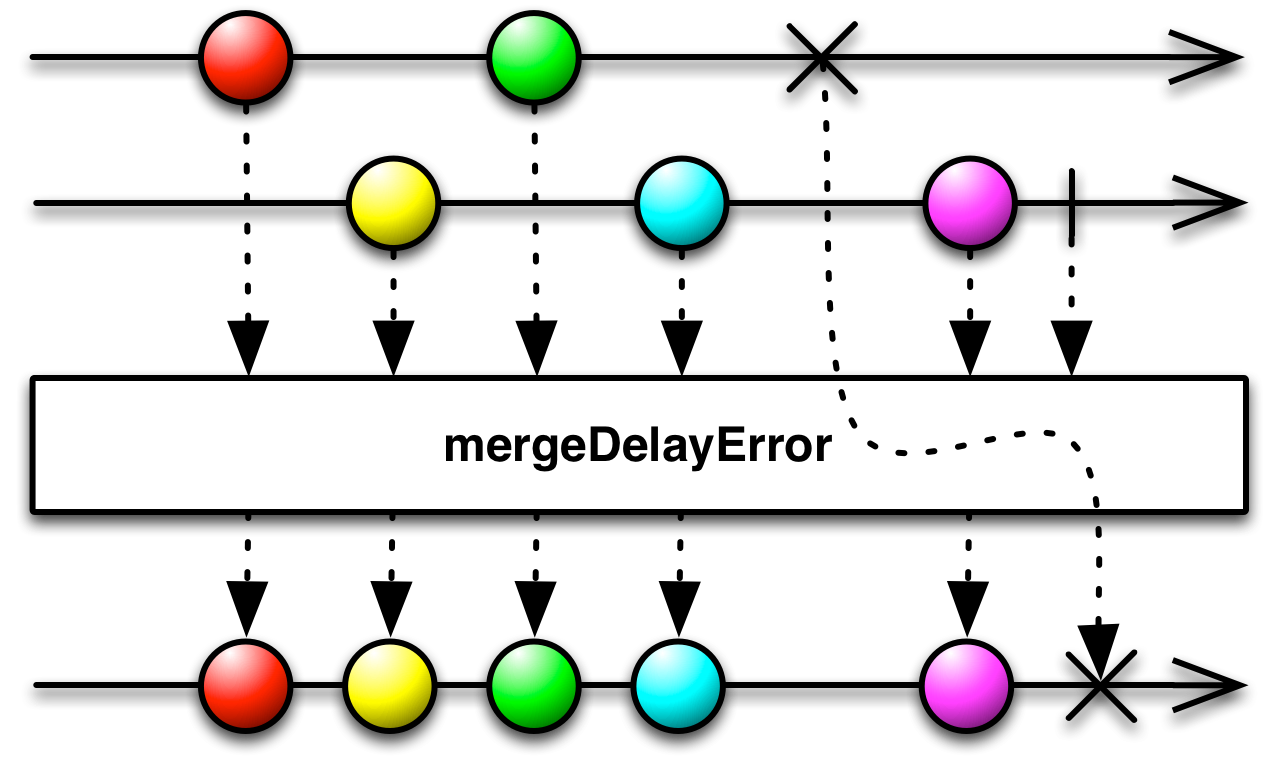
Even if multiple merged Observables send
onErrornotifications,mergeDelayErrorwill only invoke theonErrormethod of its Observers once.- Scheduler:
-
mergeDelayErrordoes not operate by default on a particularScheduler.
- Parameters:
-
source- an Observable that emits Observables - Returns:
-
an Observable that emits all of the items emitted by the Observables emitted by the
sourceObservable - See Also:
- RxJava wiki: mergeDelayError
mergeDelayError
public static final <T> Observable
<T> mergeDelayError(Observable <? extends T> t1, Observable <? extends T> t2) Flattens two Observables into one Observable, in a way that allows an Observer to receive all successfully emitted items from each of the source Observables without being interrupted by an error notification from one of them.This behaves like
merge(Observable, Observable)except that if any of the merged Observables notify of an error viaonError,mergeDelayErrorwill refrain from propagating that error notification until all of the merged Observables have finished emitting items. Even if both merged Observables send
onErrornotifications,mergeDelayErrorwill only invoke theonErrormethod of its Observers once.- Scheduler:
-
mergeDelayErrordoes not operate by default on a particularScheduler.
- Parameters:
-
t1- an Observable to be merged -
t2- an Observable to be merged - Returns:
- an Observable that emits all of the items that are emitted by the two source Observables
- See Also:
- RxJava wiki: mergeDelayError
mergeDelayError
public static final <T> Observable
<T> mergeDelayError(Observable <? extends T> t1, Observable <? extends T> t2, Observable <? extends T> t3) Flattens three Observables into one Observable, in a way that allows an Observer to receive all successfully emitted items from all of the source Observables without being interrupted by an error notification from one of them.This behaves like
merge(Observable, Observable, Observable)except that if any of the merged Observables notify of an error viaonError,mergeDelayErrorwill refrain from propagating that error notification until all of the merged Observables have finished emitting items. Even if multiple merged Observables send
onErrornotifications,mergeDelayErrorwill only invoke theonErrormethod of its Observers once.- Scheduler:
-
mergeDelayErrordoes not operate by default on a particularScheduler.
- Parameters:
-
t1- an Observable to be merged -
t2- an Observable to be merged -
t3- an Observable to be merged - Returns:
- an Observable that emits all of the items that are emitted by the source Observables
- See Also:
- RxJava wiki: mergeDelayError
mergeDelayError
public static final <T> Observable
<T> mergeDelayError(Observable <? extends T> t1, Observable <? extends T> t2, Observable <? extends T> t3, Observable <? extends T> t4) Flattens four Observables into one Observable, in a way that allows an Observer to receive all successfully emitted items from all of the source Observables without being interrupted by an error notification from one of them.This behaves like
merge(Observable, Observable, Observable, Observable)except that if any of the merged Observables notify of an error viaonError,mergeDelayErrorwill refrain from propagating that error notification until all of the merged Observables have finished emitting items. Even if multiple merged Observables send
onErrornotifications,mergeDelayErrorwill only invoke theonErrormethod of its Observers once.- Scheduler:
-
mergeDelayErrordoes not operate by default on a particularScheduler.
- Parameters:
-
t1- an Observable to be merged -
t2- an Observable to be merged -
t3- an Observable to be merged -
t4- an Observable to be merged - Returns:
- an Observable that emits all of the items that are emitted by the source Observables
- See Also:
- RxJava wiki: mergeDelayError
mergeDelayError
public static final <T> Observable
<T> mergeDelayError(Observable <? extends T> t1, Observable <? extends T> t2, Observable <? extends T> t3, Observable <? extends T> t4, Observable <? extends T> t5) Flattens five Observables into one Observable, in a way that allows an Observer to receive all successfully emitted items from all of the source Observables without being interrupted by an error notification from one of them.This behaves like
merge(Observable, Observable, Observable, Observable, Observable)except that if any of the merged Observables notify of an error viaonError,mergeDelayErrorwill refrain from propagating that error notification until all of the merged Observables have finished emitting items. Even if multiple merged Observables send
onErrornotifications,mergeDelayErrorwill only invoke theonErrormethod of its Observers once.- Scheduler:
-
mergeDelayErrordoes not operate by default on a particularScheduler.
- Parameters:
-
t1- an Observable to be merged -
t2- an Observable to be merged -
t3- an Observable to be merged -
t4- an Observable to be merged -
t5- an Observable to be merged - Returns:
- an Observable that emits all of the items that are emitted by the source Observables
- See Also:
- RxJava wiki: mergeDelayError
mergeDelayError
public static final <T> Observable
<T> mergeDelayError(Observable <? extends T> t1, Observable <? extends T> t2, Observable <? extends T> t3, Observable <? extends T> t4, Observable <? extends T> t5, Observable <? extends T> t6) Flattens six Observables into one Observable, in a way that allows an Observer to receive all successfully emitted items from all of the source Observables without being interrupted by an error notification from one of them.This behaves like
merge(Observable, Observable, Observable, Observable, Observable, Observable)except that if any of the merged Observables notify of an error viaonError,mergeDelayErrorwill refrain from propagating that error notification until all of the merged Observables have finished emitting items. Even if multiple merged Observables send
onErrornotifications,mergeDelayErrorwill only invoke theonErrormethod of its Observers once.- Scheduler:
-
mergeDelayErrordoes not operate by default on a particularScheduler.
- Parameters:
-
t1- an Observable to be merged -
t2- an Observable to be merged -
t3- an Observable to be merged -
t4- an Observable to be merged -
t5- an Observable to be merged -
t6- an Observable to be merged - Returns:
- an Observable that emits all of the items that are emitted by the source Observables
- See Also:
- RxJava wiki: mergeDelayError
mergeDelayError
public static final <T> Observable
<T> mergeDelayError(Observable <? extends T> t1, Observable <? extends T> t2, Observable <? extends T> t3, Observable <? extends T> t4, Observable <? extends T> t5, Observable <? extends T> t6, Observable <? extends T> t7) Flattens seven Observables into one Observable, in a way that allows an Observer to receive all successfully emitted items from all of the source Observables without being interrupted by an error notification from one of them.This behaves like
merge(Observable, Observable, Observable, Observable, Observable, Observable, Observable)except that if any of the merged Observables notify of an error viaonError,mergeDelayErrorwill refrain from propagating that error notification until all of the merged Observables have finished emitting items. Even if multiple merged Observables send
onErrornotifications,mergeDelayErrorwill only invoke theonErrormethod of its Observers once.- Scheduler:
-
mergeDelayErrordoes not operate by default on a particularScheduler.
- Parameters:
-
t1- an Observable to be merged -
t2- an Observable to be merged -
t3- an Observable to be merged -
t4- an Observable to be merged -
t5- an Observable to be merged -
t6- an Observable to be merged -
t7- an Observable to be merged - Returns:
- an Observable that emits all of the items that are emitted by the source Observables
- See Also:
- RxJava wiki: mergeDelayError
mergeDelayError
public static final <T> Observable
<T> mergeDelayError(Observable <? extends T> t1, Observable <? extends T> t2, Observable <? extends T> t3, Observable <? extends T> t4, Observable <? extends T> t5, Observable <? extends T> t6, Observable <? extends T> t7, Observable <? extends T> t8) Flattens eight Observables into one Observable, in a way that allows an Observer to receive all successfully emitted items from all of the source Observables without being interrupted by an error notification from one of them.This behaves like
merge(Observable, Observable, Observable, Observable, Observable, Observable, Observable, Observable)except that if any of the merged Observables notify of an error viaonError,mergeDelayErrorwill refrain from propagating that error notification until all of the merged Observables have finished emitting items. Even if multiple merged Observables send
onErrornotifications,mergeDelayErrorwill only invoke theonErrormethod of its Observers once.- Scheduler:
-
mergeDelayErrordoes not operate by default on a particularScheduler.
- Parameters:
-
t1- an Observable to be merged -
t2- an Observable to be merged -
t3- an Observable to be merged -
t4- an Observable to be merged -
t5- an Observable to be merged -
t6- an Observable to be merged -
t7- an Observable to be merged -
t8- an Observable to be merged - Returns:
- an Observable that emits all of the items that are emitted by the source Observables
- See Also:
- RxJava wiki: mergeDelayError
mergeDelayError
public static final <T> Observable
<T> mergeDelayError(Observable <? extends T> t1, Observable <? extends T> t2, Observable <? extends T> t3, Observable <? extends T> t4, Observable <? extends T> t5, Observable <? extends T> t6, Observable <? extends T> t7, Observable <? extends T> t8, Observable <? extends T> t9) Flattens nine Observables into one Observable, in a way that allows an Observer to receive all successfully emitted items from all of the source Observables without being interrupted by an error notification from one of them.This behaves like
merge(Observable, Observable, Observable, Observable, Observable, Observable, Observable, Observable, Observable)except that if any of the merged Observables notify of an error viaonError,mergeDelayErrorwill refrain from propagating that error notification until all of the merged Observables have finished emitting items. Even if multiple merged Observables send
onErrornotifications,mergeDelayErrorwill only invoke theonErrormethod of its Observers once.- Scheduler:
-
mergeDelayErrordoes not operate by default on a particularScheduler.
- Parameters:
-
t1- an Observable to be merged -
t2- an Observable to be merged -
t3- an Observable to be merged -
t4- an Observable to be merged -
t5- an Observable to be merged -
t6- an Observable to be merged -
t7- an Observable to be merged -
t8- an Observable to be merged -
t9- an Observable to be merged - Returns:
- an Observable that emits all of the items that are emitted by the source Observables
- See Also:
- RxJava wiki: mergeDelayError
nest
public final Observable
<Observable <T>> nest() Converts the sourceObservable<T>into anObservable<Observable<T>>that emits the source Observable as its single emission.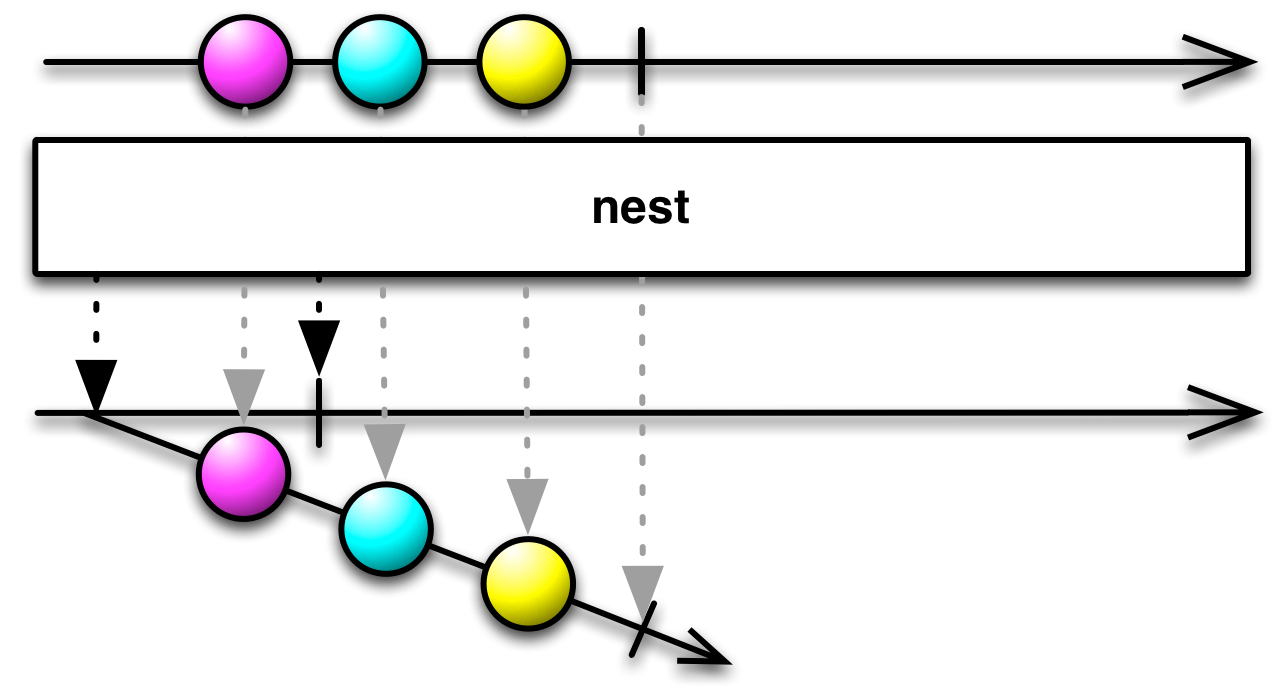
- Scheduler:
-
nestdoes not operate by default on a particularScheduler.
- Returns:
- an Observable that emits a single item: the source Observable
never
public static final <T> Observable
<T> never() Returns an Observable that never sends any items or notifications to anObserver.
This Observable is useful primarily for testing purposes.
- Scheduler:
-
neverdoes not operate by default on a particularScheduler.
- Type Parameters:
-
T- the type of items (not) emitted by the Observable - Returns:
-
an Observable that never emits any items or sends any notifications to an
Observer - See Also:
- RxJava wiki: never
range
public static final Observable
<Integer > range(int start, int count) Returns an Observable that emits a sequence of Integers within a specified range.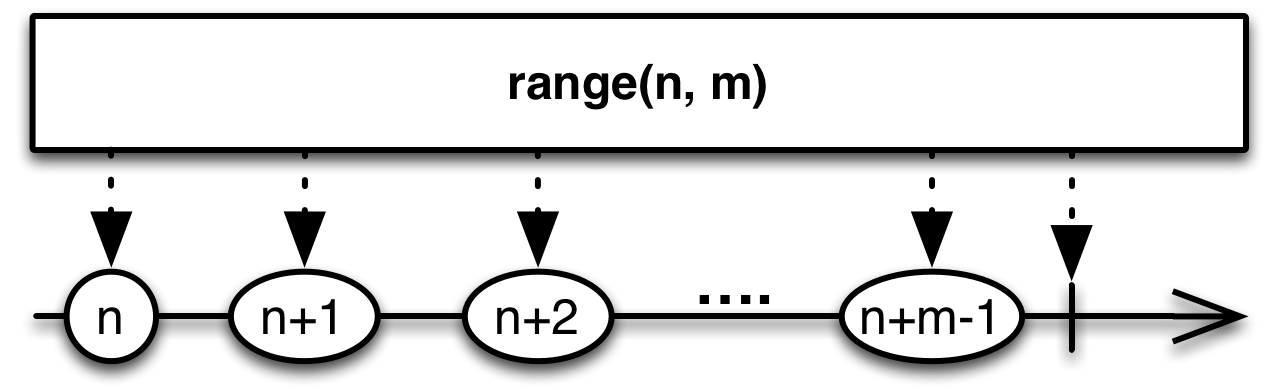
- Scheduler:
-
rangedoes not operate by default on a particularScheduler.
- Parameters:
-
start- the value of the first Integer in the sequence -
count- the number of sequential Integers to generate - Returns:
- an Observable that emits a range of sequential Integers
- Throws:
-
IllegalArgumentException- ifcountis less than zero, or ifstart+count− 1 exceedsInteger.MAX_VALUE - See Also:
- RxJava wiki: range
range
public static final Observable
<Integer > range(int start, int count, Scheduler scheduler) Returns an Observable that emits a sequence of Integers within a specified range, on a specified Scheduler.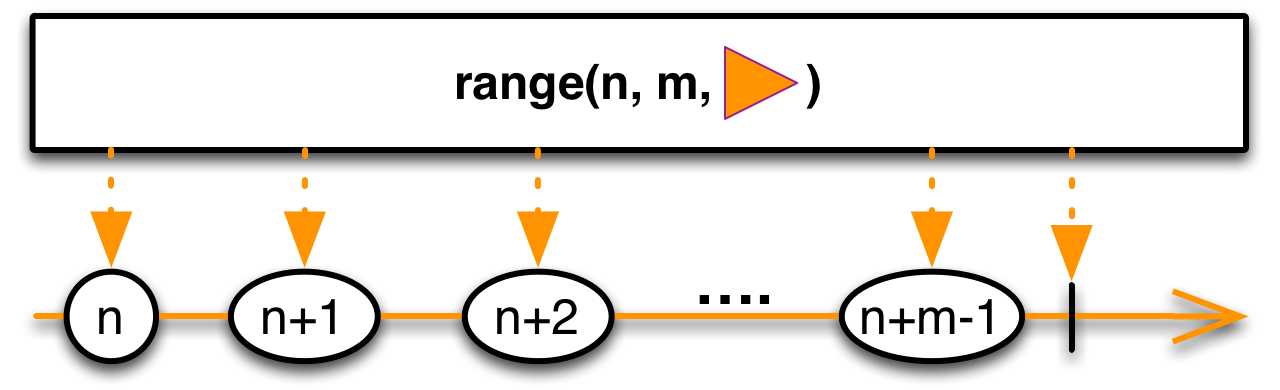
- Scheduler:
-
you specify which
Schedulerthis operator will use
- Parameters:
-
start- the value of the first Integer in the sequence -
count- the number of sequential Integers to generate -
scheduler- the Scheduler to run the generator loop on - Returns:
- an Observable that emits a range of sequential Integers
- See Also:
- RxJava wiki: range
sequenceEqual
public static final <T> Observable
<Boolean > sequenceEqual(Observable <? extends T> first, Observable <? extends T> second) Returns an Observable that emits a Boolean value that indicates whether two Observable sequences are the same by comparing the items emitted by each Observable pairwise.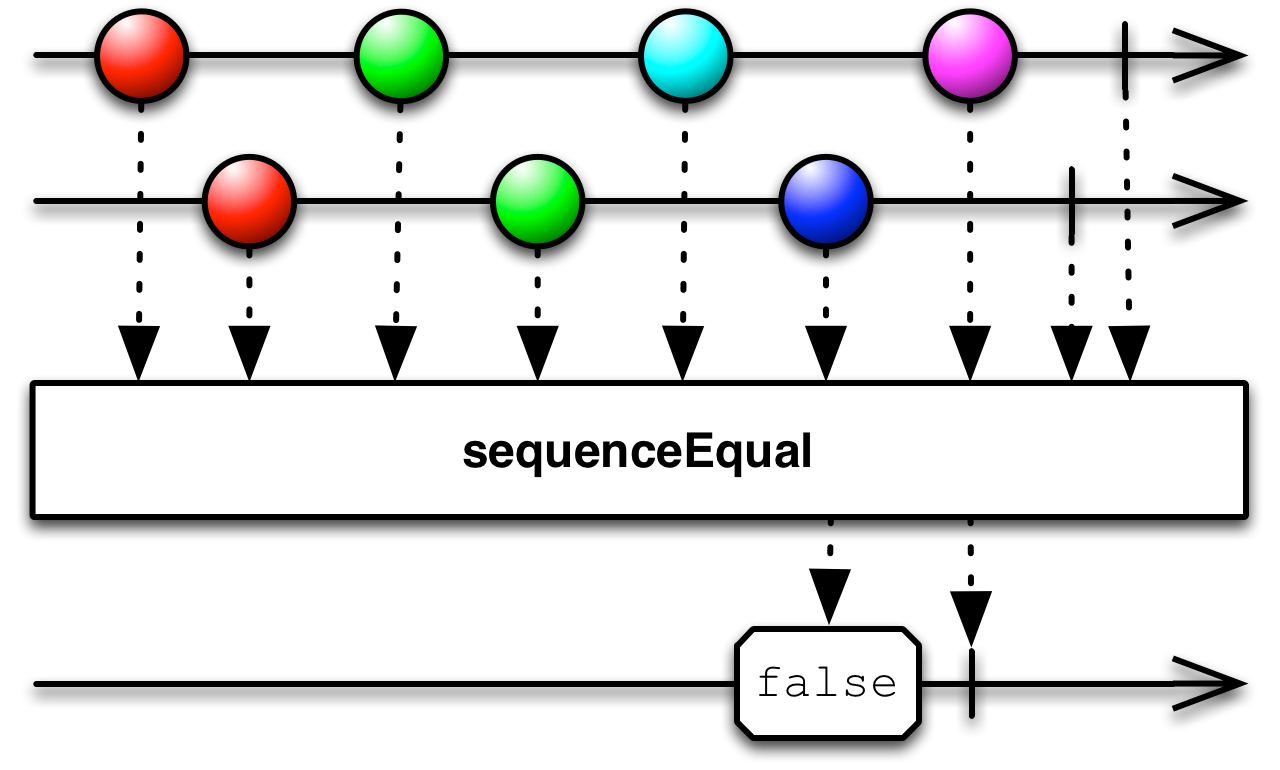
- Scheduler:
-
sequenceEqualdoes not operate by default on a particularScheduler.
- Type Parameters:
-
T- the type of items emitted by each Observable - Parameters:
-
first- the first Observable to compare -
second- the second Observable to compare - Returns:
- an Observable that emits a Boolean value that indicates whether the two sequences are the same
- See Also:
- RxJava wiki: sequenceEqual
sequenceEqual
public static final <T> Observable
<Boolean > sequenceEqual(Observable <? extends T> first, Observable <? extends T> second, Func2 <? super T ,? super T ,Boolean > equality) Returns an Observable that emits a Boolean value that indicates whether two Observable sequences are the same by comparing the items emitted by each Observable pairwise based on the results of a specified equality function. - Scheduler:
-
sequenceEqualdoes not operate by default on a particularScheduler.
- Type Parameters:
-
T- the type of items emitted by each Observable - Parameters:
-
first- the first Observable to compare -
second- the second Observable to compare -
equality- a function used to compare items emitted by each Observable - Returns:
- an Observable that emits a Boolean value that indicates whether the two Observable two sequences are the same according to the specified function
- See Also:
- RxJava wiki: sequenceEqual
switchOnNext
public static final <T> Observable
<T> switchOnNext(Observable <? extends Observable <? extends T>> sequenceOfSequences) Converts an Observable that emits Observables into an Observable that emits the items emitted by the most recently emitted of those Observables.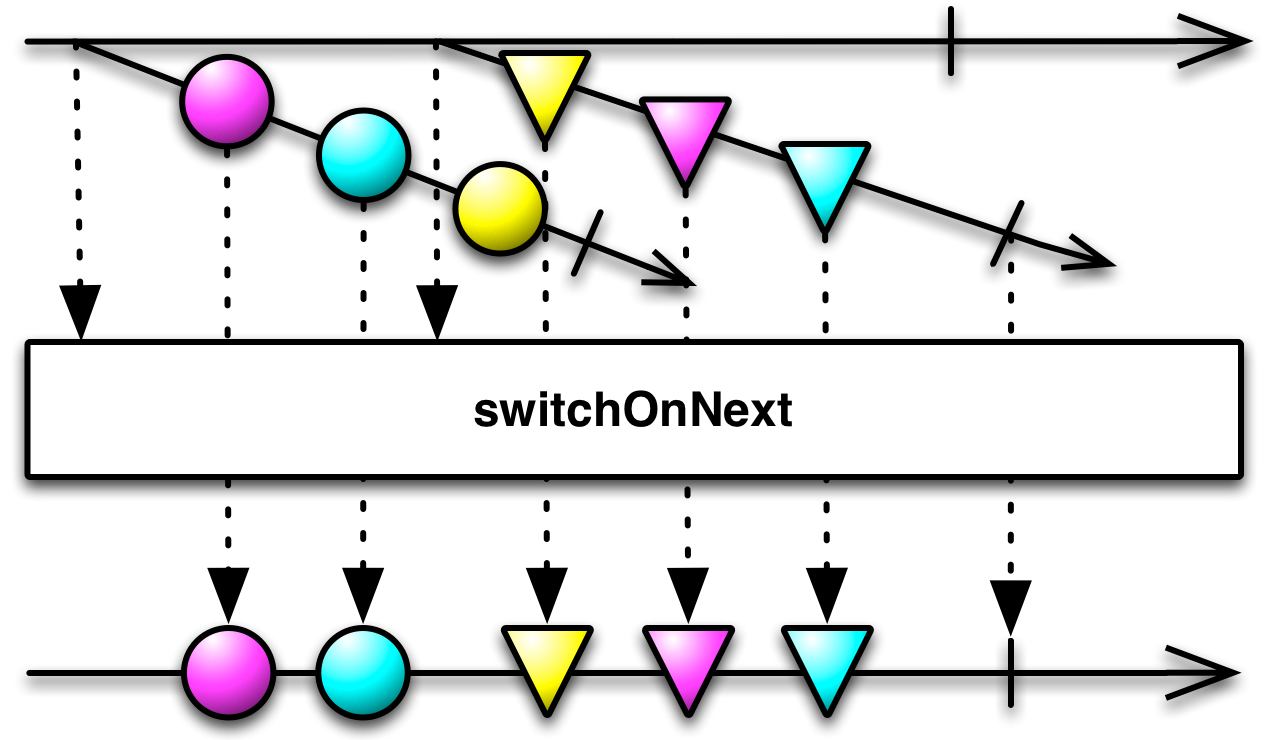
switchOnNextsubscribes to an Observable that emits Observables. Each time it observes one of these emitted Observables, the Observable returned byswitchOnNextbegins emitting the items emitted by that Observable. When a new Observable is emitted,switchOnNextstops emitting items from the earlier-emitted Observable and begins emitting items from the new one.- Scheduler:
-
switchOnNextdoes not operate by default on a particularScheduler.
- Type Parameters:
-
T- the item type - Parameters:
-
sequenceOfSequences- the source Observable that emits Observables - Returns:
- an Observable that emits the items emitted by the Observable most recently emitted by the source Observable
- See Also:
- RxJava wiki: switchOnNext
timer
public static final Observable
<Long > timer(long initialDelay, long period, TimeUnit unit) Returns an Observable that emits a0Lafter theinitialDelayand ever increasing numbers after eachperiodof time thereafter.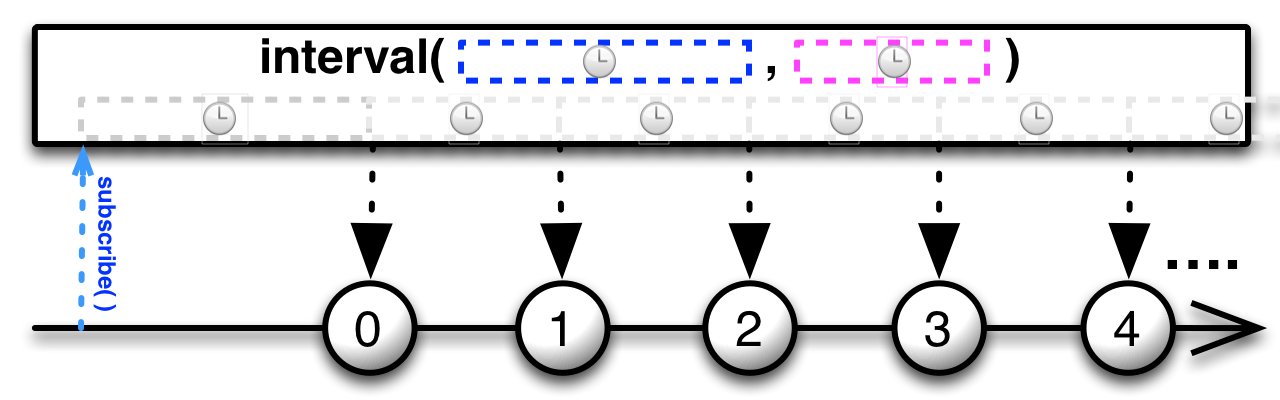
- Backpressure Support:
-
This operator does not support backpressure as it uses time. If the downstream needs a slower rate it should slow the timer or use something like
onBackpressureDrop(). - Scheduler:
-
timeroperates by default on thecomputationScheduler.
- Parameters:
-
initialDelay- the initial delay time to wait before emitting the first value of 0L -
period- the period of time between emissions of the subsequent numbers -
unit- the time unit for bothinitialDelayandperiod - Returns:
-
an Observable that emits a 0L after the
initialDelayand ever increasing numbers after eachperiodof time thereafter - See Also:
- RxJava wiki: timer
timer
public static final Observable
<Long > timer(long initialDelay, long period, TimeUnit unit, Scheduler scheduler) Returns an Observable that emits a0Lafter theinitialDelayand ever increasing numbers after eachperiodof time thereafter, on a specifiedScheduler.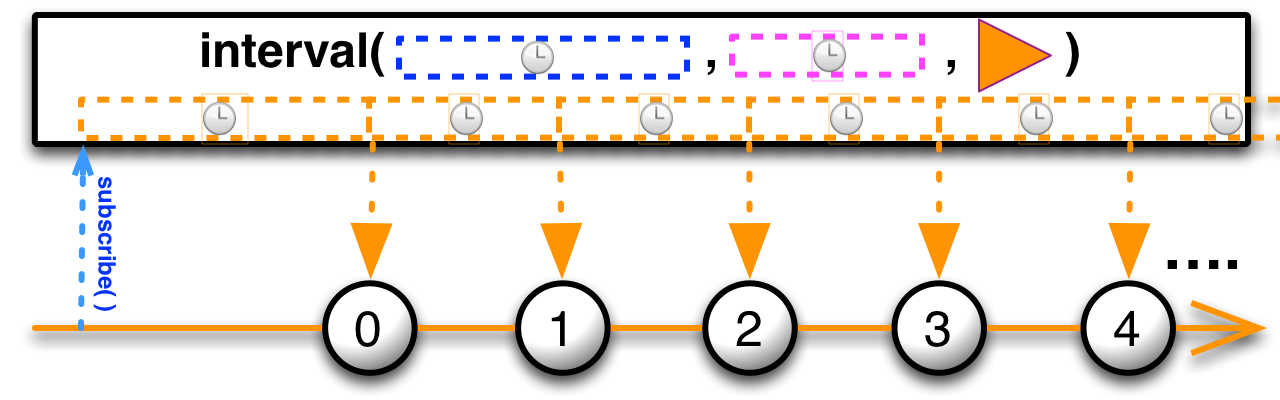
- Backpressure Support:
-
This operator does not support backpressure as it uses time. If the downstream needs a slower rate it should slow the timer or use something like
onBackpressureDrop(). - Scheduler:
-
you specify which
Schedulerthis operator will use
- Parameters:
-
initialDelay- the initial delay time to wait before emitting the first value of 0L -
period- the period of time between emissions of the subsequent numbers -
unit- the time unit for bothinitialDelayandperiod -
scheduler- the Scheduler on which the waiting happens and items are emitted - Returns:
-
an Observable that emits a 0L after the
initialDelayand ever increasing numbers after eachperiodof time thereafter, while running on the given Scheduler - See Also:
- RxJava wiki: timer
timer
public static final Observable
<Long > timer(long delay, TimeUnit unit) Returns an Observable that emits one item after a specified delay, and then completes.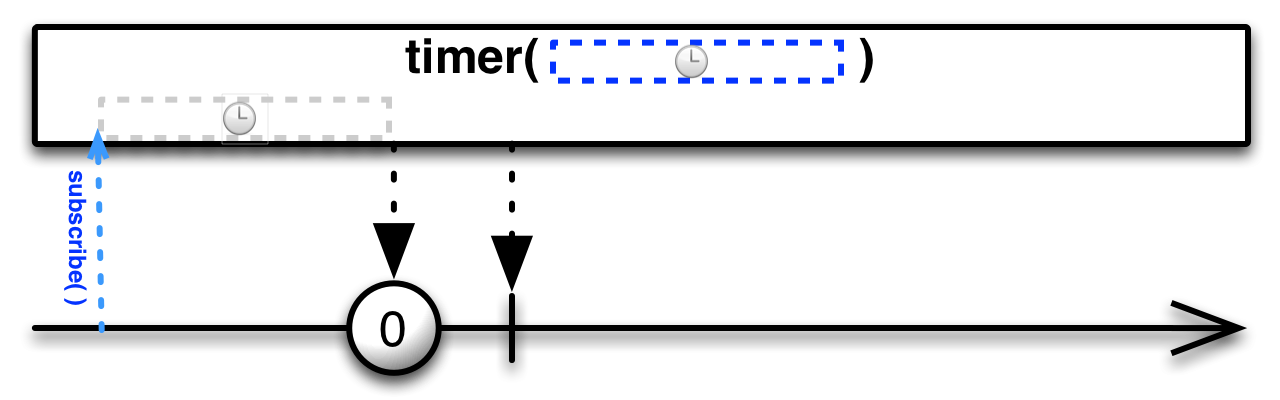
- Backpressure Support:
-
This operator does not support backpressure as it uses time. If the downstream needs a slower rate it should slow the timer or use something like
onBackpressureDrop(). - Scheduler:
-
timeroperates by default on thecomputationScheduler.
- Parameters:
-
delay- the initial delay before emitting a single0L -
unit- time units to use fordelay - Returns:
- an Observable that emits one item after a specified delay, and then completes
- See Also:
- RxJava wiki: timer
timer
public static final Observable
<Long > timer(long delay, TimeUnit unit, Scheduler scheduler) Returns an Observable that emits one item after a specified delay, on a specified Scheduler, and then completes.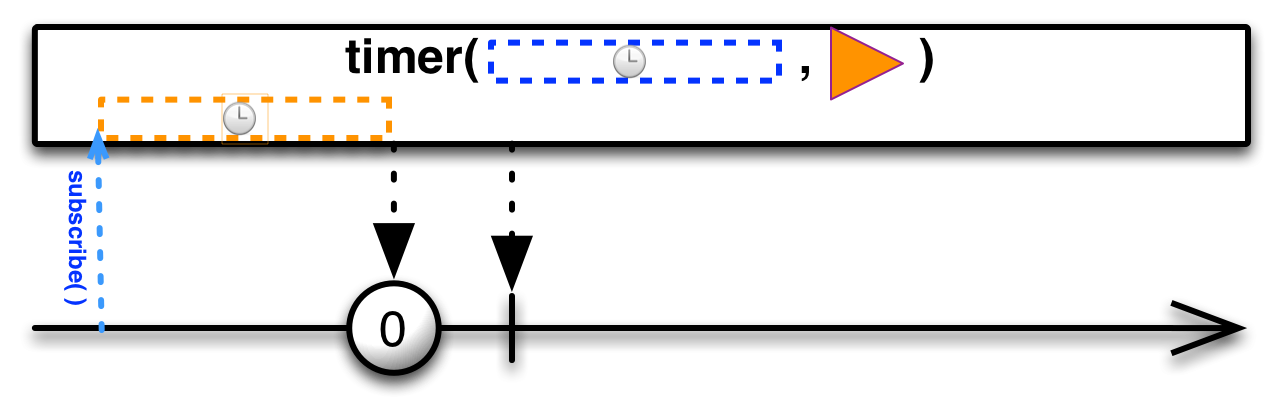
- Backpressure Support:
-
This operator does not support backpressure as it uses time. If the downstream needs a slower rate it should slow the timer or use something like
onBackpressureDrop(). - Scheduler:
-
you specify which
Schedulerthis operator will use
- Parameters:
-
delay- the initial delay before emitting a single 0L -
unit- time units to use fordelay -
scheduler- theSchedulerto use for scheduling the item - Returns:
- an Observable that emits one item after a specified delay, on a specified Scheduler, and then completes
- See Also:
- RxJava wiki: timer
using
public static final <T
,Resource> Observable <T> using(Func0 <Resource> resourceFactory, Func1 <? super Resource ,? extends Observable <? extends T>> observableFactory, Action1 <? super Resource> disposeAction) Constructs an Observable that creates a dependent resource object.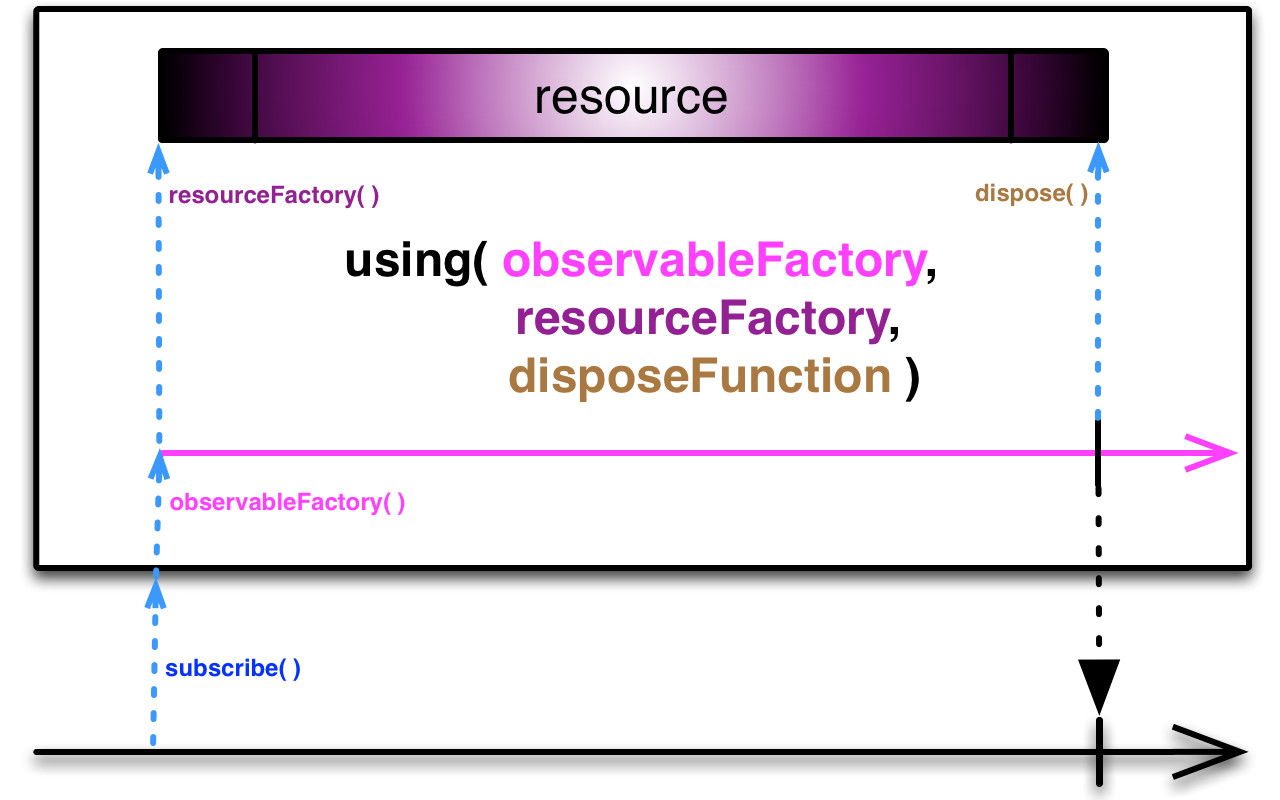
- Scheduler:
-
usingdoes not operate by default on a particularScheduler.
- Parameters:
-
resourceFactory- the factory function to create a resource object that depends on the Observable -
observableFactory- the factory function to create an Observable -
disposeAction- the function that will dispose of the resource - Returns:
- the Observable whose lifetime controls the lifetime of the dependent resource object
- See Also:
- RxJava wiki: using
zip
public static final <R> Observable
<R> zip(Iterable <? extends Observable <?>> ws, FuncN <? extends R> zipFunction) Returns an Observable that emits the results of a specified combiner function applied to combinations of items emitted, in sequence, by an Iterable of other Observables.zipapplies this function in strict sequence, so the first item emitted by the new Observable will be the result of the function applied to the first item emitted by each of the source Observables; the second item emitted by the new Observable will be the result of the function applied to the second item emitted by each of those Observables; and so forth.The resulting
Observable<R>returned fromzipwill invokeonNextas many times as the number ofonNextinvokations of the source Observable that emits the fewest items.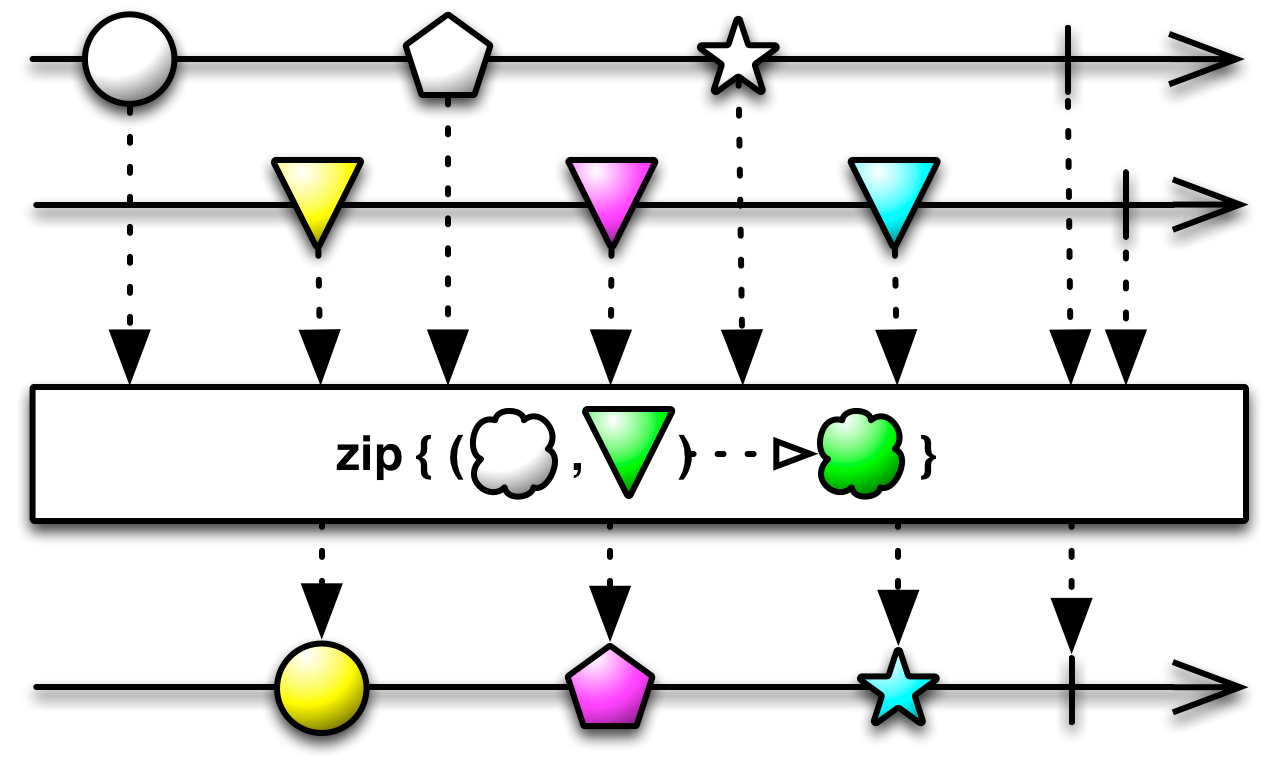
- Scheduler:
-
zipdoes not operate by default on a particularScheduler.
- Parameters:
-
ws- an Iterable of source Observables -
zipFunction- a function that, when applied to an item emitted by each of the source Observables, results in an item that will be emitted by the resulting Observable - Returns:
- an Observable that emits the zipped results
- See Also:
- RxJava wiki: zip
zip
public static final <R> Observable
<R> zip(Observable <? extends Observable <?>> ws, FuncN <? extends R> zipFunction) Returns an Observable that emits the results of a specified combiner function applied to combinations of n items emitted, in sequence, by the n Observables emitted by a specified Observable.zipapplies this function in strict sequence, so the first item emitted by the new Observable will be the result of the function applied to the first item emitted by each of the Observables emitted by the source Observable; the second item emitted by the new Observable will be the result of the function applied to the second item emitted by each of those Observables; and so forth.The resulting
Observable<R>returned fromzipwill invokeonNextas many times as the number ofonNextinvokations of the source Observable that emits the fewest items.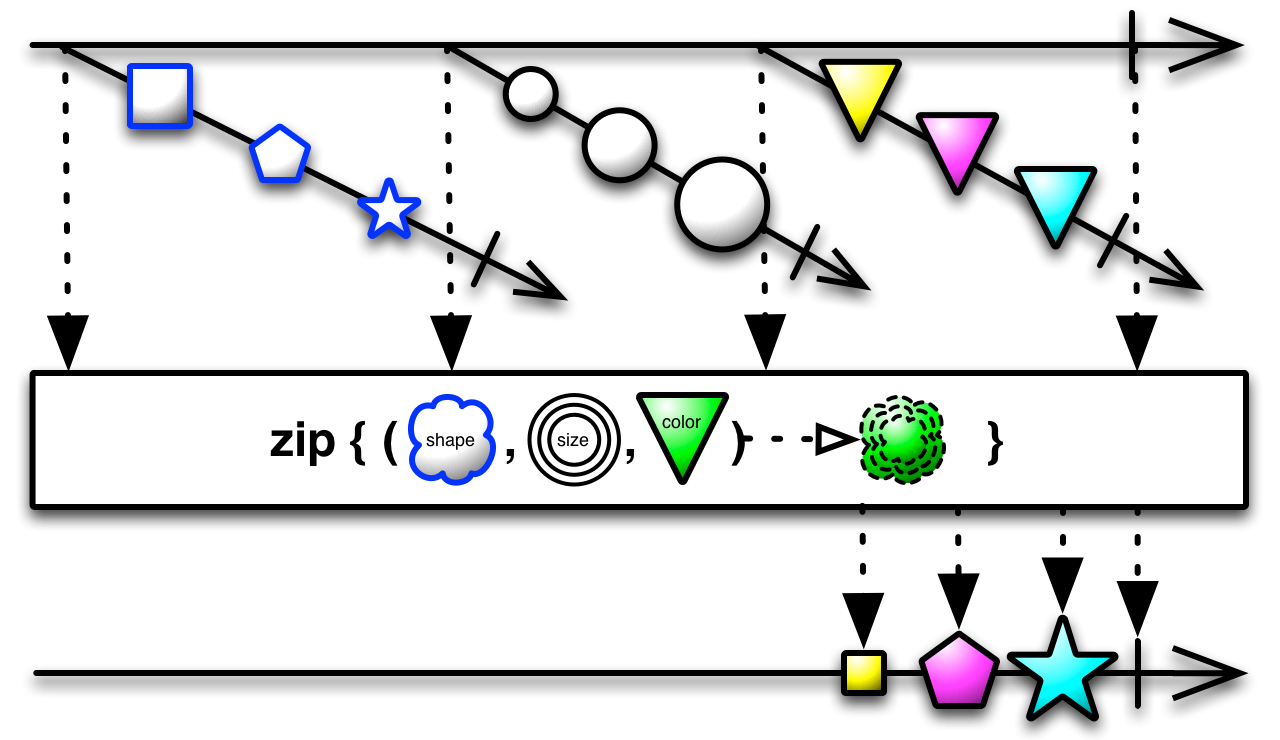
- Scheduler:
-
zipdoes not operate by default on a particularScheduler.
- Parameters:
-
ws- an Observable of source Observables -
zipFunction- a function that, when applied to an item emitted by each of the Observables emitted byws, results in an item that will be emitted by the resulting Observable - Returns:
- an Observable that emits the zipped results
- See Also:
- RxJava wiki: zip
zip
public static final <T1
,T2 ,R> Observable <R> zip(Observable <? extends T1> o1, Observable <? extends T2> o2, Func2 <? super T1 ,? super T2 ,? extends R> zipFunction) Returns an Observable that emits the results of a specified combiner function applied to combinations of two items emitted, in sequence, by two other Observables. zipapplies this function in strict sequence, so the first item emitted by the new Observable will be the result of the function applied to the first item emitted byo1and the first item emitted byo2; the second item emitted by the new Observable will be the result of the function applied to the second item emitted byo1and the second item emitted byo2; and so forth.The resulting
Observable<R>returned fromzipwill invokeonNextas many times as the number ofonNextinvocations of the source Observable that emits the fewest items.- Scheduler:
-
zipdoes not operate by default on a particularScheduler.
- Parameters:
-
o1- the first source Observable -
o2- a second source Observable -
zipFunction- a function that, when applied to an item emitted by each of the source Observables, results in an item that will be emitted by the resulting Observable - Returns:
- an Observable that emits the zipped results
- See Also:
- RxJava wiki: zip
zip
public static final <T1
,T2 ,T3 ,R> Observable <R> zip(Observable <? extends T1> o1, Observable <? extends T2> o2, Observable <? extends T3> o3, Func3 <? super T1 ,? super T2 ,? super T3 ,? extends R> zipFunction) Returns an Observable that emits the results of a specified combiner function applied to combinations of three items emitted, in sequence, by three other Observables. zipapplies this function in strict sequence, so the first item emitted by the new Observable will be the result of the function applied to the first item emitted byo1, the first item emitted byo2, and the first item emitted byo3; the second item emitted by the new Observable will be the result of the function applied to the second item emitted byo1, the second item emitted byo2, and the second item emitted byo3; and so forth.The resulting
Observable<R>returned fromzipwill invokeonNextas many times as the number ofonNextinvocations of the source Observable that emits the fewest items.- Scheduler:
-
zipdoes not operate by default on a particularScheduler.
- Parameters:
-
o1- the first source Observable -
o2- a second source Observable -
o3- a third source Observable -
zipFunction- a function that, when applied to an item emitted by each of the source Observables, results in an item that will be emitted by the resulting Observable - Returns:
- an Observable that emits the zipped results
- See Also:
- RxJava wiki: zip
zip
public static final <T1
,T2 ,T3 ,T4 ,R> Observable <R> zip(Observable <? extends T1> o1, Observable <? extends T2> o2, Observable <? extends T3> o3, Observable <? extends T4> o4, Func4 <? super T1 ,? super T2 ,? super T3 ,? super T4 ,? extends R> zipFunction) Returns an Observable that emits the results of a specified combiner function applied to combinations of four items emitted, in sequence, by four other Observables. zipapplies this function in strict sequence, so the first item emitted by the new Observable will be the result of the function applied to the first item emitted byo1, the first item emitted byo2, the first item emitted byo3, and the first item emitted by04; the second item emitted by the new Observable will be the result of the function applied to the second item emitted by each of those Observables; and so forth.The resulting
Observable<R>returned fromzipwill invokeonNextas many times as the number ofonNextinvocations of the source Observable that emits the fewest items.- Scheduler:
-
zipdoes not operate by default on a particularScheduler.
- Parameters:
-
o1- the first source Observable -
o2- a second source Observable -
o3- a third source Observable -
o4- a fourth source Observable -
zipFunction- a function that, when applied to an item emitted by each of the source Observables, results in an item that will be emitted by the resulting Observable - Returns:
- an Observable that emits the zipped results
- See Also:
- RxJava wiki: zip
zip
public static final <T1
,T2 ,T3 ,T4 ,T5 ,R> Observable <R> zip(Observable <? extends T1> o1, Observable <? extends T2> o2, Observable <? extends T3> o3, Observable <? extends T4> o4, Observable <? extends T5> o5, Func5 <? super T1 ,? super T2 ,? super T3 ,? super T4 ,? super T5 ,? extends R> zipFunction) Returns an Observable that emits the results of a specified combiner function applied to combinations of five items emitted, in sequence, by five other Observables. zipapplies this function in strict sequence, so the first item emitted by the new Observable will be the result of the function applied to the first item emitted byo1, the first item emitted byo2, the first item emitted byo3, the first item emitted byo4, and the first item emitted byo5; the second item emitted by the new Observable will be the result of the function applied to the second item emitted by each of those Observables; and so forth.The resulting
Observable<R>returned fromzipwill invokeonNextas many times as the number ofonNextinvocations of the source Observable that emits the fewest items.- Scheduler:
-
zipdoes not operate by default on a particularScheduler.
- Parameters:
-
o1- the first source Observable -
o2- a second source Observable -
o3- a third source Observable -
o4- a fourth source Observable -
o5- a fifth source Observable -
zipFunction- a function that, when applied to an item emitted by each of the source Observables, results in an item that will be emitted by the resulting Observable - Returns:
- an Observable that emits the zipped results
- See Also:
- RxJava wiki: zip
zip
public static final <T1
,T2 ,T3 ,T4 ,T5 ,T6 ,R> Observable <R> zip(Observable <? extends T1> o1, Observable <? extends T2> o2, Observable <? extends T3> o3, Observable <? extends T4> o4, Observable <? extends T5> o5, Observable <? extends T6> o6, Func6 <? super T1 ,? super T2 ,? super T3 ,? super T4 ,? super T5 ,? super T6 ,? extends R> zipFunction) Returns an Observable that emits the results of a specified combiner function applied to combinations of six items emitted, in sequence, by six other Observables. zipapplies this function in strict sequence, so the first item emitted by the new Observable will be the result of the function applied to the first item emitted by each source Observable, the second item emitted by the new Observable will be the result of the function applied to the second item emitted by each of those Observables, and so forth.The resulting
Observable<R>returned fromzipwill invokeonNextas many times as the number ofonNextinvocations of the source Observable that emits the fewest items.- Scheduler:
-
zipdoes not operate by default on a particularScheduler.
- Parameters:
-
o1- the first source Observable -
o2- a second source Observable -
o3- a third source Observable -
o4- a fourth source Observable -
o5- a fifth source Observable -
o6- a sixth source Observable -
zipFunction- a function that, when applied to an item emitted by each of the source Observables, results in an item that will be emitted by the resulting Observable - Returns:
- an Observable that emits the zipped results
- See Also:
- RxJava wiki: zip
zip
public static final <T1
,T2 ,T3 ,T4 ,T5 ,T6 ,T7 ,R> Observable <R> zip(Observable <? extends T1> o1, Observable <? extends T2> o2, Observable <? extends T3> o3, Observable <? extends T4> o4, Observable <? extends T5> o5, Observable <? extends T6> o6, Observable <? extends T7> o7, Func7 <? super T1 ,? super T2 ,? super T3 ,? super T4 ,? super T5 ,? super T6 ,? super T7 ,? extends R> zipFunction) Returns an Observable that emits the results of a specified combiner function applied to combinations of seven items emitted, in sequence, by seven other Observables. zipapplies this function in strict sequence, so the first item emitted by the new Observable will be the result of the function applied to the first item emitted by each source Observable, the second item emitted by the new Observable will be the result of the function applied to the second item emitted by each of those Observables, and so forth.The resulting
Observable<R>returned fromzipwill invokeonNextas many times as the number ofonNextinvocations of the source Observable that emits the fewest items.- Scheduler:
-
zipdoes not operate by default on a particularScheduler.
- Parameters:
-
o1- the first source Observable -
o2- a second source Observable -
o3- a third source Observable -
o4- a fourth source Observable -
o5- a fifth source Observable -
o6- a sixth source Observable -
o7- a seventh source Observable -
zipFunction- a function that, when applied to an item emitted by each of the source Observables, results in an item that will be emitted by the resulting Observable - Returns:
- an Observable that emits the zipped results
- See Also:
- RxJava wiki: zip
zip
public static final <T1
,T2 ,T3 ,T4 ,T5 ,T6 ,T7 ,T8 ,R> Observable <R> zip(Observable <? extends T1> o1, Observable <? extends T2> o2, Observable <? extends T3> o3, Observable <? extends T4> o4, Observable <? extends T5> o5, Observable <? extends T6> o6, Observable <? extends T7> o7, Observable <? extends T8> o8, Func8 <? super T1 ,? super T2 ,? super T3 ,? super T4 ,? super T5 ,? super T6 ,? super T7 ,? super T8 ,? extends R> zipFunction) Returns an Observable that emits the results of a specified combiner function applied to combinations of eight items emitted, in sequence, by eight other Observables. zipapplies this function in strict sequence, so the first item emitted by the new Observable will be the result of the function applied to the first item emitted by each source Observable, the second item emitted by the new Observable will be the result of the function applied to the second item emitted by each of those Observables, and so forth.The resulting
Observable<R>returned fromzipwill invokeonNextas many times as the number ofonNextinvocations of the source Observable that emits the fewest items.- Scheduler:
-
zipdoes not operate by default on a particularScheduler.
- Parameters:
-
o1- the first source Observable -
o2- a second source Observable -
o3- a third source Observable -
o4- a fourth source Observable -
o5- a fifth source Observable -
o6- a sixth source Observable -
o7- a seventh source Observable -
o8- an eighth source Observable -
zipFunction- a function that, when applied to an item emitted by each of the source Observables, results in an item that will be emitted by the resulting Observable - Returns:
- an Observable that emits the zipped results
- See Also:
- RxJava wiki: zip
zip
public static final <T1
,T2 ,T3 ,T4 ,T5 ,T6 ,T7 ,T8 ,T9 ,R> Observable <R> zip(Observable <? extends T1> o1, Observable <? extends T2> o2, Observable <? extends T3> o3, Observable <? extends T4> o4, Observable <? extends T5> o5, Observable <? extends T6> o6, Observable <? extends T7> o7, Observable <? extends T8> o8, Observable <? extends T9> o9, Func9 <? super T1 ,? super T2 ,? super T3 ,? super T4 ,? super T5 ,? super T6 ,? super T7 ,? super T8 ,? super T9 ,? extends R> zipFunction) Returns an Observable that emits the results of a specified combiner function applied to combinations of nine items emitted, in sequence, by nine other Observables. zipapplies this function in strict sequence, so the first item emitted by the new Observable will be the result of the function applied to the first item emitted by each source Observable, the second item emitted by the new Observable will be the result of the function applied to the second item emitted by each of those Observables, and so forth.The resulting
Observable<R>returned fromzipwill invokeonNextas many times as the number ofonNextinvocations of the source Observable that emits the fewest items.- Scheduler:
-
zipdoes not operate by default on a particularScheduler.
- Parameters:
-
o1- the first source Observable -
o2- a second source Observable -
o3- a third source Observable -
o4- a fourth source Observable -
o5- a fifth source Observable -
o6- a sixth source Observable -
o7- a seventh source Observable -
o8- an eighth source Observable -
o9- a ninth source Observable -
zipFunction- a function that, when applied to an item emitted by each of the source Observables, results in an item that will be emitted by the resulting Observable - Returns:
- an Observable that emits the zipped results
- See Also:
- RxJava wiki: zip
all
public final Observable
<Boolean > all(Func1 <? super T ,Boolean > predicate) Returns an Observable that emits a Boolean that indicates whether all of the items emitted by the source Observable satisfy a condition.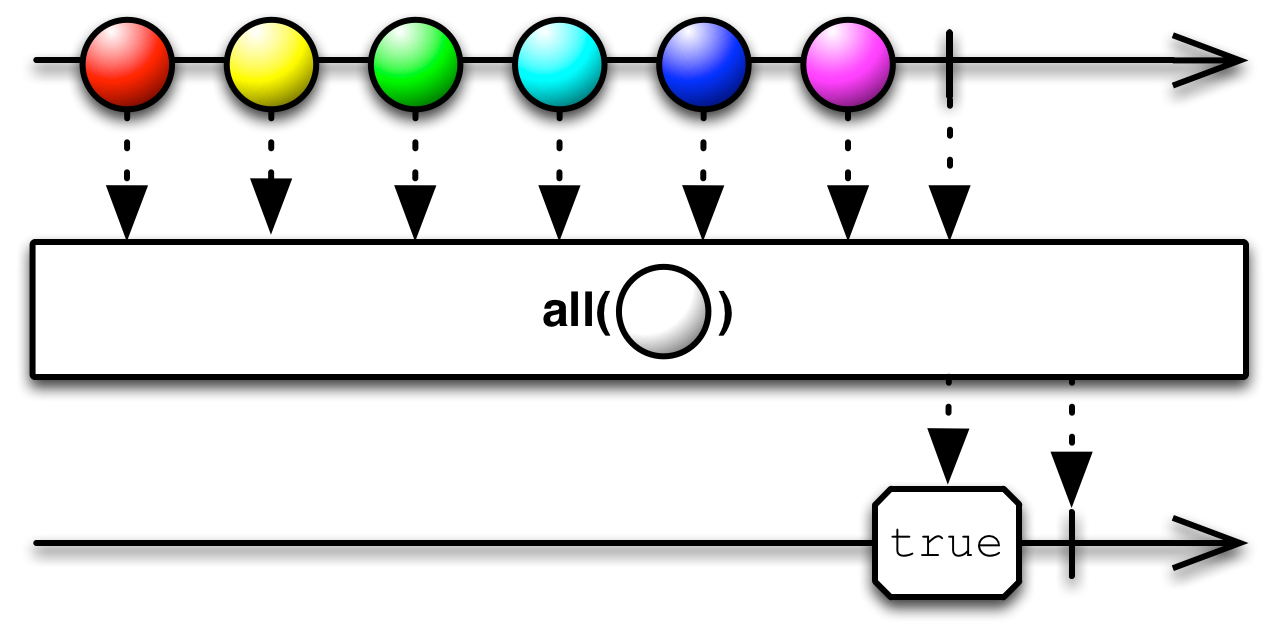
- Scheduler:
-
alldoes not operate by default on a particularScheduler.
- Parameters:
-
predicate- a function that evaluates an item and returns a Boolean - Returns:
-
an Observable that emits
trueif all items emitted by the source Observable satisfy the predicate; otherwise,false - See Also:
- RxJava wiki: all
ambWith
public final Observable
<T> ambWith(Observable <? extends T> t1) Mirrors the first Observable (current or provided) that emits an item. - Scheduler:
-
ambdoes not operate by default on a particularScheduler.
- Parameters:
-
t1- an Observable competing to react first - Returns:
- an Observable that emits the same sequence of items as whichever of the source Observables first emitted an item
- See Also:
- RxJava wiki: amb
asObservable
public final Observable
<T> asObservable() Portrays a object of an Observable subclass as a simple Observable object. This is useful, for instance, when you have an implementation of a subclass of Observable but you want to hide the properties and methods of this subclass from whomever you are passing the Observable to.- Scheduler:
-
asObservabledoes not operate by default on a particularScheduler.
- Returns:
- an Observable that hides the identity of this Observable
buffer
public final <TClosing> Observable
<List <T>> buffer(Func0 <? extends Observable <? extends TClosing>> bufferClosingSelector) Returns an Observable that emits buffers of items it collects from the source Observable. The resulting Observable emits connected, non-overlapping buffers. It emits the current buffer and replaces it with a new buffer whenever the Observable produced by the specifiedbufferClosingSelectoremits an item.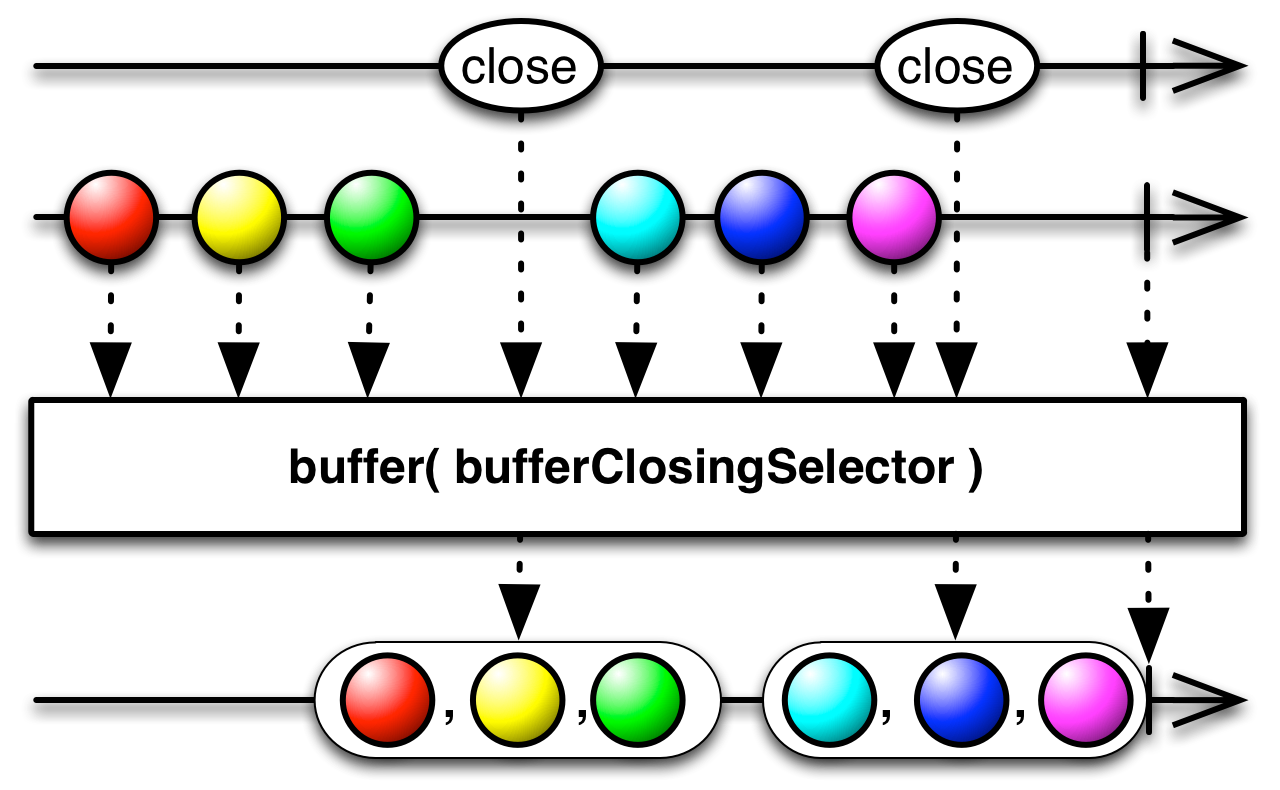
- Backpressure Support:
-
This operator does not support backpressure as it is instead controlled by the given Observables and buffers data. It requests
Long.MAX_VALUEupstream and does not obey downstream requests. - Scheduler:
-
This version of
bufferdoes not operate by default on a particularScheduler.
- Parameters:
-
bufferClosingSelector- aFunc0that produces an Observable that governs the boundary between buffers. Whenever thisObservableemits an item,bufferemits the current buffer and begins to fill a new one - Returns:
-
an Observable that emits a connected, non-overlapping buffer of items from the source Observable each time the Observable created with the
bufferClosingSelectorargument emits an item - See Also:
- RxJava wiki: buffer
buffer
public final Observable
<List <T>> buffer(int count) Returns an Observable that emits buffers of items it collects from the source Observable. The resulting Observable emits connected, non-overlapping buffers, each containingcountitems. When the source Observable completes or encounters an error, the resulting Observable emits the current buffer and propagates the notification from the source Observable.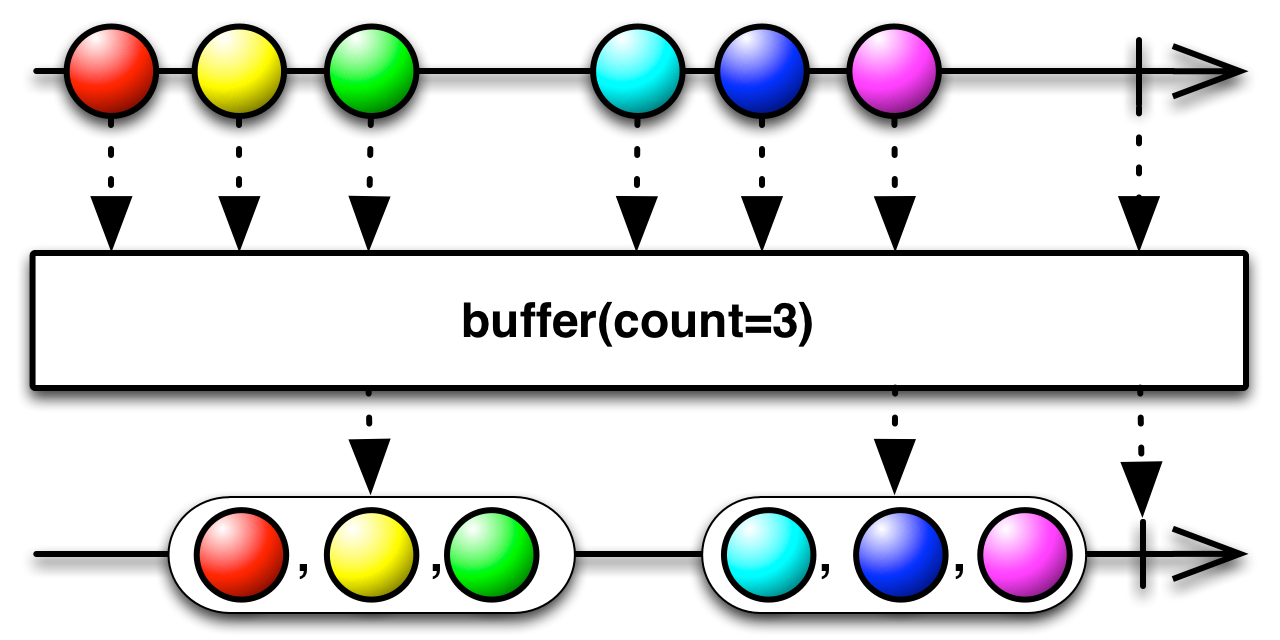
- Scheduler:
-
This version of
bufferdoes not operate by default on a particularScheduler.
- Parameters:
-
count- the maximum number of items in each buffer before it should be emitted - Returns:
-
an Observable that emits connected, non-overlapping buffers, each containing at most
countitems from the source Observable - See Also:
- RxJava wiki: buffer
buffer
public final Observable
<List <T>> buffer(int count, int skip) Returns an Observable that emits buffers of items it collects from the source Observable. The resulting Observable emits buffers everyskipitems, each containingcountitems. When the source Observable completes or encounters an error, the resulting Observable emits the current buffer and propagates the notification from the source Observable.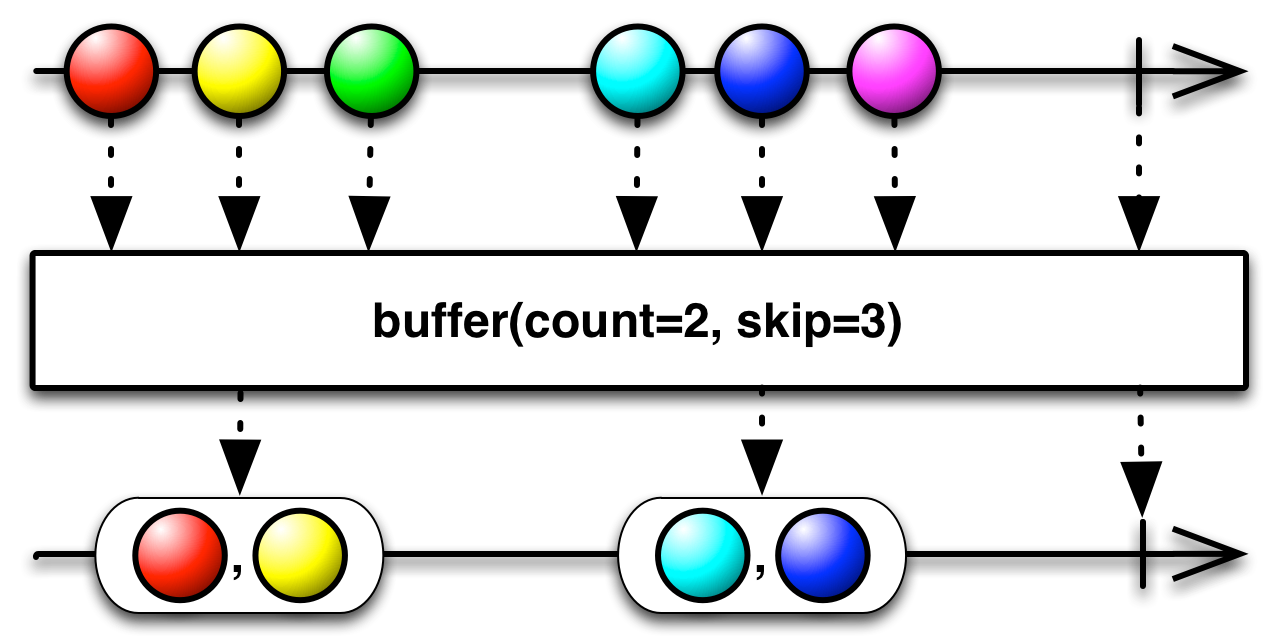
- Scheduler:
-
This version of
bufferdoes not operate by default on a particularScheduler.
- Parameters:
-
count- the maximum size of each buffer before it should be emitted -
skip- how many items emitted by the source Observable should be skipped before starting a new buffer. Note that whenskipandcountare equal, this is the same operation asbuffer(int). - Returns:
-
an Observable that emits buffers for every
skipitem from the source Observable and containing at mostcountitems - See Also:
- RxJava wiki: buffer
buffer
public final Observable
<List <T>> buffer(long timespan, long timeshift, TimeUnit unit) Returns an Observable that emits buffers of items it collects from the source Observable. The resulting Observable starts a new buffer periodically, as determined by thetimeshiftargument. It emits each buffer after a fixed timespan, specified by thetimespanargument. When the source Observable completes or encounters an error, the resulting Observable emits the current buffer and propagates the notification from the source Observable.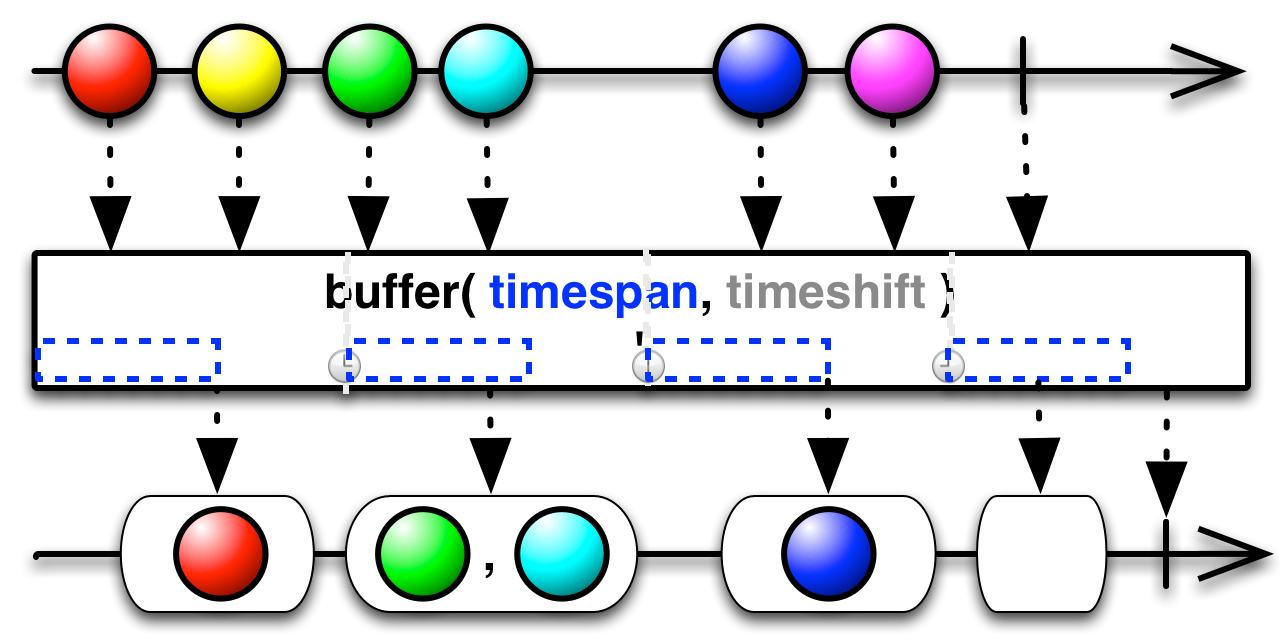
- Backpressure Support:
-
This operator does not support backpressure as it uses time. It requests
Long.MAX_VALUEupstream and does not obey downstream requests. - Scheduler:
-
This version of
bufferoperates by default on thecomputationScheduler.
- Parameters:
-
timespan- the period of time each buffer collects items before it is emitted -
timeshift- the period of time after which a new buffer will be created -
unit- the unit of time that applies to thetimespanandtimeshiftarguments - Returns:
- an Observable that emits new buffers of items emitted by the source Observable periodically after a fixed timespan has elapsed
- See Also:
- RxJava wiki: buffer
buffer
public final Observable
<List <T>> buffer(long timespan, long timeshift, TimeUnit unit, Scheduler scheduler) Returns an Observable that emits buffers of items it collects from the source Observable. The resulting Observable starts a new buffer periodically, as determined by thetimeshiftargument, and on the specifiedscheduler. It emits each buffer after a fixed timespan, specified by thetimespanargument. When the source Observable completes or encounters an error, the resulting Observable emits the current buffer and propagates the notification from the source Observable.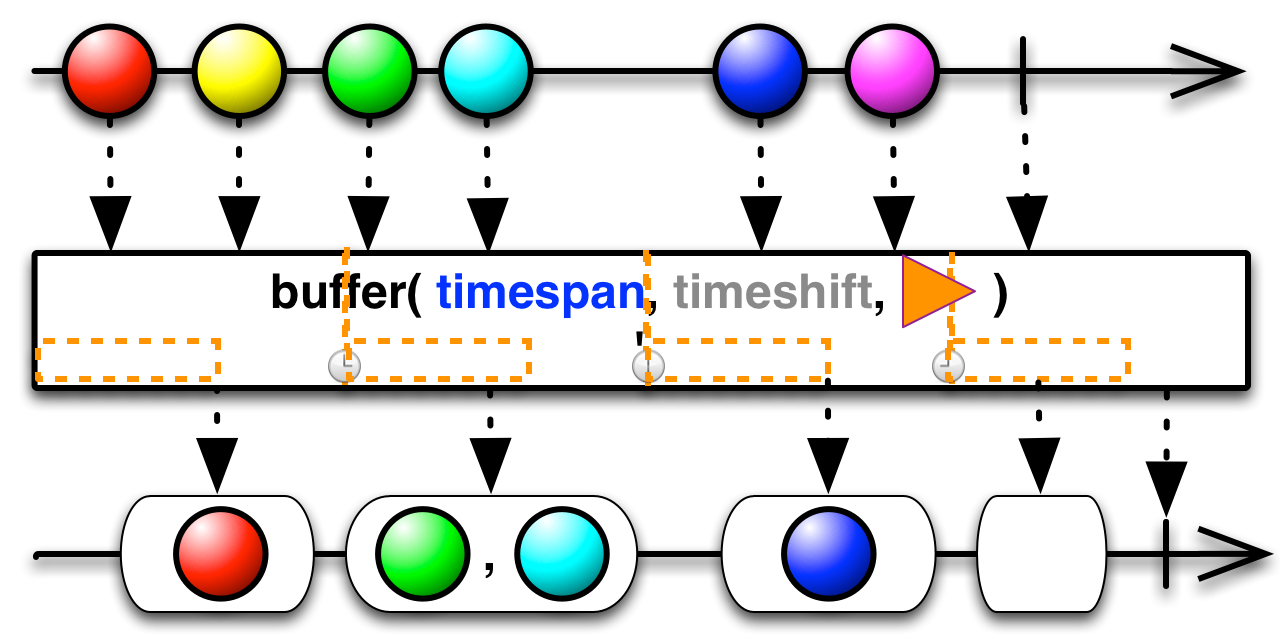
- Backpressure Support:
-
This operator does not support backpressure as it uses time. It requests
Long.MAX_VALUEupstream and does not obey downstream requests. - Scheduler:
-
you specify which
Schedulerthis operator will use
- Parameters:
-
timespan- the period of time each buffer collects items before it is emitted -
timeshift- the period of time after which a new buffer will be created -
unit- the unit of time that applies to thetimespanandtimeshiftarguments -
scheduler- theSchedulerto use when determining the end and start of a buffer - Returns:
- an Observable that emits new buffers of items emitted by the source Observable periodically after a fixed timespan has elapsed
- See Also:
- RxJava wiki: buffer
buffer
public final Observable
<List <T>> buffer(long timespan, TimeUnit unit) Returns an Observable that emits buffers of items it collects from the source Observable. The resulting Observable emits connected, non-overlapping buffers, each of a fixed duration specified by thetimespanargument. When the source Observable completes or encounters an error, the resulting Observable emits the current buffer and propagates the notification from the source Observable.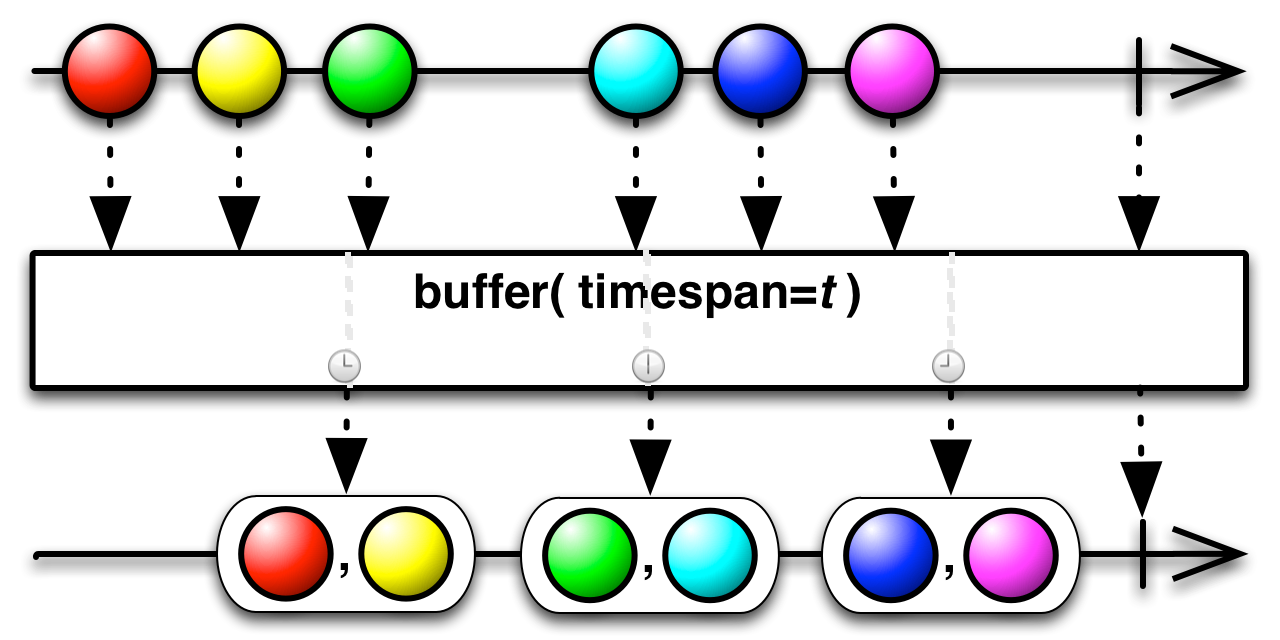
- Backpressure Support:
-
This operator does not support backpressure as it uses time. It requests
Long.MAX_VALUEupstream and does not obey downstream requests. - Scheduler:
-
This version of
bufferoperates by default on thecomputationScheduler.
- Parameters:
-
timespan- the period of time each buffer collects items before it is emitted and replaced with a new buffer -
unit- the unit of time that applies to thetimespanargument - Returns:
- an Observable that emits connected, non-overlapping buffers of items emitted by the source Observable within a fixed duration
- See Also:
- RxJava wiki: buffer
buffer
public final Observable
<List <T>> buffer(long timespan, TimeUnit unit, int count) Returns an Observable that emits buffers of items it collects from the source Observable. The resulting Observable emits connected, non-overlapping buffers, each of a fixed duration specified by thetimespanargument or a maximum size specified by thecountargument (whichever is reached first). When the source Observable completes or encounters an error, the resulting Observable emits the current buffer and propagates the notification from the source Observable.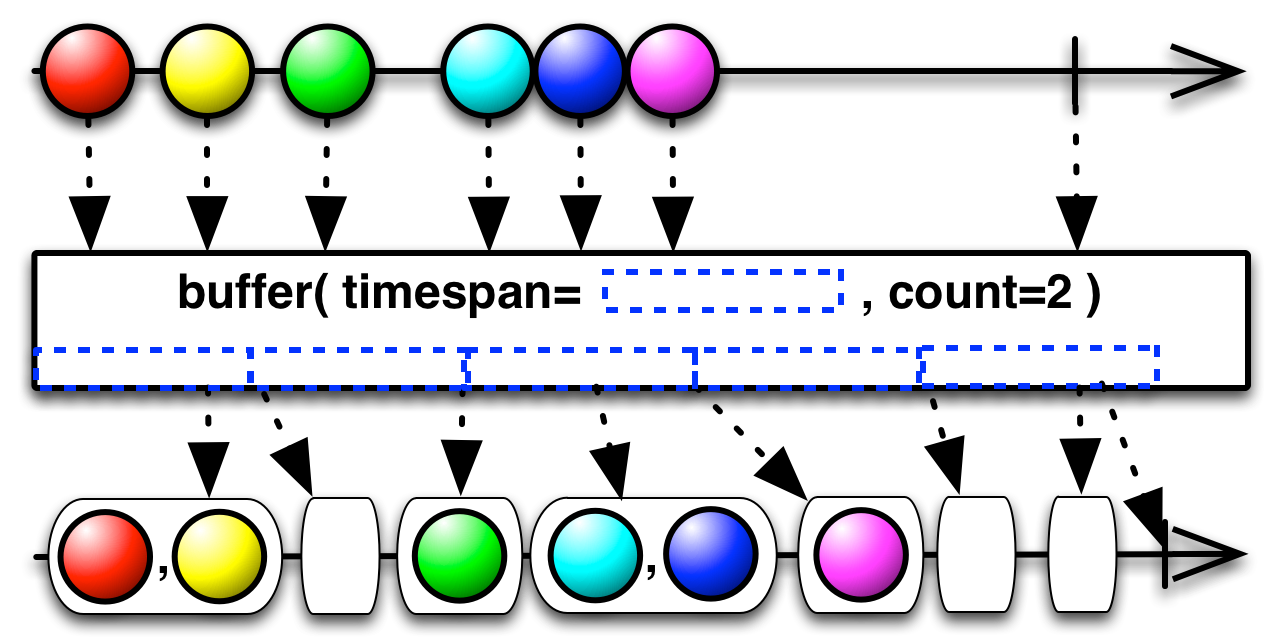
- Backpressure Support:
-
This operator does not support backpressure as it uses time. It requests
Long.MAX_VALUEupstream and does not obey downstream requests. - Scheduler:
-
This version of
bufferoperates by default on thecomputationScheduler.
- Parameters:
-
timespan- the period of time each buffer collects items before it is emitted and replaced with a new buffer -
unit- the unit of time which applies to thetimespanargument -
count- the maximum size of each buffer before it is emitted - Returns:
- an Observable that emits connected, non-overlapping buffers of items emitted by the source Observable, after a fixed duration or when the buffer reaches maximum capacity (whichever occurs first)
- See Also:
- RxJava wiki: buffer
buffer
public final Observable
<List <T>> buffer(long timespan, TimeUnit unit, int count, Scheduler scheduler) Returns an Observable that emits buffers of items it collects from the source Observable. The resulting Observable emits connected, non-overlapping buffers, each of a fixed duration specified by thetimespanargument as measured on the specifiedscheduler, or a maximum size specified by thecountargument (whichever is reached first). When the source Observable completes or encounters an error, the resulting Observable emits the current buffer and propagates the notification from the source Observable.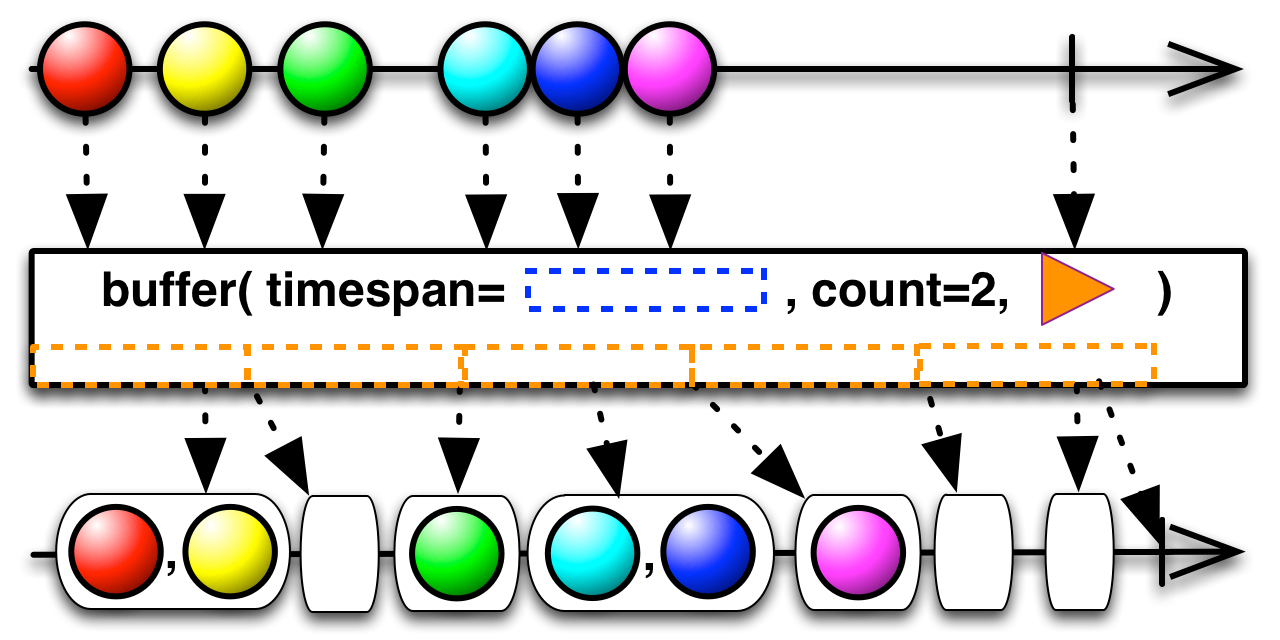
- Backpressure Support:
-
This operator does not support backpressure as it uses time. It requests
Long.MAX_VALUEupstream and does not obey downstream requests. - Scheduler:
-
you specify which
Schedulerthis operator will use
- Parameters:
-
timespan- the period of time each buffer collects items before it is emitted and replaced with a new buffer -
unit- the unit of time which applies to thetimespanargument -
count- the maximum size of each buffer before it is emitted -
scheduler- theSchedulerto use when determining the end and start of a buffer - Returns:
- an Observable that emits connected, non-overlapping buffers of items emitted by the source Observable after a fixed duration or when the buffer reaches maximum capacity (whichever occurs first)
- See Also:
- RxJava wiki: buffer
buffer
public final Observable
<List <T>> buffer(long timespan, TimeUnit unit, Scheduler scheduler) Returns an Observable that emits buffers of items it collects from the source Observable. The resulting Observable emits connected, non-overlapping buffers, each of a fixed duration specified by thetimespanargument and on the specifiedscheduler. When the source Observable completes or encounters an error, the resulting Observable emits the current buffer and propagates the notification from the source Observable.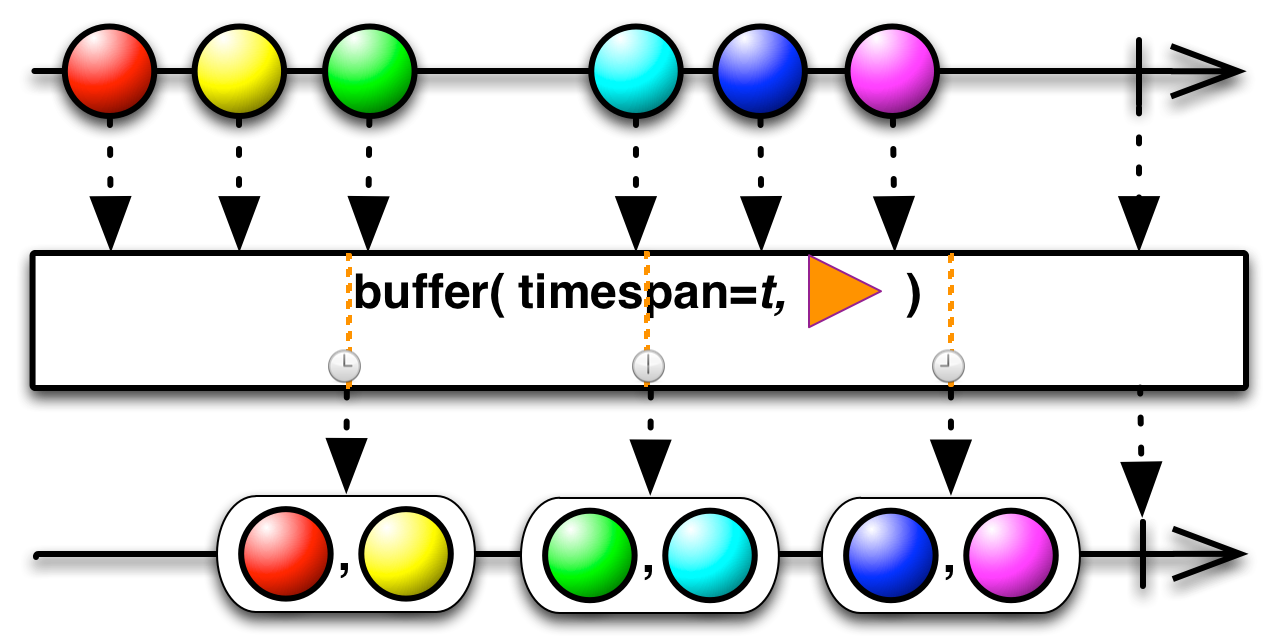
- Backpressure Support:
-
This operator does not support backpressure as it uses time. It requests
Long.MAX_VALUEupstream and does not obey downstream requests. - Scheduler:
-
you specify which
Schedulerthis operator will use
- Parameters:
-
timespan- the period of time each buffer collects items before it is emitted and replaced with a new buffer -
unit- the unit of time which applies to thetimespanargument -
scheduler- theSchedulerto use when determining the end and start of a buffer - Returns:
- an Observable that emits connected, non-overlapping buffers of items emitted by the source Observable within a fixed duration
- See Also:
- RxJava wiki: buffer
buffer
public final <TOpening
,TClosing> Observable <List <T>> buffer(Observable <? extends TOpening> bufferOpenings, Func1 <? super TOpening ,? extends Observable <? extends TClosing>> bufferClosingSelector) Returns an Observable that emits buffers of items it collects from the source Observable. The resulting Observable emits buffers that it creates when the specifiedbufferOpeningsObservable emits an item, and closes when the Observable returned frombufferClosingSelectoremits an item.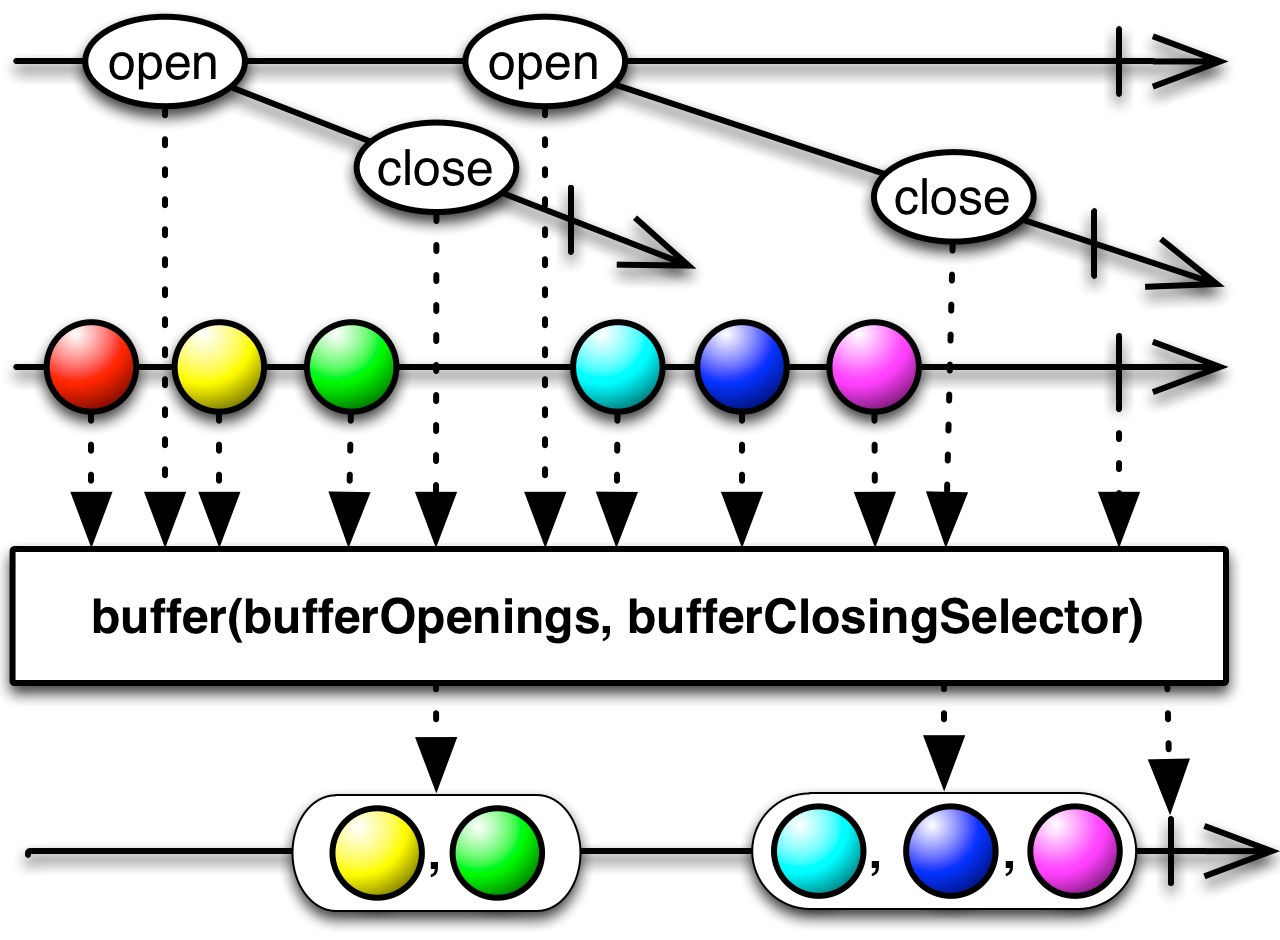
- Backpressure Support:
-
This operator does not support backpressure as it is instead controlled by the given Observables and buffers data. It requests
Long.MAX_VALUEupstream and does not obey downstream requests. - Scheduler:
-
This version of
bufferdoes not operate by default on a particularScheduler.
- Parameters:
-
bufferOpenings- the Observable that, when it emits an item, causes a new buffer to be created -
bufferClosingSelector- theFunc1that is used to produce an Observable for every buffer created. When this Observable emits an item, the associated buffer is emitted. - Returns:
- an Observable that emits buffers, containing items from the source Observable, that are created and closed when the specified Observables emit items
- See Also:
- RxJava wiki: buffer
buffer
public final <B> Observable
<List <T>> buffer(Observable <B> boundary) Returns an Observable that emits non-overlapping buffered items from the source Observable each time the specified boundary Observable emits an item.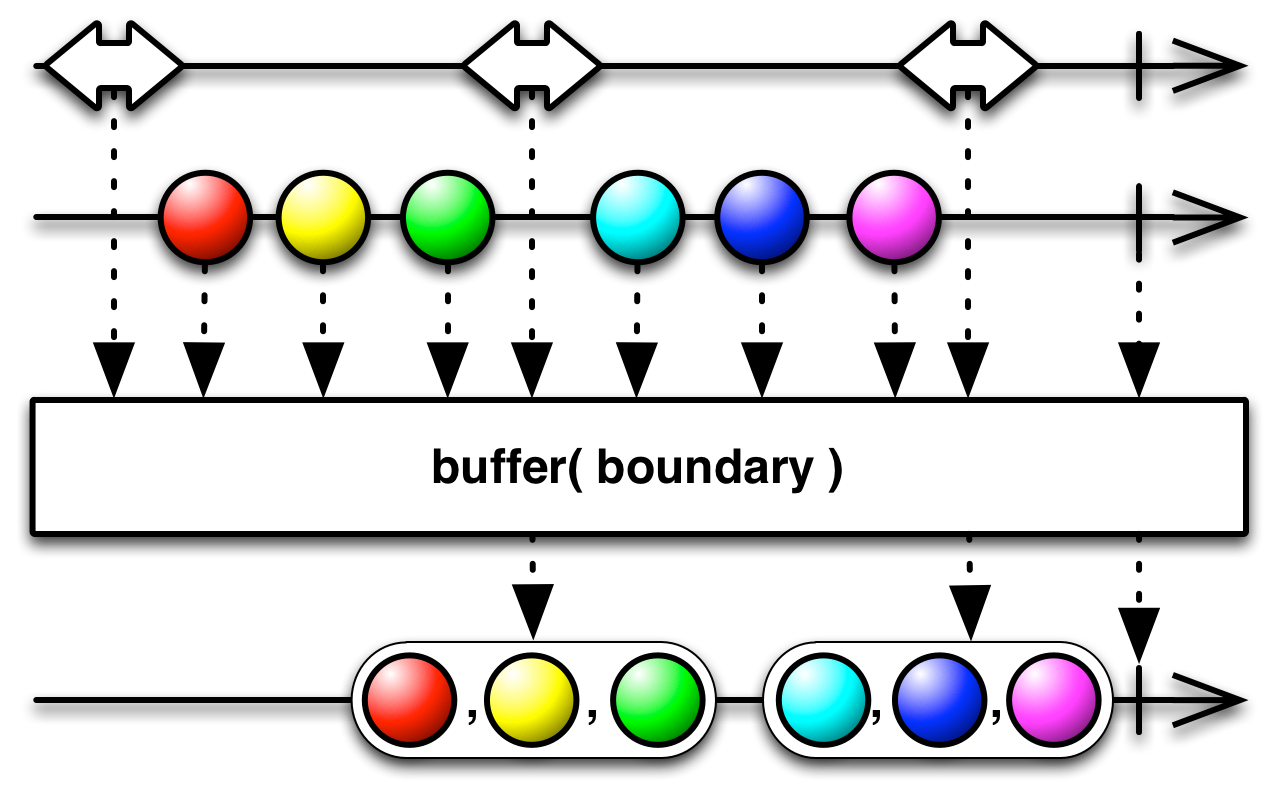
Completion of either the source or the boundary Observable causes the returned Observable to emit the latest buffer and complete.
- Backpressure Support:
-
This operator does not support backpressure as it is instead controlled by the
Observableboundaryand buffers data. It requestsLong.MAX_VALUEupstream and does not obey downstream requests. - Scheduler:
-
This version of
bufferdoes not operate by default on a particularScheduler.
- Type Parameters:
-
B- the boundary value type (ignored) - Parameters:
-
boundary- the boundary Observable - Returns:
- an Observable that emits buffered items from the source Observable when the boundary Observable emits an item
- See Also:
-
buffer(rx.Observable, int), RxJava wiki: buffer
buffer
public final <B> Observable
<List <T>> buffer(Observable <B> boundary, int initialCapacity) Returns an Observable that emits non-overlapping buffered items from the source Observable each time the specified boundary Observable emits an item. Completion of either the source or the boundary Observable causes the returned Observable to emit the latest buffer and complete.
- Backpressure Support:
-
This operator does not support backpressure as it is instead controlled by the
Observableboundaryand buffers data. It requestsLong.MAX_VALUEupstream and does not obey downstream requests. - Scheduler:
-
This version of
bufferdoes not operate by default on a particularScheduler.
- Type Parameters:
-
B- the boundary value type (ignored) - Parameters:
-
boundary- the boundary Observable -
initialCapacity- the initial capacity of each buffer chunk - Returns:
- an Observable that emits buffered items from the source Observable when the boundary Observable emits an item
- See Also:
-
RxJava wiki: buffer,
buffer(rx.Observable, int)
cache
public final Observable
<T> cache() Caches the emissions from the source Observable and replays them in order to any subsequent Subscribers. This method has similar behavior toreplay()except that this auto-subscribes to the source Observable rather than returning aConnectableObservablefor which you must callconnectto activate the subscription.
This is useful when you want an Observable to cache responses and you can't control the subscribe/unsubscribe behavior of all the
Subscribers.When you call
cache, it does not yet subscribe to the source Observable and so does not yet begin cacheing items. This only happens when the first Subscriber calls the resulting Observable'ssubscribemethod.Note: You sacrifice the ability to unsubscribe from the origin when you use the
cacheObserver so be careful not to use this Observer on Observables that emit an infinite or very large number of items that will use up memory.- Backpressure Support:
- This operator does not support upstream backpressure as it is purposefully requesting and caching everything emitted.
- Scheduler:
-
cachedoes not operate by default on a particularScheduler.
- Returns:
- an Observable that, when first subscribed to, caches all of its items and notifications for the benefit of subsequent subscribers
- See Also:
- RxJava wiki: cache
cache
public final Observable
<T> cache(int capacity) Caches emissions from the source Observable and replays them in order to any subsequent Subscribers. This method has similar behavior toreplay()except that this auto-subscribes to the source Observable rather than returning aConnectableObservablefor which you must callconnectto activate the subscription. This is useful when you want an Observable to cache responses and you can't control the subscribe/unsubscribe behavior of all the
Subscribers.When you call
cache, it does not yet subscribe to the source Observable and so does not yet begin cacheing items. This only happens when the first Subscriber calls the resulting Observable'ssubscribemethod.Note: You sacrifice the ability to unsubscribe from the origin when you use the
cacheObserver so be careful not to use this Observer on Observables that emit an infinite or very large number of items that will use up memory.- Backpressure Support:
- This operator does not support upstream backpressure as it is purposefully requesting and caching everything emitted.
- Scheduler:
-
cachedoes not operate by default on a particularScheduler.
- Parameters:
-
capacity- hint for number of items to cache (for optimizing underlying data structure) - Returns:
- an Observable that, when first subscribed to, caches all of its items and notifications for the benefit of subsequent subscribers
- See Also:
- RxJava wiki: cache
cast
public final <R> Observable
<R> cast(Class <R> klass) Returns an Observable that emits the items emitted by the source Observable, converted to the specified type.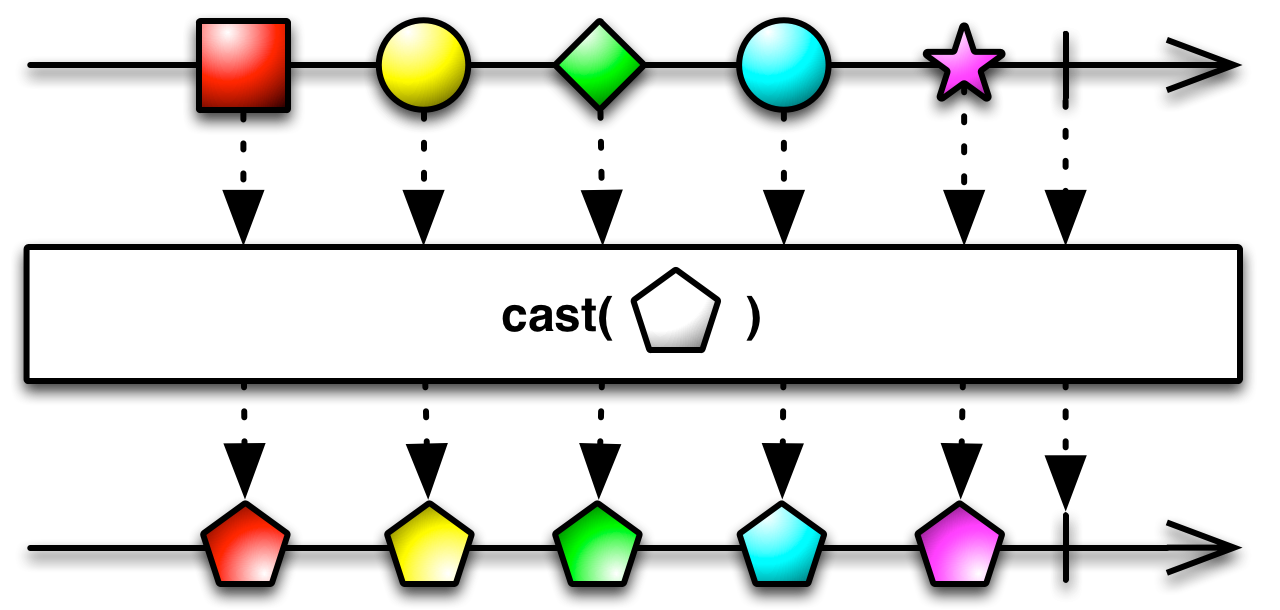
- Scheduler:
-
castdoes not operate by default on a particularScheduler.
- Parameters:
-
klass- the target class type thatcastwill cast the items emitted by the source Observable into before emitting them from the resulting Observable - Returns:
- an Observable that emits each item from the source Observable after converting it to the specified type
- See Also:
- RxJava wiki: cast
collect
public final <R> Observable
<R> collect(Func0 <R> stateFactory, Action2 <R ,? super T> collector) Collects items emitted by the source Observable into a single mutable data structure and returns an Observable that emits this structure.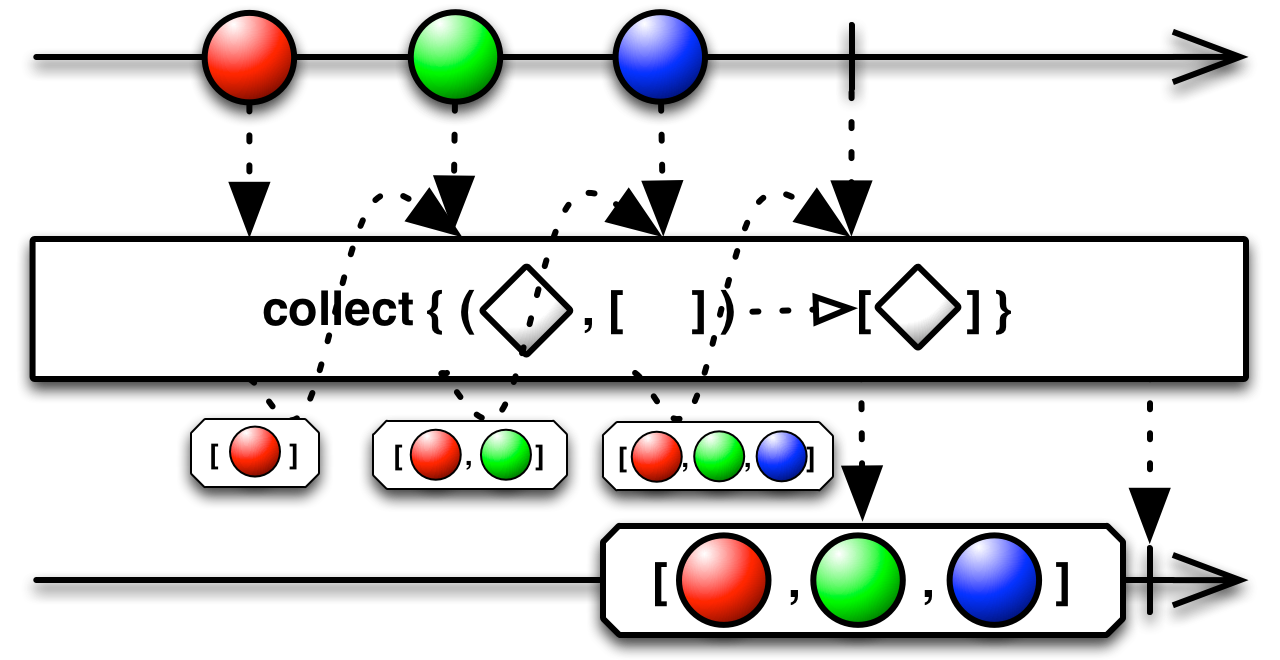
This is a simplified version of
reducethat does not need to return the state on each pass.- Backpressure Support:
-
This operator does not support backpressure because by intent it will receive all values and reduce them to a single
onNext. - Scheduler:
-
collectdoes not operate by default on a particularScheduler.
- Parameters:
-
stateFactory- the mutable data structure that will collect the items -
collector- a function that accepts thestateand an emitted item, and modifiesstateaccordingly - Returns:
- an Observable that emits the result of collecting the values emitted by the source Observable into a single mutable data structure
- See Also:
- RxJava wiki: collect
concatMap
public final <R> Observable
<R> concatMap(Func1 <? super T ,? extends Observable <? extends R>> func) Returns a new Observable that emits items resulting from applying a function that you supply to each item emitted by the source Observable, where that function returns an Observable, and then emitting the items that result from concatinating those resulting Observables.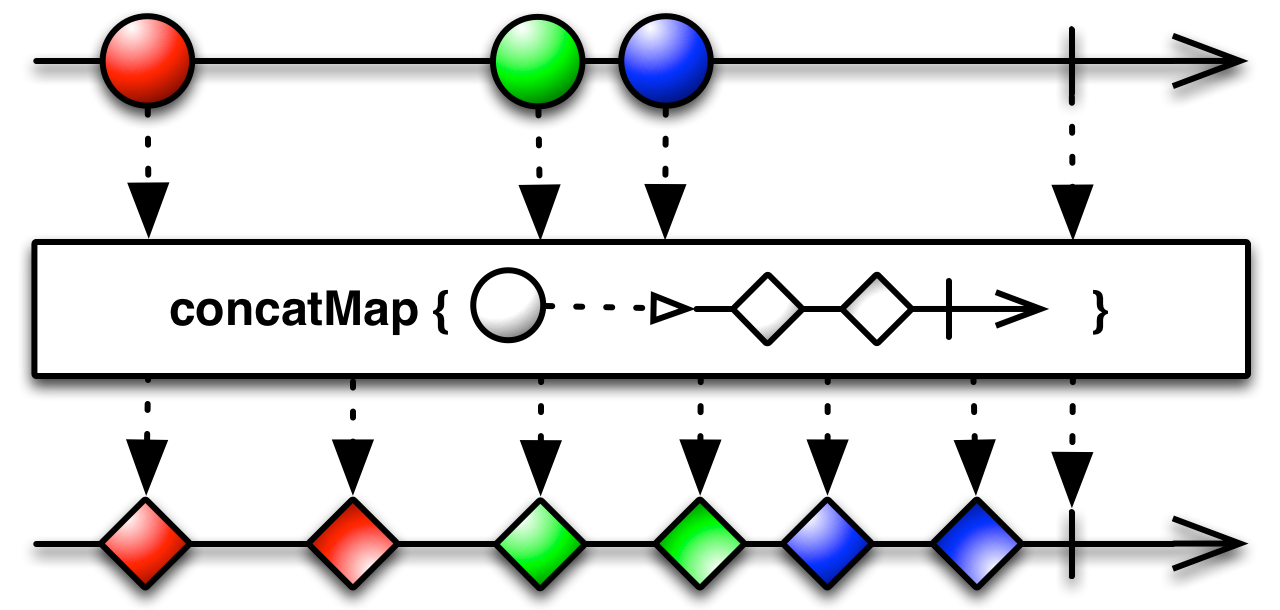
- Scheduler:
-
concatMapdoes not operate by default on a particularScheduler.
- Parameters:
-
func- a function that, when applied to an item emitted by the source Observable, returns an Observable - Returns:
- an Observable that emits the result of applying the transformation function to each item emitted by the source Observable and concatinating the Observables obtained from this transformation
- See Also:
- RxJava wiki: concatMap
concatWith
public final Observable
<T> concatWith(Observable <? extends T> t1) Returns an Observable that emits the items emitted from the current Observable, then the next, one after the other, without interleaving them. - Scheduler:
-
concatdoes not operate by default on a particularScheduler.
- Parameters:
-
t1- an Observable to be concatenated after the current - Returns:
- an Observable that emits items emitted by the two source Observables, one after the other, without interleaving them
- See Also:
- RxJava wiki: concat
contains
public final Observable
<Boolean > contains(Object element) Returns an Observable that emits a Boolean that indicates whether the source Observable emitted a specified item.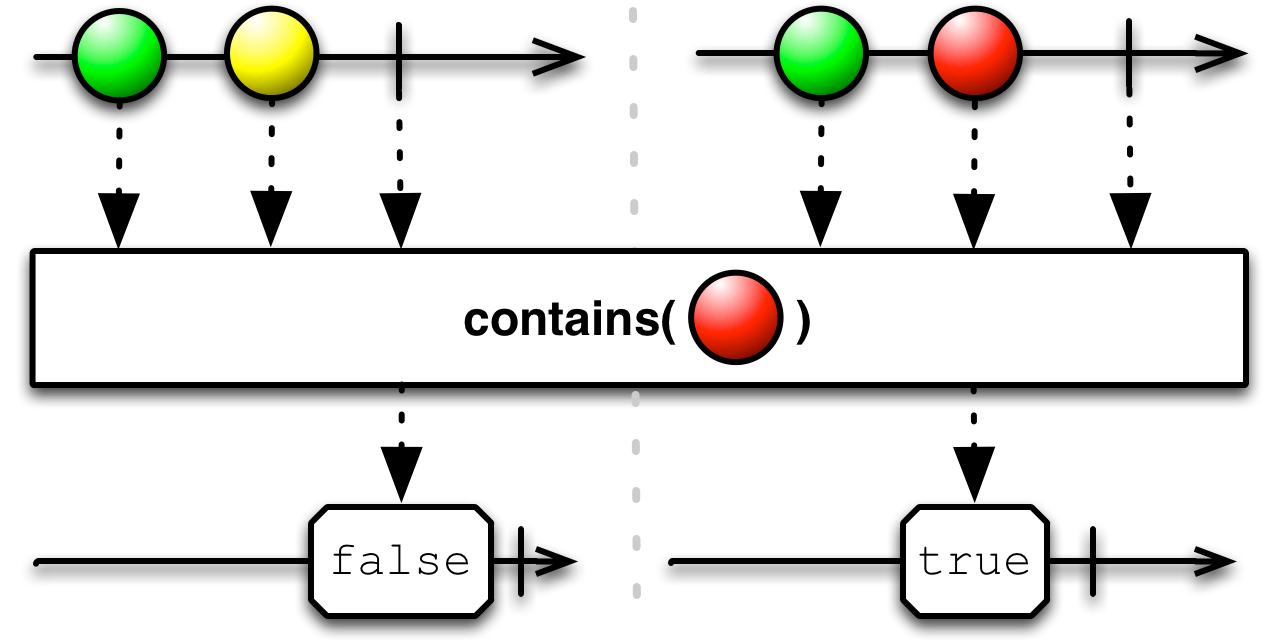
- Scheduler:
-
containsdoes not operate by default on a particularScheduler.
- Parameters:
-
element- the item to search for in the emissions from the source Observable - Returns:
-
an Observable that emits
trueif the specified item is emitted by the source Observable, orfalseif the source Observable completes without emitting that item - See Also:
- RxJava wiki: contains
count
public final Observable
<Integer > count() Returns an Observable that emits the count of the total number of items emitted by the source Observable.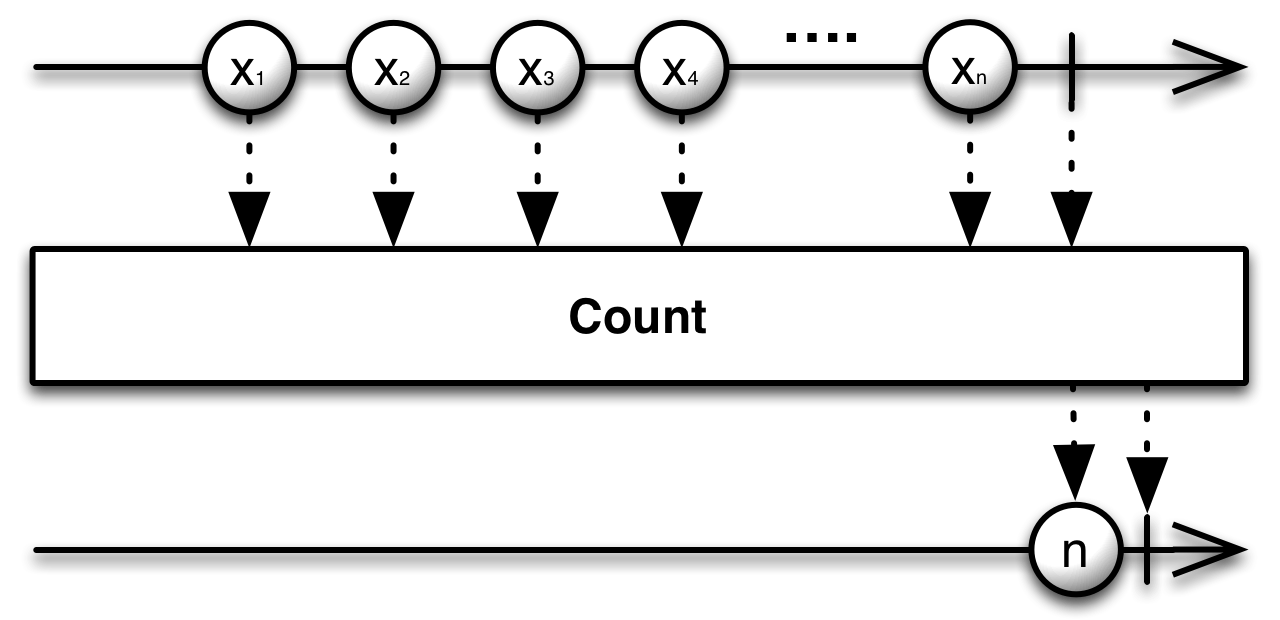
- Backpressure Support:
-
This operator does not support backpressure because by intent it will receive all values and reduce them to a single
onNext. - Scheduler:
-
countdoes not operate by default on a particularScheduler.
- Returns:
- an Observable that emits a single item: the number of elements emitted by the source Observable
- See Also:
-
RxJava wiki: count,
countLong()
countLong
public final Observable
<Long > countLong() Returns an Observable that counts the total number of items emitted by the source Observable and emits this count as a 64-bit Long.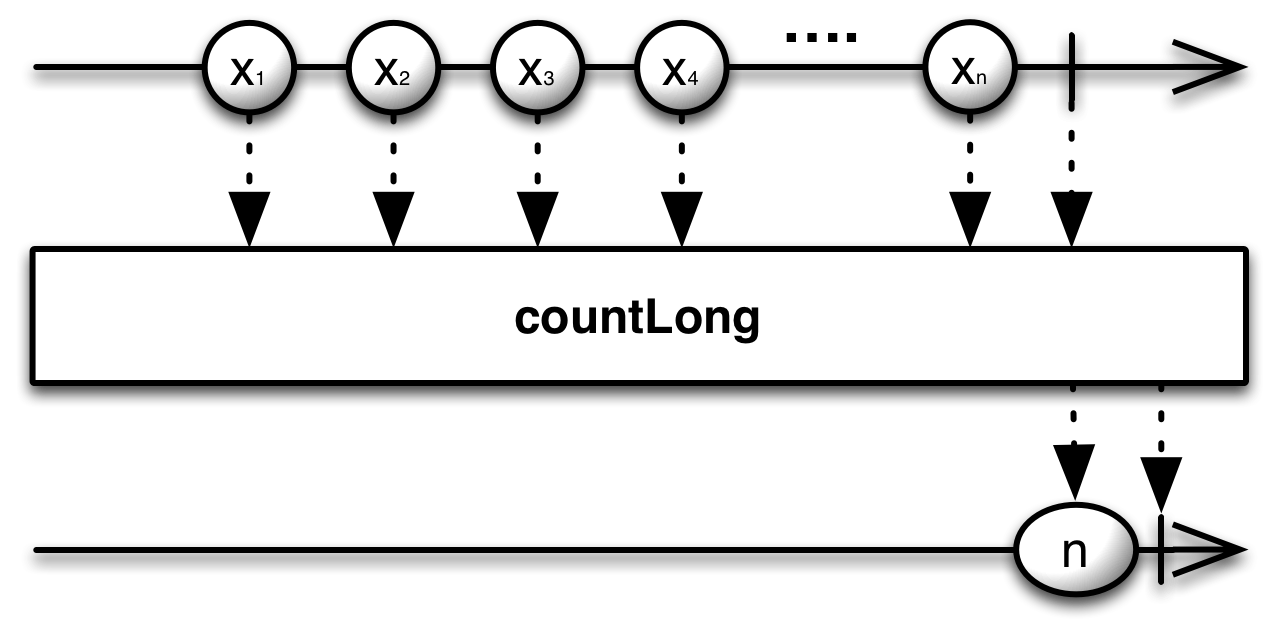
- Backpressure Support:
-
This operator does not support backpressure because by intent it will receive all values and reduce them to a single
onNext. - Scheduler:
-
countLongdoes not operate by default on a particularScheduler.
- Returns:
- an Observable that emits a single item: the number of items emitted by the source Observable as a 64-bit Long item
- See Also:
-
RxJava wiki: countLong,
count()
debounce
public final <U> Observable
<T> debounce(Func1 <? super T ,? extends Observable <U>> debounceSelector) Returns an Observable that mirrors the source Observable, except that it drops items emitted by the source Observable that are followed by another item within a computed debounce duration.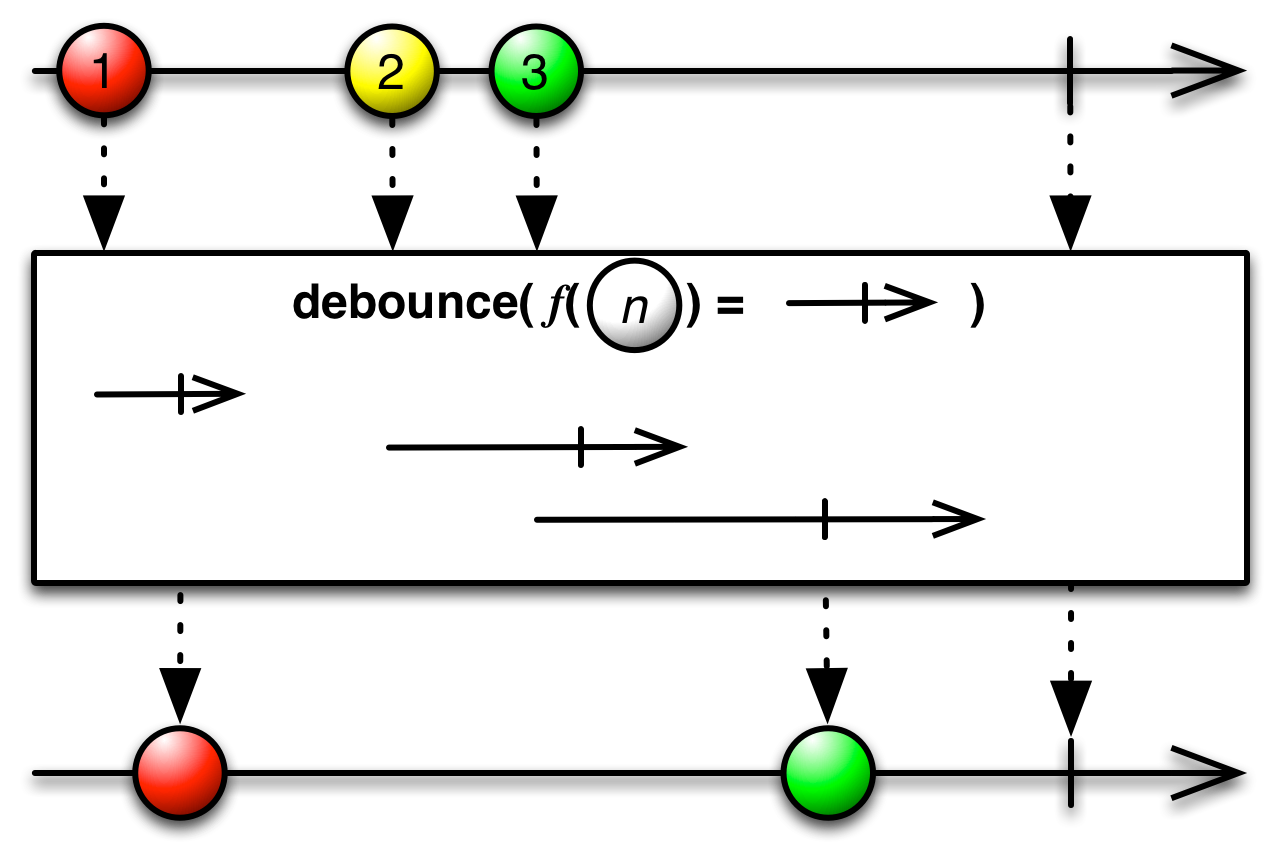
- Backpressure Support:
-
This operator does not support backpressure as it uses the
debounceSelectorto mark boundaries. - Scheduler:
-
This version of
debouncedoes not operate by default on a particularScheduler.
- Type Parameters:
-
U- the debounce value type (ignored) - Parameters:
-
debounceSelector- function to retrieve a sequence that indicates the throttle duration for each item - Returns:
- an Observable that omits items emitted by the source Observable that are followed by another item within a computed debounce duration
- See Also:
- RxJava wiki: debounce, RxJava wiki: Backpressure
debounce
public final Observable
<T> debounce(long timeout, TimeUnit unit) Returns an Observable that mirrors the source Observable, except that it drops items emitted by the source Observable that are followed by newer items before a timeout value expires. The timer resets on each emission.Note: If items keep being emitted by the source Observable faster than the timeout then no items will be emitted by the resulting Observable.
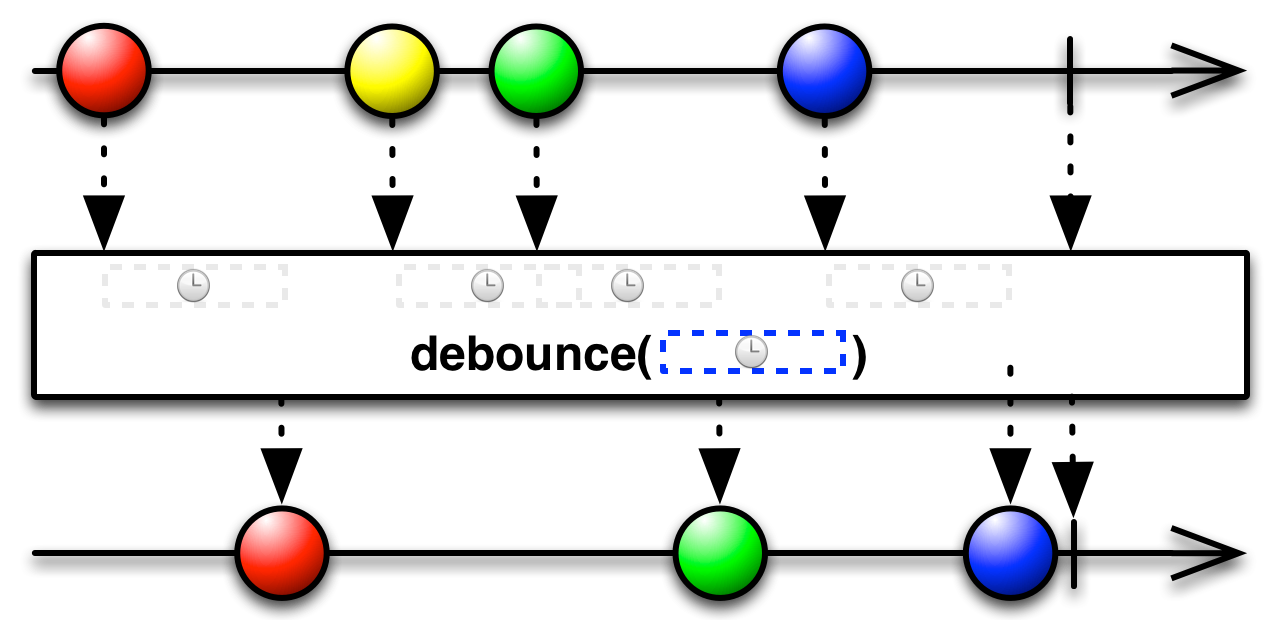
Information on debounce vs throttle:
- Debounce and Throttle: visual explanation
- Debouncing: javascript methods
- Javascript - don't spam your server: debounce and throttle
- Backpressure Support:
- This operator does not support backpressure as it uses time to control data flow.
- Scheduler:
-
This version of
debounceoperates by default on thecomputationScheduler.
- Parameters:
-
timeout- the time each item has to be "the most recent" of those emitted by the source Observable to ensure that it's not dropped -
unit- theTimeUnitfor the timeout - Returns:
- an Observable that filters out items from the source Observable that are too quickly followed by newer items
- See Also:
-
RxJava wiki: debounce,
RxJava wiki: Backpressure,
throttleWithTimeout(long, TimeUnit)
debounce
public final Observable
<T> debounce(long timeout, TimeUnit unit, Scheduler scheduler) Returns an Observable that mirrors the source Observable, except that it drops items emitted by the source Observable that are followed by newer items before a timeout value expires on a specified Scheduler. The timer resets on each emission.Note: If items keep being emitted by the source Observable faster than the timeout then no items will be emitted by the resulting Observable.
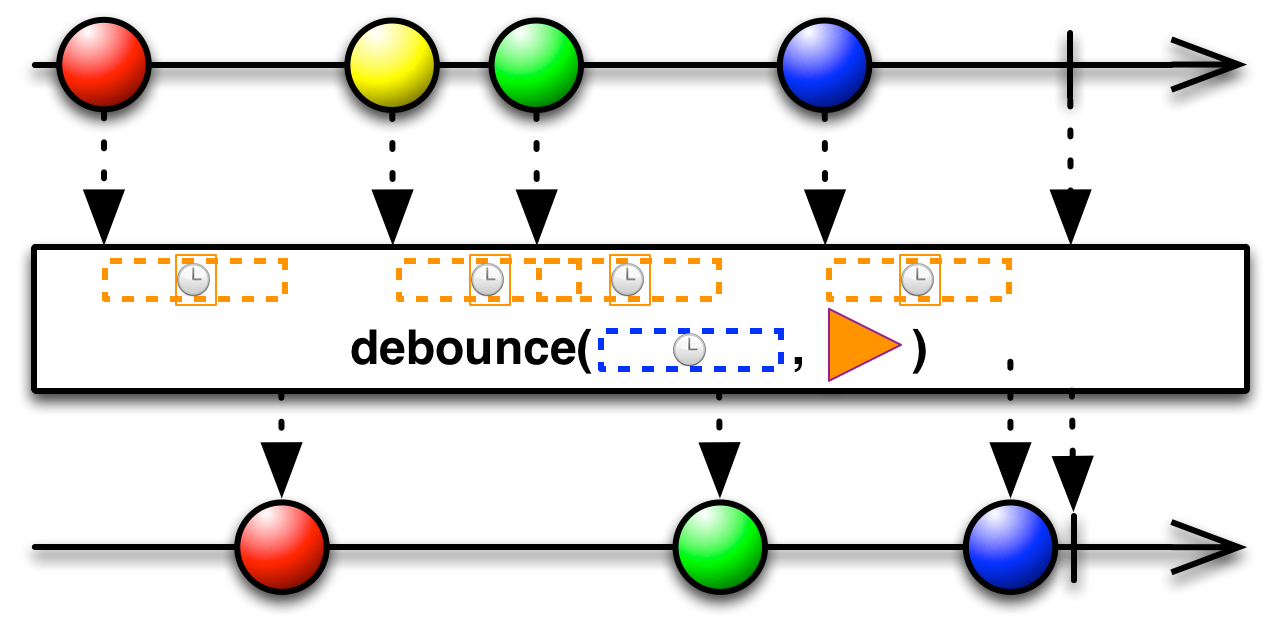
Information on debounce vs throttle:
- Debounce and Throttle: visual explanation
- Debouncing: javascript methods
- Javascript - don't spam your server: debounce and throttle
- Backpressure Support:
- This operator does not support backpressure as it uses time to control data flow.
- Scheduler:
-
you specify which
Schedulerthis operator will use
- Parameters:
-
timeout- the time each item has to be "the most recent" of those emitted by the source Observable to ensure that it's not dropped -
unit- the unit of time for the specified timeout -
scheduler- theSchedulerto use internally to manage the timers that handle the timeout for each item - Returns:
- an Observable that filters out items from the source Observable that are too quickly followed by newer items
- See Also:
-
RxJava wiki: debounce,
RxJava wiki: Backpressure,
throttleWithTimeout(long, TimeUnit, Scheduler)
defaultIfEmpty
public final Observable
<T> defaultIfEmpty(T defaultValue) Returns an Observable that emits the items emitted by the source Observable or a specified default item if the source Observable is empty.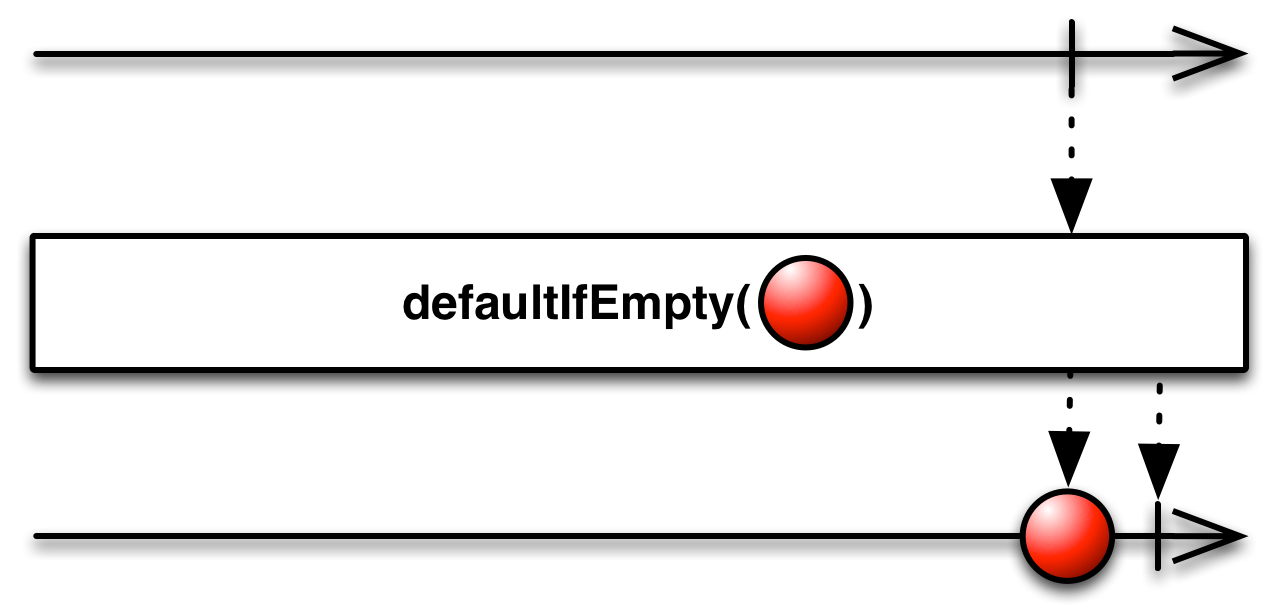
- Scheduler:
-
defaultIfEmptydoes not operate by default on a particularScheduler.
- Parameters:
-
defaultValue- the item to emit if the source Observable emits no items - Returns:
- an Observable that emits either the specified default item if the source Observable emits no items, or the items emitted by the source Observable
- See Also:
- RxJava wiki: defaultIfEmpty
delay
public final <U
,V> Observable <T> delay(Func0 <? extends Observable <U>> subscriptionDelay, Func1 <? super T ,? extends Observable <V>> itemDelay) Returns an Observable that delays the subscription to and emissions from the souce Observable via another Observable on a per-item basis.
Note: the resulting Observable will immediately propagate any
onErrornotification from the source Observable.- Scheduler:
-
This version of
delaydoes not operate by default on a particularScheduler.
- Type Parameters:
-
U- the subscription delay value type (ignored) -
V- the item delay value type (ignored) - Parameters:
-
subscriptionDelay- a function that returns an Observable that triggers the subscription to the source Observable once it emits any item -
itemDelay- a function that returns an Observable for each item emitted by the source Observable, which is then used to delay the emission of that item by the resulting Observable until the Observable returned fromitemDelayemits an item - Returns:
- an Observable that delays the subscription and emissions of the source Observable via another Observable on a per-item basis
- See Also:
- RxJava wiki: delay
delay
public final <U> Observable
<T> delay(Func1 <? super T ,? extends Observable <U>> itemDelay) Returns an Observable that delays the emissions of the source Observable via another Observable on a per-item basis.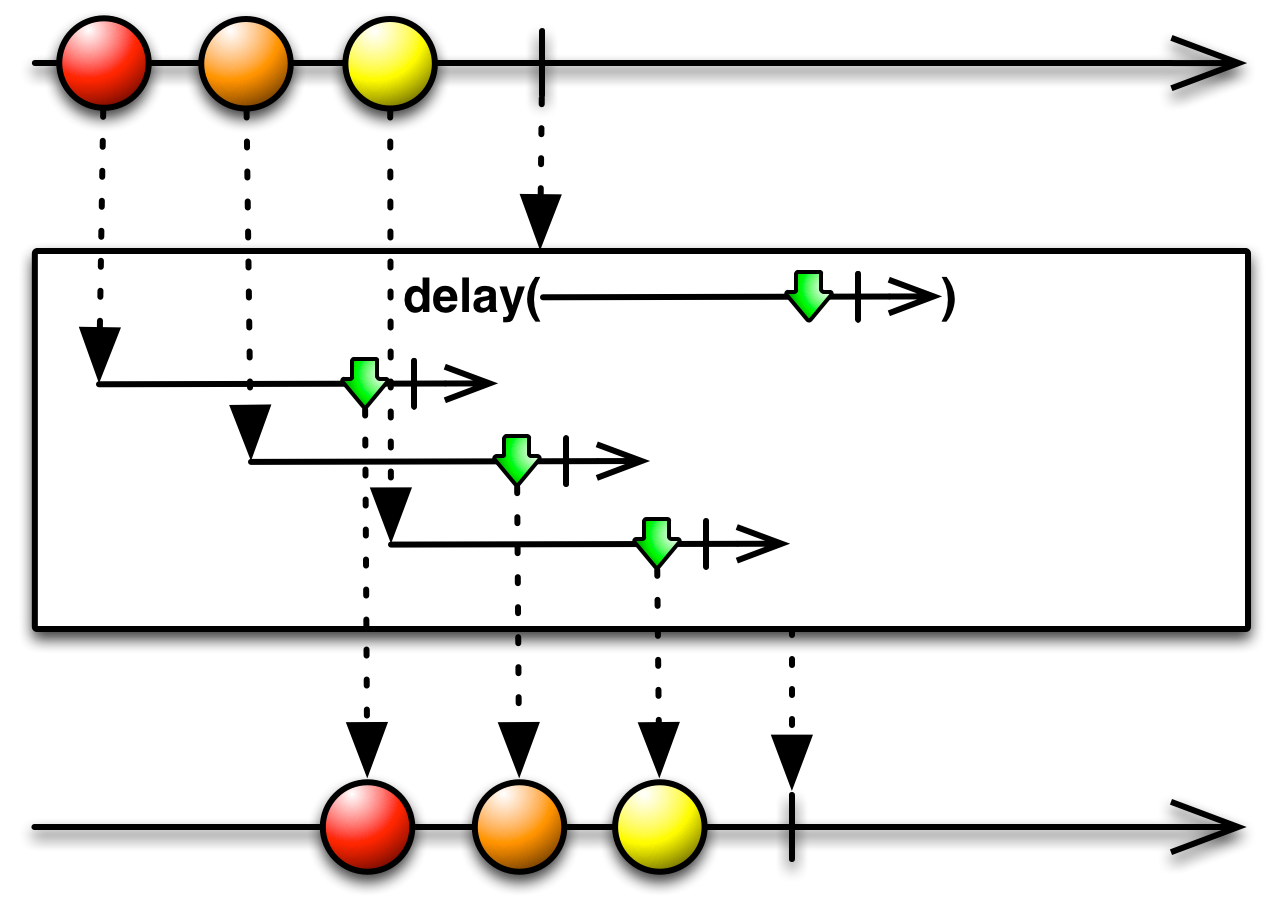
Note: the resulting Observable will immediately propagate any
onErrornotification from the source Observable.- Scheduler:
-
This version of
delaydoes not operate by default on a particularScheduler.
- Type Parameters:
-
U- the item delay value type (ignored) - Parameters:
-
itemDelay- a function that returns an Observable for each item emitted by the source Observable, which is then used to delay the emission of that item by the resulting Observable until the Observable returned fromitemDelayemits an item - Returns:
- an Observable that delays the emissions of the source Observable via another Observable on a per-item basis
- See Also:
- RxJava wiki: delay
delay
public final Observable
<T> delay(long delay, TimeUnit unit) Returns an Observable that emits the items emitted by the source Observable shifted forward in time by a specified delay. Error notifications from the source Observable are not delayed.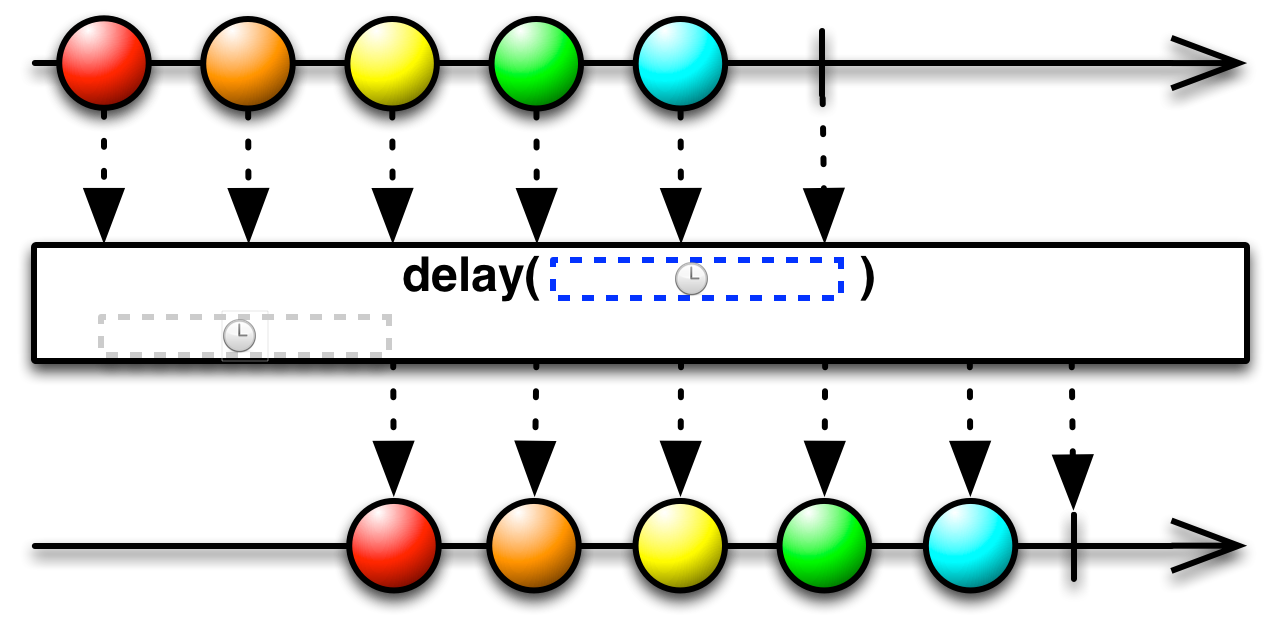
- Scheduler:
-
This version of
delayoperates by default on thecompuationScheduler.
- Parameters:
-
delay- the delay to shift the source by -
unit- theTimeUnitin whichperiodis defined - Returns:
- the source Observable shifted in time by the specified delay
- See Also:
- RxJava wiki: delay
delay
public final Observable
<T> delay(long delay, TimeUnit unit, Scheduler scheduler) Returns an Observable that emits the items emitted by the source Observable shifted forward in time by a specified delay. Error notifications from the source Observable are not delayed.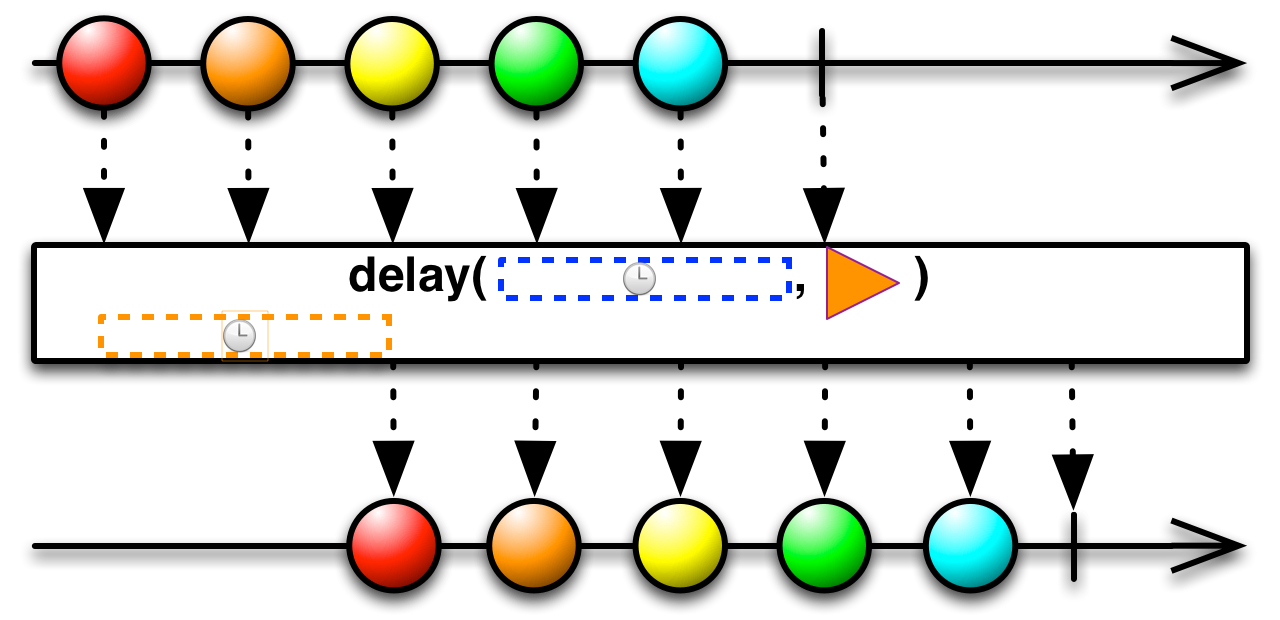
- Scheduler:
-
you specify which
Schedulerthis operator will use
- Parameters:
-
delay- the delay to shift the source by -
unit- the time unit ofdelay -
scheduler- theSchedulerto use for delaying - Returns:
- the source Observable shifted in time by the specified delay
- See Also:
- RxJava wiki: delay
delaySubscription
public final Observable
<T> delaySubscription(long delay, TimeUnit unit) Returns an Observable that delays the subscription to the source Observable by a given amount of time.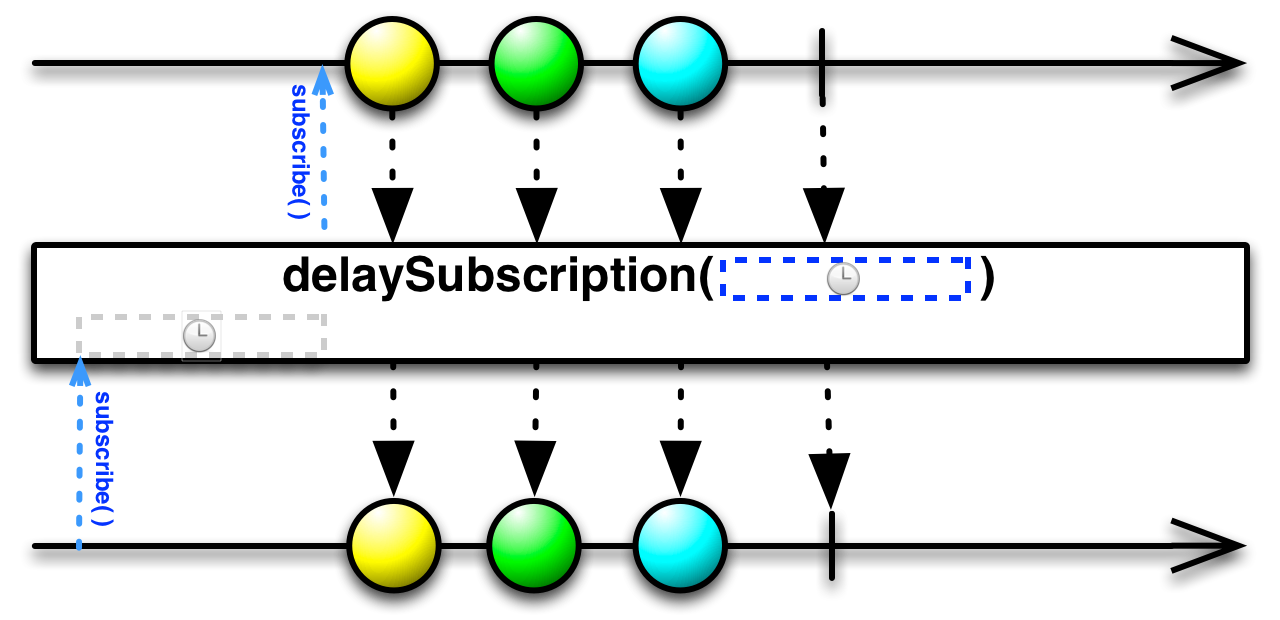
- Scheduler:
-
This version of
delayoperates by default on thecompuationScheduler.
- Parameters:
-
delay- the time to delay the subscription -
unit- the time unit ofdelay - Returns:
- an Observable that delays the subscription to the source Observable by the given amount
- See Also:
- RxJava wiki: delaySubscription
delaySubscription
public final Observable
<T> delaySubscription(long delay, TimeUnit unit, Scheduler scheduler) Returns an Observable that delays the subscription to the source Observable by a given amount of time, both waiting and subscribing on a given Scheduler.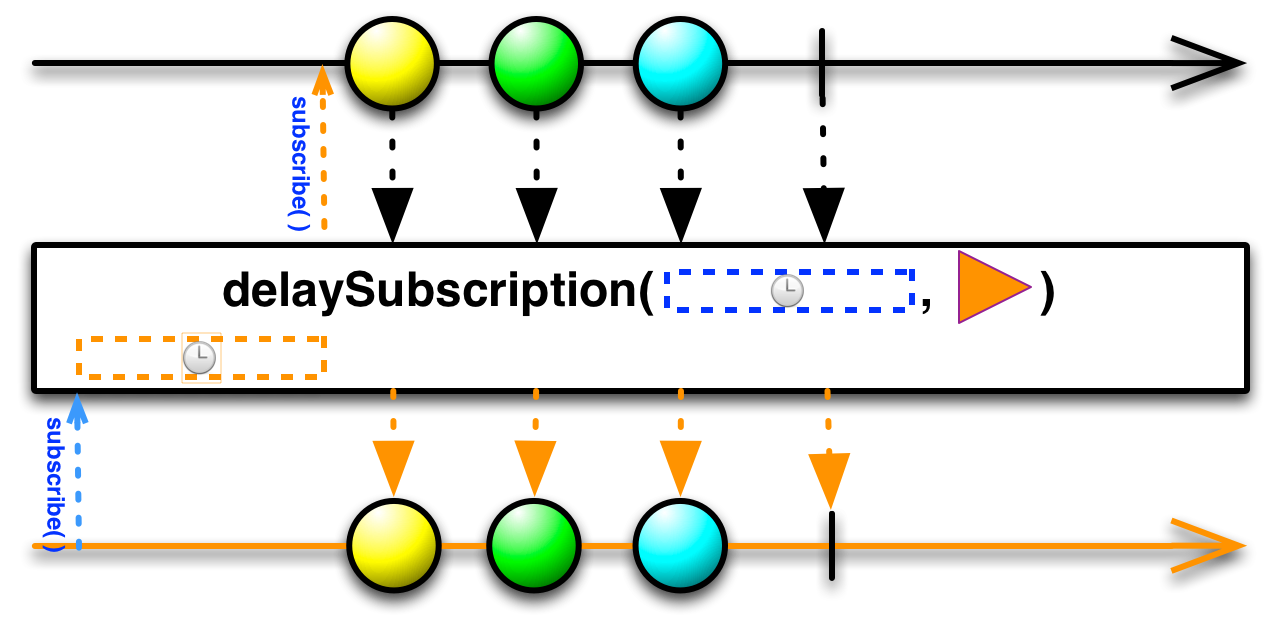
- Scheduler:
-
you specify which
Schedulerthis operator will use
- Parameters:
-
delay- the time to delay the subscription -
unit- the time unit ofdelay -
scheduler- the Scheduler on which the waiting and subscription will happen - Returns:
- an Observable that delays the subscription to the source Observable by a given amount, waiting and subscribing on the given Scheduler
- See Also:
- RxJava wiki: delaySubscription
delaySubscription
public final <U> Observable
<T> delaySubscription(Func0 <? extends Observable <U>> subscriptionDelay) Returns an Observable that delays the subscription to the source Observable until a second Observable emits an item.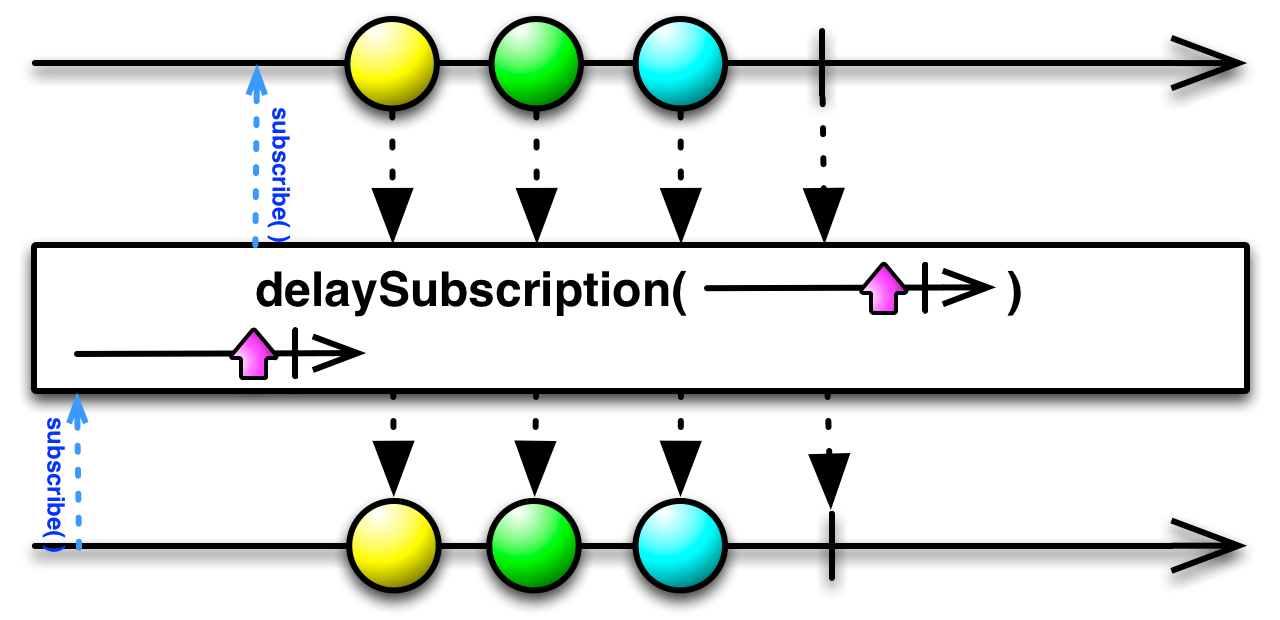
- Scheduler:
-
This version of
delayoperates by default on thecompuationScheduler.
- Parameters:
-
subscriptionDelay- a function that returns an Observable that triggers the subscription to the source Observable once it emits any item - Returns:
-
an Observable that delays the subscription to the source Observable until the Observable returned by
subscriptionDelayemits an item - See Also:
- RxJava wiki: delaySubscription
dematerialize
public final <T2> Observable
<T2> dematerialize() Returns an Observable that reverses the effect ofmaterializeby transforming theNotificationobjects emitted by the source Observable into the items or notifications they represent.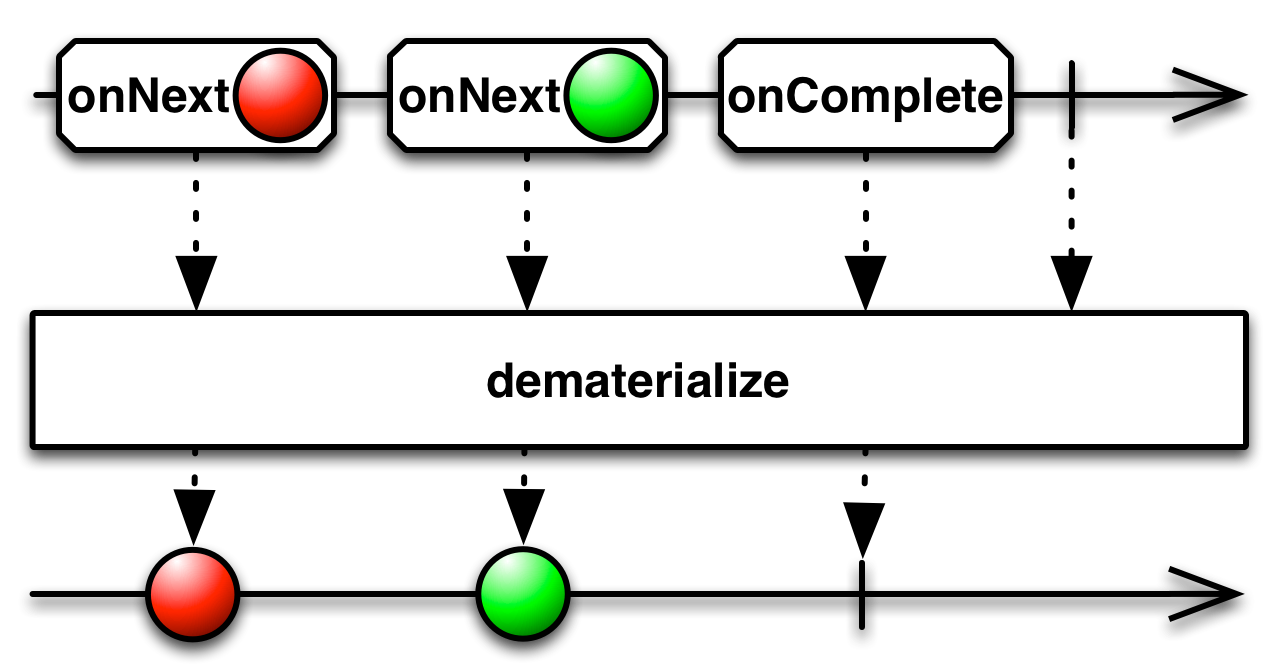
- Scheduler:
-
dematerializedoes not operate by default on a particularScheduler.
- Returns:
-
an Observable that emits the items and notifications embedded in the
Notificationobjects emitted by the source Observable - Throws:
-
OnErrorNotImplementedException- if the source Observable is not of typeObservable<Notification<T>> - See Also:
- RxJava wiki: dematerialize
distinct
public final Observable
<T> distinct() Returns an Observable that emits all items emitted by the source Observable that are distinct.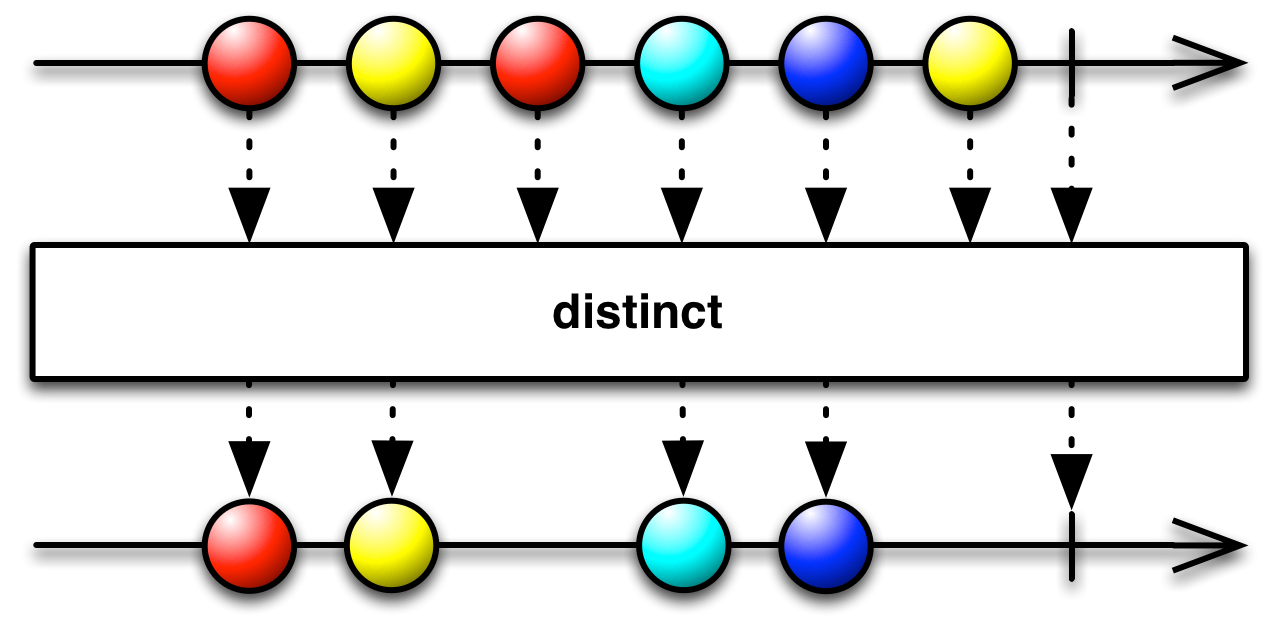
- Scheduler:
-
distinctdoes not operate by default on a particularScheduler.
- Returns:
- an Observable that emits only those items emitted by the source Observable that are distinct from each other
- See Also:
- RxJava wiki: distinct
distinct
public final <U> Observable
<T> distinct(Func1 <? super T ,? extends U> keySelector) Returns an Observable that emits all items emitted by the source Observable that are distinct according to a key selector function.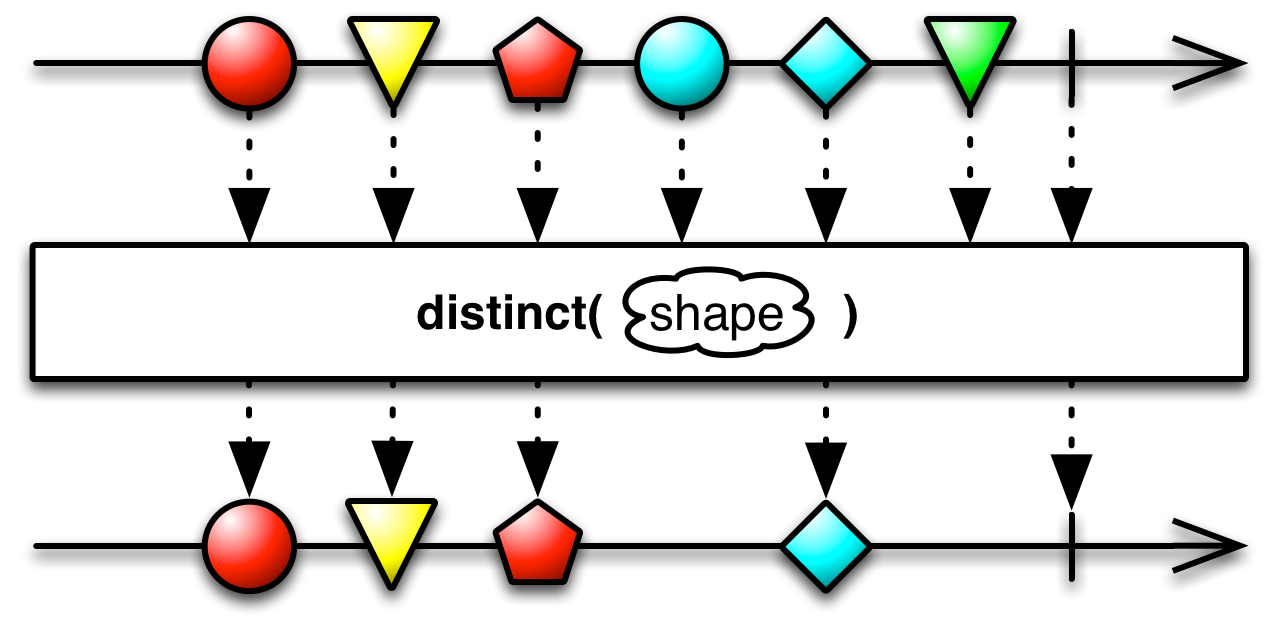
- Scheduler:
-
distinctdoes not operate by default on a particularScheduler.
- Parameters:
-
keySelector- a function that projects an emitted item to a key value that is used to decide whether an item is distinct from another one or not - Returns:
- an Observable that emits those items emitted by the source Observable that have distinct keys
- See Also:
- RxJava wiki: distinct
distinctUntilChanged
public final Observable
<T> distinctUntilChanged() Returns an Observable that emits all items emitted by the source Observable that are distinct from their immediate predecessors.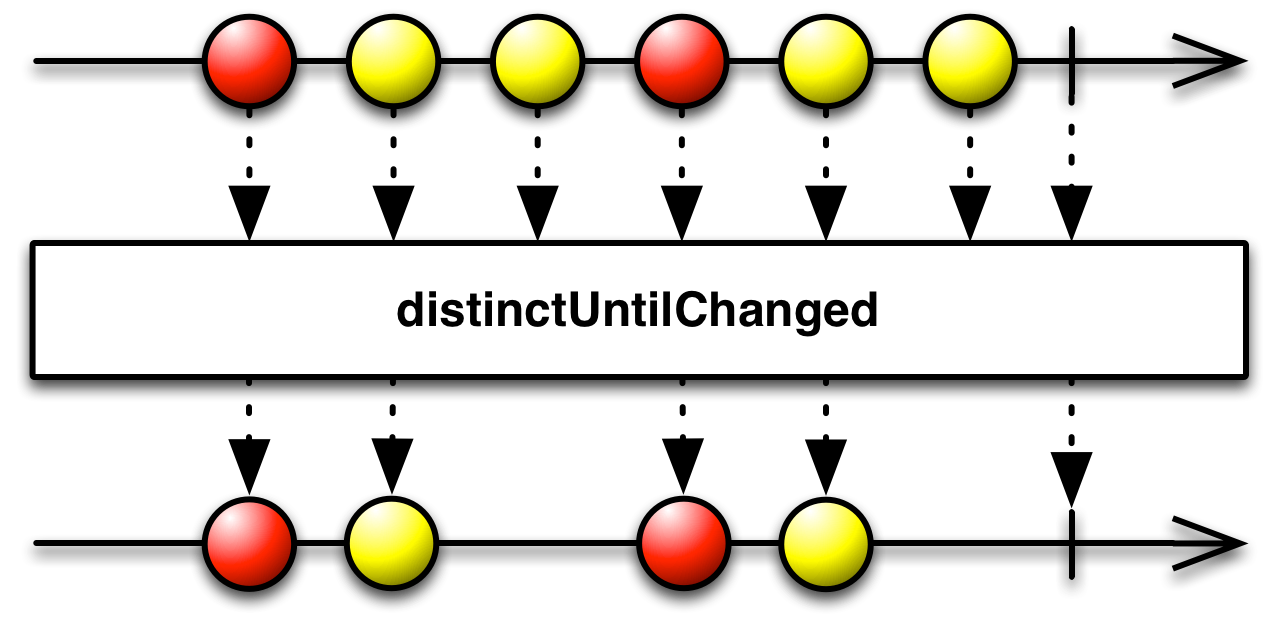
- Scheduler:
-
distinctUntilChangeddoes not operate by default on a particularScheduler.
- Returns:
- an Observable that emits those items from the source Observable that are distinct from their immediate predecessors
- See Also:
- RxJava wiki: distinctUntilChanged
distinctUntilChanged
public final <U> Observable
<T> distinctUntilChanged(Func1 <? super T ,? extends U> keySelector) Returns an Observable that emits all items emitted by the source Observable that are distinct from their immediate predecessors, according to a key selector function.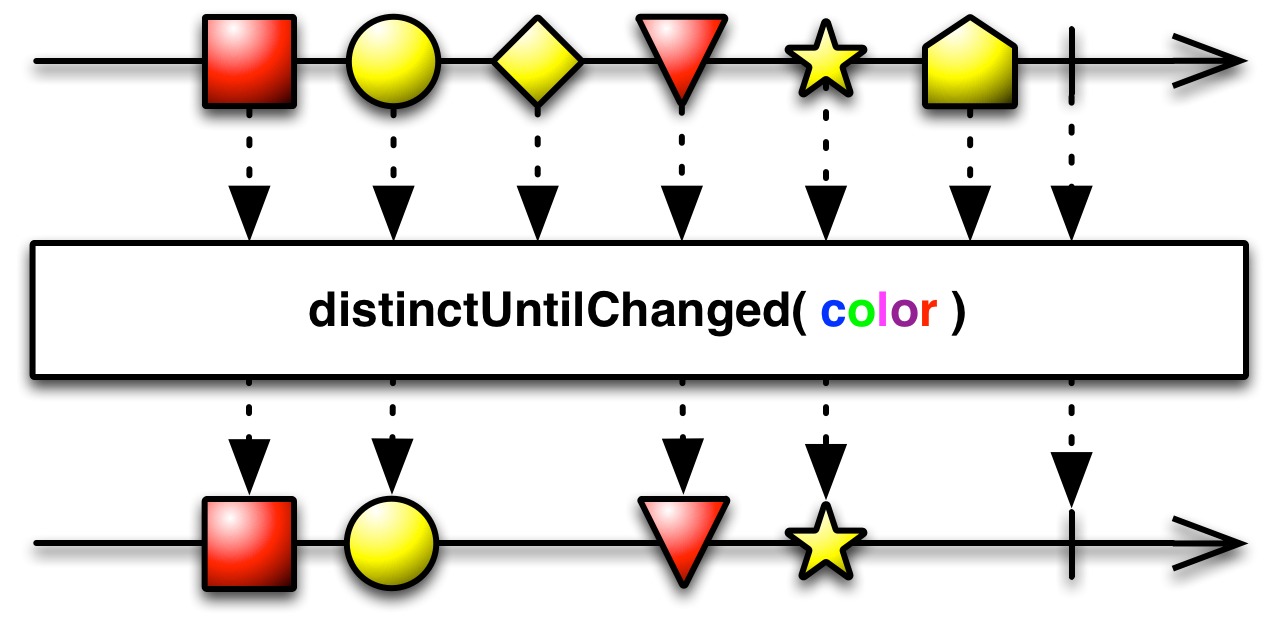
- Scheduler:
-
distinctUntilChangeddoes not operate by default on a particularScheduler.
- Parameters:
-
keySelector- a function that projects an emitted item to a key value that is used to decide whether an item is distinct from another one or not - Returns:
- an Observable that emits those items from the source Observable whose keys are distinct from those of their immediate predecessors
- See Also:
- RxJava wiki: distinctUntilChanged
doOnCompleted
public final Observable
<T> doOnCompleted(Action0 onCompleted) Modifies the source Observable so that it invokes an action when it callsonCompleted.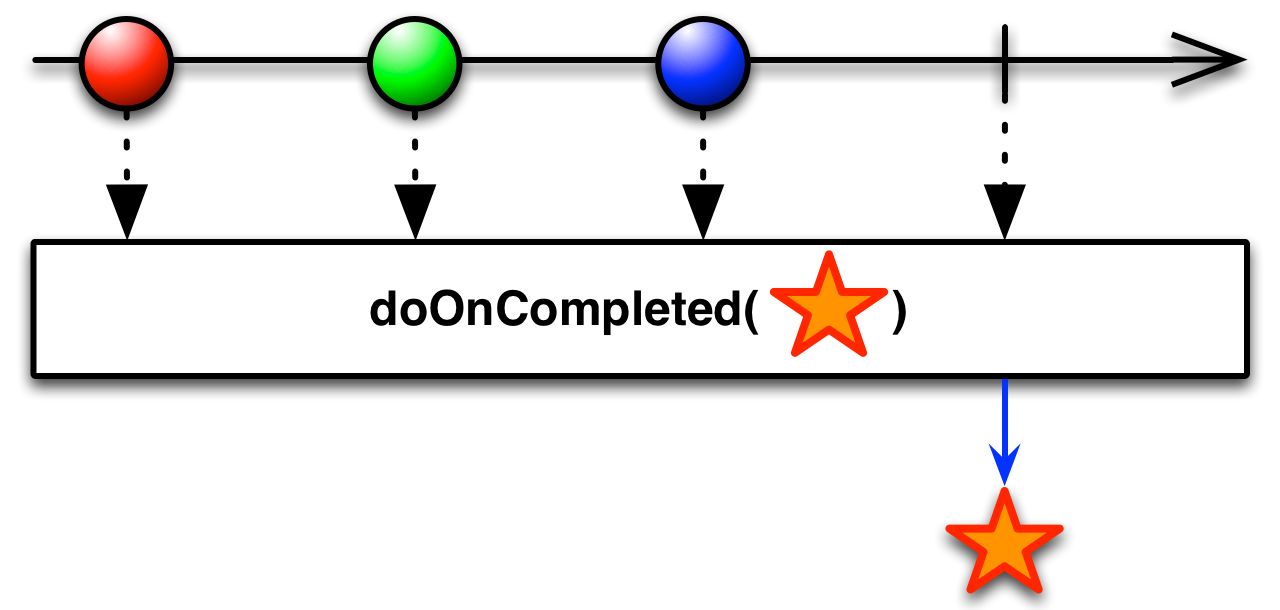
- Scheduler:
-
doOnCompleteddoes not operate by default on a particularScheduler.
- Parameters:
-
onCompleted- the action to invoke when the source Observable callsonCompleted - Returns:
- the source Observable with the side-effecting behavior applied
- See Also:
- RxJava wiki: doOnCompleted
doOnEach
public final Observable
<T> doOnEach(Action1 <Notification <? super T>> onNotification) Modifies the source Observable so that it invokes an action for each item it emits.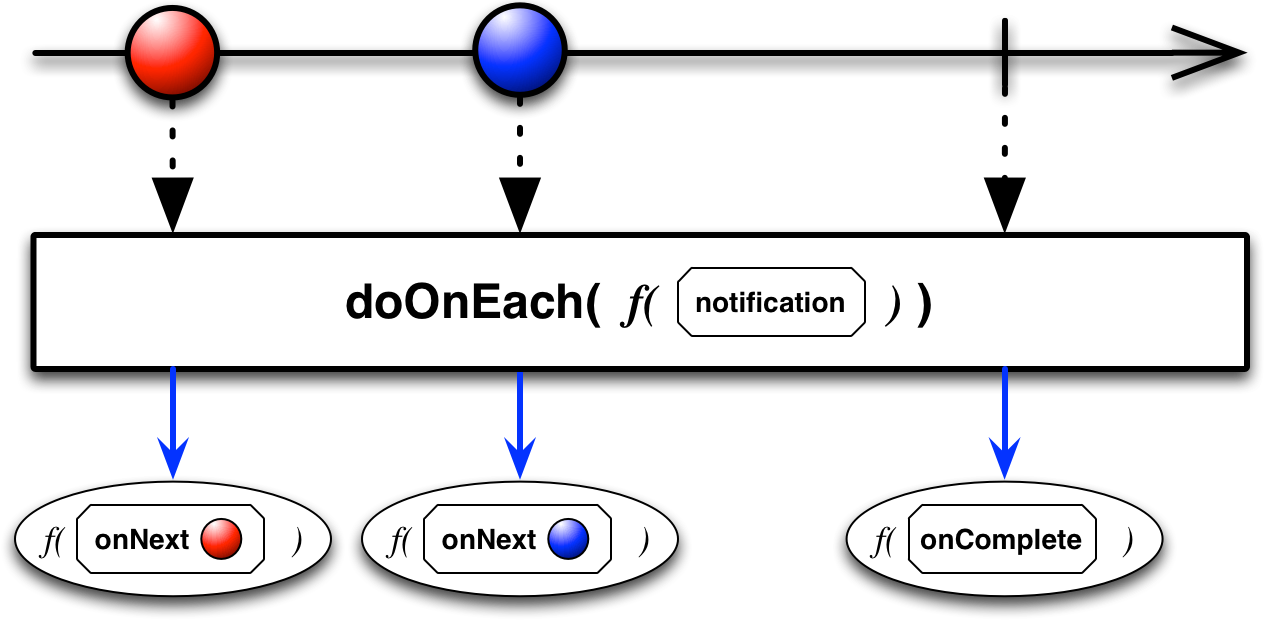
- Scheduler:
-
doOnEachdoes not operate by default on a particularScheduler.
- Parameters:
-
onNotification- the action to invoke for each item emitted by the source Observable - Returns:
- the source Observable with the side-effecting behavior applied
- See Also:
- RxJava wiki: doOnEach
doOnEach
public final Observable
<T> doOnEach(Observer <? super T> observer) Modifies the source Observable so that it notifies an Observer for each item it emits. - Scheduler:
-
doOnEachdoes not operate by default on a particularScheduler.
- Parameters:
-
observer- the action to invoke for each item emitted by the source Observable - Returns:
- the source Observable with the side-effecting behavior applied
- See Also:
- RxJava wiki: doOnEach
doOnError
public final Observable
<T> doOnError(Action1 <Throwable > onError) Modifies the source Observable so that it invokes an action if it callsonError.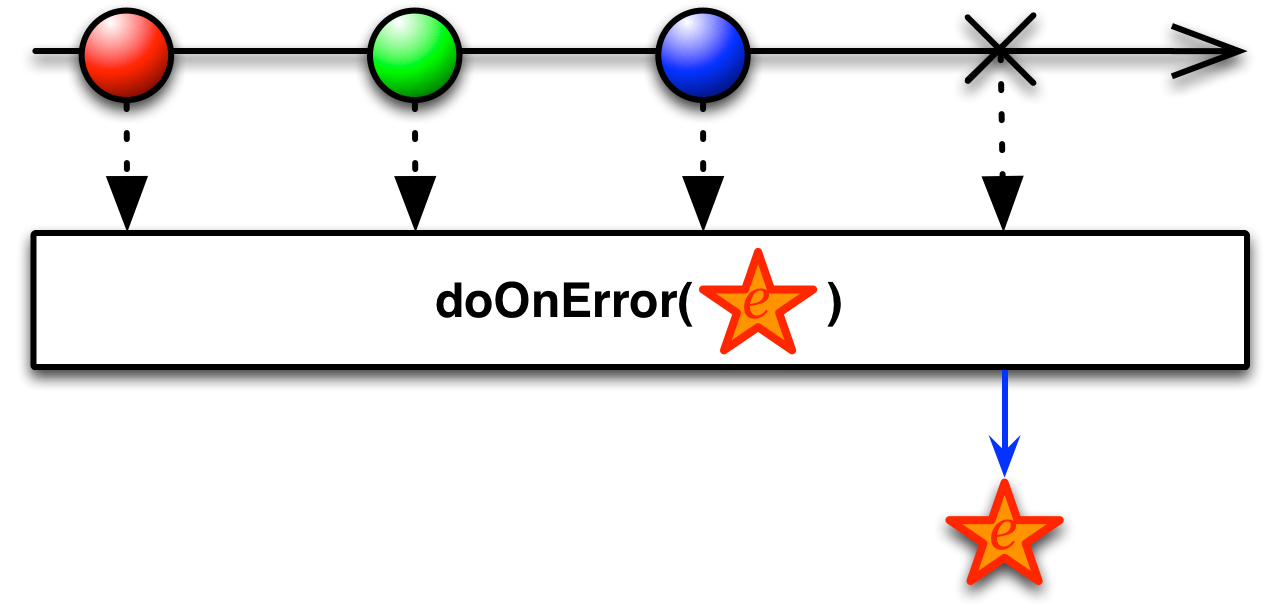
- Scheduler:
-
doOnErrordoes not operate by default on a particularScheduler.
- Parameters:
-
onError- the action to invoke if the source Observable callsonError - Returns:
- the source Observable with the side-effecting behavior applied
- See Also:
- RxJava wiki: doOnError
doOnNext
public final Observable
<T> doOnNext(Action1 <? super T> onNext) Modifies the source Observable so that it invokes an action when it callsonNext.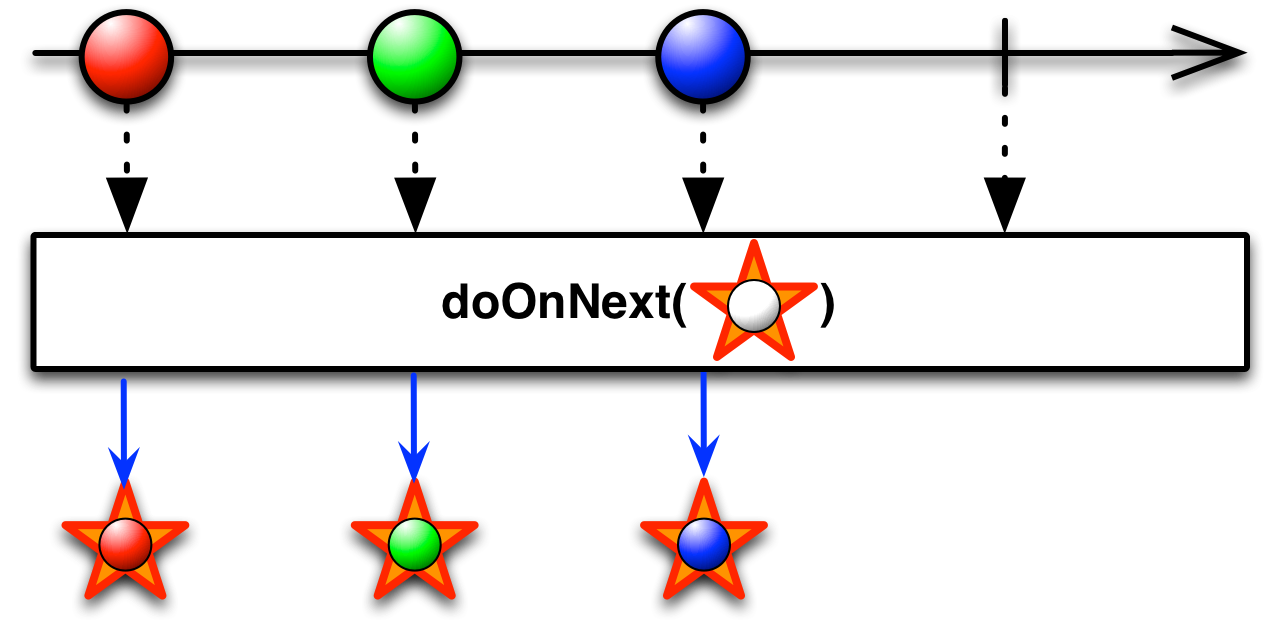
- Scheduler:
-
doOnNextdoes not operate by default on a particularScheduler.
- Parameters:
-
onNext- the action to invoke when the source Observable callsonNext - Returns:
- the source Observable with the side-effecting behavior applied
- See Also:
- RxJava wiki: doOnEach
doOnSubscribe
public final Observable
<T> doOnSubscribe(Action0 subscribe) Modifies the sourceObservableso that it invokes the given action when it is subscribed from its subscribers. Each subscription will result in an invocation of the given action except when the sourceObservableis reference counted, in which case the sourceObservablewill invoke the given action for the first subscription.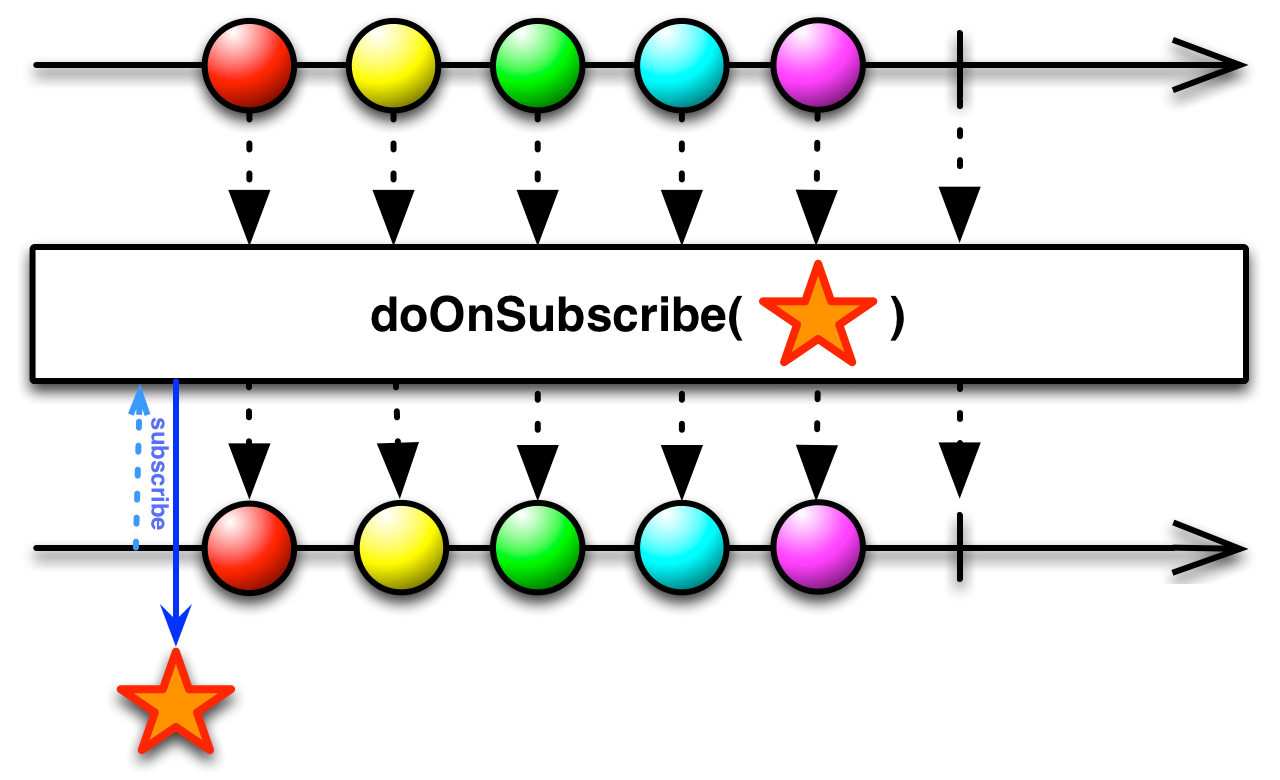
- Scheduler:
-
doOnSubscribedoes not operate by default on a particularScheduler.
- Parameters:
-
subscribe- the action that gets called when an observer subscribes to thisObservable - Returns:
-
the source
Observablemodified so as to call this Action when appropriate - See Also:
- RxJava wiki: doOnSubscribe
doOnTerminate
public final Observable
<T> doOnTerminate(Action0 onTerminate) Modifies the source Observable so that it invokes an action when it callsonCompletedoronError.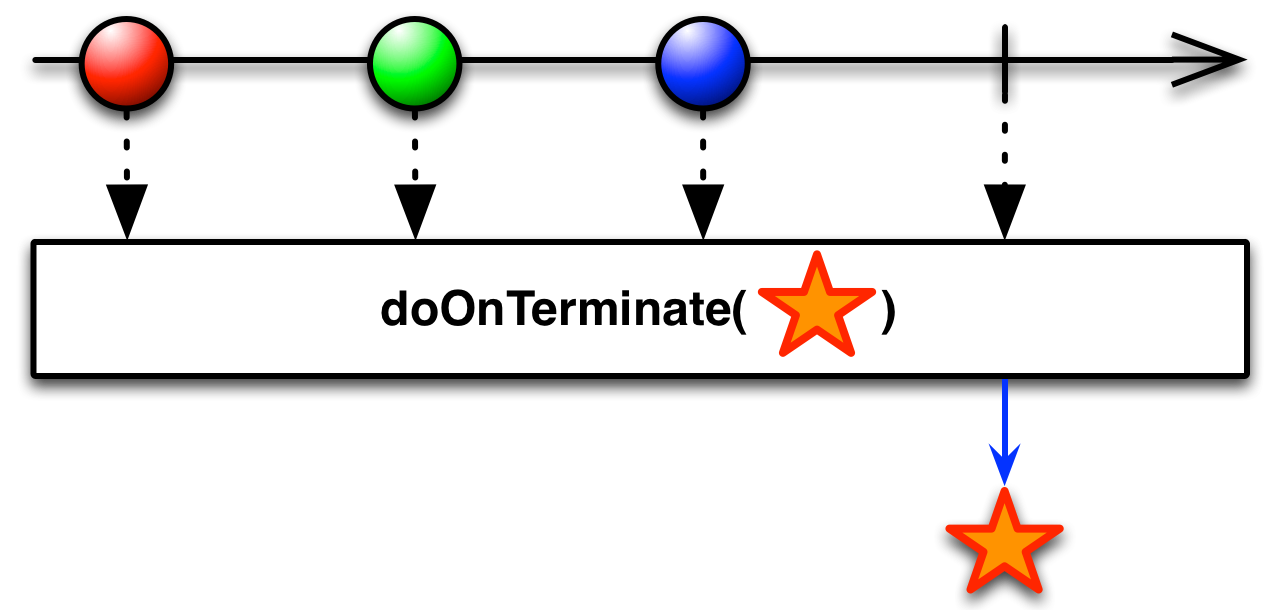
This differs from
finallyDoin that this happens before theonCompletedoronErrornotification.- Scheduler:
-
doOnTerminatedoes not operate by default on a particularScheduler.
- Parameters:
-
onTerminate- the action to invoke when the source Observable callsonCompletedoronError - Returns:
- the source Observable with the side-effecting behavior applied
- See Also:
-
RxJava wiki: doOnTerminate,
finallyDo(Action0)
doOnUnsubscribe
public final Observable
<T> doOnUnsubscribe(Action0 unsubscribe) Modifies the sourceObservableso that it invokes the given action when it is unsubscribed from its subscribers. Each un-subscription will result in an invocation of the given action except when the sourceObservableis reference counted, in which case the sourceObservablewill invoke the given action for the very last un-subscription.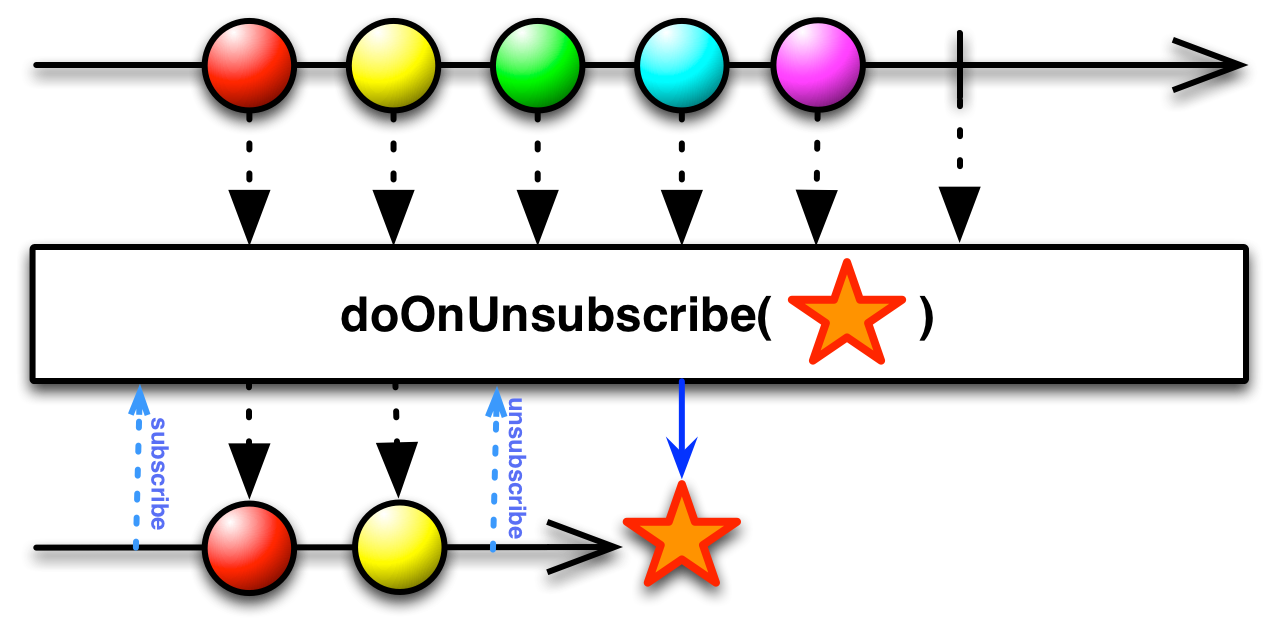
- Scheduler:
-
doOnUnsubscribedoes not operate by default on a particularScheduler.
- Parameters:
-
unsubscribe- the action that gets called when thisObservableis unsubscribed - Returns:
-
the source
Observablemodified so as to call this Action when appropriate - See Also:
- RxJava wiki: doOnUnsubscribe
elementAt
public final Observable
<T> elementAt(int index) Returns an Observable that emits the single item at a specified index in a sequence of emissions from a source Observbable.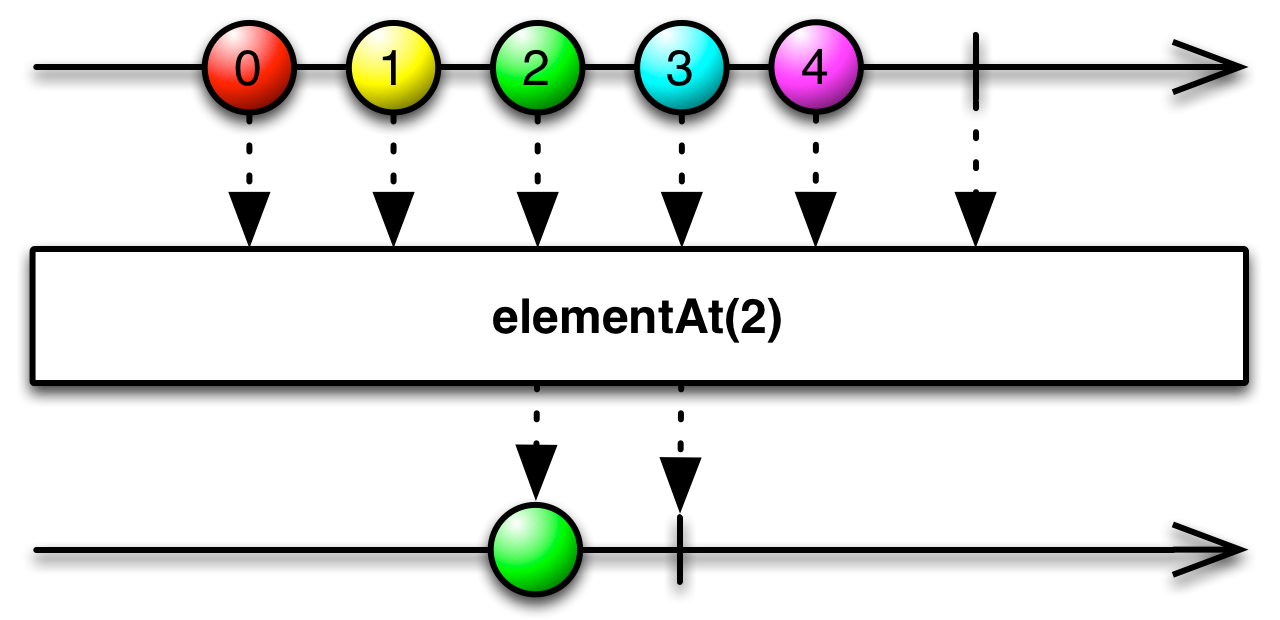
- Scheduler:
-
elementAtdoes not operate by default on a particularScheduler.
- Parameters:
-
index- the zero-based index of the item to retrieve - Returns:
- an Observable that emits a single item: the item at the specified position in the sequence of those emitted by the source Observable
- Throws:
-
IndexOutOfBoundsException- ifindexis greater than or equal to the number of items emitted by the source Observable, or ifindexis less than 0 - See Also:
- RxJava wiki: elementAt
elementAtOrDefault
public final Observable
<T> elementAtOrDefault(int index, T defaultValue) Returns an Observable that emits the item found at a specified index in a sequence of emissions from a source Observable, or a default item if that index is out of range.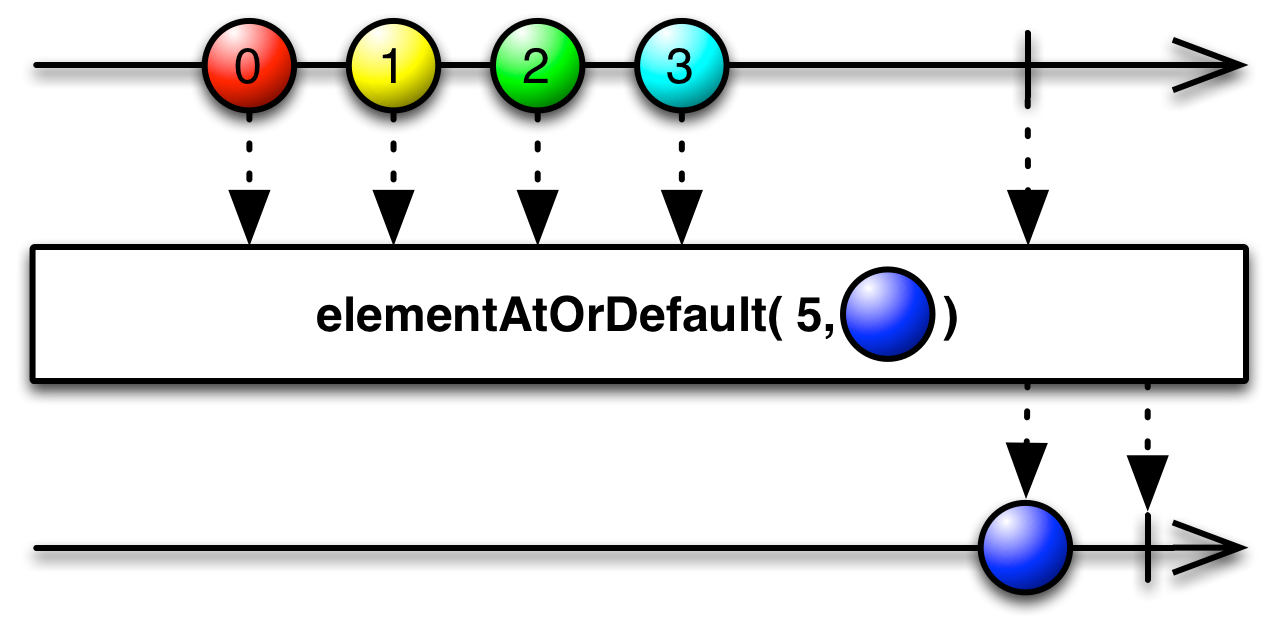
- Scheduler:
-
elementAtOrDefaultdoes not operate by default on a particularScheduler.
- Parameters:
-
index- the zero-based index of the item to retrieve -
defaultValue- the default item - Returns:
- an Observable that emits the item at the specified position in the sequence emitted by the source Observable, or the default item if that index is outside the bounds of the source sequence
- Throws:
-
IndexOutOfBoundsException- ifindexis less than 0 - See Also:
- RxJava wiki: elementAtOrDefault
exists
public final Observable
<Boolean > exists(Func1 <? super T ,Boolean > predicate) Returns an Observable that emitstrueif any item emitted by the source Observable satisfies a specified condition, otherwisefalse. Note: this always emitsfalseif the source Observable is empty.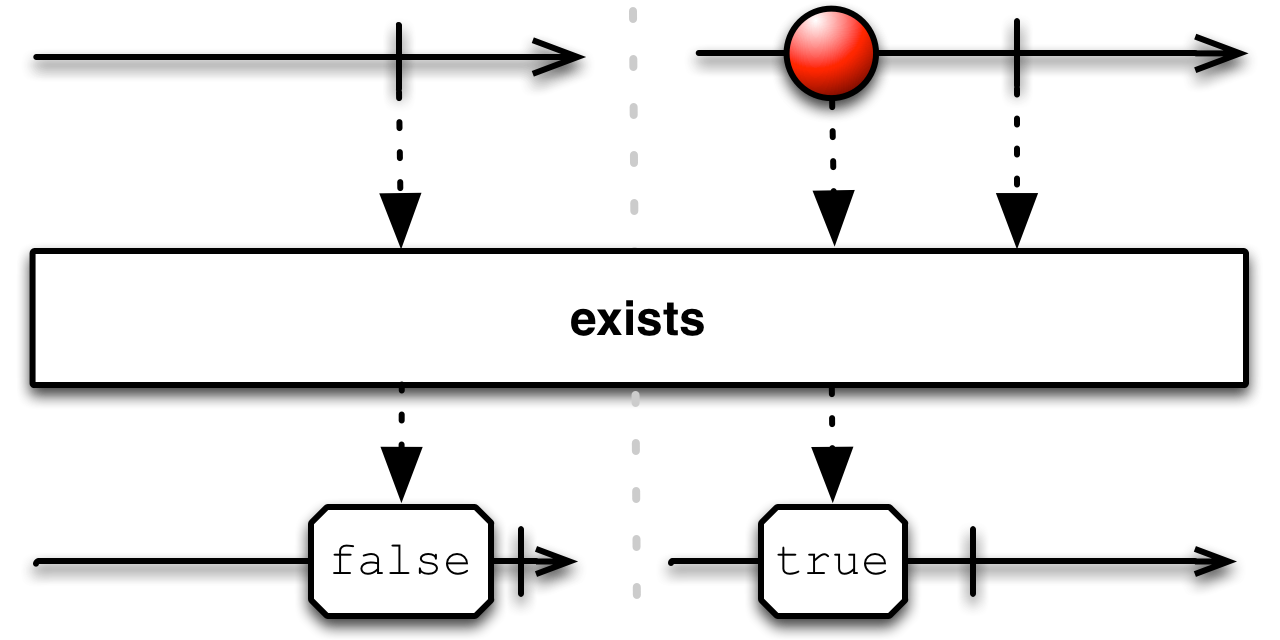
In Rx.Net this is the
anyObserver but we renamed it in RxJava to better match Java naming idioms.- Scheduler:
-
existsdoes not operate by default on a particularScheduler.
- Parameters:
-
predicate- the condition to test items emitted by the source Observable - Returns:
-
an Observable that emits a Boolean that indicates whether any item emitted by the source Observable satisfies the
predicate - See Also:
- RxJava wiki: exists
filter
public final Observable
<T> filter(Func1 <? super T ,Boolean > predicate) Filters items emitted by an Observable by only emitting those that satisfy a specified predicate.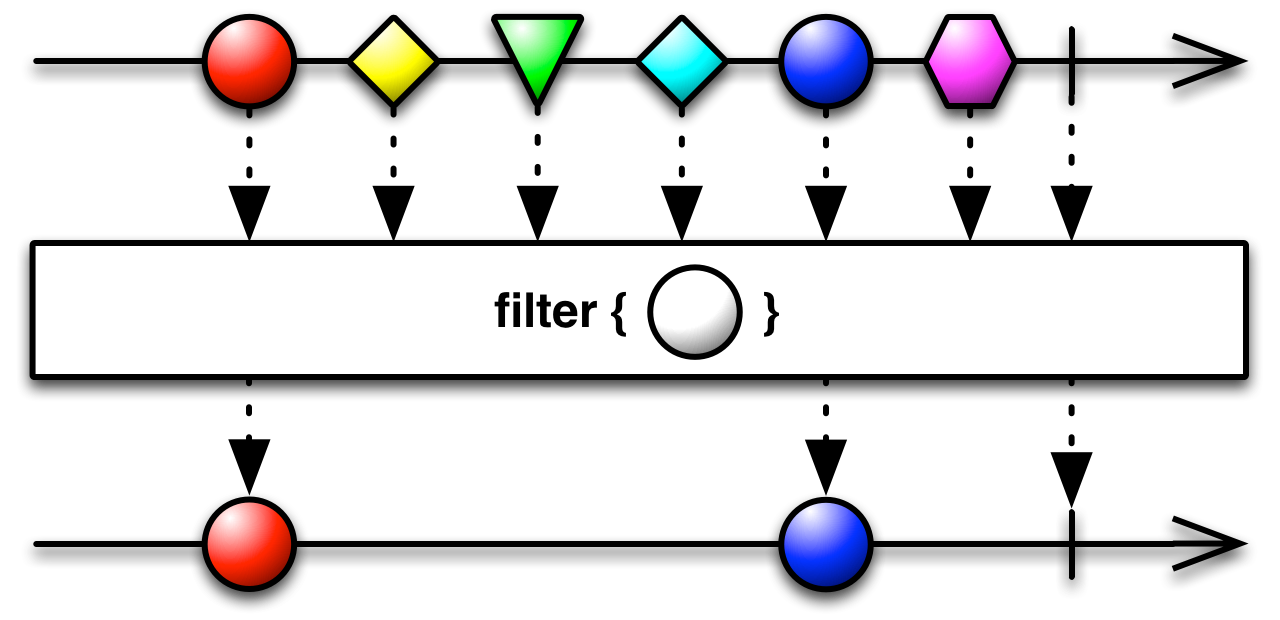
- Scheduler:
-
filterdoes not operate by default on a particularScheduler.
- Parameters:
-
predicate- a function that evaluates each item emitted by the source Observable, returningtrueif it passes the filter - Returns:
-
an Observable that emits only those items emitted by the source Observable that the filter evaluates as
true - See Also:
- RxJava wiki: filter
finallyDo
public final Observable
<T> finallyDo(Action0 action) Registers anAction0to be called when this Observable invokes eitheronCompletedoronError.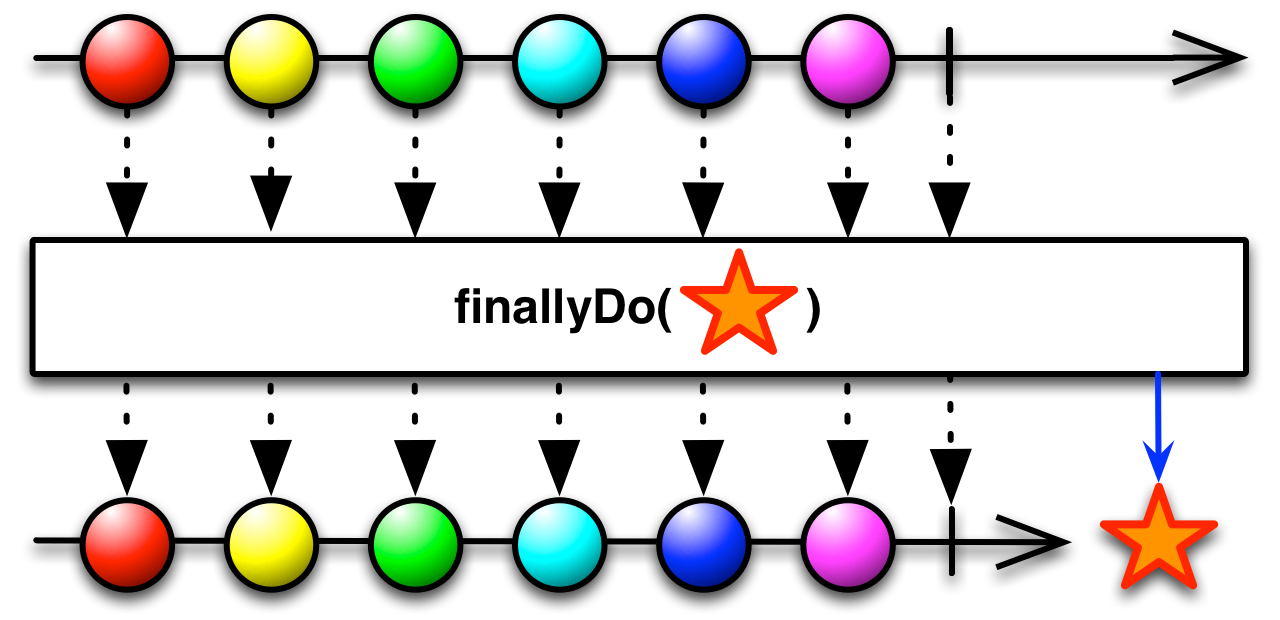
- Scheduler:
-
finallyDodoes not operate by default on a particularScheduler.
- Parameters:
-
action- anAction0to be invoked when the source Observable finishes - Returns:
-
an Observable that emits the same items as the source Observable, then invokes the
Action0 - See Also:
-
RxJava wiki: finallyDo,
doOnTerminate(Action0)
first
public final Observable
<T> first() Returns an Observable that emits only the very first item emitted by the source Observable, or notifies of anNoSuchElementExceptionif the source Observable is empty.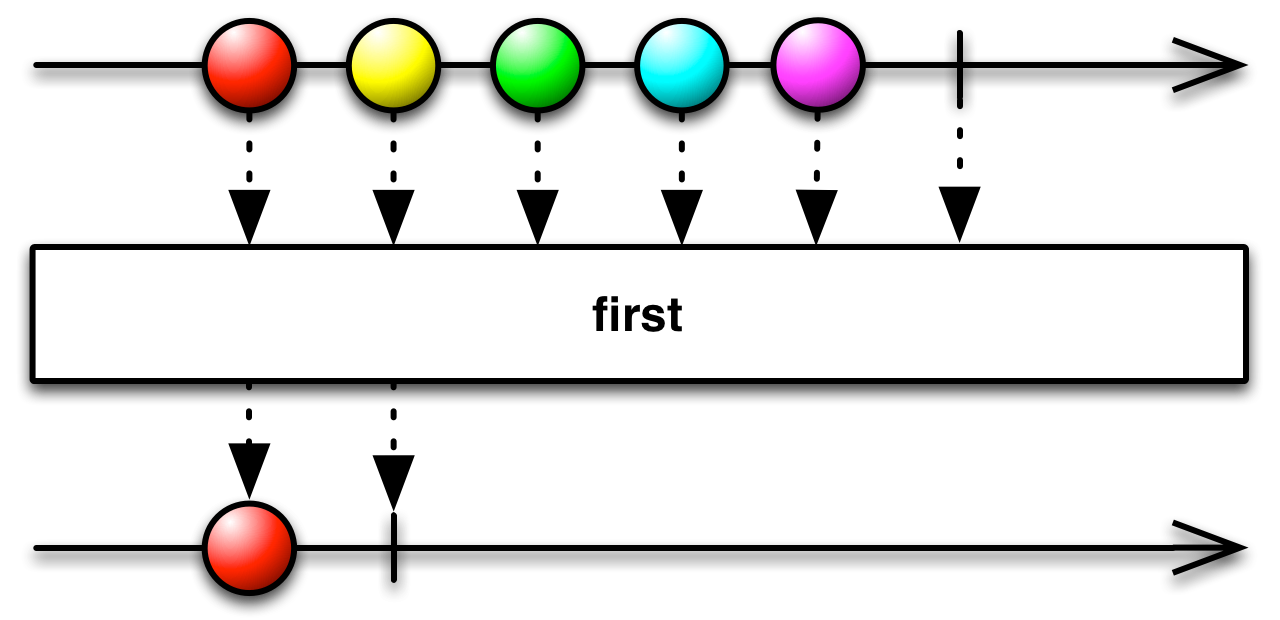
- Scheduler:
-
firstdoes not operate by default on a particularScheduler.
- Returns:
-
an Observable that emits only the very first item emitted by the source Observable, or raises an
NoSuchElementExceptionif the source Observable is empty - See Also:
- RxJava wiki: first, "MSDN: Observable.firstAsync"
first
public final Observable
<T> first(Func1 <? super T ,Boolean > predicate) Returns an Observable that emits only the very first item emitted by the source Observable that satisfies a specified condition, or notifies of anNoSuchElementExceptionif no such items are emitted.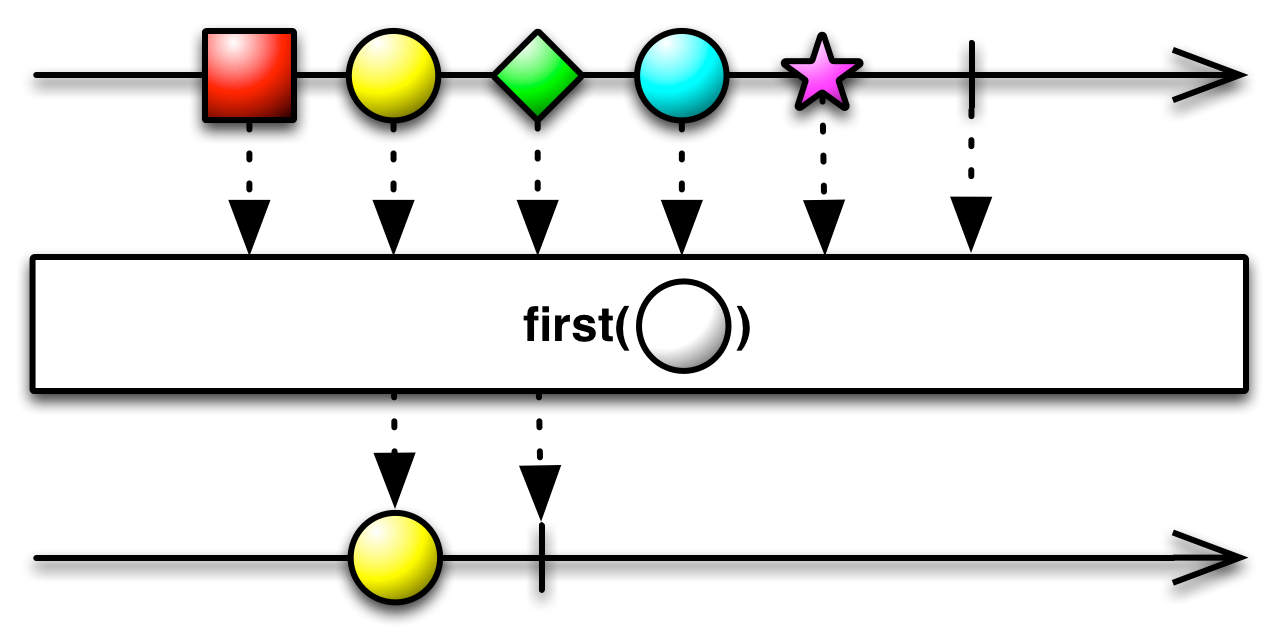
- Scheduler:
-
firstdoes not operate by default on a particularScheduler.
- Parameters:
-
predicate- the condition that an item emitted by the source Observable has to satisfy - Returns:
-
an Observable that emits only the very first item emitted by the source Observable that satisfies the
predicate, or raises anNoSuchElementExceptionif no such items are emitted - See Also:
- RxJava wiki: takeFirst, "MSDN: Observable.firstAsync"
firstOrDefault
public final Observable
<T> firstOrDefault(T defaultValue) Returns an Observable that emits only the very first item emitted by the source Observable, or a default item if the source Observable completes without emitting anything.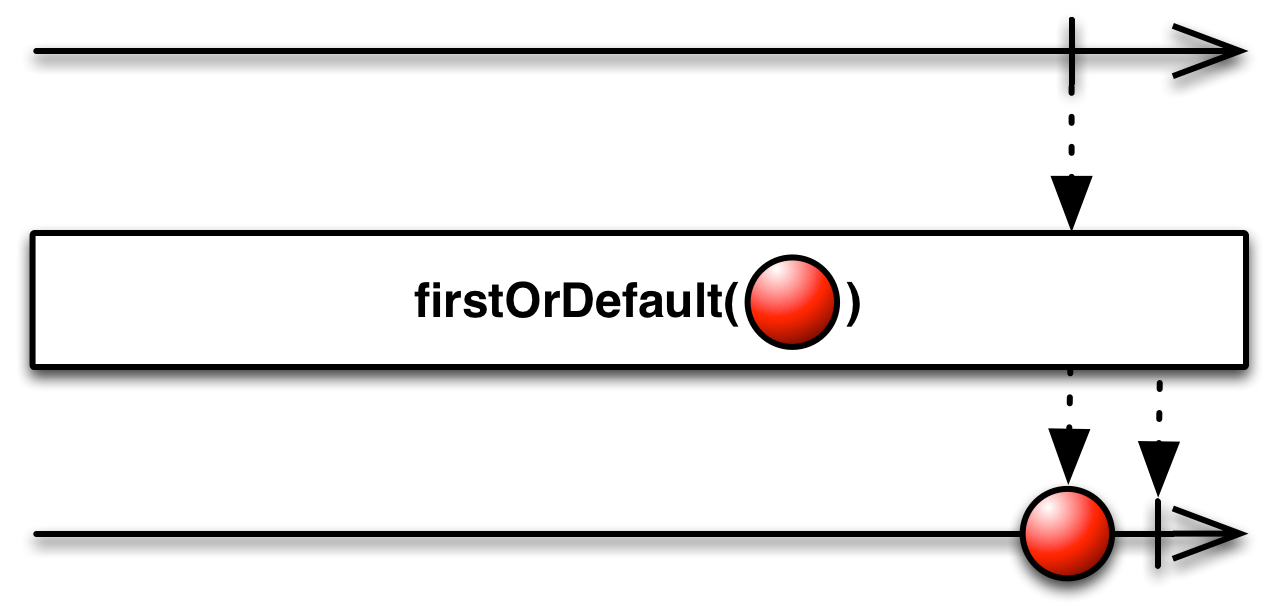
- Scheduler:
-
firstOrDefaultdoes not operate by default on a particularScheduler.
- Parameters:
-
defaultValue- the default item to emit if the source Observable doesn't emit anything - Returns:
- an Observable that emits only the very first item from the source, or a default item if the source Observable completes without emitting any items
- See Also:
- RxJava wiki: firstOrDefault, "MSDN: Observable.firstOrDefaultAsync"
firstOrDefault
public final Observable
<T> firstOrDefault(T defaultValue, Func1 <? super T ,Boolean > predicate) Returns an Observable that emits only the very first item emitted by the source Observable that satisfies a specified condition, or a default item if the source Observable emits no such items.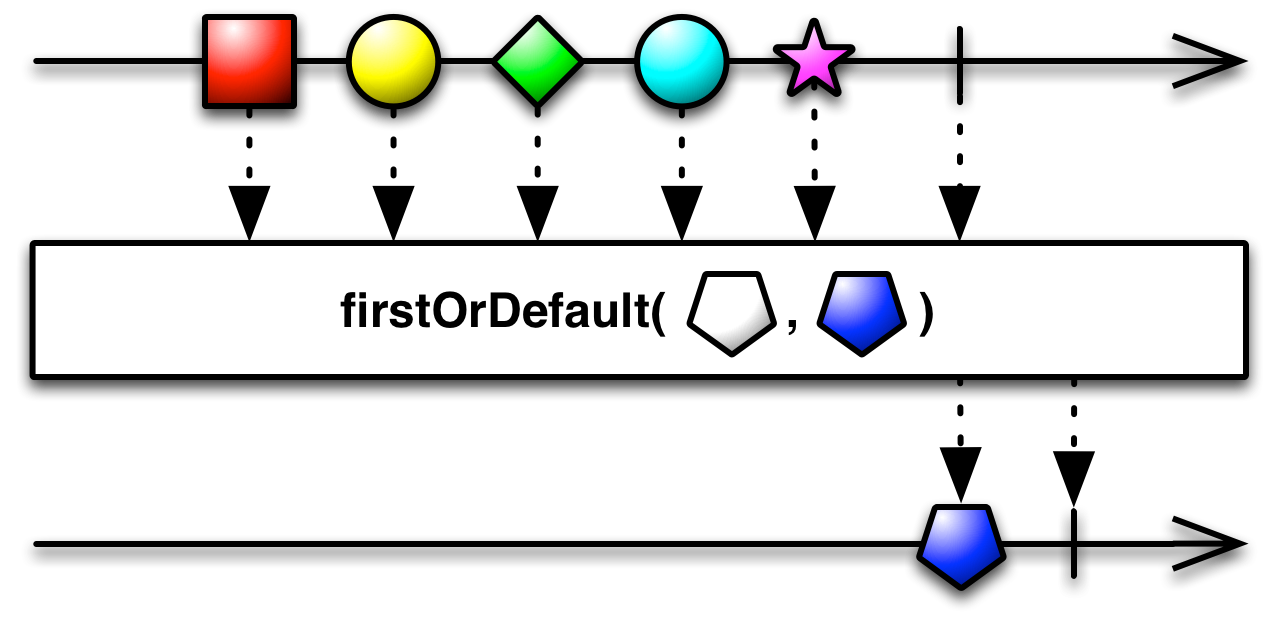
- Scheduler:
-
firstOrDefaultdoes not operate by default on a particularScheduler.
- Parameters:
-
predicate- the condition any item emitted by the source Observable has to satisfy -
defaultValue- the default item to emit if the source Observable doesn't emit anything that satisfies thepredicate - Returns:
-
an Observable that emits only the very first item emitted by the source Observable that satisfies the
predicate, or a default item if the source Observable emits no such items - See Also:
- RxJava wiki: firstOrDefault, "MSDN: Observable.firstOrDefaultAsync"
flatMap
public final <R> Observable
<R> flatMap(Func1 <? super T ,? extends Observable <? extends R>> func) Returns an Observable that emits items based on applying a function that you supply to each item emitted by the source Observable, where that function returns an Observable, and then merging those resulting Observables and emitting the results of this merger.
- Scheduler:
-
flatMapdoes not operate by default on a particularScheduler.
- Parameters:
-
func- a function that, when applied to an item emitted by the source Observable, returns an Observable - Returns:
- an Observable that emits the result of applying the transformation function to each item emitted by the source Observable and merging the results of the Observables obtained from this transformation
- See Also:
- RxJava wiki: flatMap
flatMap
public final <R> Observable
<R> flatMap(Func1 <? super T ,? extends Observable <? extends R>> onNext, Func1 <? super Throwable ,? extends Observable <? extends R>> onError, Func0 <? extends Observable <? extends R>> onCompleted) Returns an Observable that applies a function to each item emitted or notification raised by the source Observable and then flattens the Observables returned from these functions and emits the resulting items.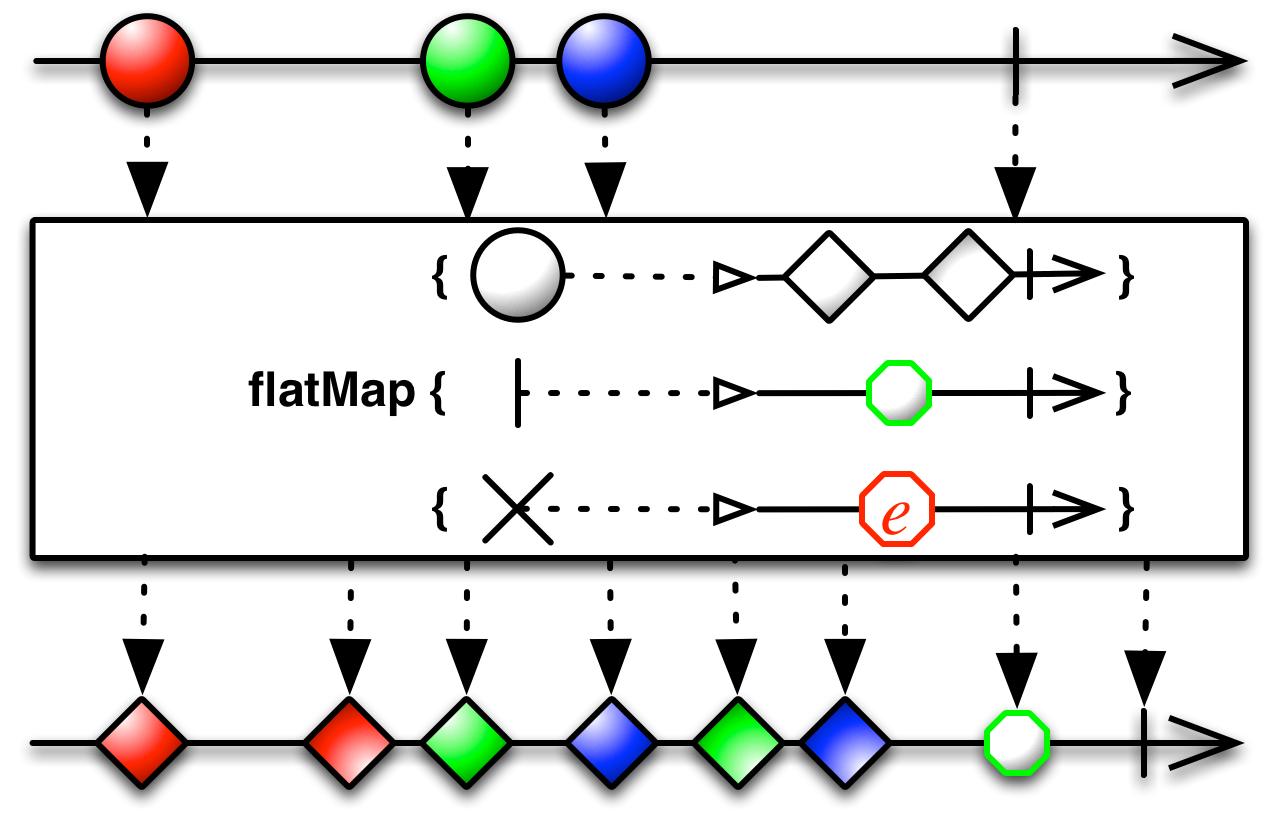
- Scheduler:
-
flatMapdoes not operate by default on a particularScheduler.
- Type Parameters:
-
R- the result type - Parameters:
-
onNext- a function that returns an Observable to merge for each item emitted by the source Observable -
onError- a function that returns an Observable to merge for an onError notification from the source Observable -
onCompleted- a function that returns an Observable to merge for an onCompleted notification from the source Observable - Returns:
- an Observable that emits the results of merging the Observables returned from applying the specified functions to the emissions and notifications of the source Observable
- See Also:
- RxJava wiki: flatMap
flatMap
public final <U
,R> Observable <R> flatMap(Func1 <? super T ,? extends Observable <? extends U>> collectionSelector, Func2 <? super T ,? super U ,? extends R> resultSelector) Returns an Observable that emits the results of a specified function to the pair of values emitted by the source Observable and a specified collection Observable.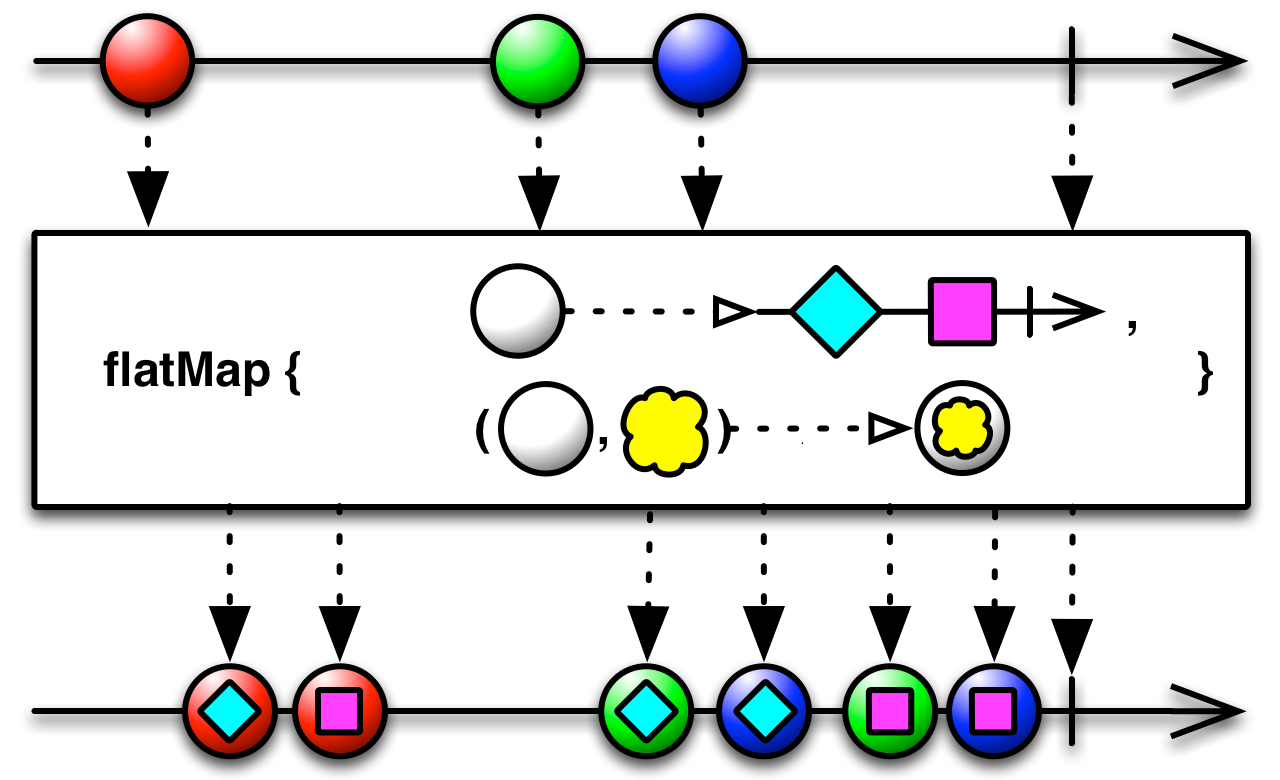
- Scheduler:
-
flatMapdoes not operate by default on a particularScheduler.
- Type Parameters:
-
U- the type of items emitted by the collection Observable -
R- the type of items emitted by the resulting Observable - Parameters:
-
collectionSelector- a function that returns an Observable for each item emitted by the source Observable -
resultSelector- a function that combines one item emitted by each of the source and collection Observables and returns an item to be emitted by the resulting Observable - Returns:
- an Observable that emits the results of applying a function to a pair of values emitted by the source Observable and the collection Observable
- See Also:
- RxJava wiki: flatMap
flatMapIterable
public final <R> Observable
<R> flatMapIterable(Func1 <? super T ,? extends Iterable <? extends R>> collectionSelector) Returns an Observable that merges each item emitted by the source Observable with the values in an Iterable corresponding to that item that is generated by a selector.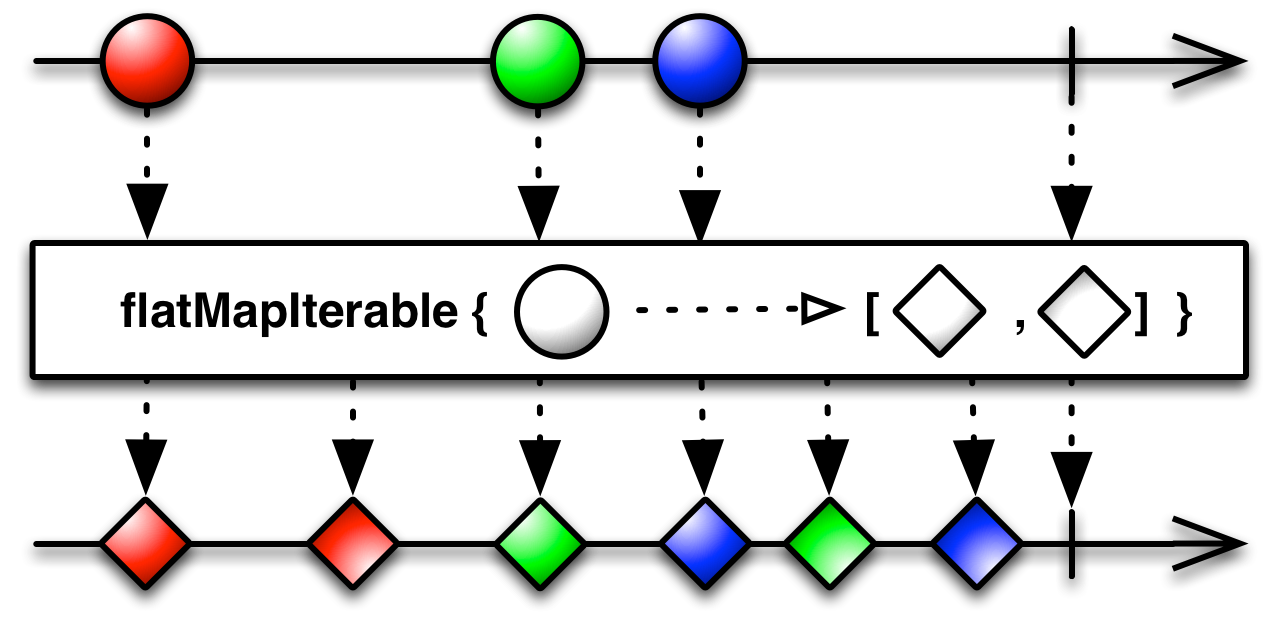
- Scheduler:
-
flatMapIterabledoes not operate by default on a particularScheduler.
- Type Parameters:
-
R- the type of item emitted by the resulting Observable - Parameters:
-
collectionSelector- a function that returns an Iterable sequence of values for when given an item emitted by the source Observable - Returns:
-
an Observable that emits the results of merging the items emitted by the source Observable with the values in the Iterables corresponding to those items, as generated by
collectionSelector - See Also:
- RxJava wiki: flatMapIterable
flatMapIterable
public final <U
,R> Observable <R> flatMapIterable(Func1 <? super T ,? extends Iterable <? extends U>> collectionSelector, Func2 <? super T ,? super U ,? extends R> resultSelector) Returns an Observable that emits the results of applying a function to the pair of values from the source Observable and an Iterable corresponding to that item that is generated by a selector.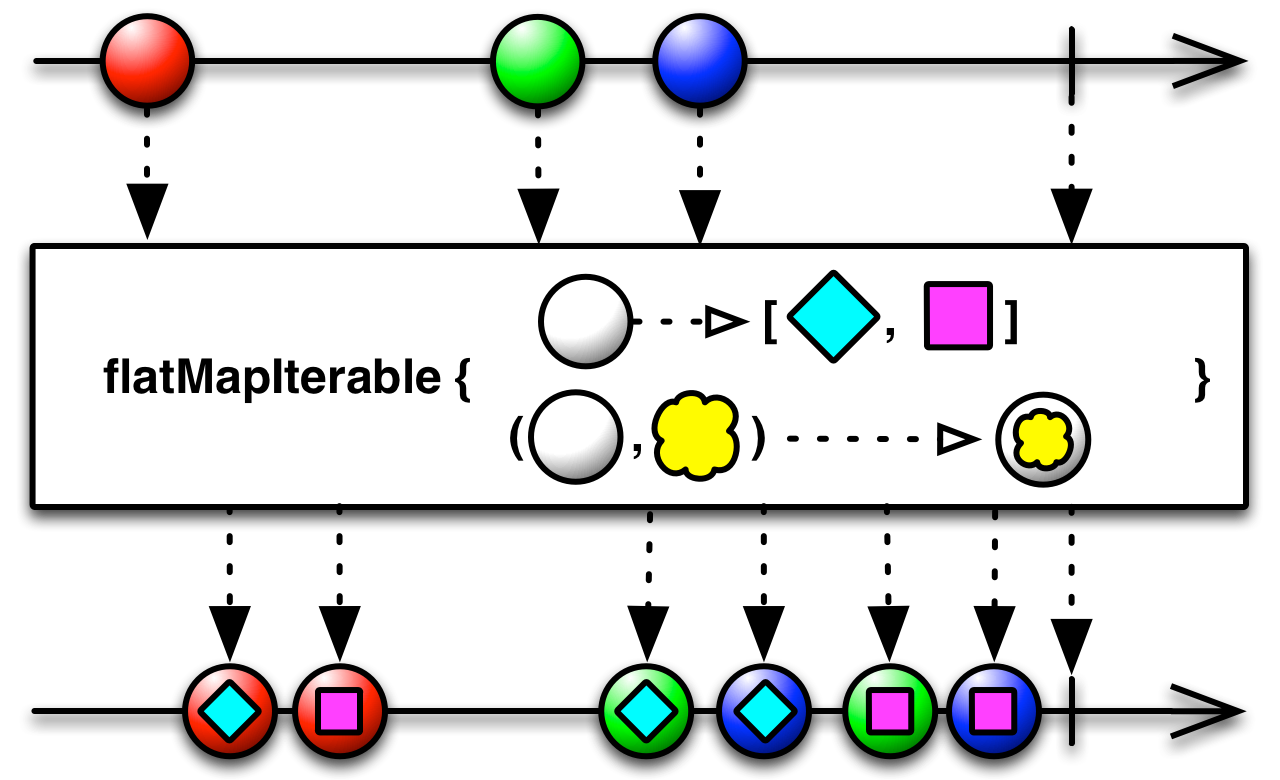
- Scheduler:
-
flatMapIterabledoes not operate by default on a particularScheduler.
- Type Parameters:
-
U- the collection element type -
R- the type of item emited by the resulting Observable - Parameters:
-
collectionSelector- a function that returns an Iterable sequence of values for each item emitted by the source Observable -
resultSelector- a function that returns an item based on the item emitted by the source Observable and the Iterable returned for that item by thecollectionSelector - Returns:
-
an Observable that emits the items returned by
resultSelectorfor each item in the source Observable - See Also:
- RxJava wiki: flatMapIterable
forEach
public final void forEach(Action1
<? super T> onNext) Subscribes to theObservableand receives notifications for each element.Alias to
subscribe(Action1)- Scheduler:
-
forEachdoes not operate by default on a particularScheduler.
- Parameters:
-
onNext-Action1to execute for each item. - Throws:
-
IllegalArgumentException- ifonNextis null, or ifonErroris null, or ifonCompleteis null - See Also:
- RxJava wiki: onNext, onCompleted, and onError
forEach
public final void forEach(Action1
<? super T> onNext, Action1 <Throwable > onError) Subscribes to theObservableand receives notifications for each element and error events.Alias to
subscribe(Action1, Action1)- Scheduler:
-
forEachdoes not operate by default on a particularScheduler.
- Parameters:
-
onNext-Action1to execute for each item. -
onError-Action1to execute when an error is emitted. - Throws:
-
IllegalArgumentException- ifonNextis null, or ifonErroris null, or ifonCompleteis null - See Also:
- RxJava wiki: onNext, onCompleted, and onError
forEach
public final void forEach(Action1
<? super T> onNext, Action1 <Throwable > onError, Action0 onComplete) Subscribes to theObservableand receives notifications for each element and the terminal events.Alias to
subscribe(Action1, Action1, Action0)- Scheduler:
-
forEachdoes not operate by default on a particularScheduler.
- Parameters:
-
onNext-Action1to execute for each item. -
onError-Action1to execute when an error is emitted. -
onComplete-Action0to execute when completion is signalled. - Throws:
-
IllegalArgumentException- ifonNextis null, or ifonErroris null, or ifonCompleteis null - See Also:
- RxJava wiki: onNext, onCompleted, and onError
groupBy
public final <K
,R> Observable <GroupedObservable <K ,R>> groupBy(Func1 <? super T ,? extends K> keySelector, Func1 <? super T ,? extends R> elementSelector) Groups the items emitted by anObservableaccording to a specified criterion, and emits these grouped items asGroupedObservables, oneGroupedObservableper group.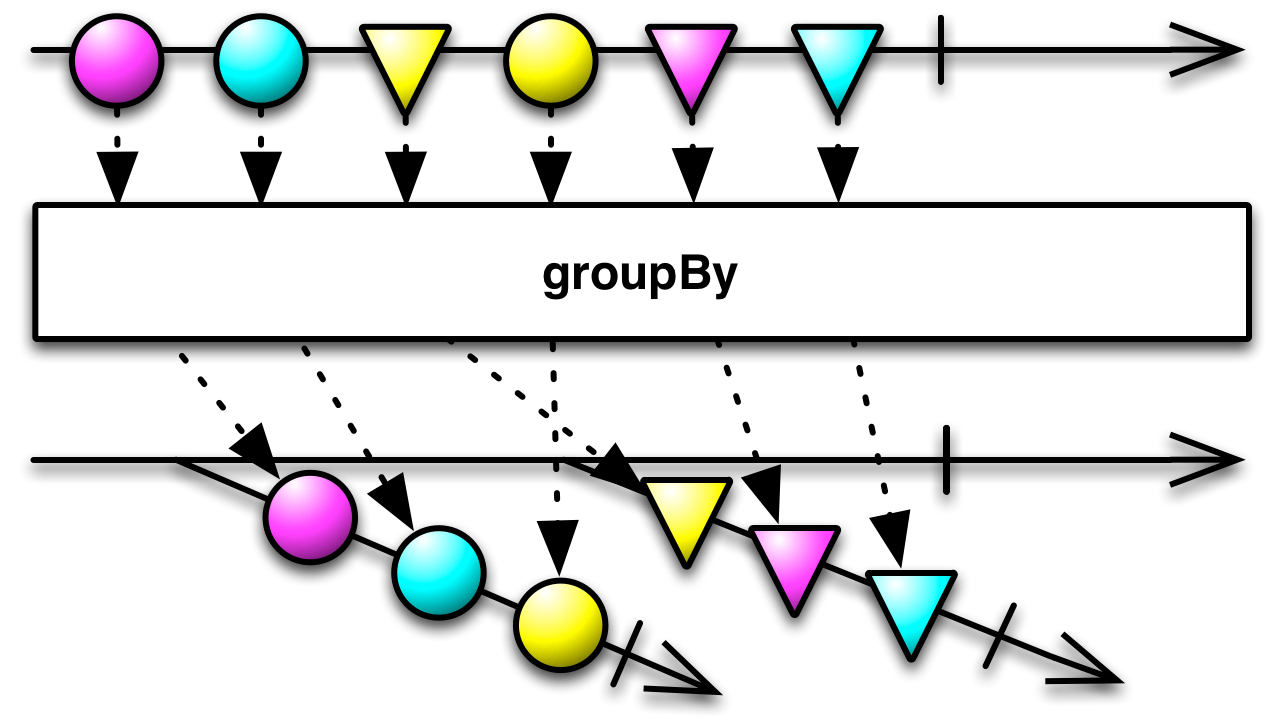
Note: A
GroupedObservablewill cache the items it is to emit until such time as it is subscribed to. For this reason, in order to avoid memory leaks, you should not simply ignore thoseGroupedObservables that do not concern you. Instead, you can signal to them that they may discard their buffers by applying an operator liketake(int)(0)to them.- Scheduler:
-
groupBydoes not operate by default on a particularScheduler.
- Type Parameters:
-
K- the key type -
R- the element type - Parameters:
-
keySelector- a function that extracts the key for each item -
elementSelector- a function that extracts the return element for each item - Returns:
-
an
Observablethat emitsGroupedObservables, each of which corresponds to a unique key value and each of which emits those items from the source Observable that share that key value - See Also:
- RxJava wiki: groupBy
groupBy
public final <K> Observable
<GroupedObservable <K ,T>> groupBy(Func1 <? super T ,? extends K> keySelector) Groups the items emitted by anObservableaccording to a specified criterion, and emits these grouped items asGroupedObservables, oneGroupedObservableper group. Note: A
GroupedObservablewill cache the items it is to emit until such time as it is subscribed to. For this reason, in order to avoid memory leaks, you should not simply ignore thoseGroupedObservables that do not concern you. Instead, you can signal to them that they may discard their buffers by applying an operator liketake(int)(0)to them.- Scheduler:
-
groupBydoes not operate by default on a particularScheduler.
- Type Parameters:
-
K- the key type - Parameters:
-
keySelector- a function that extracts the key for each item - Returns:
-
an
Observablethat emitsGroupedObservables, each of which corresponds to a unique key value and each of which emits those items from the source Observable that share that key value - See Also:
- RxJava wiki: groupBy
groupJoin
public final <T2
,D1 ,D2 ,R> Observable <R> groupJoin(Observable <T2> right, Func1 <? super T ,? extends Observable <D1>> leftDuration, Func1 <? super T2 ,? extends Observable <D2>> rightDuration, Func2 <? super T ,? super Observable <T2> ,? extends R> resultSelector) Returns an Observable that correlates two Observables when they overlap in time and groups the results.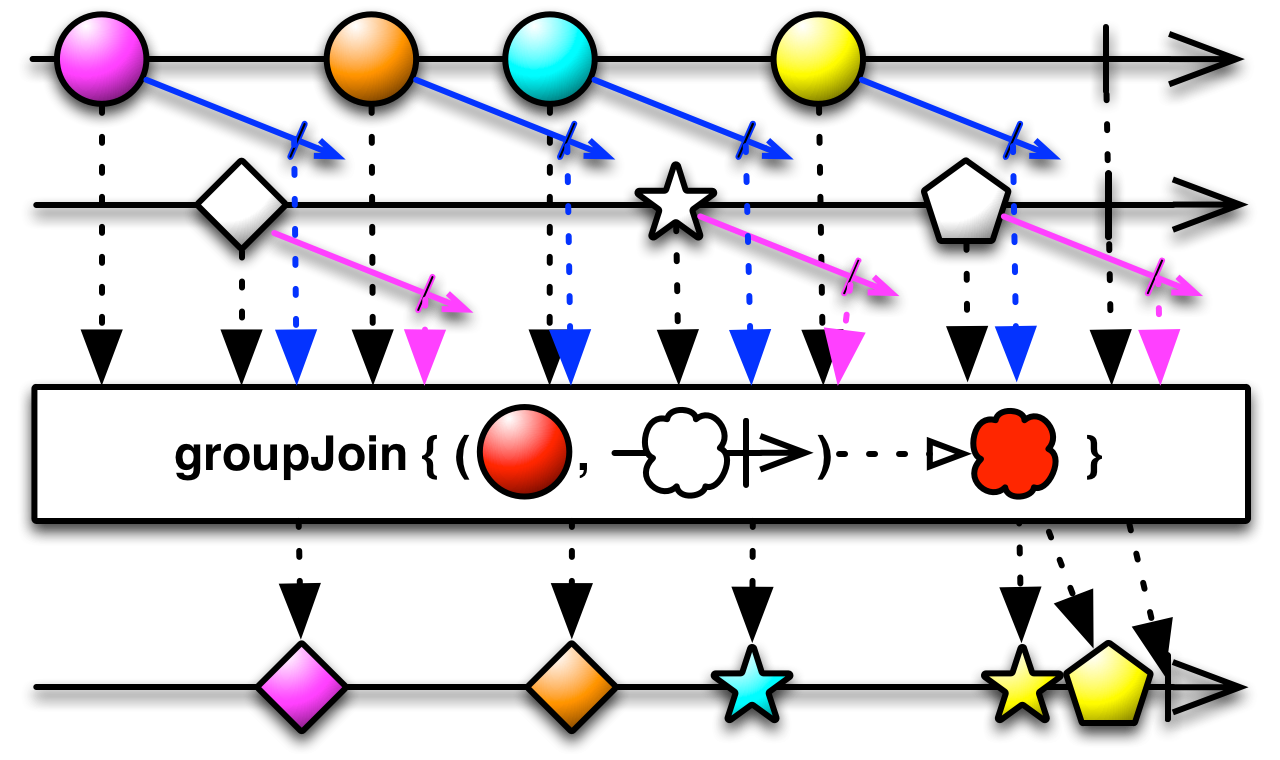
- Scheduler:
-
groupJoindoes not operate by default on a particularScheduler.
- Parameters:
-
right- the other Observable to correlate items from the source Observable with -
leftDuration- a function that returns an Observable whose emissions indicate the duration of the values of the source Observable -
rightDuration- a function that returns an Observable whose emissions indicate the duration of the values of therightObservable -
resultSelector- a function that takes an item emitted by each Observable and returns the value to be emitted by the resulting Observable - Returns:
- an Observable that emits items based on combining those items emitted by the source Observables whose durations overlap
- See Also:
- RxJava Wiiki: groupJoin
ignoreElements
public final Observable
<T> ignoreElements() Ignores all items emitted by the source Observable and only callsonCompletedoronError.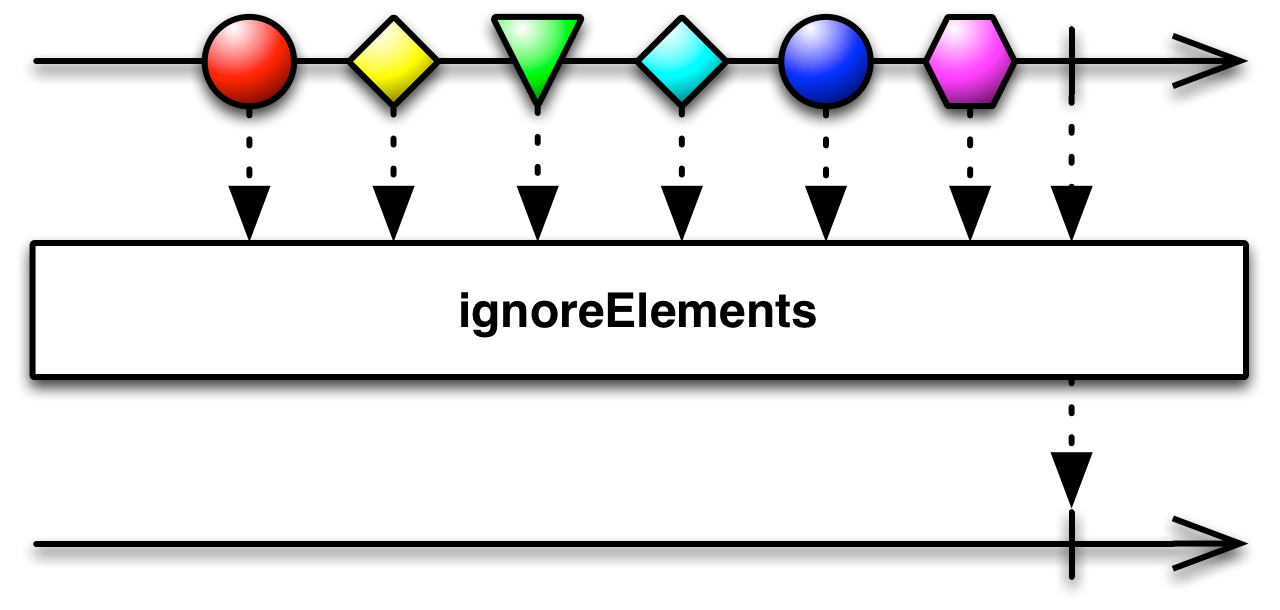
- Scheduler:
-
ignoreElementsdoes not operate by default on a particularScheduler.
- Returns:
-
an empty Observable that only calls
onCompletedoronError, based on which one is called by the source Observable - See Also:
- RxJava wiki: ignoreElements
isEmpty
public final Observable
<Boolean > isEmpty() Returns an Observable that emitstrueif the source Observable is empty, otherwisefalse.In Rx.Net this is negated as the
anyObserver but we renamed this in RxJava to better match Java naming idioms.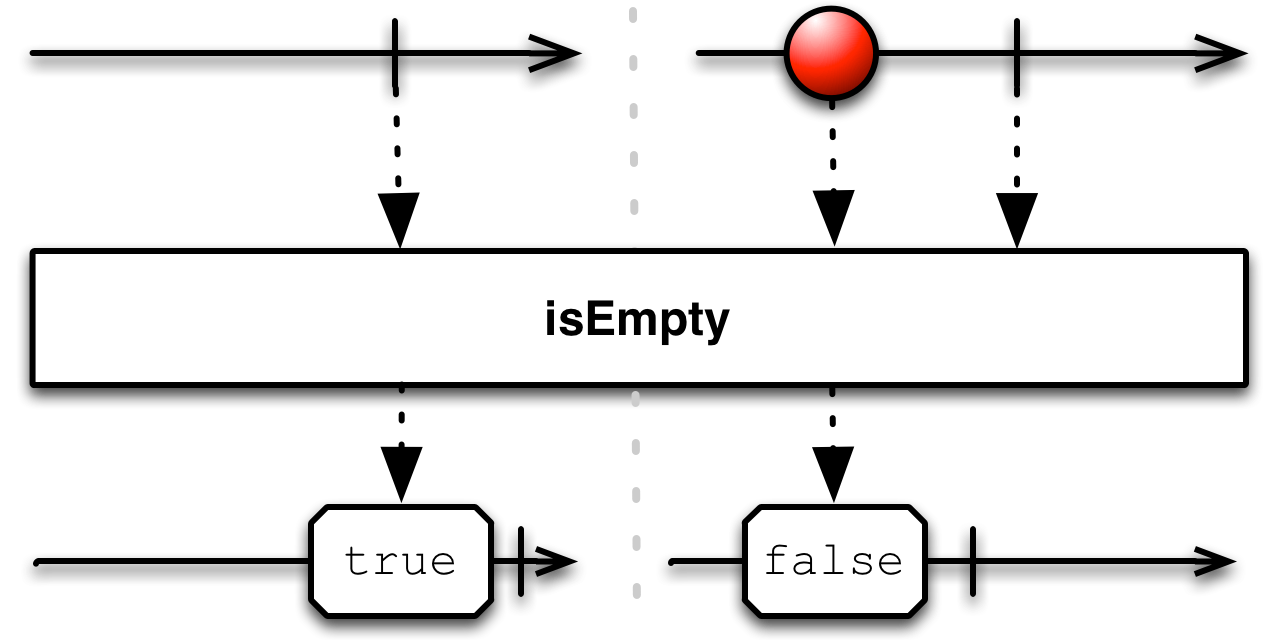
- Scheduler:
-
isEmptydoes not operate by default on a particularScheduler.
- Returns:
- an Observable that emits a Boolean
- See Also:
- RxJava wiki: isEmpty
join
public final <TRight
,TLeftDuration ,TRightDuration ,R> Observable <R> join(Observable <TRight> right, Func1 <T ,Observable <TLeftDuration>> leftDurationSelector, Func1 <TRight ,Observable <TRightDuration>> rightDurationSelector, Func2 <T ,TRight ,R> resultSelector) Correlates the items emitted by two Observables based on overlapping durations.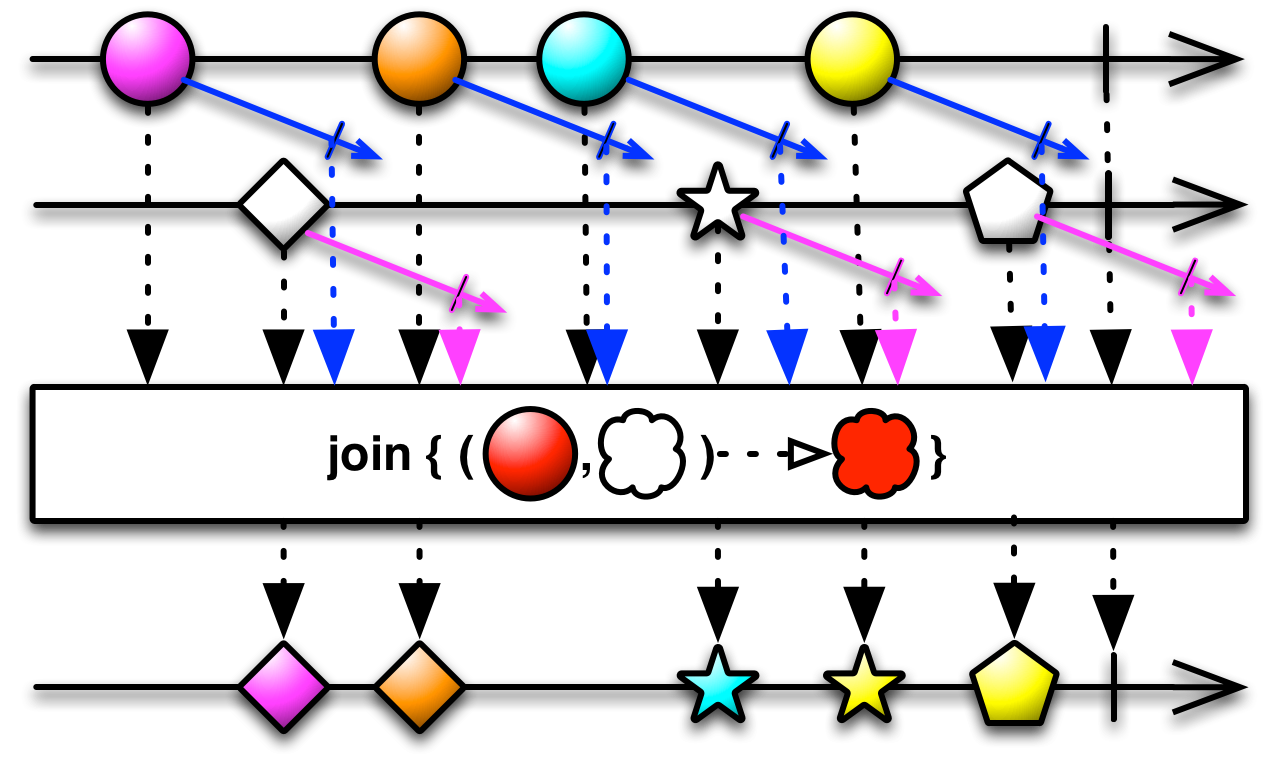
- Scheduler:
-
joindoes not operate by default on a particularScheduler.
- Parameters:
-
right- the second Observable to join items from -
leftDurationSelector- a function to select a duration for each item emitted by the source Observable, used to determine overlap -
rightDurationSelector- a function to select a duration for each item emitted by therightObservable, used to determine overlap -
resultSelector- a function that computes an item to be emitted by the resulting Observable for any two overlapping items emitted by the two Observables - Returns:
- an Observable that emits items correlating to items emitted by the source Observables that have overlapping durations
- See Also:
- RxJava wiki: join
last
public final Observable
<T> last() Returns an Observable that emits the last item emitted by the source Observable or notifies observers of aNoSuchElementExceptionif the source Observable is empty.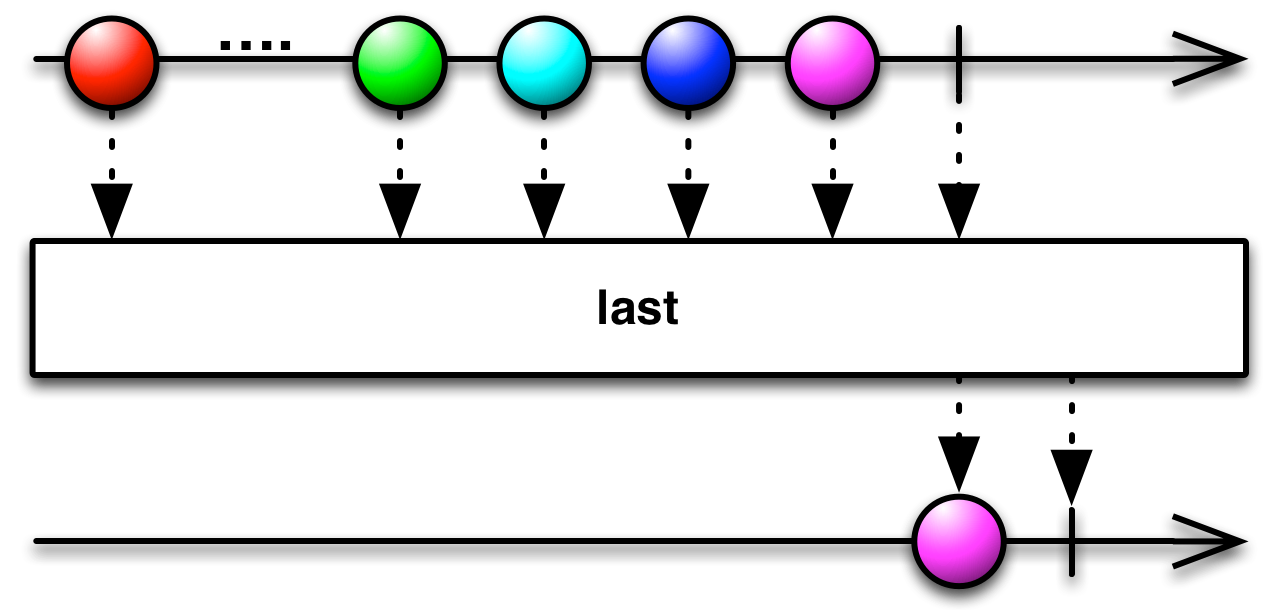
- Scheduler:
-
lastdoes not operate by default on a particularScheduler.
- Returns:
- an Observable that emits the last item from the source Observable or notifies observers of an error
- See Also:
- RxJava wiki: last, "MSDN: Observable.lastAsync"
last
public final Observable
<T> last(Func1 <? super T ,Boolean > predicate) Returns an Observable that emits only the last item emitted by the source Observable that satisfies a given condition, or notifies of aNoSuchElementExceptionif no such items are emitted.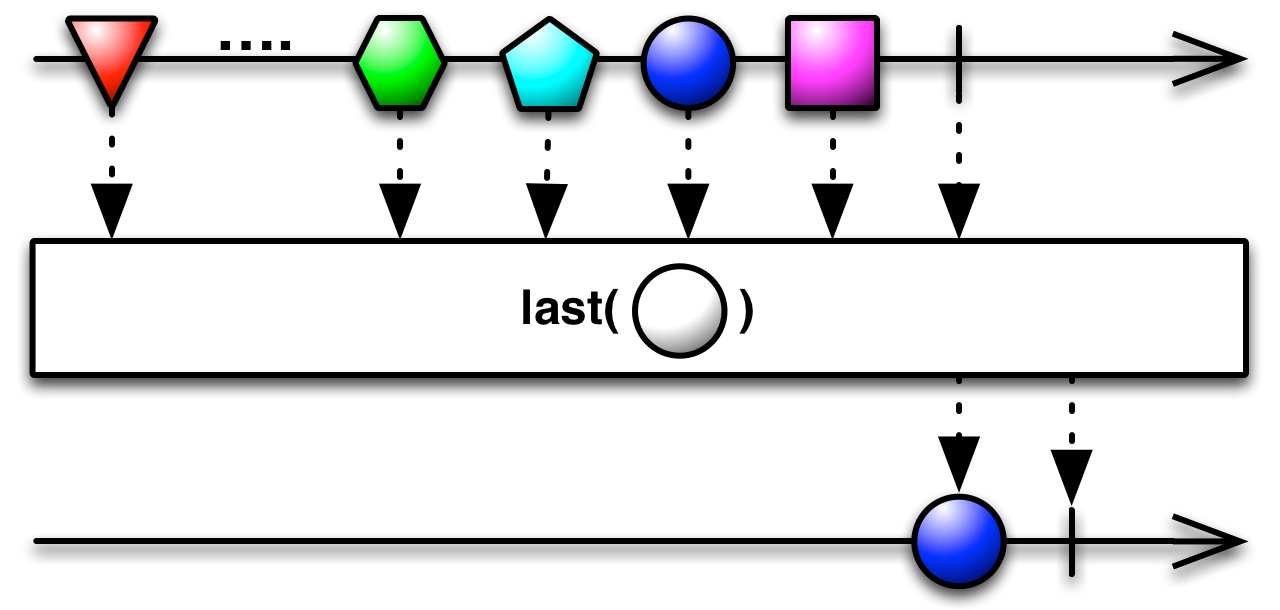
- Scheduler:
-
lastdoes not operate by default on a particularScheduler.
- Parameters:
-
predicate- the condition any source emitted item has to satisfy - Returns:
-
an Observable that emits only the last item satisfying the given condition from the source, or an
NoSuchElementExceptionif no such items are emitted - Throws:
-
IllegalArgumentException- if no items that match the predicate are emitted by the source Observable - See Also:
- RxJava wiki: last, "MSDN: Observable.lastAsync"
lastOrDefault
public final Observable
<T> lastOrDefault(T defaultValue) Returns an Observable that emits only the last item emitted by the source Observable, or a default item if the source Observable completes without emitting any items.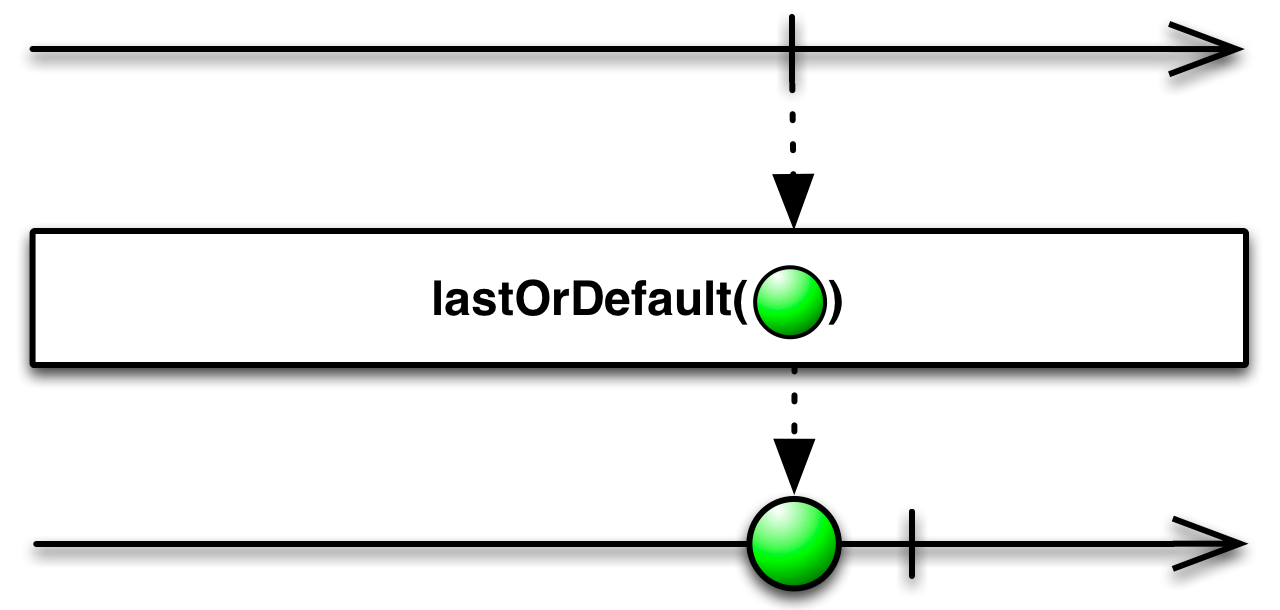
- Scheduler:
-
lastOrDefaultdoes not operate by default on a particularScheduler.
- Parameters:
-
defaultValue- the default item to emit if the source Observable is empty - Returns:
- an Observable that emits only the last item emitted by the source Observable, or a default item if the source Observable is empty
- See Also:
- RxJava wiki: lastOrDefault, "MSDN: Observable.lastOrDefaultAsync"
lastOrDefault
public final Observable
<T> lastOrDefault(T defaultValue, Func1 <? super T ,Boolean > predicate) Returns an Observable that emits only the last item emitted by the source Observable that satisfies a specified condition, or a default item if no such item is emitted by the source Observable.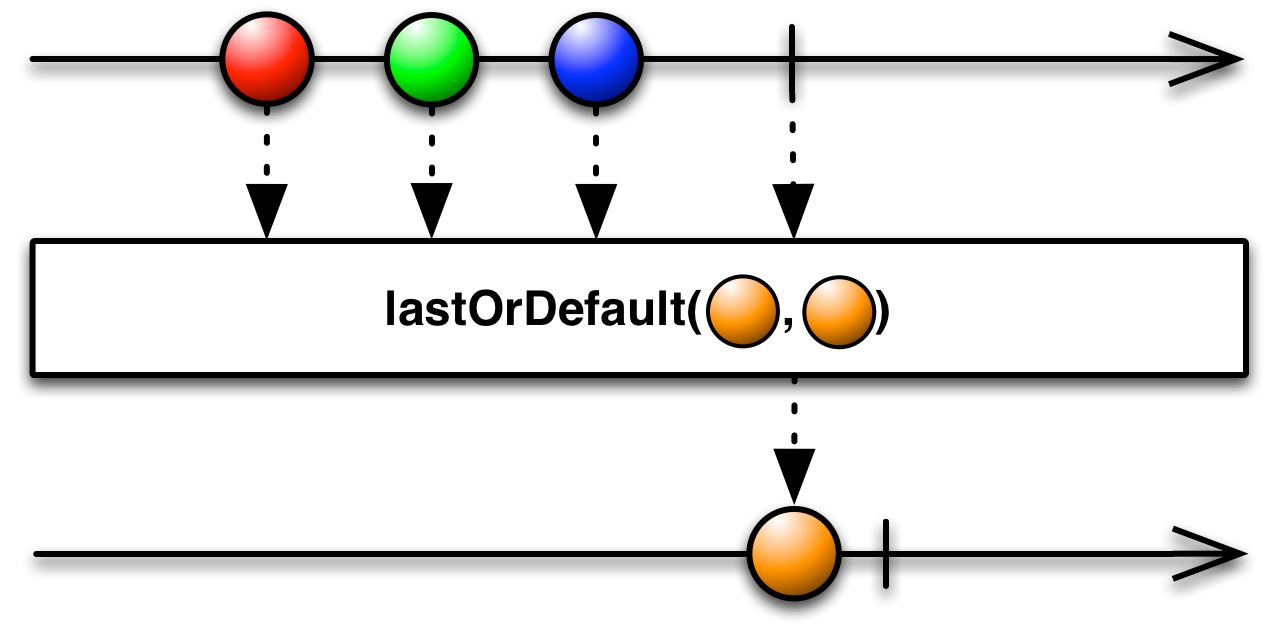
- Scheduler:
-
lastOrDefaultdoes not operate by default on a particularScheduler.
- Parameters:
-
defaultValue- the default item to emit if the source Observable doesn't emit anything that satisfies the specifiedpredicate -
predicate- the condition any item emitted by the source Observable has to satisfy - Returns:
- an Observable that emits only the last item emitted by the source Observable that satisfies the given condition, or a default item if no such item is emitted by the source Observable
- See Also:
- RxJava wiki: lastOrDefault, "MSDN: Observable.lastOrDefaultAsync"
limit
public final Observable
<T> limit(int num) Returns an Observable that emits only the firstnumitems emitted by the source Observable.Alias of
take(int)to match Java 8 Stream API naming convention.
This method returns an Observable that will invoke a subscribing
Observer'sonNextfunction a maximum ofnumtimes before invokingonCompleted.- Scheduler:
-
limitdoes not operate by default on a particularScheduler.
- Parameters:
-
num- the maximum number of items to emit - Returns:
-
an Observable that emits only the first
numitems emitted by the source Observable, or all of the items from the source Observable if that Observable emits fewer thannumitems - See Also:
- RxJava wiki: take
map
public final <R> Observable
<R> map(Func1 <? super T ,? extends R> func) Returns an Observable that applies a specified function to each item emitted by the source Observable and emits the results of these function applications.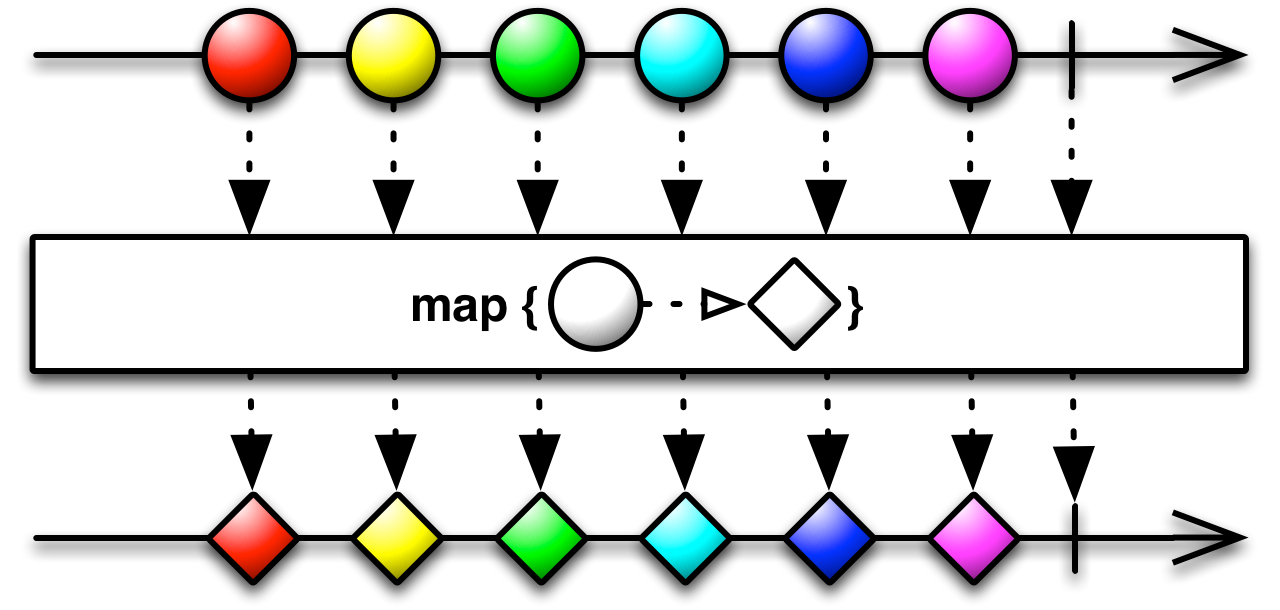
- Scheduler:
-
mapdoes not operate by default on a particularScheduler.
- Parameters:
-
func- a function to apply to each item emitted by the Observable - Returns:
- an Observable that emits the items from the source Observable, transformed by the specified function
- See Also:
- RxJava wiki: map
materialize
public final Observable
<Notification <T>> materialize() Returns an Observable that represents all of the emissions and notifications from the source Observable into emissions marked with their original types withinNotificationobjects.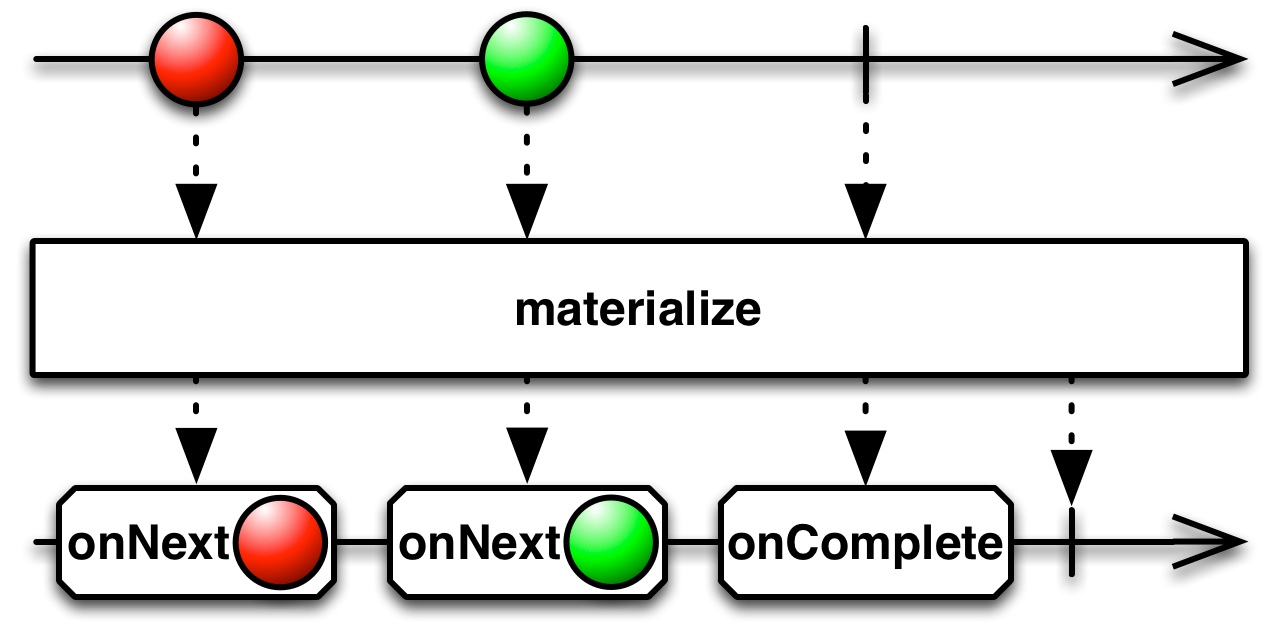
- Scheduler:
-
materializedoes not operate by default on a particularScheduler.
- Returns:
- an Observable that emits items that are the result of materializing the items and notifications of the source Observable
- See Also:
- RxJava wiki: materialize
mergeWith
public final Observable
<T> mergeWith(Observable <? extends T> t1) Flattens this and another Observable into a single Observable, without any transformation. You can combine items emitted by multiple Observables so that they appear as a single Observable, by using the
mergeWithmethod.- Scheduler:
-
mergeWithdoes not operate by default on a particularScheduler.
- Parameters:
-
t1- an Observable to be merged - Returns:
- an Observable that emits all of the items emitted by the source Observables
- See Also:
- RxJava wiki: merge
observeOn
public final Observable
<T> observeOn(Scheduler scheduler) Modifies an Observable to perform its emissions and notifications on a specifiedScheduler, asynchronously with an unbounded buffer.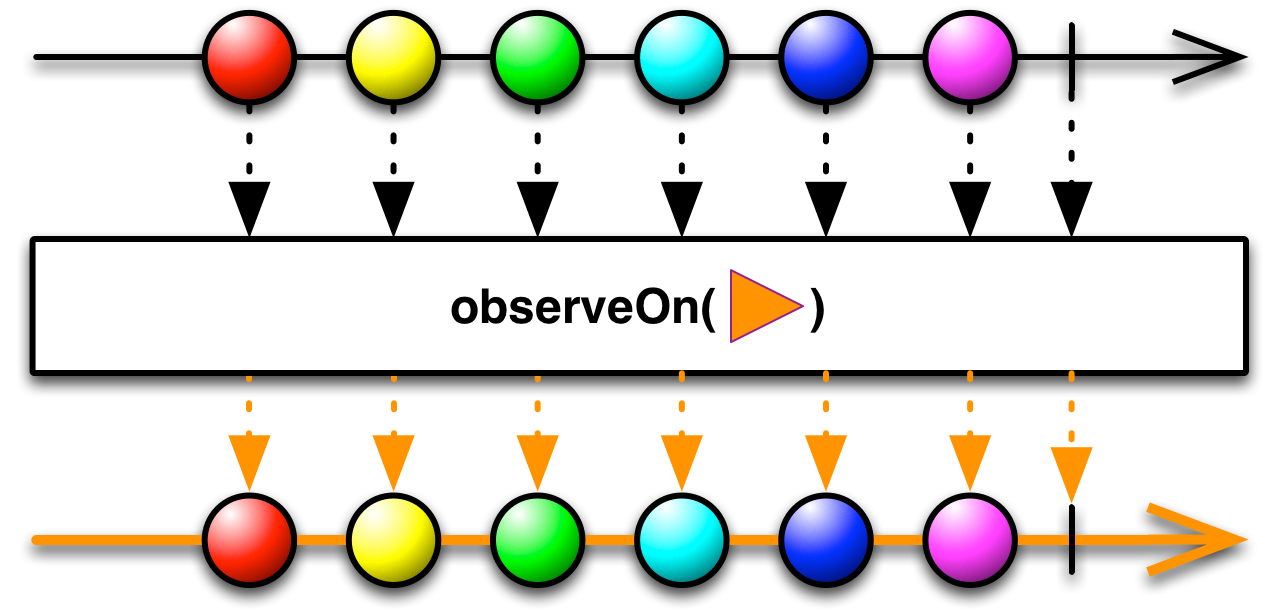
- Scheduler:
-
you specify which
Schedulerthis operator will use
- Parameters:
-
scheduler- theSchedulerto notifyObservers on - Returns:
-
the source Observable modified so that its
Observers are notified on the specifiedScheduler - See Also:
-
RxJava wiki: observeOn,
RxJava Threading Examples,
subscribeOn(rx.Scheduler)
ofType
public final <R> Observable
<R> ofType(Class <R> klass) Filters the items emitted by an Observable, only emitting those of the specified type.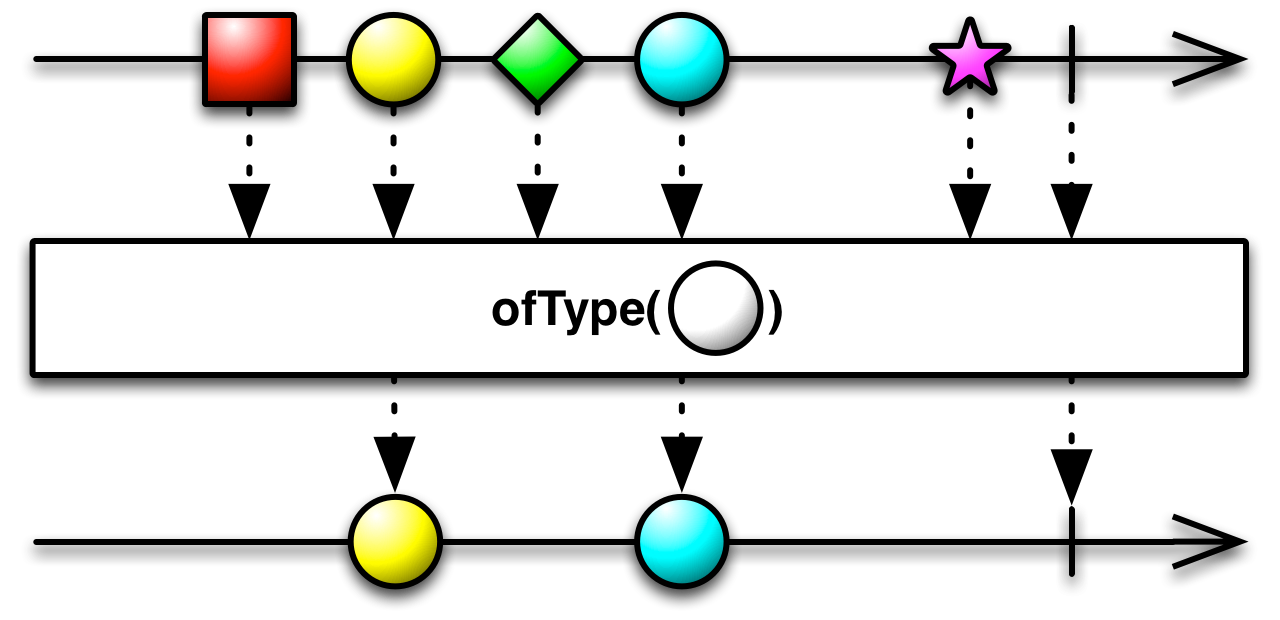
- Scheduler:
-
ofTypedoes not operate by default on a particularScheduler.
- Parameters:
-
klass- the class type to filter the items emitted by the source Observable - Returns:
-
an Observable that emits items from the source Observable of type
klass - See Also:
- RxJava wiki: ofType
onBackpressureBuffer
public final Observable
<T> onBackpressureBuffer() Instructs an Observable that is emitting items faster than its observer can consume them to buffer these items indefinitely until they can be emitted.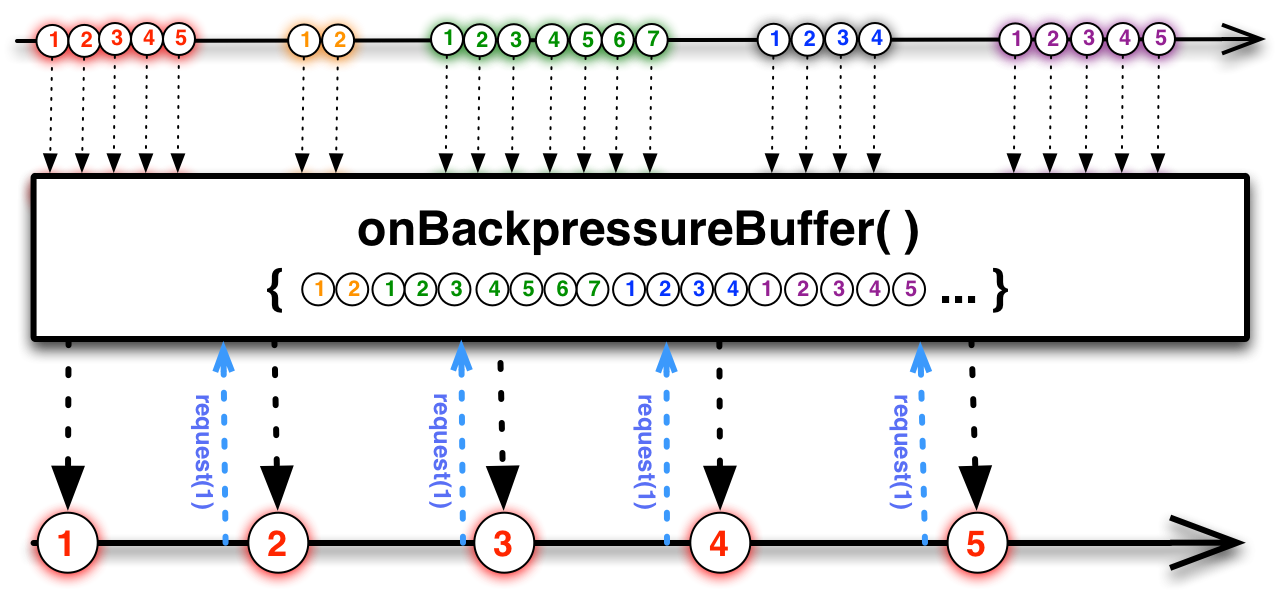
- Scheduler:
-
onBackpressureBufferdoes not operate by default on a particularScheduler.
- Returns:
- the source Observable modified to buffer items to the extent system resources allow
- See Also:
- RxJava wiki: Backpressure
onBackpressureDrop
public final Observable
<T> onBackpressureDrop() Instructs an Observable that is emitting items faster than its observer can consume them to discard, rather than emit, those items that its observer is not prepared to observe.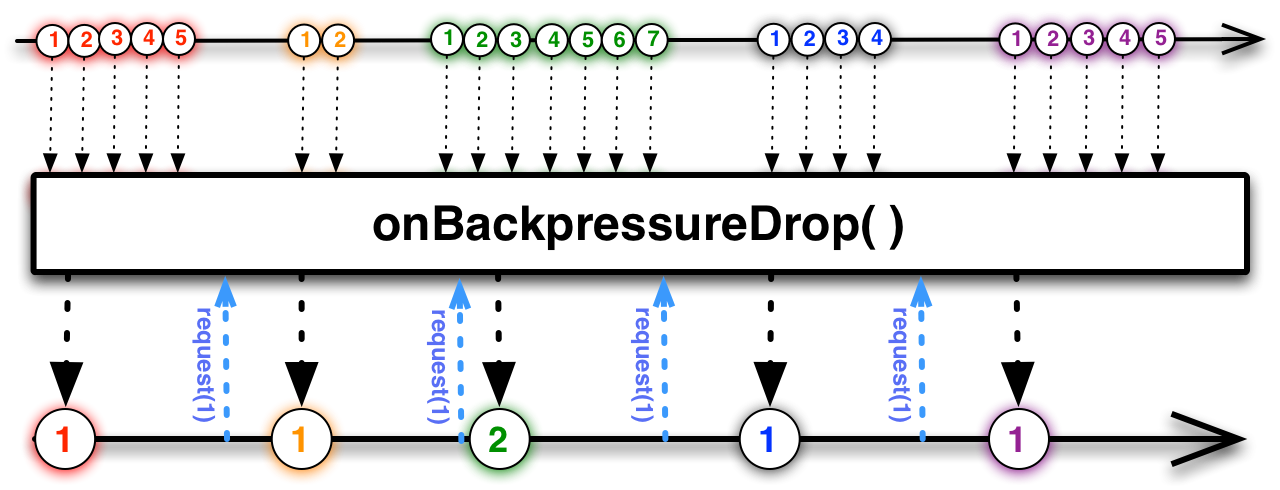
If the downstream request count hits 0 then the Observable will refrain from calling
onNextuntil the observer invokesrequest(n)again to increase the request count.- Scheduler:
-
onBackpressureDropdoes not operate by default on a particularScheduler.
- Returns:
-
the source Observable modified to drop
onNextnotifications on overflow - See Also:
- RxJava wiki: Backpressure
onErrorResumeNext
public final Observable
<T> onErrorResumeNext(Func1 <Throwable ,? extends Observable <? extends T>> resumeFunction) Instructs an Observable to pass control to another Observable rather than invokingonErrorif it encounters an error.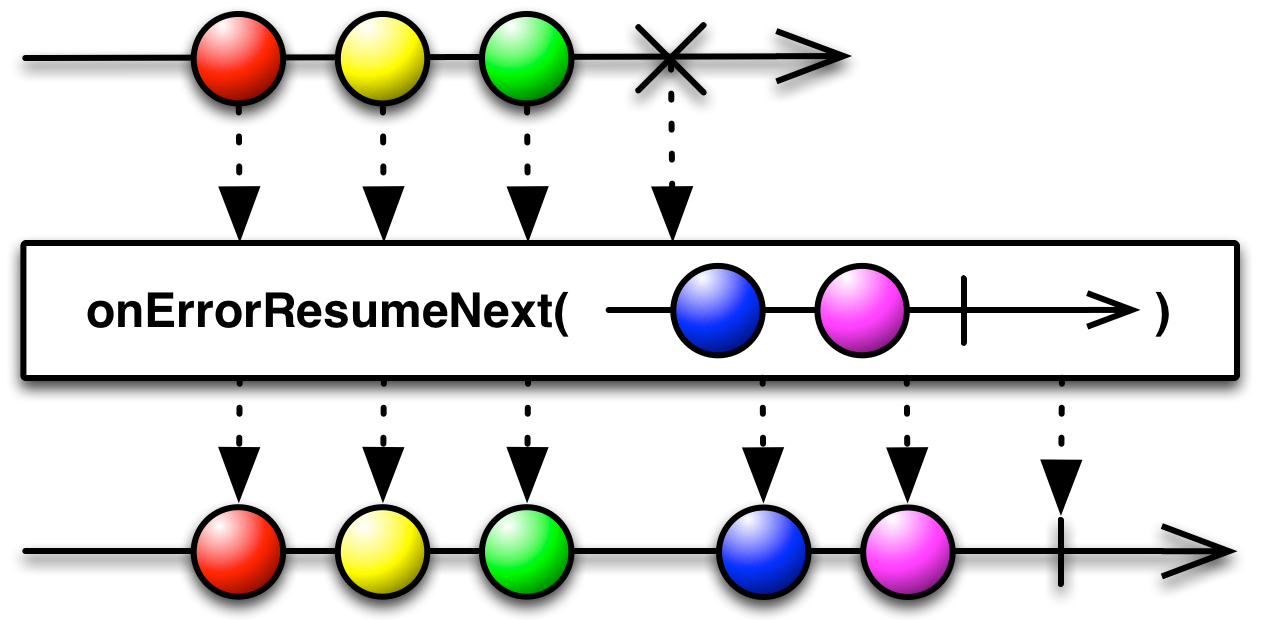
By default, when an Observable encounters an error that prevents it from emitting the expected item to its
Observer, the Observable invokes its Observer'sonErrormethod, and then quits without invoking any more of its Observer's methods. TheonErrorResumeNextmethod changes this behavior. If you pass a function that returns an Observable (resumeFunction) toonErrorResumeNext, if the original Observable encounters an error, instead of invoking its Observer'sonErrormethod, it will instead relinquish control to the Observable returned fromresumeFunction, which will invoke the Observer'sonNextmethod if it is able to do so. In such a case, because no Observable necessarily invokesonError, the Observer may never know that an error happened.You can use this to prevent errors from propagating or to supply fallback data should errors be encountered.
- Scheduler:
-
onErrorResumeNextdoes not operate by default on a particularScheduler.
- Parameters:
-
resumeFunction- a function that returns an Observable that will take over if the source Observable encounters an error - Returns:
- the original Observable, with appropriately modified behavior
- See Also:
- RxJava wiki: onErrorResumeNext
onErrorResumeNext
public final Observable
<T> onErrorResumeNext(Observable <? extends T> resumeSequence) Instructs an Observable to pass control to another Observable rather than invokingonErrorif it encounters an error. By default, when an Observable encounters an error that prevents it from emitting the expected item to its
Observer, the Observable invokes its Observer'sonErrormethod, and then quits without invoking any more of its Observer's methods. TheonErrorResumeNextmethod changes this behavior. If you pass another Observable (resumeSequence) to an Observable'sonErrorResumeNextmethod, if the original Observable encounters an error, instead of invoking its Observer'sonErrormethod, it will instead relinquish control toresumeSequencewhich will invoke the Observer'sonNextmethod if it is able to do so. In such a case, because no Observable necessarily invokesonError, the Observer may never know that an error happened.You can use this to prevent errors from propagating or to supply fallback data should errors be encountered.
- Scheduler:
-
onErrorResumeNextdoes not operate by default on a particularScheduler.
- Parameters:
-
resumeSequence- a function that returns an Observable that will take over if the source Observable encounters an error - Returns:
- the original Observable, with appropriately modified behavior
- See Also:
- RxJava wiki: onErrorResumeNext
onErrorReturn
public final Observable
<T> onErrorReturn(Func1 <Throwable ,? extends T> resumeFunction) Instructs an Observable to emit an item (returned by a specified function) rather than invokingonErrorif it encounters an error.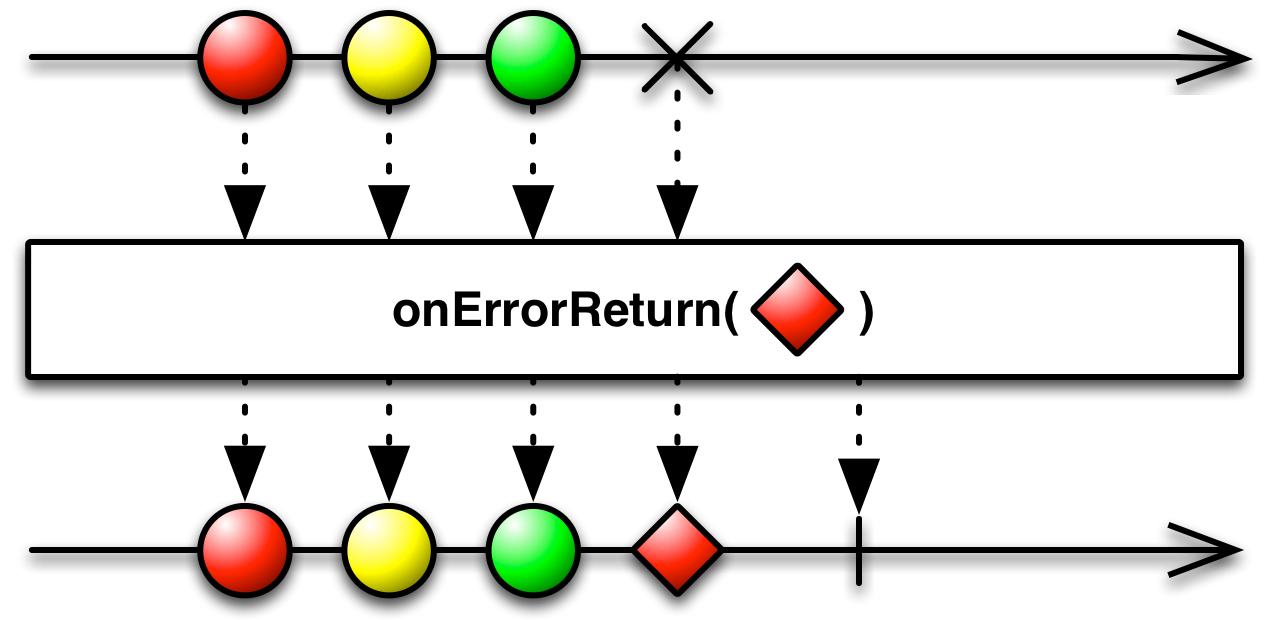
By default, when an Observable encounters an error that prevents it from emitting the expected item to its
Observer, the Observable invokes its Observer'sonErrormethod, and then quits without invoking any more of its Observer's methods. TheonErrorReturnmethod changes this behavior. If you pass a function (resumeFunction) to an Observable'sonErrorReturnmethod, if the original Observable encounters an error, instead of invoking its Observer'sonErrormethod, it will instead emit the return value ofresumeFunction.You can use this to prevent errors from propagating or to supply fallback data should errors be encountered.
- Scheduler:
-
onErrorReturndoes not operate by default on a particularScheduler.
- Parameters:
-
resumeFunction- a function that returns an item that the new Observable will emit if the source Observable encounters an error - Returns:
- the original Observable with appropriately modified behavior
- See Also:
- RxJava wiki: onErrorReturn
onExceptionResumeNext
public final Observable
<T> onExceptionResumeNext(Observable <? extends T> resumeSequence) Instructs an Observable to pass control to another Observable rather than invokingonErrorif it encounters anException.This differs from
onErrorResumeNext(rx.functions.Func1<java.lang.Throwable, ? extends rx.Observable<? extends T>>)in that this one does not handleThrowableorErrorbut lets those continue through.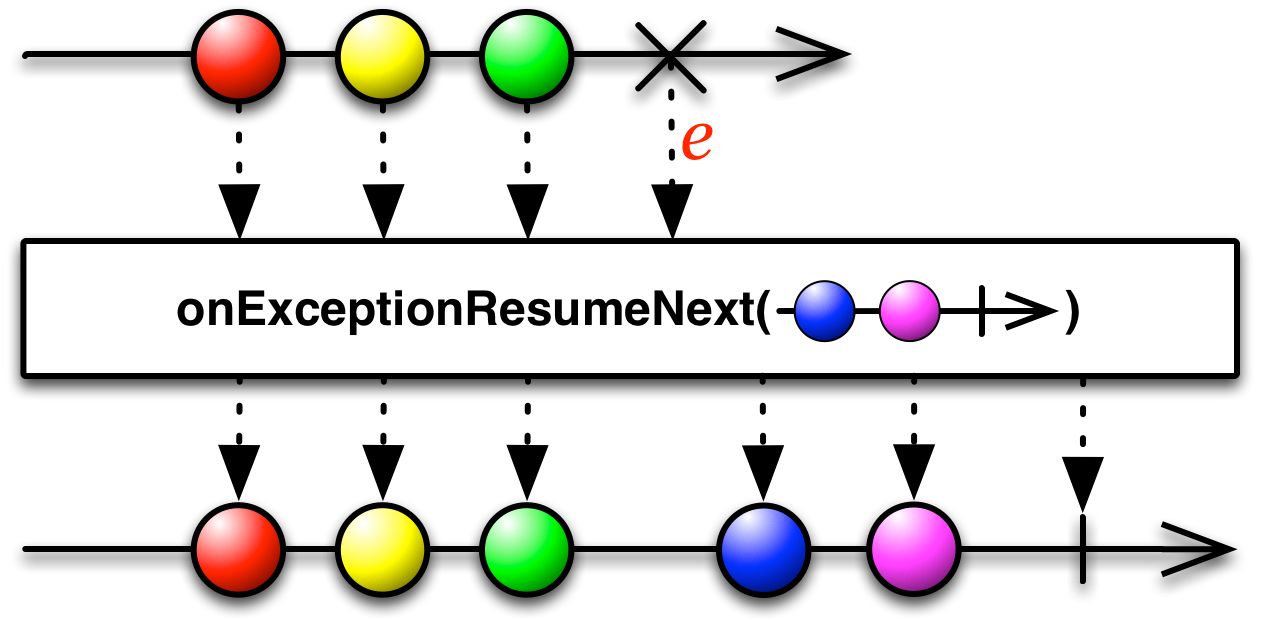
By default, when an Observable encounters an exception that prevents it from emitting the expected item to its
Observer, the Observable invokes its Observer'sonErrormethod, and then quits without invoking any more of its Observer's methods. TheonExceptionResumeNextmethod changes this behavior. If you pass another Observable (resumeSequence) to an Observable'sonExceptionResumeNextmethod, if the original Observable encounters an exception, instead of invoking its Observer'sonErrormethod, it will instead relinquish control toresumeSequencewhich will invoke the Observer'sonNextmethod if it is able to do so. In such a case, because no Observable necessarily invokesonError, the Observer may never know that an exception happened.You can use this to prevent exceptions from propagating or to supply fallback data should exceptions be encountered.
- Scheduler:
-
onErrorResumeNextdoes not operate by default on a particularScheduler.
- Parameters:
-
resumeSequence- a function that returns an Observable that will take over if the source Observable encounters an exception - Returns:
- the original Observable, with appropriately modified behavior
- See Also:
- RxJava wiki: onExceptionResumeNext
publish
public final ConnectableObservable
<T> publish() Returns aConnectableObservable, which is a variety of Observable that waits until itsconnectmethod is called before it begins emitting items to thoseObservers that have subscribed to it.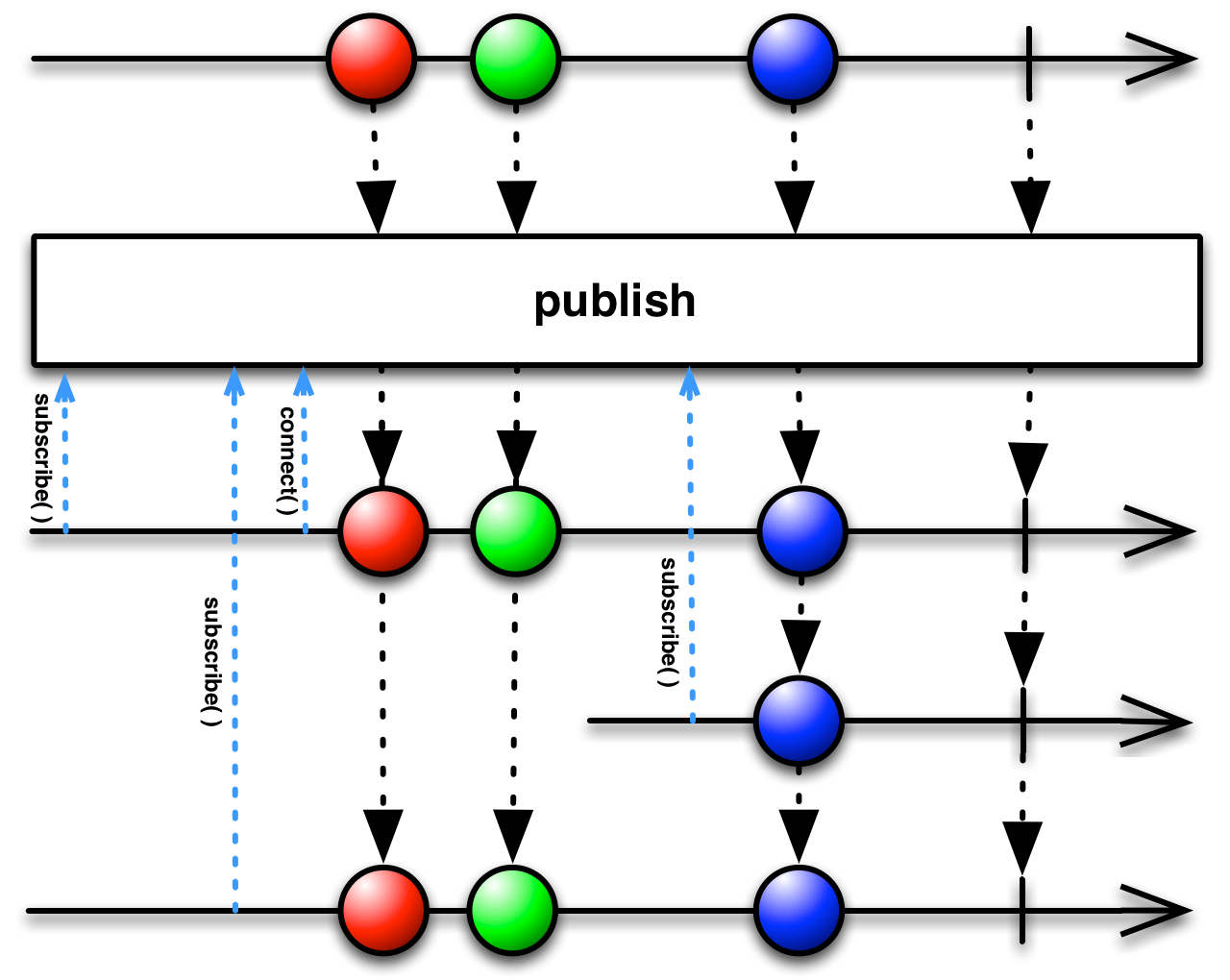
- Scheduler:
-
publishdoes not operate by default on a particularScheduler.
- Returns:
-
a
ConnectableObservablethat upon connection causes the source Observable to emit items to itsObservers - See Also:
- RxJava wiki: publish
publish
public final <R> Observable
<R> publish(Func1 <? super Observable <T> ,? extends Observable <R>> selector) Returns an Observable that emits the results of invoking a specified selector on items emitted by aConnectableObservablethat shares a single subscription to the underlying sequence.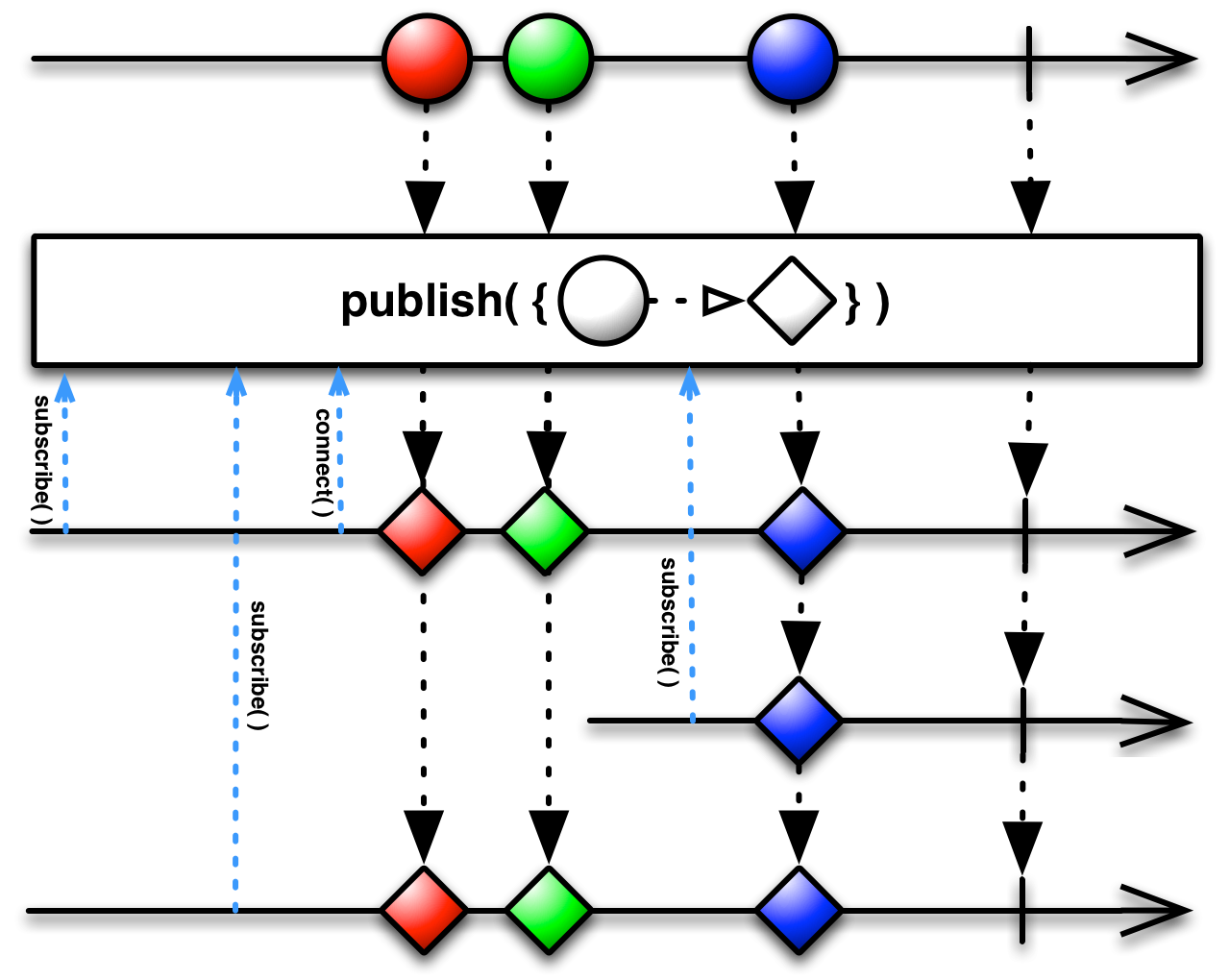
- Scheduler:
-
publishdoes not operate by default on a particularScheduler.
- Type Parameters:
-
R- the type of items emitted by the resulting Observable - Parameters:
-
selector- a function that can use the multicasted source sequence as many times as needed, without causing multiple subscriptions to the source sequence. Subscribers to the given source will receive all notifications of the source from the time of the subscription forward. - Returns:
-
an Observable that emits the results of invoking the selector on the items emitted by a
ConnectableObservablethat shares a single subscription to the underlying sequence - See Also:
- RxJava wiki: publish
reduce
public final Observable
<T> reduce(Func2 <T ,T ,T> accumulator) Returns an Observable that applies a specified accumulator function to the first item emitted by a source Observable, then feeds the result of that function along with the second item emitted by the source Observable into the same function, and so on until all items have been emitted by the source Observable, and emits the final result from the final call to your function as its sole item.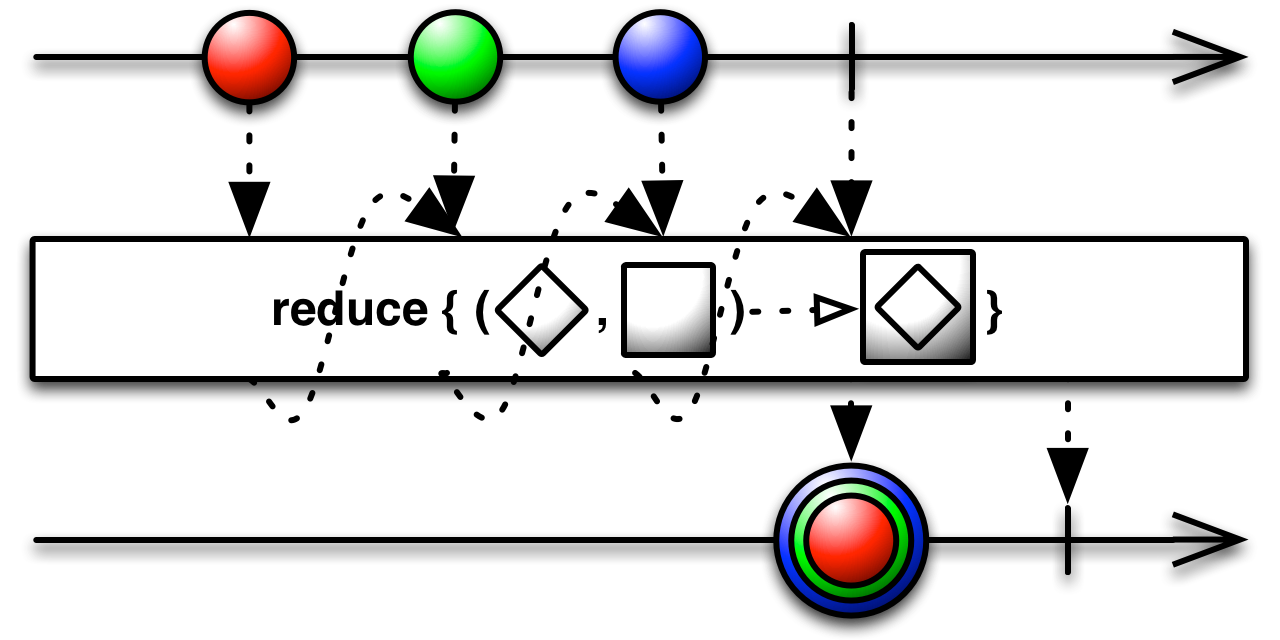
This technique, which is called "reduce" here, is sometimes called "aggregate," "fold," "accumulate," "compress," or "inject" in other programming contexts. Groovy, for instance, has an
injectmethod that does a similar operation on lists.- Backpressure Support:
-
This operator does not support backpressure because by intent it will receive all values and reduce them to a single
onNext. - Scheduler:
-
reducedoes not operate by default on a particularScheduler.
- Parameters:
-
accumulator- an accumulator function to be invoked on each item emitted by the source Observable, whose result will be used in the next accumulator call - Returns:
- an Observable that emits a single item that is the result of accumulating the items emitted by the source Observable
- Throws:
-
IllegalArgumentException- if the source Observable emits no items - See Also:
- RxJava wiki: reduce, Wikipedia: Fold (higher-order function)
reduce
public final <R> Observable
<R> reduce(R initialValue, Func2 <R ,? super T ,R> accumulator) Returns an Observable that applies a specified accumulator function to the first item emitted by a source Observable and a specified seed value, then feeds the result of that function along with the second item emitted by an Observable into the same function, and so on until all items have been emitted by the source Observable, emitting the final result from the final call to your function as its sole item.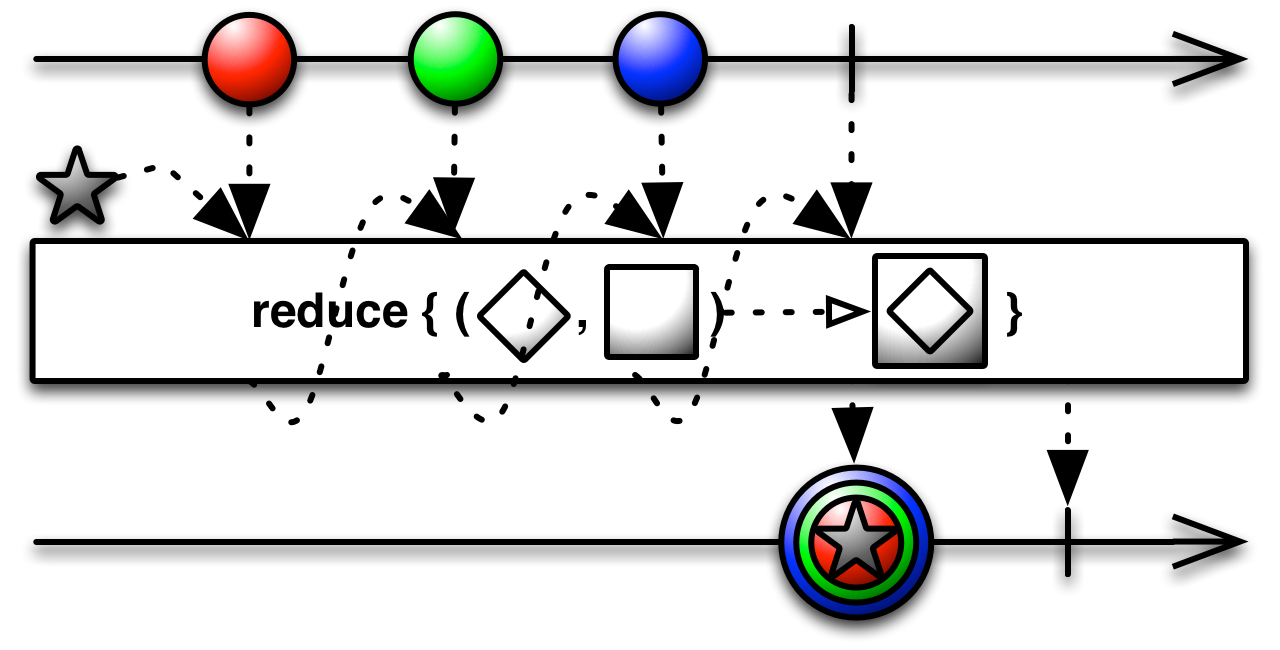
This technique, which is called "reduce" here, is sometimec called "aggregate," "fold," "accumulate," "compress," or "inject" in other programming contexts. Groovy, for instance, has an
injectmethod that does a similar operation on lists.- Backpressure Support:
-
This operator does not support backpressure because by intent it will receive all values and reduce them to a single
onNext. - Scheduler:
-
reducedoes not operate by default on a particularScheduler.
- Parameters:
-
initialValue- the initial (seed) accumulator value -
accumulator- an accumulator function to be invoked on each item emitted by the source Observable, the result of which will be used in the next accumulator call - Returns:
- an Observable that emits a single item that is the result of accumulating the output from the items emitted by the source Observable
- See Also:
- RxJava wiki: reduce, Wikipedia: Fold (higher-order function)
repeat
public final Observable
<T> repeat() Returns an Observable that repeats the sequence of items emitted by the source Observable indefinitely.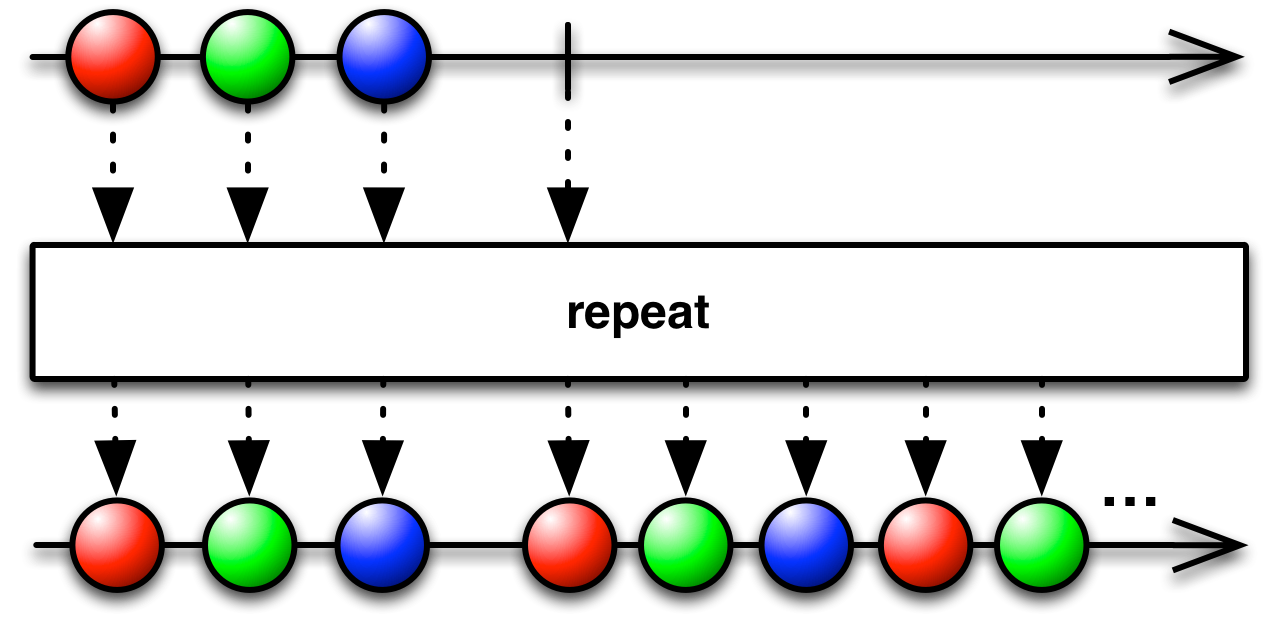
- Scheduler:
-
repeatoperates by default on thetrampolineScheduler.
- Returns:
- an Observable that emits the items emitted by the source Observable repeatedly and in sequence
- See Also:
- RxJava wiki: repeat
repeat
public final Observable
<T> repeat(Scheduler scheduler) Returns an Observable that repeats the sequence of items emitted by the source Observable indefinitely, on a particular Scheduler.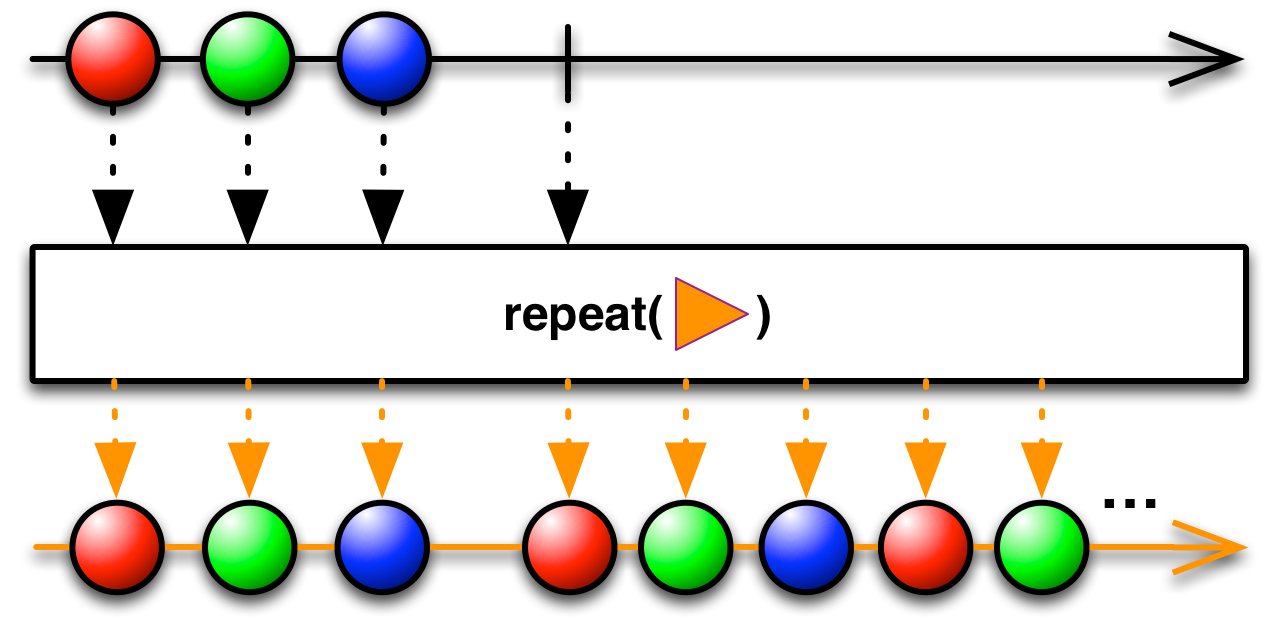
- Scheduler:
-
you specify which
Schedulerthis operator will use
- Parameters:
-
scheduler- the Scheduler to emit the items on - Returns:
- an Observable that emits the items emitted by the source Observable repeatedly and in sequence
- See Also:
- RxJava wiki: repeat
repeat
public final Observable
<T> repeat(long count) Returns an Observable that repeats the sequence of items emitted by the source Observable at mostcounttimes.
- Scheduler:
-
repeatoperates by default on thetrampolineScheduler.
- Parameters:
-
count- the number of times the source Observable items are repeated, a count of 0 will yield an empty sequence - Returns:
-
an Observable that repeats the sequence of items emitted by the source Observable at most
counttimes - Throws:
-
IllegalArgumentException- ifcountis less than zero - See Also:
- RxJava wiki: repeat
repeat
public final Observable
<T> repeat(long count, Scheduler scheduler) Returns an Observable that repeats the sequence of items emitted by the source Observable at mostcounttimes, on a particular Scheduler.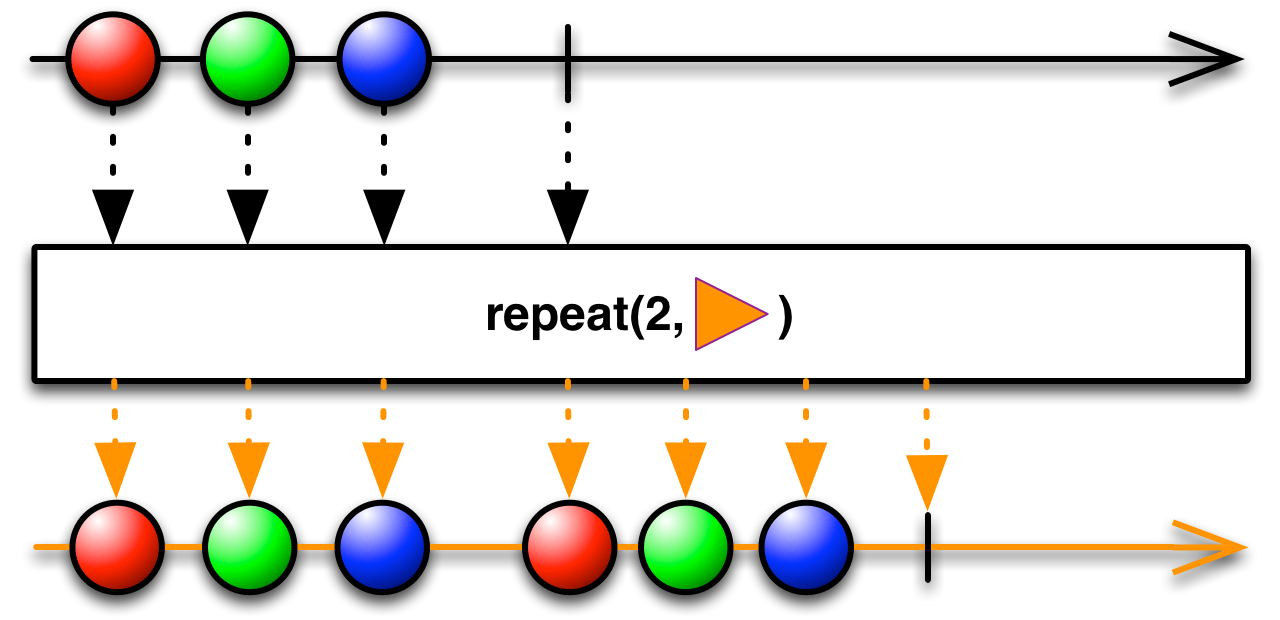
- Scheduler:
-
you specify which
Schedulerthis operator will use
- Parameters:
-
count- the number of times the source Observable items are repeated, a count of 0 will yield an empty sequence -
scheduler- theSchedulerto emit the items on - Returns:
-
an Observable that repeats the sequence of items emitted by the source Observable at most
counttimes on a particular Scheduler - See Also:
- RxJava Wiki: repeat()
repeatWhen
public final Observable
<T> repeatWhen(Func1 <? super Observable <? extends Void > ,? extends Observable <?>> notificationHandler, Scheduler scheduler) Returns an Observable that emits the same values as the source Observable with the exception of anonCompleted. AnonCompletednotification from the source will result in the emission of avoiditem to the Observable provided as an argument to thenotificationHandlerfunction. If that Observable callsonCompleteoronErrorthenrepeatWhenwill callonCompletedoronErroron the child subscription. Otherwise, this Observable will resubscribe to the source Observable, on a particular Scheduler.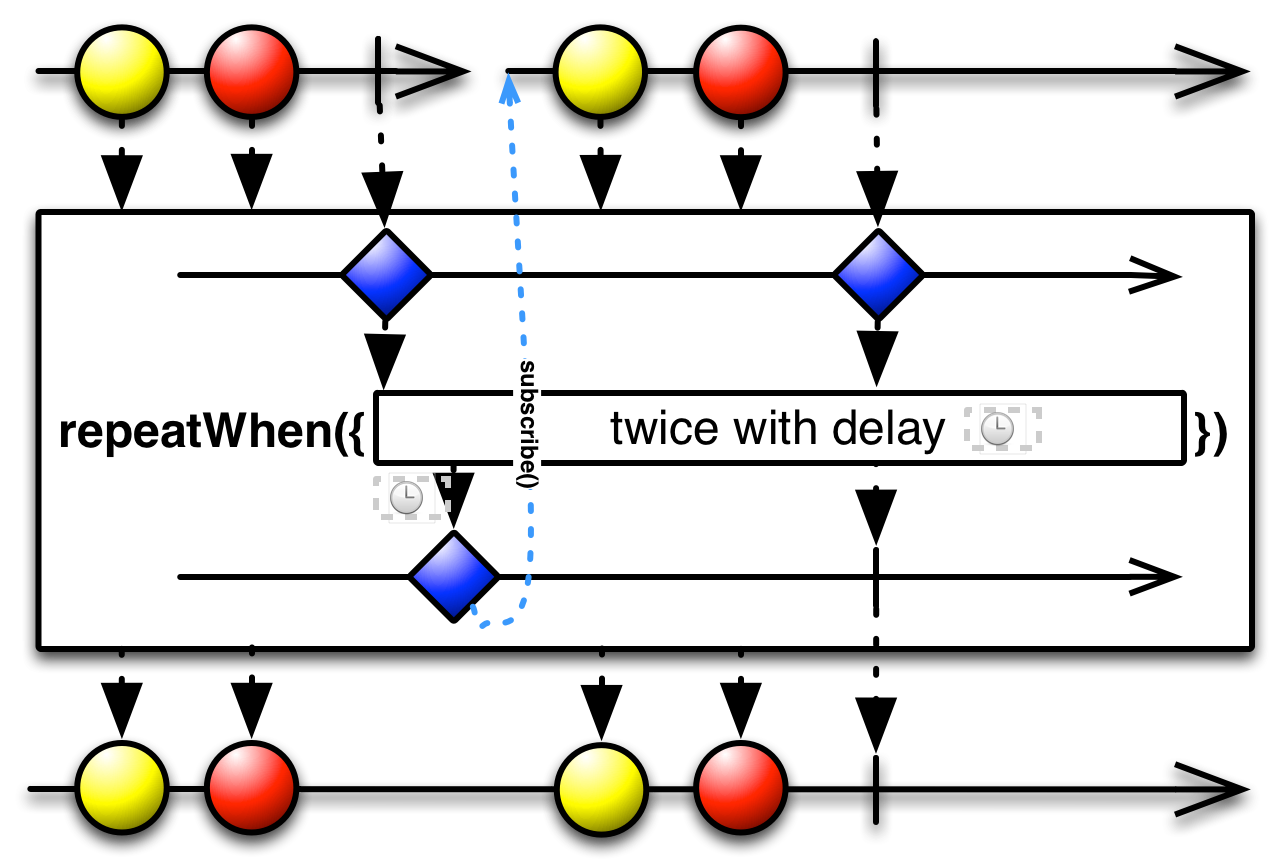
- Scheduler:
-
you specify which
Schedulerthis operator will use
- Parameters:
-
notificationHandler- receives an Observable of notifications with which a user can complete or error, aborting the repeat. -
scheduler- theSchedulerto emit the items on - Returns:
- the source Observable modified with repeat logic
- See Also:
- RxJava Wiki: repeatWhen()
repeatWhen
public final Observable
<T> repeatWhen(Func1 <? super Observable <? extends Void > ,? extends Observable <?>> notificationHandler) Returns an Observable that emits the same values as the source Observable with the exception of anonCompleted. AnonCompletednotification from the source will result in the emission of avoiditem to the Observable provided as an argument to thenotificationHandlerfunction. If that Observable callsonCompleteoronErrorthenrepeatWhenwill callonCompletedoronErroron the child subscription. Otherwise, this Observable will resubscribe to the source observable. - Scheduler:
-
repeatWhenoperates by default on thetrampolineScheduler.
- Parameters:
-
notificationHandler- receives an Observable of notifications with which a user can complete or error, aborting the repeat. - Returns:
- the source Observable modified with repeat logic
- See Also:
- RxJava Wiki: repeatWhen()
replay
public final ConnectableObservable
<T> replay() Returns aConnectableObservablethat shares a single subscription to the underlying Observable that will replay all of its items and notifications to any futureObserver. A Connectable Observable resembles an ordinary Observable, except that it does not begin emitting items when it is subscribed to, but only when itsconnectmethod is called.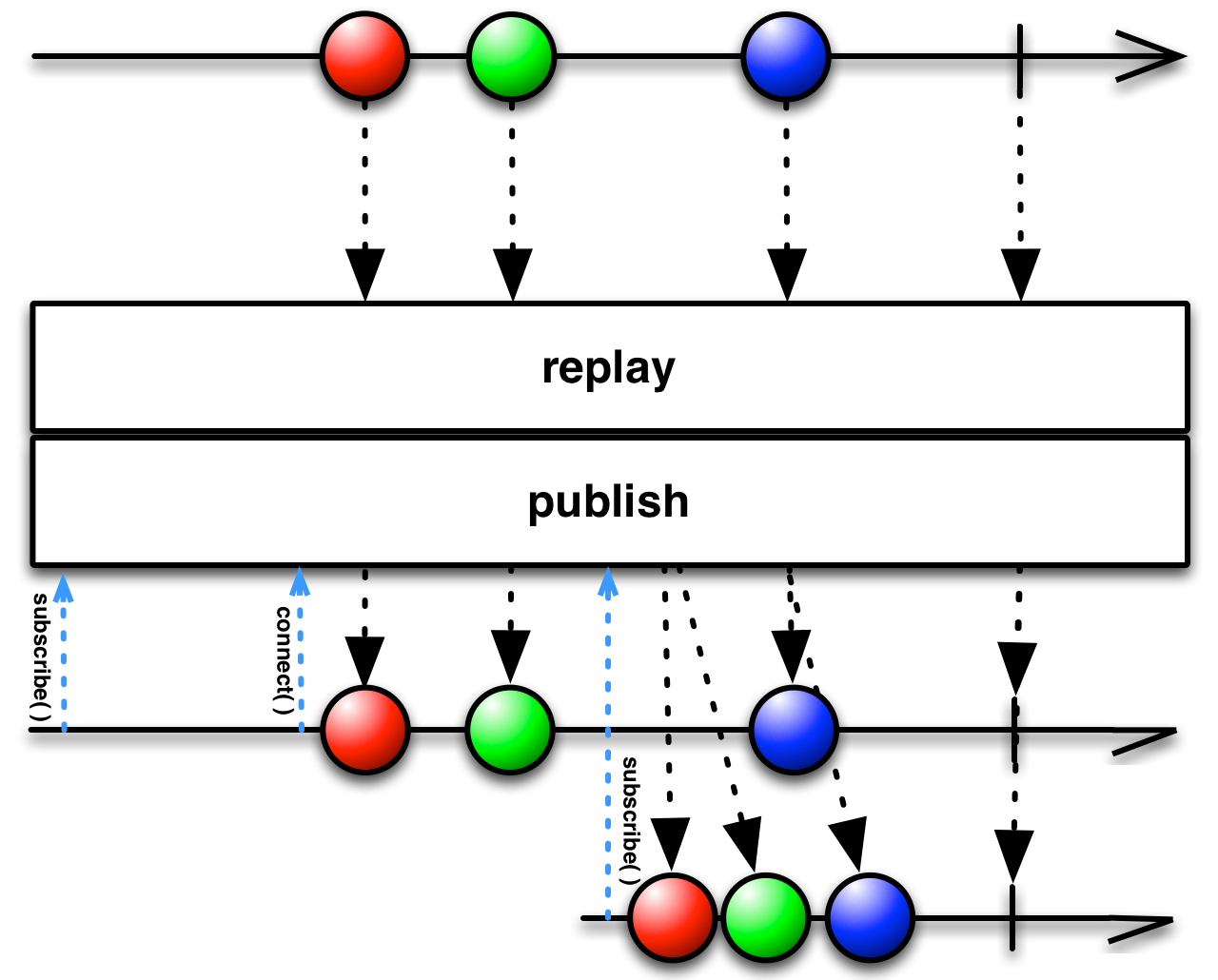
- Backpressure Support:
-
This operator does not support backpressure because multicasting means the stream is "hot" with multiple subscribers. Each child will need to manage backpressure independently using operators such as
onBackpressureDrop()andonBackpressureBuffer(). - Scheduler:
-
This version of
replaydoes not operate by default on a particularScheduler.
- Returns:
-
a
ConnectableObservablethat upon connection causes the source Observable to emit its items to itsObservers - See Also:
- RxJava wiki: replay
replay
public final <R> Observable
<R> replay(Func1 <? super Observable <T> ,? extends Observable <R>> selector) Returns an Observable that emits items that are the results of invoking a specified selector on the items emitted by aConnectableObservablethat shares a single subscription to the source Observable.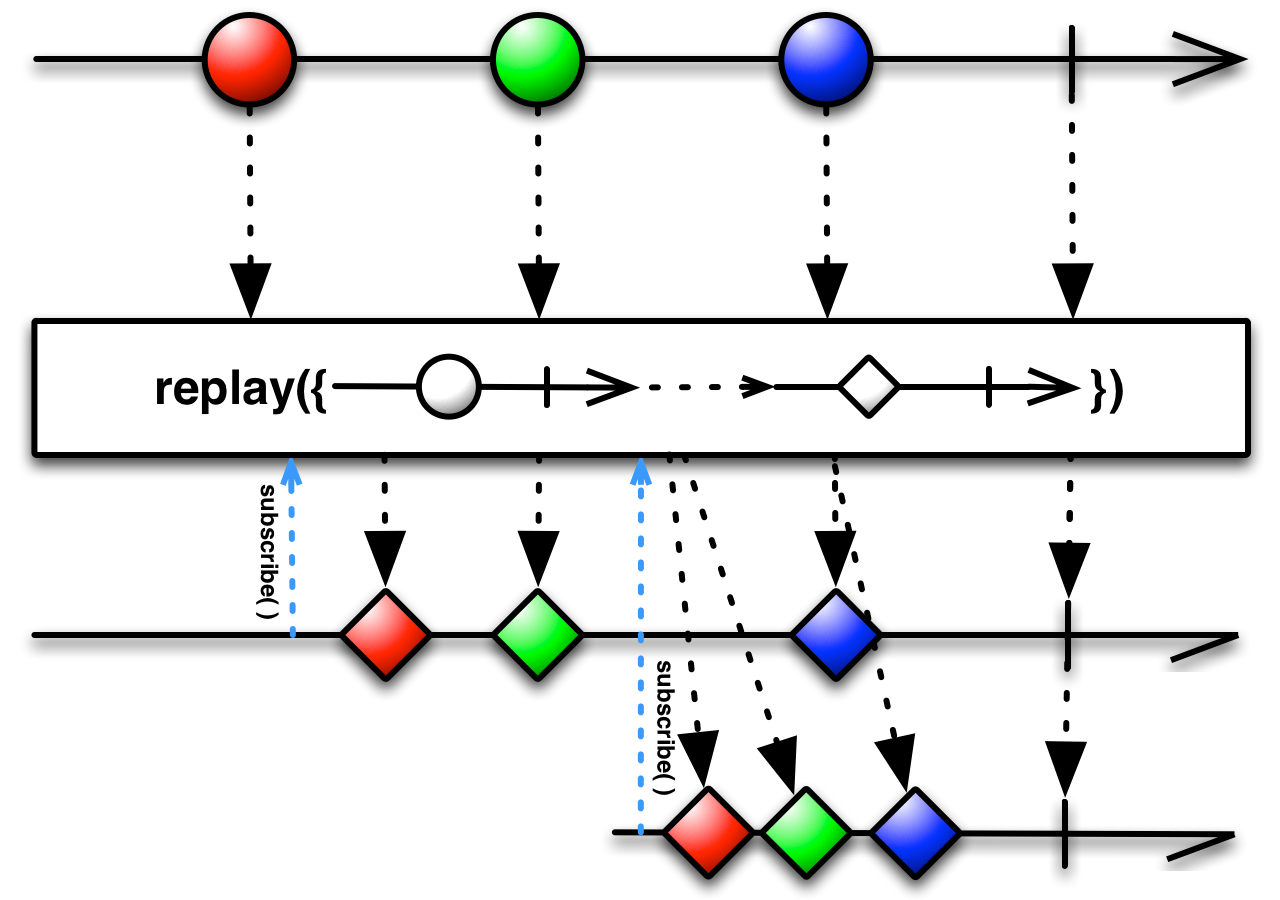
- Backpressure Support:
-
This operator does not support backpressure because multicasting means the stream is "hot" with multiple subscribers. Each child will need to manage backpressure independently using operators such as
onBackpressureDrop()andonBackpressureBuffer(). - Scheduler:
-
This version of
replaydoes not operate by default on a particularScheduler.
- Type Parameters:
-
R- the type of items emitted by the resulting Observable - Parameters:
-
selector- the selector function, which can use the multicasted sequence as many times as needed, without causing multiple subscriptions to the Observable - Returns:
-
an Observable that emits items that are the results of invoking the selector on a
ConnectableObservablethat shares a single subscription to the source Observable - See Also:
- RxJava wiki: replay
replay
public final <R> Observable
<R> replay(Func1 <? super Observable <T> ,? extends Observable <R>> selector, int bufferSize) Returns an Observable that emits items that are the results of invoking a specified selector on items emitted by aConnectableObservablethat shares a single subscription to the source Observable, replayingbufferSizenotifications.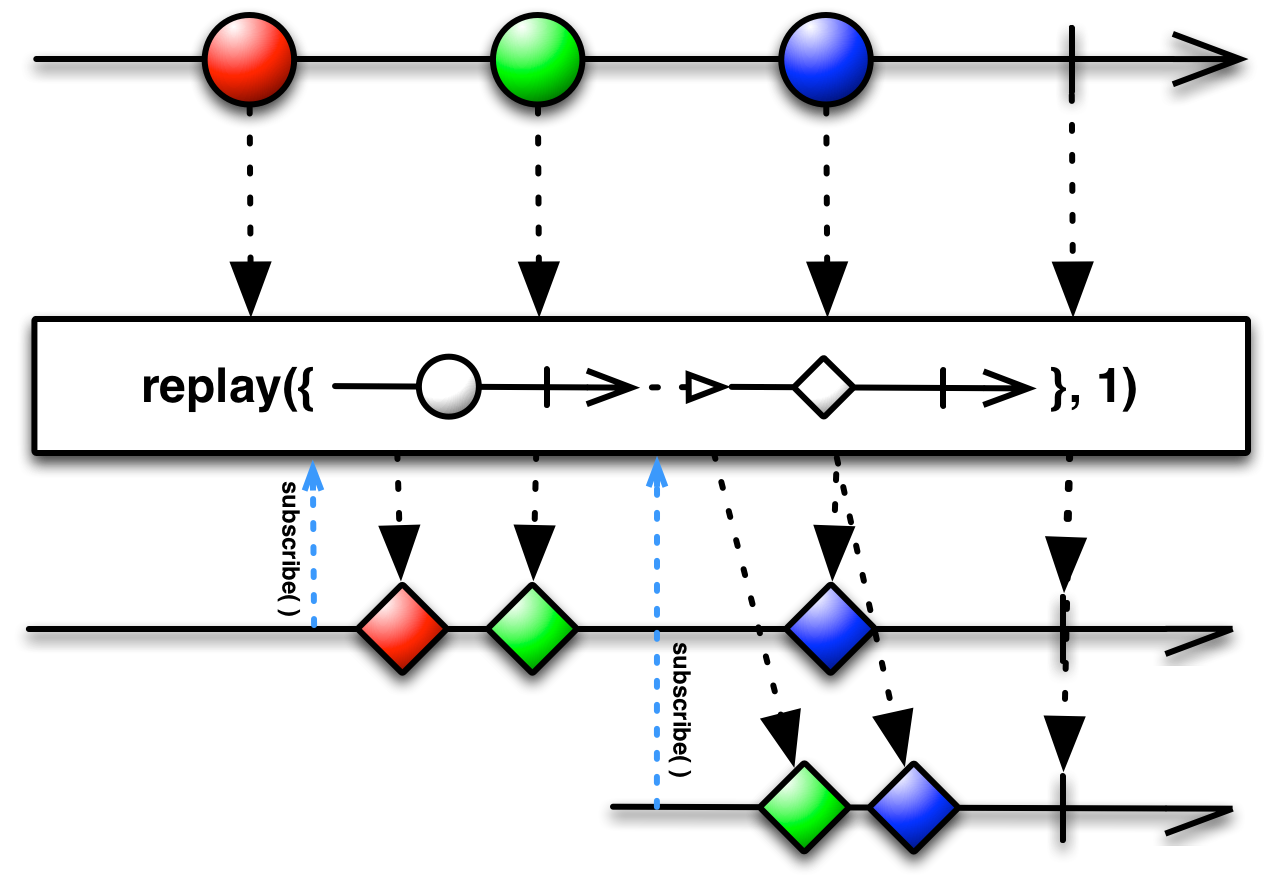
- Backpressure Support:
-
This operator does not support backpressure because multicasting means the stream is "hot" with multiple subscribers. Each child will need to manage backpressure independently using operators such as
onBackpressureDrop()andonBackpressureBuffer(). - Scheduler:
-
This version of
replaydoes not operate by default on a particularScheduler.
- Type Parameters:
-
R- the type of items emitted by the resulting Observable - Parameters:
-
selector- the selector function, which can use the multicasted sequence as many times as needed, without causing multiple subscriptions to the Observable -
bufferSize- the buffer size that limits the number of items the connectable observable can replay - Returns:
-
an Observable that emits items that are the results of invoking the selector on items emitted by a
ConnectableObservablethat shares a single subscription to the source Observable replaying no more thanbufferSizeitems - See Also:
- RxJava wiki: replay
replay
public final <R> Observable
<R> replay(Func1 <? super Observable <T> ,? extends Observable <R>> selector, int bufferSize, long time, TimeUnit unit) Returns an Observable that emits items that are the results of invoking a specified selector on items emitted by aConnectableObservablethat shares a single subscription to the source Observable, replaying no more thanbufferSizeitems that were emitted within a specified time window.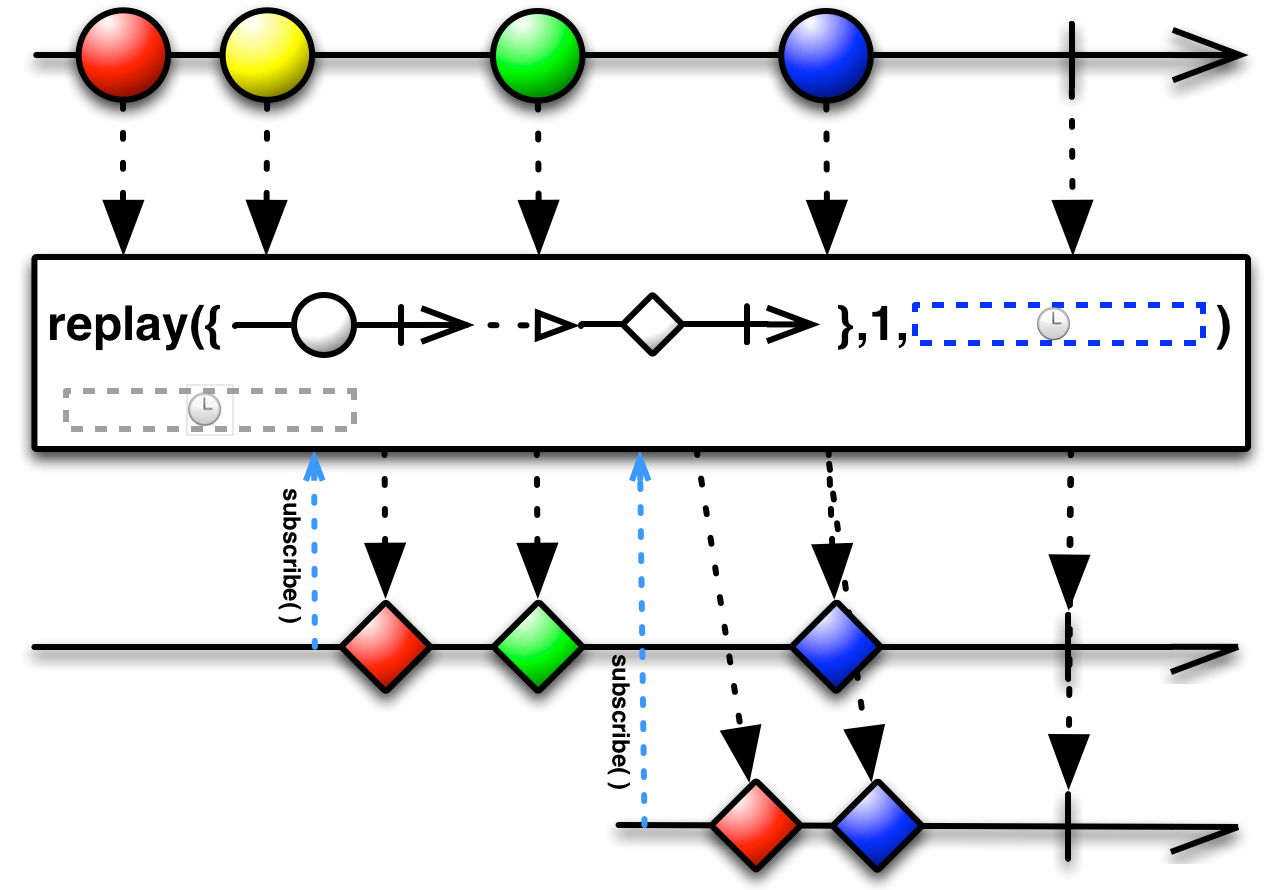
- Backpressure Support:
-
This operator does not support backpressure because multicasting means the stream is "hot" with multiple subscribers. Each child will need to manage backpressure independently using operators such as
onBackpressureDrop()andonBackpressureBuffer(). - Scheduler:
-
This version of
replayoperates by default on thecomputationScheduler.
- Type Parameters:
-
R- the type of items emitted by the resulting Observable - Parameters:
-
selector- a selector function, which can use the multicasted sequence as many times as needed, without causing multiple subscriptions to the Observable -
bufferSize- the buffer size that limits the number of items the connectable observable can replay -
time- the duration of the window in which the replayed items must have been emitted -
unit- the time unit oftime - Returns:
-
an Observable that emits items that are the results of invoking the selector on items emitted by a
ConnectableObservablethat shares a single subscription to the source Observable, and replays no more thanbufferSizeitems that were emitted within the window defined bytime - See Also:
- RxJava wiki: replay
replay
public final <R> Observable
<R> replay(Func1 <? super Observable <T> ,? extends Observable <R>> selector, int bufferSize, long time, TimeUnit unit, Scheduler scheduler) Returns an Observable that emits items that are the results of invoking a specified selector on items emitted by aConnectableObservablethat shares a single subscription to the source Observable, replaying no more thanbufferSizeitems that were emitted within a specified time window.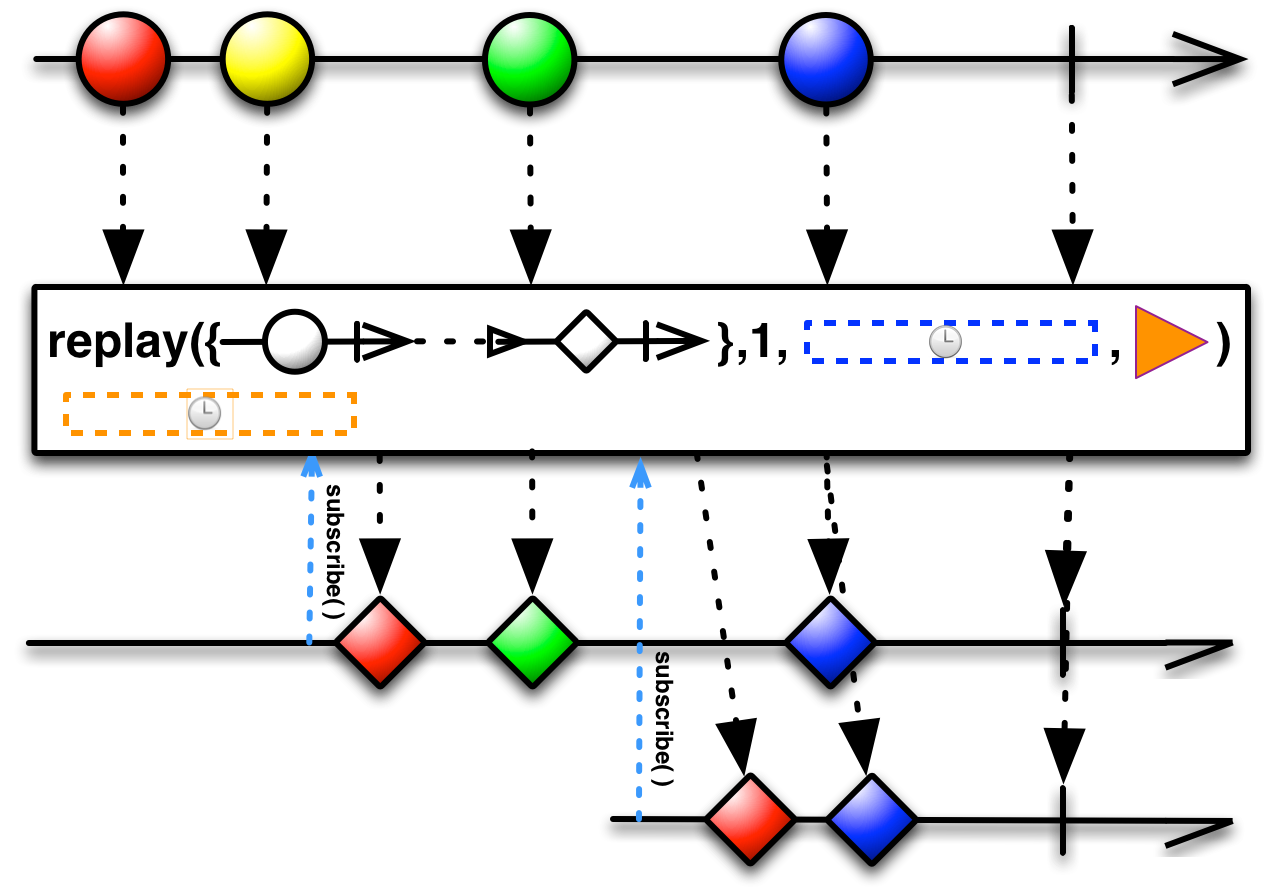
- Backpressure Support:
-
This operator does not support backpressure because multicasting means the stream is "hot" with multiple subscribers. Each child will need to manage backpressure independently using operators such as
onBackpressureDrop()andonBackpressureBuffer(). - Scheduler:
-
you specify which
Schedulerthis operator will use
- Type Parameters:
-
R- the type of items emitted by the resulting Observable - Parameters:
-
selector- a selector function, which can use the multicasted sequence as many times as needed, without causing multiple subscriptions to the Observable -
bufferSize- the buffer size that limits the number of items the connectable observable can replay -
time- the duration of the window in which the replayed items must have been emitted -
unit- the time unit oftime -
scheduler- the Scheduler that is the time source for the window - Returns:
-
an Observable that emits items that are the results of invoking the selector on items emitted by a
ConnectableObservablethat shares a single subscription to the source Observable, and replays no more thanbufferSizeitems that were emitted within the window defined bytime - Throws:
-
IllegalArgumentException- ifbufferSizeis less than zero - See Also:
- RxJava wiki: replay
replay
public final <R> Observable
<R> replay(Func1 <? super Observable <T> ,? extends Observable <R>> selector, int bufferSize, Scheduler scheduler) Returns an Observable that emits items that are the results of invoking a specified selector on items emitted by aConnectableObservablethat shares a single subscription to the source Observable, replaying a maximum ofbufferSizeitems.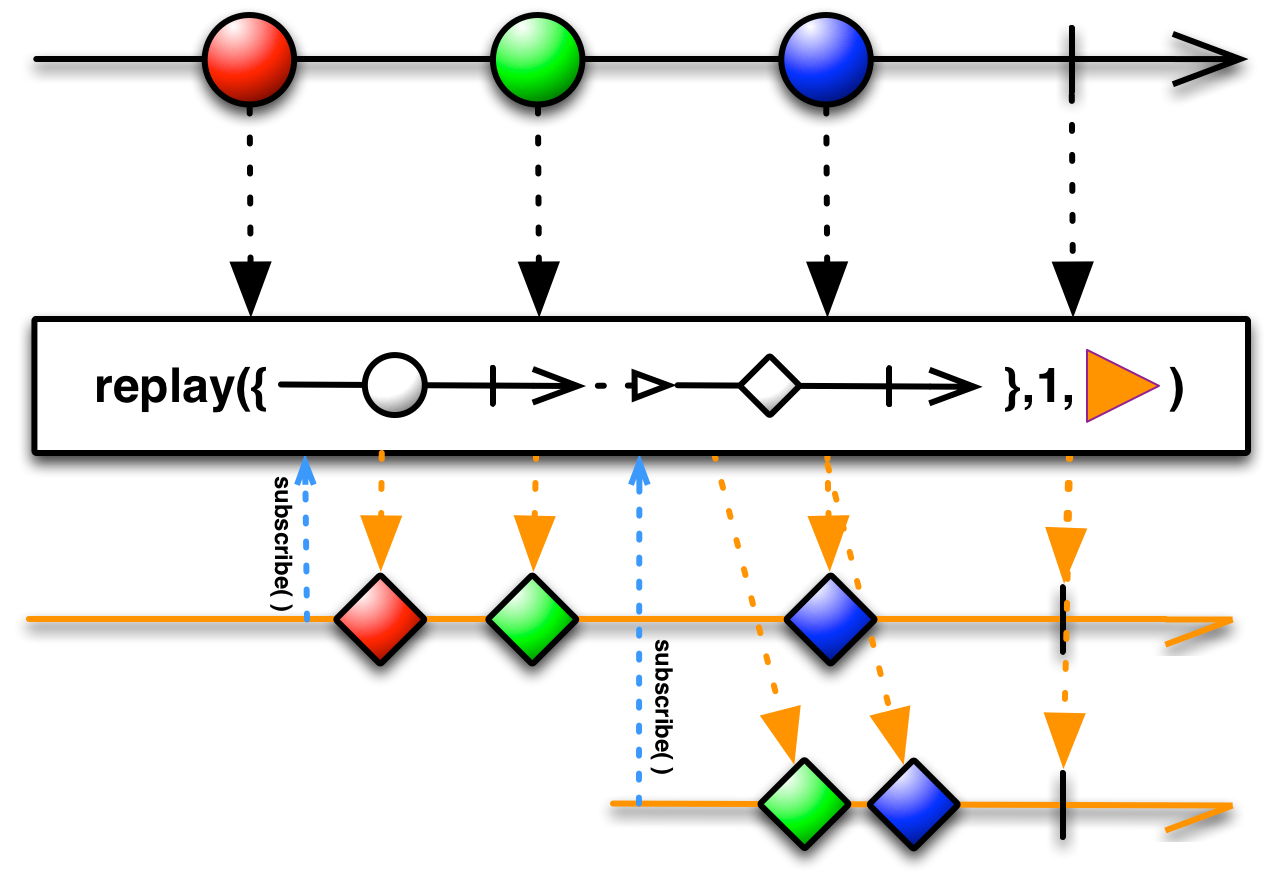
- Backpressure Support:
-
This operator does not support backpressure because multicasting means the stream is "hot" with multiple subscribers. Each child will need to manage backpressure independently using operators such as
onBackpressureDrop()andonBackpressureBuffer(). - Scheduler:
-
you specify which
Schedulerthis operator will use
- Type Parameters:
-
R- the type of items emitted by the resulting Observable - Parameters:
-
selector- a selector function, which can use the multicasted sequence as many times as needed, without causing multiple subscriptions to the Observable -
bufferSize- the buffer size that limits the number of items the connectable observable can replay -
scheduler- the Scheduler on which the replay is observed - Returns:
-
an Observable that emits items that are the results of invoking the selector on items emitted by a
ConnectableObservablethat shares a single subscription to the source Observable, replaying no more thanbufferSizenotifications - See Also:
- RxJava wiki: replay
replay
public final <R> Observable
<R> replay(Func1 <? super Observable <T> ,? extends Observable <R>> selector, long time, TimeUnit unit) Returns an Observable that emits items that are the results of invoking a specified selector on items emitted by aConnectableObservablethat shares a single subscription to the source Observable, replaying all items that were emitted within a specified time window.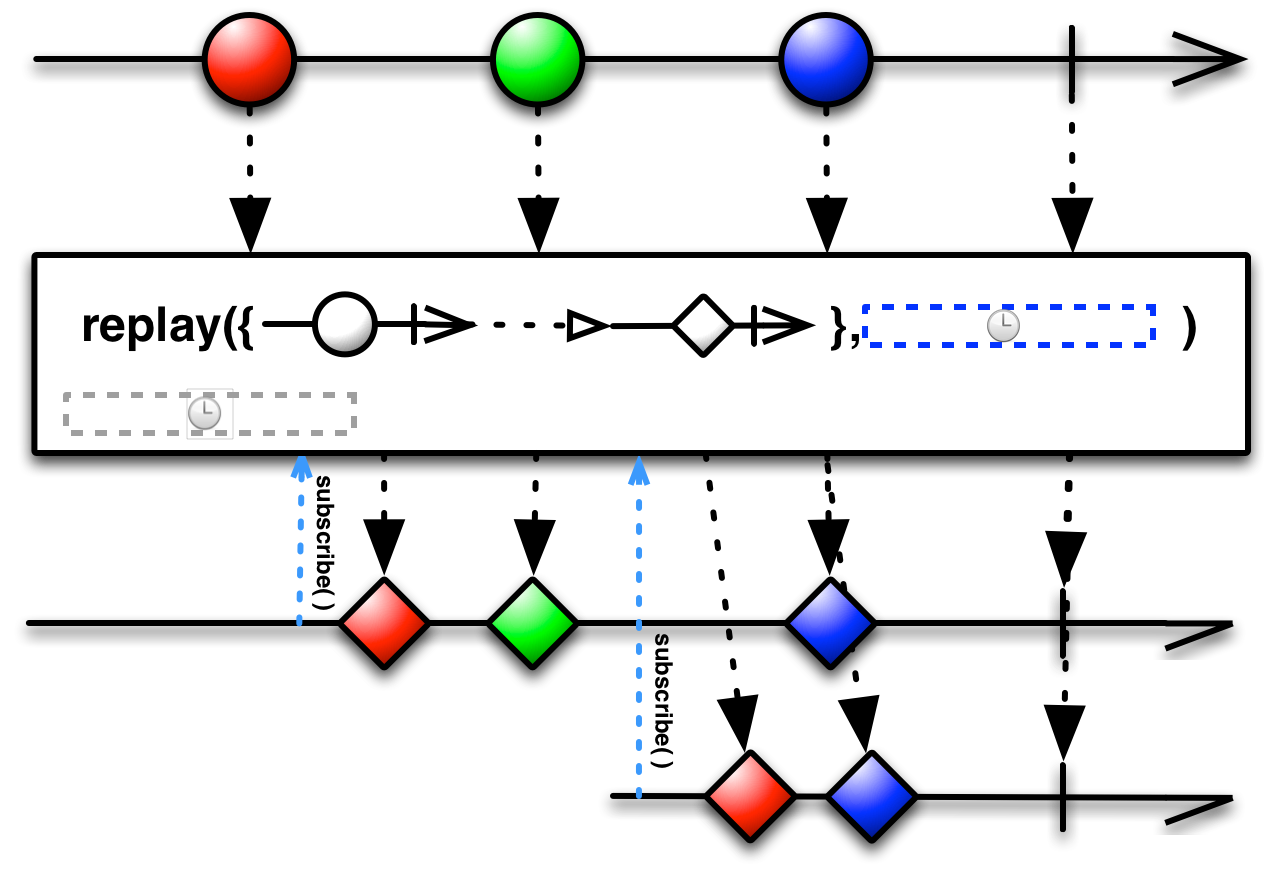
- Backpressure Support:
-
This operator does not support backpressure because multicasting means the stream is "hot" with multiple subscribers. Each child will need to manage backpressure independently using operators such as
onBackpressureDrop()andonBackpressureBuffer(). - Scheduler:
-
This version of
replayoperates by default on thecomputationScheduler.
- Type Parameters:
-
R- the type of items emitted by the resulting Observable - Parameters:
-
selector- a selector function, which can use the multicasted sequence as many times as needed, without causing multiple subscriptions to the Observable -
time- the duration of the window in which the replayed items must have been emitted -
unit- the time unit oftime - Returns:
-
an Observable that emits items that are the results of invoking the selector on items emitted by a
ConnectableObservablethat shares a single subscription to the source Observable, replaying all items that were emitted within the window defined bytime - See Also:
- RxJava wiki: replay
replay
public final <R> Observable
<R> replay(Func1 <? super Observable <T> ,? extends Observable <R>> selector, long time, TimeUnit unit, Scheduler scheduler) Returns an Observable that emits items that are the results of invoking a specified selector on items emitted by aConnectableObservablethat shares a single subscription to the source Observable, replaying all items that were emitted within a specified time window.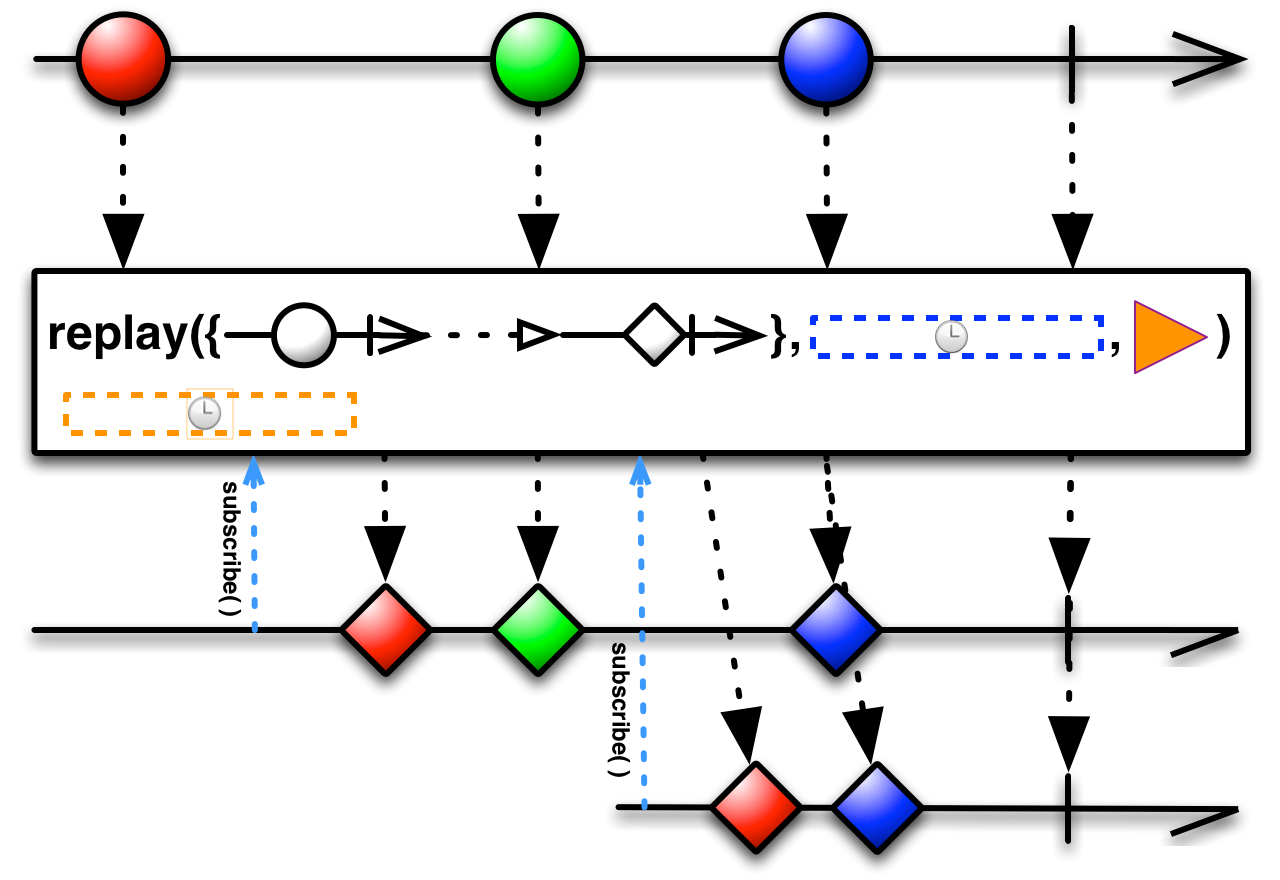
- Backpressure Support:
-
This operator does not support backpressure because multicasting means the stream is "hot" with multiple subscribers. Each child will need to manage backpressure independently using operators such as
onBackpressureDrop()andonBackpressureBuffer(). - Scheduler:
-
you specify which
Schedulerthis operator will use
- Type Parameters:
-
R- the type of items emitted by the resulting Observable - Parameters:
-
selector- a selector function, which can use the multicasted sequence as many times as needed, without causing multiple subscriptions to the Observable -
time- the duration of the window in which the replayed items must have been emitted -
unit- the time unit oftime -
scheduler- the scheduler that is the time source for the window - Returns:
-
an Observable that emits items that are the results of invoking the selector on items emitted by a
ConnectableObservablethat shares a single subscription to the source Observable, replaying all items that were emitted within the window defined bytime - See Also:
- RxJava wiki: replay
replay
public final <R> Observable
<R> replay(Func1 <? super Observable <T> ,? extends Observable <R>> selector, Scheduler scheduler) Returns an Observable that emits items that are the results of invoking a specified selector on items emitted by aConnectableObservablethat shares a single subscription to the source Observable.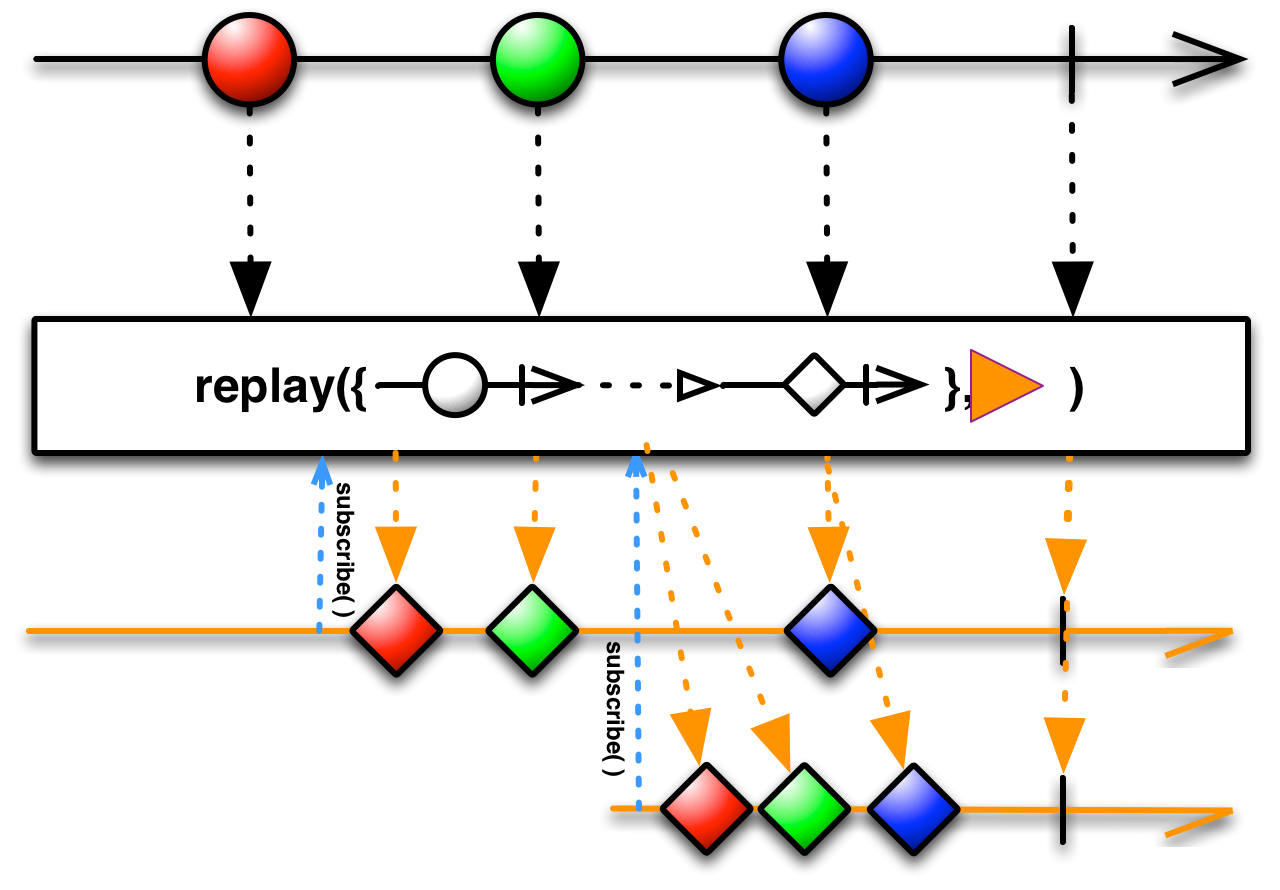
- Backpressure Support:
-
This operator does not support backpressure because multicasting means the stream is "hot" with multiple subscribers. Each child will need to manage backpressure independently using operators such as
onBackpressureDrop()andonBackpressureBuffer(). - Scheduler:
-
you specify which
Schedulerthis operator will use
- Type Parameters:
-
R- the type of items emitted by the resulting Observable - Parameters:
-
selector- a selector function, which can use the multicasted sequence as many times as needed, without causing multiple subscriptions to the Observable -
scheduler- the Scheduler where the replay is observed - Returns:
-
an Observable that emits items that are the results of invoking the selector on items emitted by a
ConnectableObservablethat shares a single subscription to the source Observable, replaying all items - See Also:
- RxJava wiki: replay
replay
public final ConnectableObservable
<T> replay(int bufferSize) Returns aConnectableObservablethat shares a single subscription to the source Observable that replays at mostbufferSizeitems emitted by that Observable. A Connectable Observable resembles an ordinary Observable, except that it does not begin emitting items when it is subscribed to, but only when itsconnectmethod is called.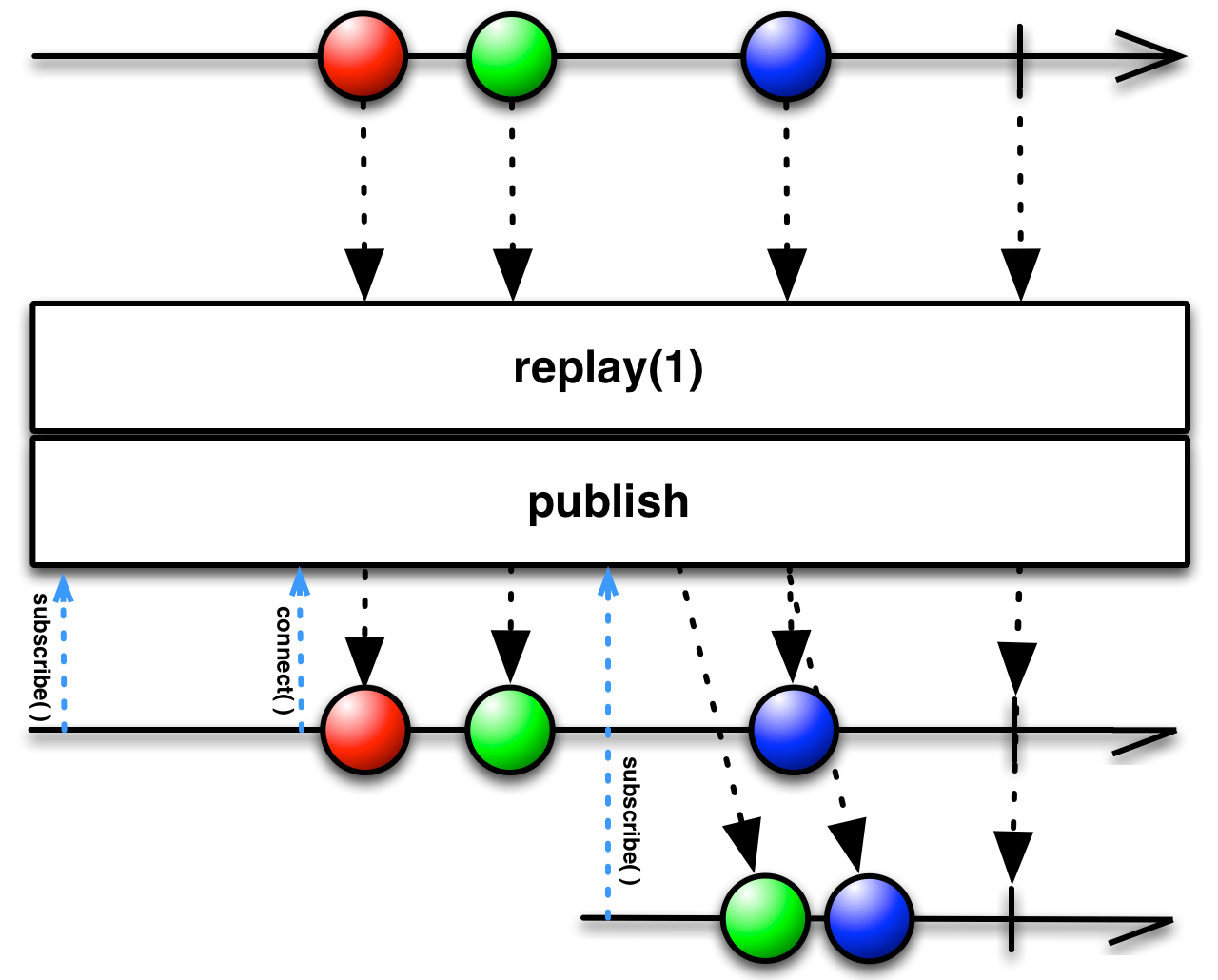
- Backpressure Support:
-
This operator does not support backpressure because multicasting means the stream is "hot" with multiple subscribers. Each child will need to manage backpressure independently using operators such as
onBackpressureDrop()andonBackpressureBuffer(). - Scheduler:
-
This version of
replaydoes not operate by default on a particularScheduler.
- Parameters:
-
bufferSize- the buffer size that limits the number of items that can be replayed - Returns:
-
a
ConnectableObservablethat shares a single subscription to the source Observable and replays at mostbufferSizeitems emitted by that Observable - See Also:
- RxJava wiki: replay
replay
public final ConnectableObservable
<T> replay(int bufferSize, long time, TimeUnit unit) Returns aConnectableObservablethat shares a single subscription to the source Observable and replays at mostbufferSizeitems that were emitted during a specified time window. A Connectable Observable resembles an ordinary Observable, except that it does not begin emitting items when it is subscribed to, but only when itsconnectmethod is called.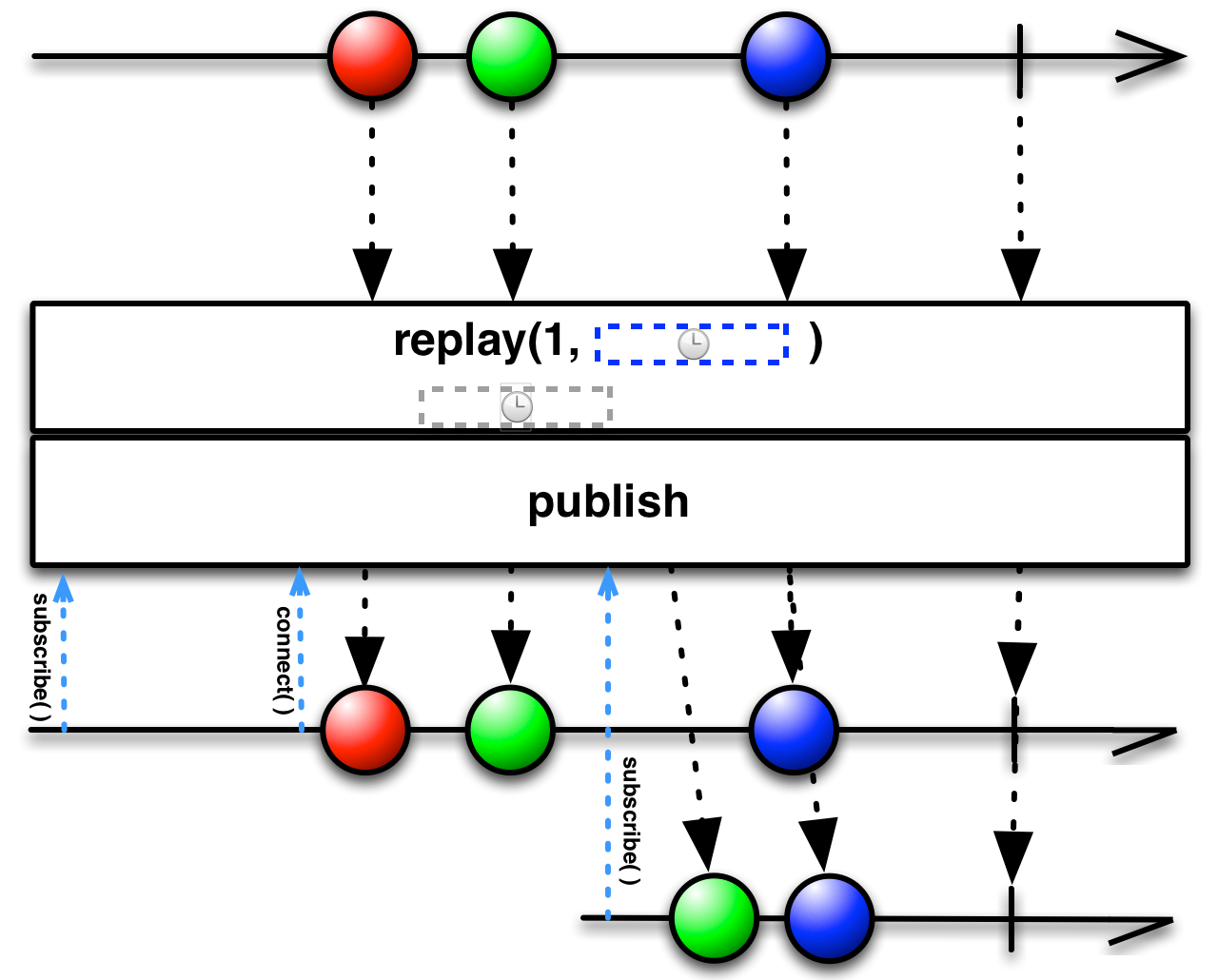
- Backpressure Support:
-
This operator does not support backpressure because multicasting means the stream is "hot" with multiple subscribers. Each child will need to manage backpressure independently using operators such as
onBackpressureDrop()andonBackpressureBuffer(). - Scheduler:
-
This version of
replayoperates by default on thecomputationScheduler.
- Parameters:
-
bufferSize- the buffer size that limits the number of items that can be replayed -
time- the duration of the window in which the replayed items must have been emitted -
unit- the time unit oftime - Returns:
-
a
ConnectableObservablethat shares a single subscription to the source Observable and replays at mostbufferSizeitems that were emitted during the window defined bytime - See Also:
- RxJava wiki: replay
replay
public final ConnectableObservable
<T> replay(int bufferSize, long time, TimeUnit unit, Scheduler scheduler) Returns aConnectableObservablethat shares a single subscription to the source Observable and that replays a maximum ofbufferSizeitems that are emitted within a specified time window. A Connectable Observable resembles an ordinary Observable, except that it does not begin emitting items when it is subscribed to, but only when itsconnectmethod is called.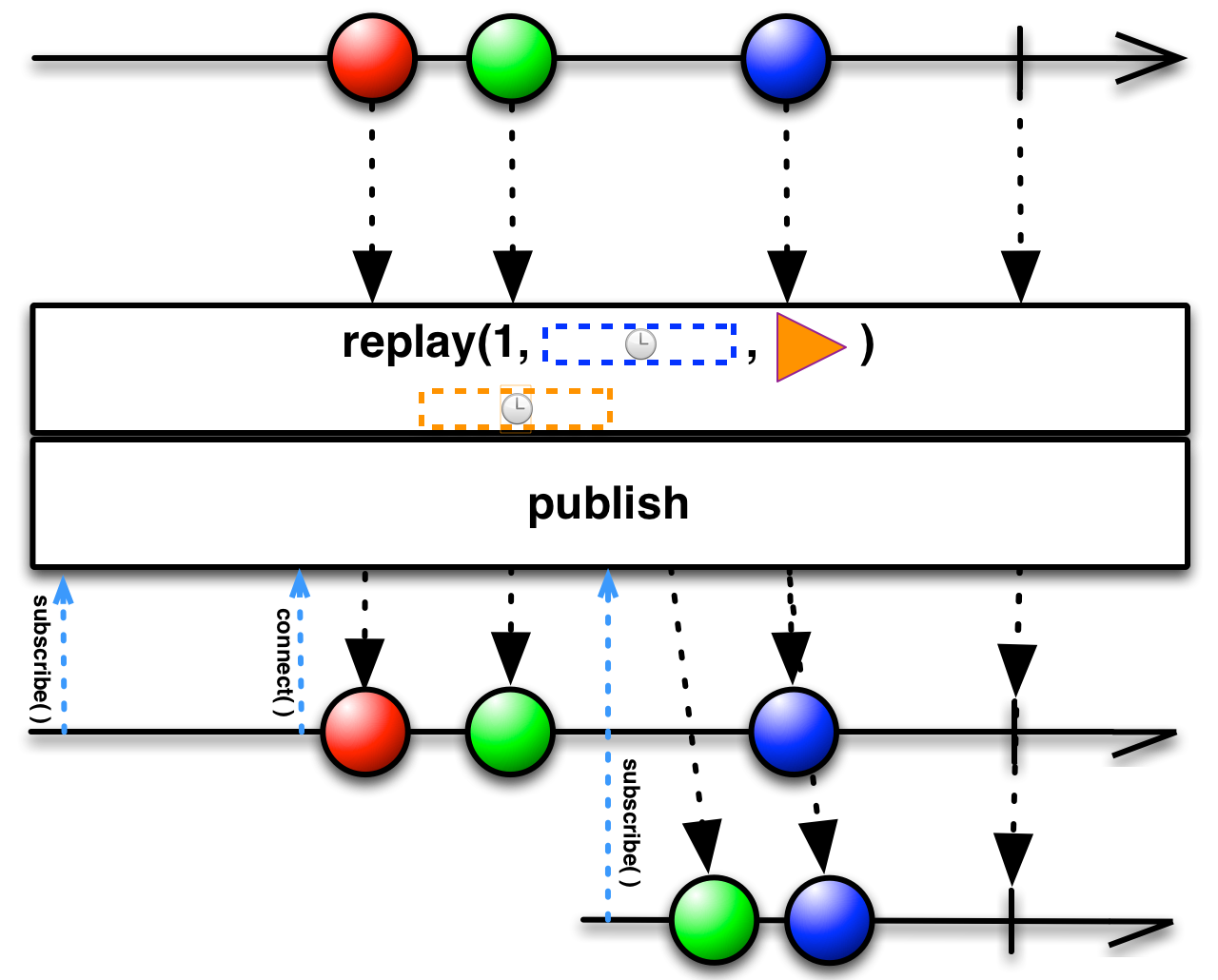
- Backpressure Support:
-
This operator does not support backpressure because multicasting means the stream is "hot" with multiple subscribers. Each child will need to manage backpressure independently using operators such as
onBackpressureDrop()andonBackpressureBuffer(). - Scheduler:
-
you specify which
Schedulerthis operator will use
- Parameters:
-
bufferSize- the buffer size that limits the number of items that can be replayed -
time- the duration of the window in which the replayed items must have been emitted -
unit- the time unit oftime -
scheduler- the scheduler that is used as a time source for the window - Returns:
-
a
ConnectableObservablethat shares a single subscription to the source Observable and replays at mostbufferSizeitems that were emitted during the window defined bytime - Throws:
-
IllegalArgumentException- ifbufferSizeis less than zero - See Also:
- RxJava wiki: replay
replay
public final ConnectableObservable
<T> replay(int bufferSize, Scheduler scheduler) Returns aConnectableObservablethat shares a single subscription to the source Observable and replays at mostbufferSizeitems emitted by that Observable. A Connectable Observable resembles an ordinary Observable, except that it does not begin emitting items when it is subscribed to, but only when itsconnectmethod is called.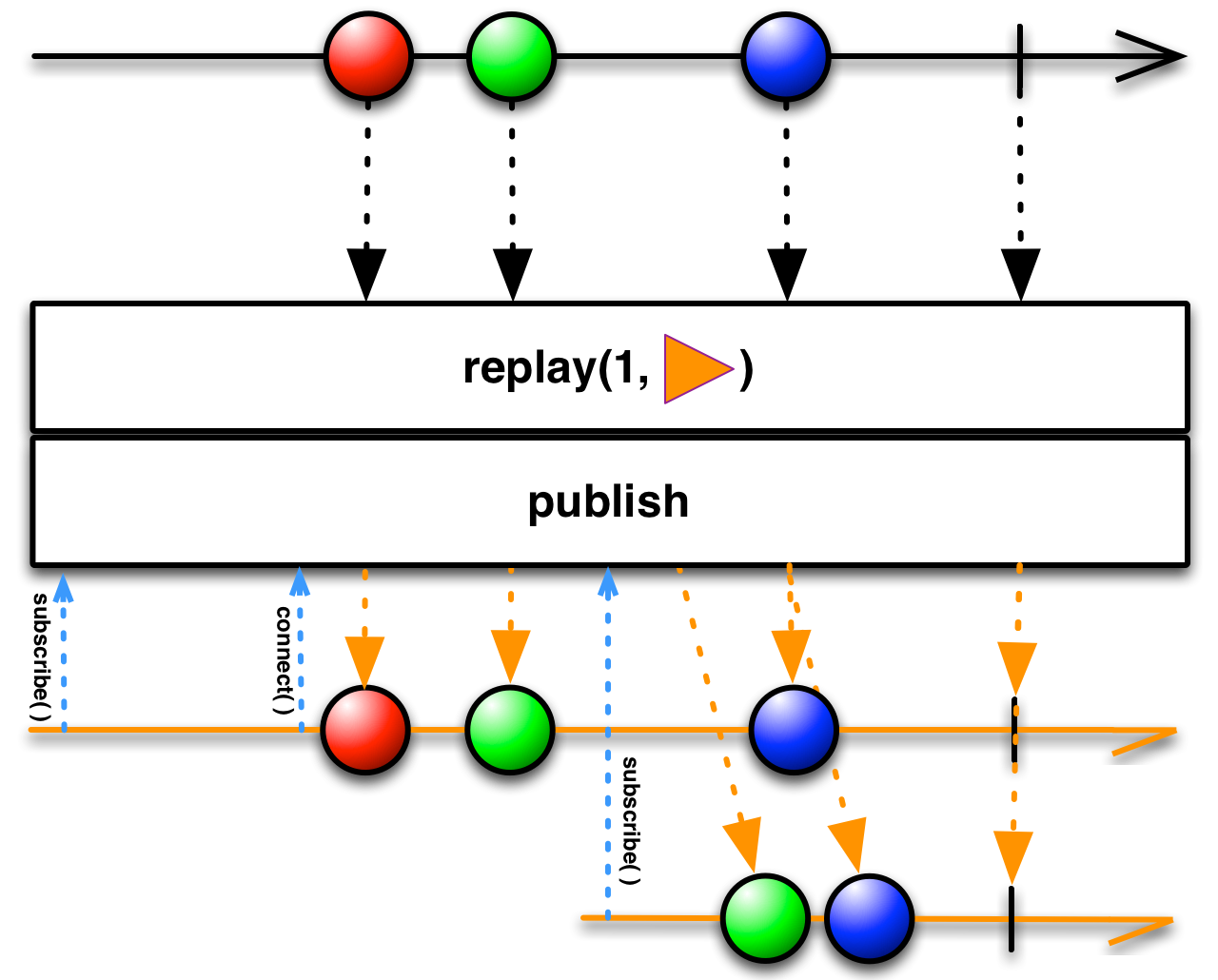
- Backpressure Support:
-
This operator does not support backpressure because multicasting means the stream is "hot" with multiple subscribers. Each child will need to manage backpressure independently using operators such as
onBackpressureDrop()andonBackpressureBuffer(). - Scheduler:
-
you specify which
Schedulerthis operator will use
- Parameters:
-
bufferSize- the buffer size that limits the number of items that can be replayed -
scheduler- the scheduler on which the Observers will observe the emitted items - Returns:
-
a
ConnectableObservablethat shares a single subscription to the source Observable and replays at mostbufferSizeitems that were emitted by the Observable - See Also:
- RxJava wiki: replay
replay
public final ConnectableObservable
<T> replay(long time, TimeUnit unit) Returns aConnectableObservablethat shares a single subscription to the source Observable and replays all items emitted by that Observable within a specified time window. A Connectable Observable resembles an ordinary Observable, except that it does not begin emitting items when it is subscribed to, but only when itsconnectmethod is called.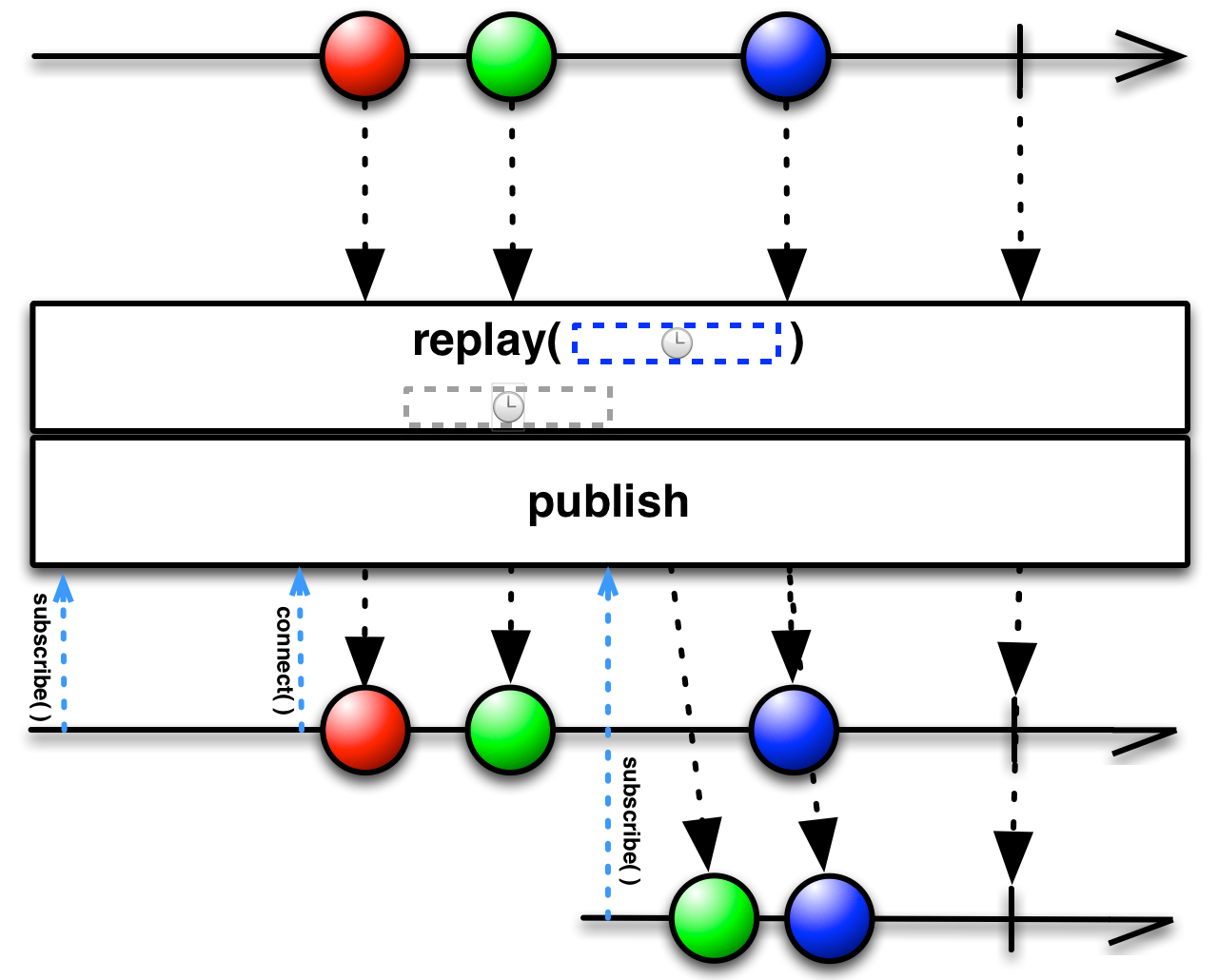
- Backpressure Support:
-
This operator does not support backpressure because multicasting means the stream is "hot" with multiple subscribers. Each child will need to manage backpressure independently using operators such as
onBackpressureDrop()andonBackpressureBuffer(). - Scheduler:
-
This version of
replayoperates by default on thecomputationScheduler.
- Parameters:
-
time- the duration of the window in which the replayed items must have been emitted -
unit- the time unit oftime - Returns:
-
a
ConnectableObservablethat shares a single subscription to the source Observable and replays the items that were emitted during the window defined bytime - See Also:
- RxJava wiki: replay
replay
public final ConnectableObservable
<T> replay(long time, TimeUnit unit, Scheduler scheduler) Returns aConnectableObservablethat shares a single subscription to the source Observable and replays all items emitted by that Observable within a specified time window. A Connectable Observable resembles an ordinary Observable, except that it does not begin emitting items when it is subscribed to, but only when itsconnectmethod is called.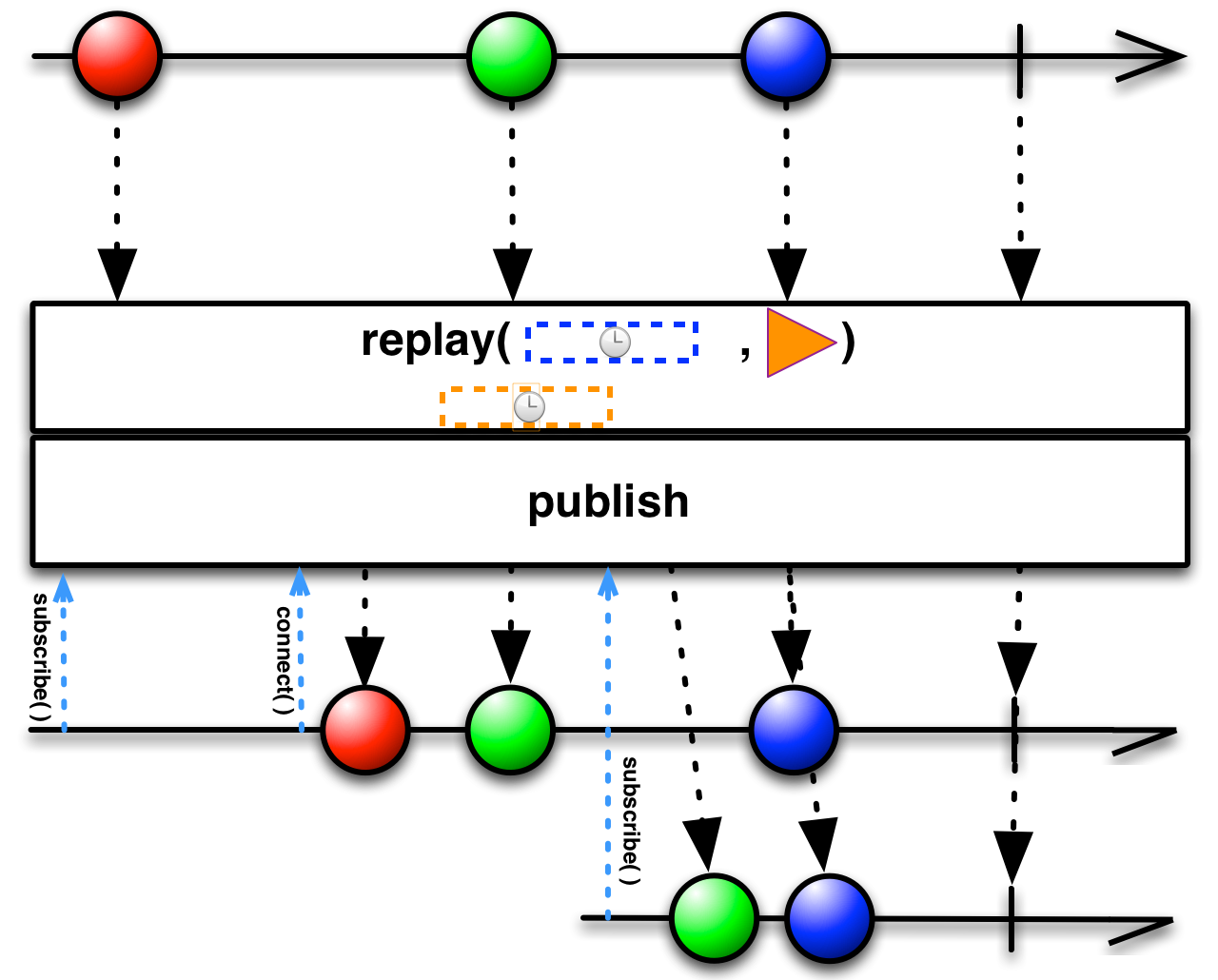
- Backpressure Support:
-
This operator does not support backpressure because multicasting means the stream is "hot" with multiple subscribers. Each child will need to manage backpressure independently using operators such as
onBackpressureDrop()andonBackpressureBuffer(). - Scheduler:
-
you specify which
Schedulerthis operator will use
- Parameters:
-
time- the duration of the window in which the replayed items must have been emitted -
unit- the time unit oftime -
scheduler- the Scheduler that is the time source for the window - Returns:
-
a
ConnectableObservablethat shares a single subscription to the source Observable and replays the items that were emitted during the window defined bytime - See Also:
- RxJava wiki: replay
replay
public final ConnectableObservable
<T> replay(Scheduler scheduler) Returns aConnectableObservablethat shares a single subscription to the source Observable that will replay all of its items and notifications to any futureObserveron the givenScheduler. A Connectable Observable resembles an ordinary Observable, except that it does not begin emitting items when it is subscribed to, but only when itsconnectmethod is called.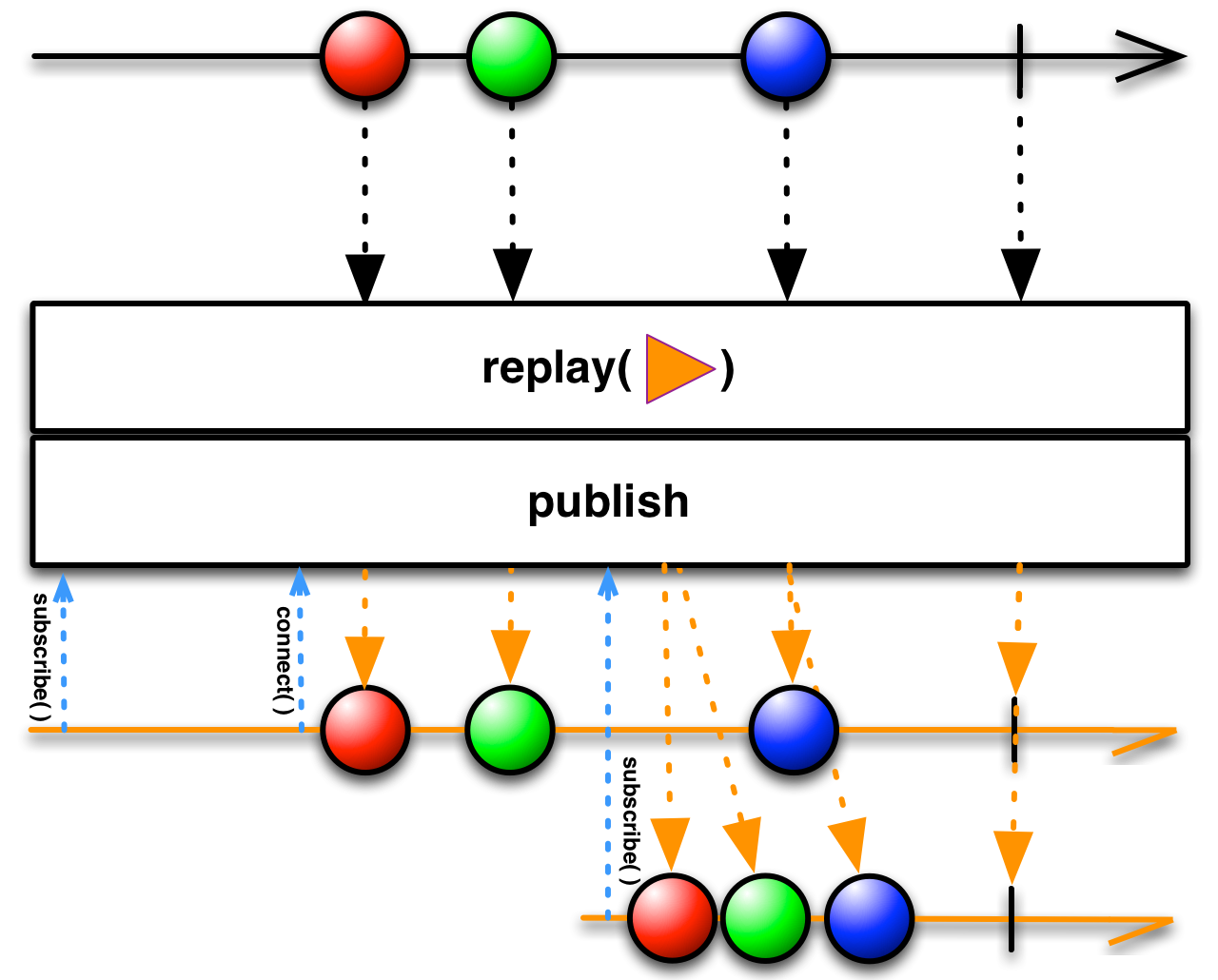
- Backpressure Support:
-
This operator does not support backpressure because multicasting means the stream is "hot" with multiple subscribers. Each child will need to manage backpressure independently using operators such as
onBackpressureDrop()andonBackpressureBuffer(). - Scheduler:
-
you specify which
Schedulerthis operator will use
- Parameters:
-
scheduler- the Scheduler on which the Observers will observe the emitted items - Returns:
-
a
ConnectableObservablethat shares a single subscription to the source Observable that will replay all of its items and notifications to any futureObserveron the givenScheduler - See Also:
- RxJava wiki: replay
retry
public final Observable
<T> retry() Returns an Observable that mirrors the source Observable, resubscribing to it if it callsonError(infinite retry count).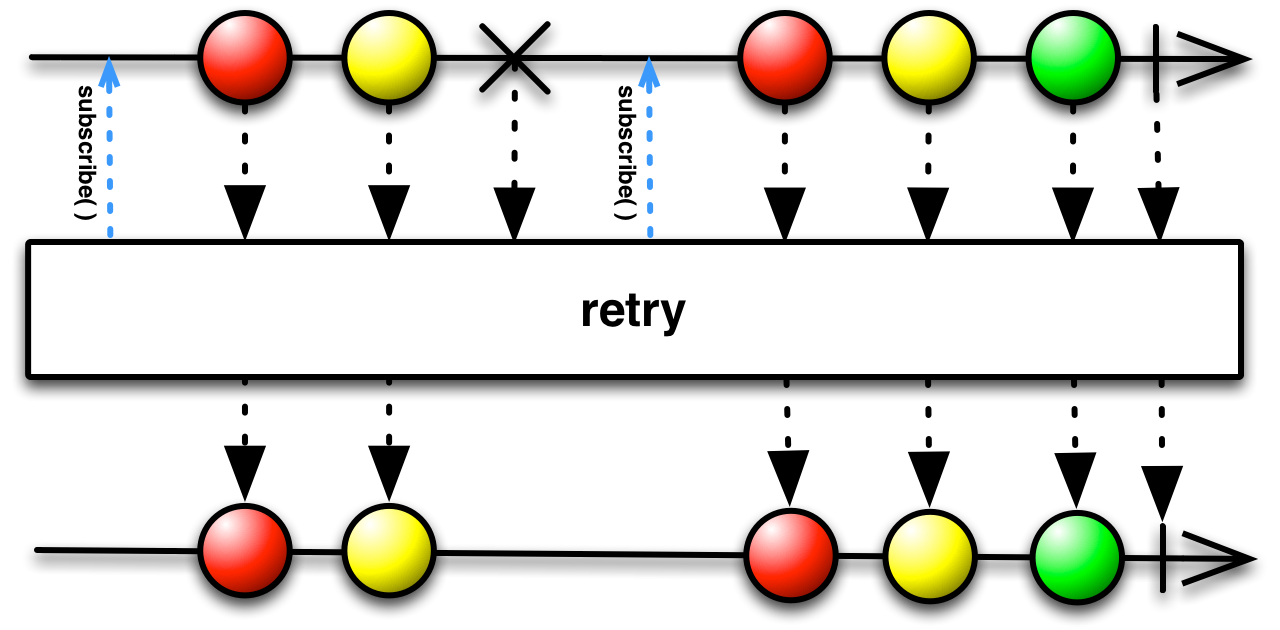
If the source Observable calls
Observer, this method will resubscribe to the source Observable rather than propagating the.onError(java.lang.Throwable) onErrorcall.Any and all items emitted by the source Observable will be emitted by the resulting Observable, even those emitted during failed subscriptions. For example, if an Observable fails at first but emits
[1, 2]then succeeds the second time and emits[1, 2, 3, 4, 5]then the complete sequence of emissions and notifications would be[1, 2, 1, 2, 3, 4, 5, onCompleted].- Scheduler:
-
retryoperates by default on thetrampolineScheduler.
- Returns:
- the source Observable modified with retry logic
- See Also:
- RxJava wiki: retry
retry
public final Observable
<T> retry(long count) Returns an Observable that mirrors the source Observable, resubscribing to it if it callsonErrorup to a specified number of retries. If the source Observable calls
Observer, this method will resubscribe to the source Observable for a maximum of.onError(java.lang.Throwable) countresubscriptions rather than propagating theonErrorcall.Any and all items emitted by the source Observable will be emitted by the resulting Observable, even those emitted during failed subscriptions. For example, if an Observable fails at first but emits
[1, 2]then succeeds the second time and emits[1, 2, 3, 4, 5]then the complete sequence of emissions and notifications would be[1, 2, 1, 2, 3, 4, 5, onCompleted].- Scheduler:
-
retryoperates by default on thetrampolineScheduler.
- Parameters:
-
count- number of retry attempts before failing - Returns:
- the source Observable modified with retry logic
- See Also:
- RxJava wiki: retry
retry
public final Observable
<T> retry(Func2 <Integer ,Throwable ,Boolean > predicate) Returns an Observable that mirrors the source Observable, resubscribing to it if it callsonErrorand the predicate returns true for that specific exception and retry count. - Scheduler:
-
retryoperates by default on thetrampolineScheduler.
- Parameters:
-
predicate- the predicate that determines if a resubscription may happen in case of a specific exception and retry count - Returns:
- the source Observable modified with retry logic
- See Also:
-
retry(), RxJava Wiki: retry()
retryWhen
public final Observable
<T> retryWhen(Func1 <? super Observable <? extends Throwable > ,? extends Observable <?>> notificationHandler) Returns an Observable that emits the same values as the source observable with the exception of anonError. AnonErrornotification from the source will result in the emission of aThrowableitem to the Observable provided as an argument to thenotificationHandlerfunction. If that Observable callsonCompleteoronErrorthenretrywill callonCompletedoronErroron the child subscription. Otherwise, this Observable will resubscribe to the source Observable.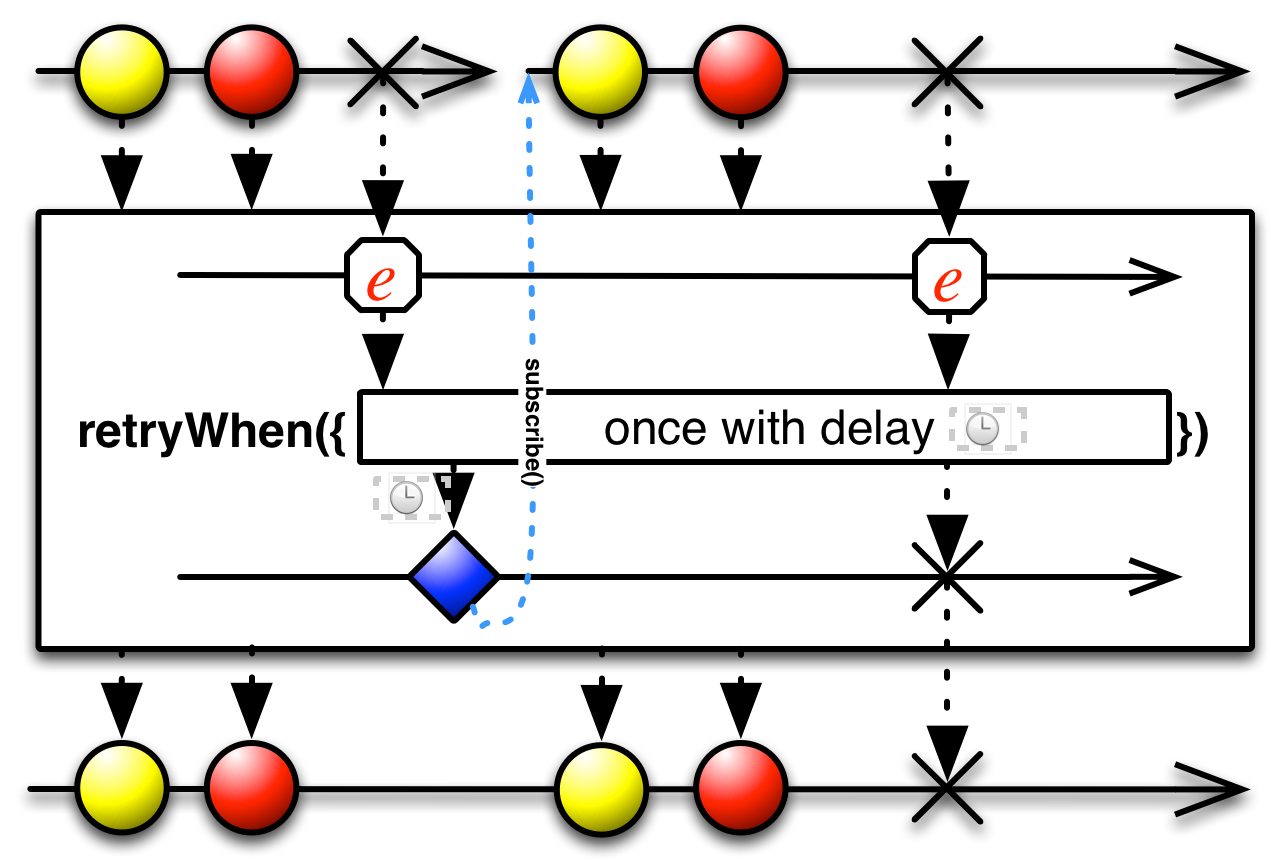 Example: This retries 3 times, each time incrementing the number of seconds it waits.
Output is:Observable.create((Subscriber<? super String> s) -> { System.out.println("subscribing"); s.onError(new RuntimeException("always fails")); }).retryWhen(attempts -> { return attempts.zipWith(Observable.range(1, 3), (n, i) -> i).flatMap(i -> { System.out.println("delay retry by " + i + " second(s)"); return Observable.timer(i, TimeUnit.SECONDS); }); }).toBlocking().forEach(System.out::println);subscribing delay retry by 1 second(s) subscribing delay retry by 2 second(s) subscribing delay retry by 3 second(s) subscribing- Scheduler:
-
retryWhenoperates by default on thetrampolineScheduler.
- Parameters:
-
notificationHandler- receives an Observable of notifications with which a user can complete or error, aborting the retry - Returns:
- the source Observable modified with retry logic
- See Also:
- RxJava Wiki: retryWhen()
retryWhen
public final Observable
<T> retryWhen(Func1 <? super Observable <? extends Throwable > ,? extends Observable <?>> notificationHandler, Scheduler scheduler) Returns an Observable that emits the same values as the source observable with the exception of anonError. AnonErrorwill cause the emission of theThrowablethat cause the error to the Observable returned fromnotificationHandler. If that Observable callsonCompleteoronErrorthenretrywill callonCompletedoronErroron the child subscription. Otherwise, this Observable will resubscribe to the source observable, on a particular Scheduler. - Scheduler:
-
you specify which
Schedulerthis operator will use
- Parameters:
-
notificationHandler- receives an Observable of notifications with which a user can complete or error, aborting the retry -
scheduler- theScheduleron which to subscribe to the source Observable - Returns:
- the source Observable modified with retry logic
- See Also:
- RxJava Wiki: retryWhen()
sample
public final Observable
<T> sample(long period, TimeUnit unit) Returns an Observable that emits the most recently emitted item (if any) emitted by the source Observable within periodic time intervals.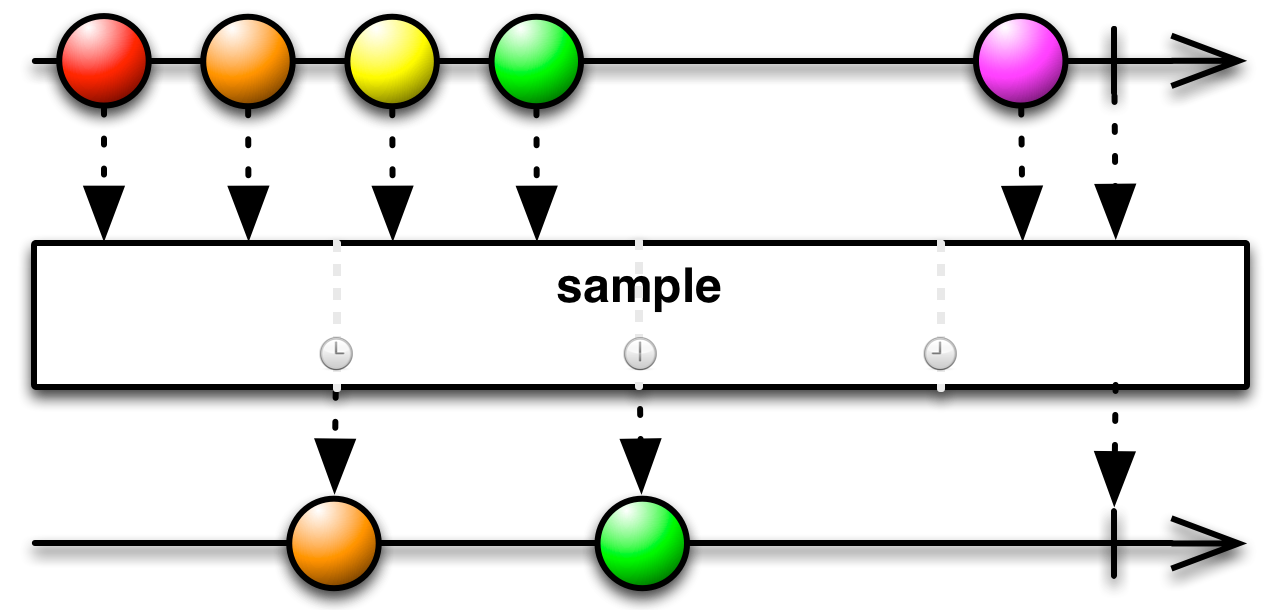
- Backpressure Support:
- This operator does not support backpressure as it uses time to control data flow.
- Scheduler:
-
sampleoperates by default on thecomputationScheduler.
- Parameters:
-
period- the sampling rate -
unit- theTimeUnitin whichperiodis defined - Returns:
- an Observable that emits the results of sampling the items emitted by the source Observable at the specified time interval
- See Also:
-
RxJava wiki: sample,
RxJava wiki: Backpressure,
throttleLast(long, TimeUnit)
sample
public final Observable
<T> sample(long period, TimeUnit unit, Scheduler scheduler) Returns an Observable that emits the most recently emitted item (if any) emitted by the source Observable within periodic time intervals, where the intervals are defined on a particular Scheduler.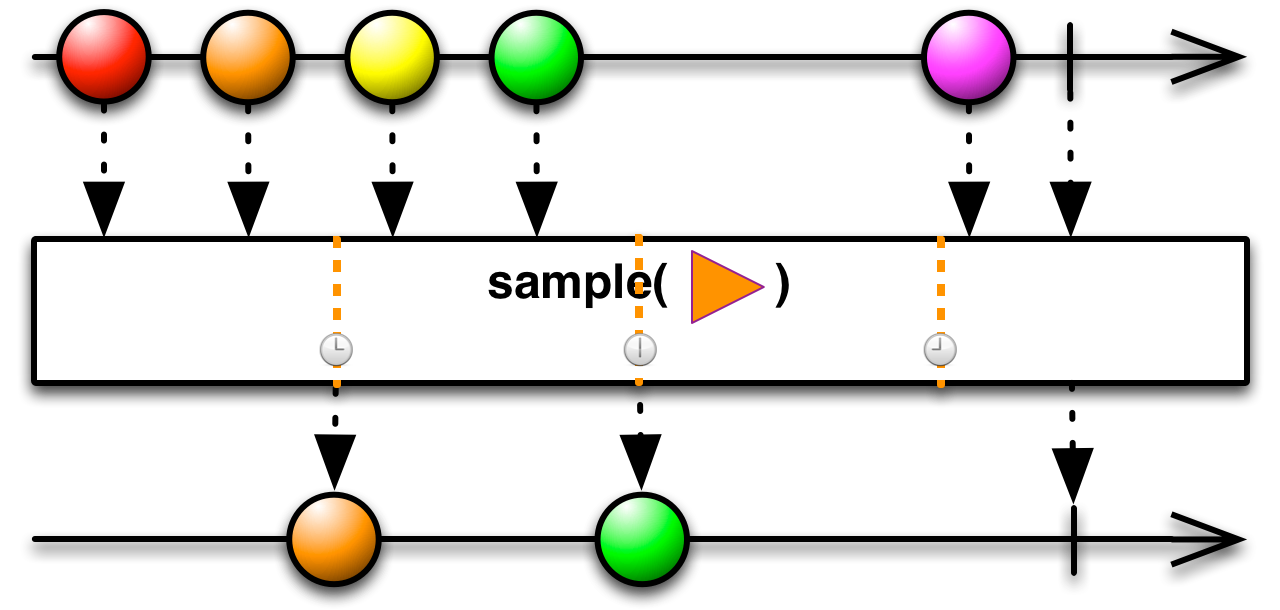
- Backpressure Support:
- This operator does not support backpressure as it uses time to control data flow.
- Scheduler:
-
you specify which
Schedulerthis operator will use
- Parameters:
-
period- the sampling rate -
unit- theTimeUnitin whichperiodis defined -
scheduler- theSchedulerto use when sampling - Returns:
- an Observable that emits the results of sampling the items emitted by the source Observable at the specified time interval
- See Also:
-
RxJava wiki: sample,
RxJava wiki: Backpressure,
throttleLast(long, TimeUnit, Scheduler)
sample
public final <U> Observable
<T> sample(Observable <U> sampler) Returns an Observable that, when the specifiedsamplerObservable emits an item or completes, emits the most recently emitted item (if any) emitted by the source Observable since the previous emission from thesamplerObservable.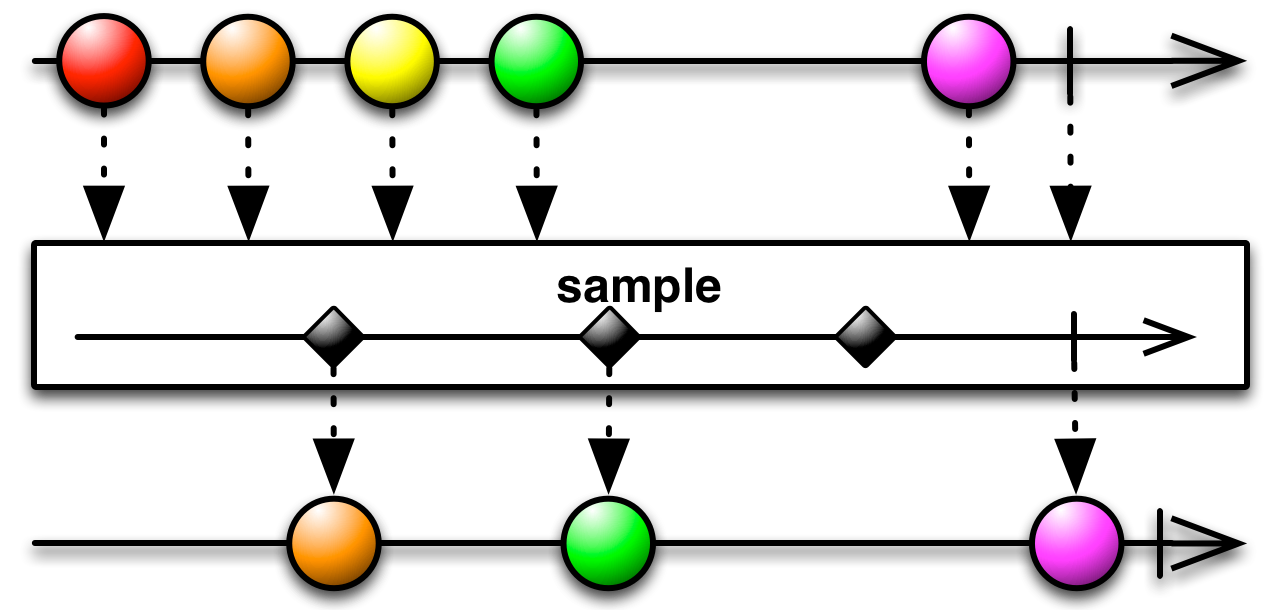
- Backpressure Support:
-
This operator does not support backpressure as it uses the emissions of the
samplerObservable to control data flow. - Scheduler:
-
This version of
sampledoes not operate by default on a particularScheduler.
- Parameters:
-
sampler- the Observable to use for sampling the source Observable - Returns:
-
an Observable that emits the results of sampling the items emitted by this Observable whenever the
samplerObservable emits an item or completes - See Also:
- RxJava wiki: sample, RxJava wiki: Backpressure
scan
public final Observable
<T> scan(Func2 <T ,T ,T> accumulator) Returns an Observable that applies a specified accumulator function to the first item emitted by a source Observable, then feeds the result of that function along with the second item emitted by the source Observable into the same function, and so on until all items have been emitted by the source Observable, emitting the result of each of these iterations.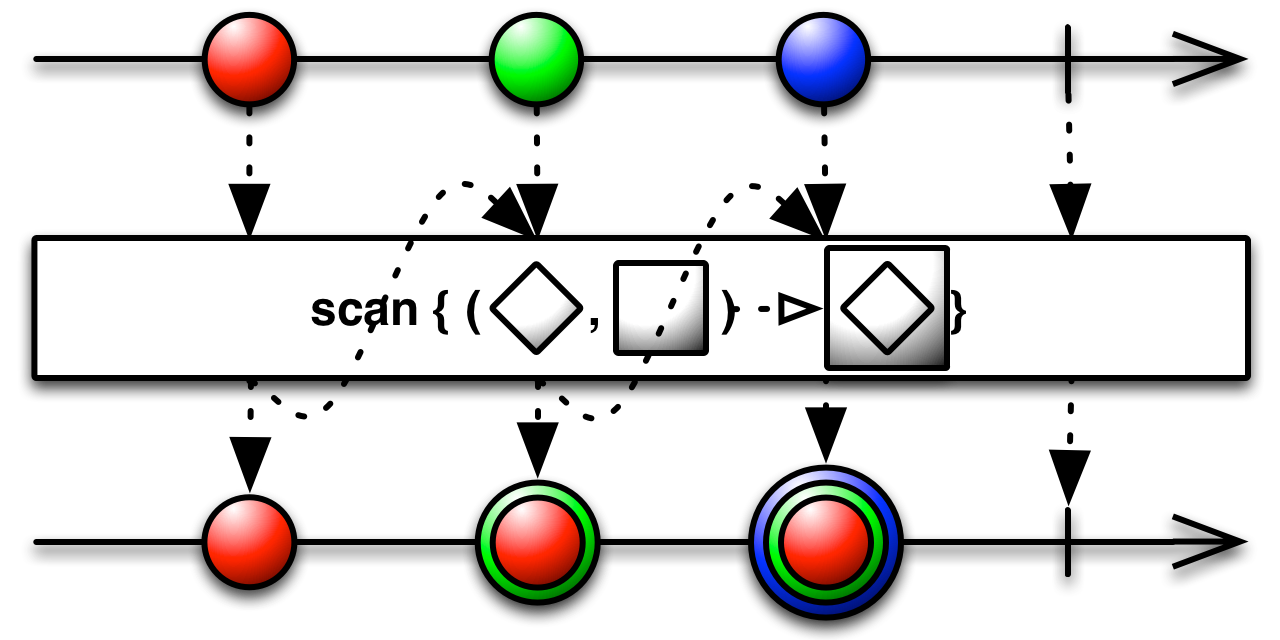
This sort of function is sometimes called an accumulator.
- Scheduler:
-
scandoes not operate by default on a particularScheduler.
- Parameters:
-
accumulator- an accumulator function to be invoked on each item emitted by the source Observable, whose result will be emitted toObservers viaonNextand used in the next accumulator call - Returns:
- an Observable that emits the results of each call to the accumulator function
- See Also:
- RxJava wiki: scan
scan
public final <R> Observable
<R> scan(R initialValue, Func2 <R ,? super T ,R> accumulator) Returns an Observable that applies a specified accumulator function to the first item emitted by a source Observable and a seed value, then feeds the result of that function along with the second item emitted by the source Observable into the same function, and so on until all items have been emitted by the source Observable, emitting the result of each of these iterations.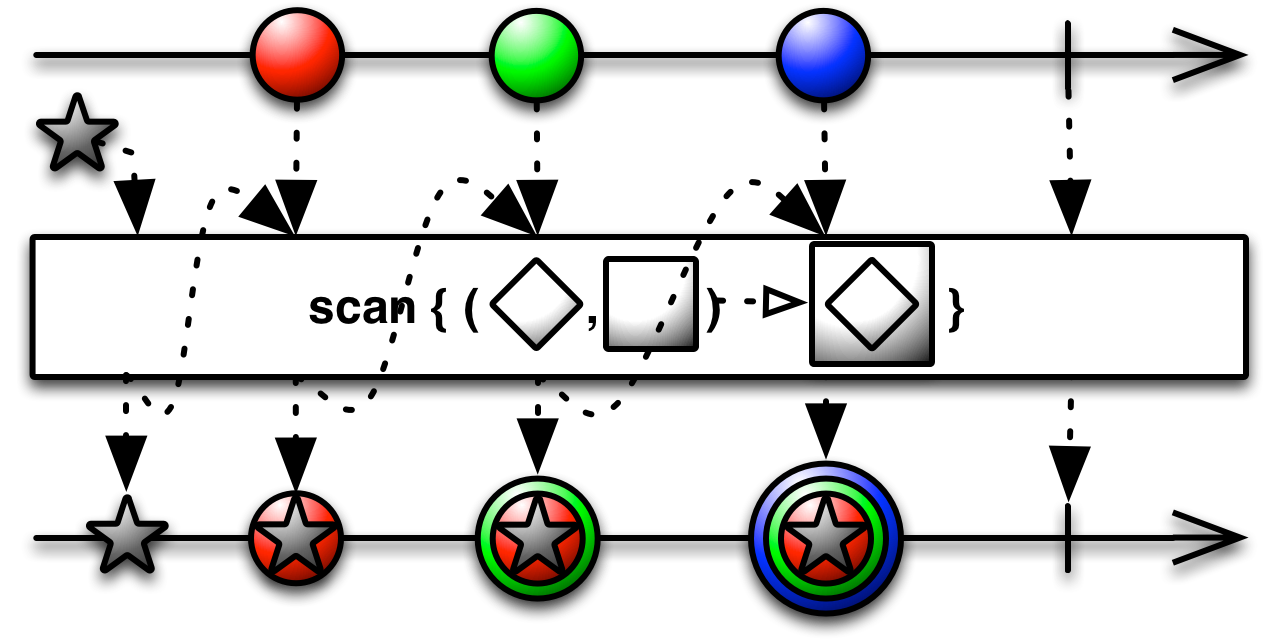
This sort of function is sometimes called an accumulator.
Note that the Observable that results from this method will emit
initialValueas its first emitted item.- Scheduler:
-
scandoes not operate by default on a particularScheduler.
- Parameters:
-
initialValue- the initial (seed) accumulator item -
accumulator- an accumulator function to be invoked on each item emitted by the source Observable, whose result will be emitted toObservers viaonNextand used in the next accumulator call - Returns:
-
an Observable that emits
initialValuefollowed by the results of each call to the accumulator function - See Also:
- RxJava wiki: scan
serialize
public final Observable
<T> serialize() Forces an Observable's emissions and notifications to be serialized and for it to obey the Rx contract in other ways.It is possible for an Observable to invoke its Subscribers' methods asynchronously, perhaps from different threads. This could make such an Observable poorly-behaved, in that it might try to invoke
onCompletedoronErrorbefore one of itsonNextinvocations, or it might callonNextfrom two different threads concurrently. You can force such an Observable to be well-behaved and sequential by applying theserializemethod to it.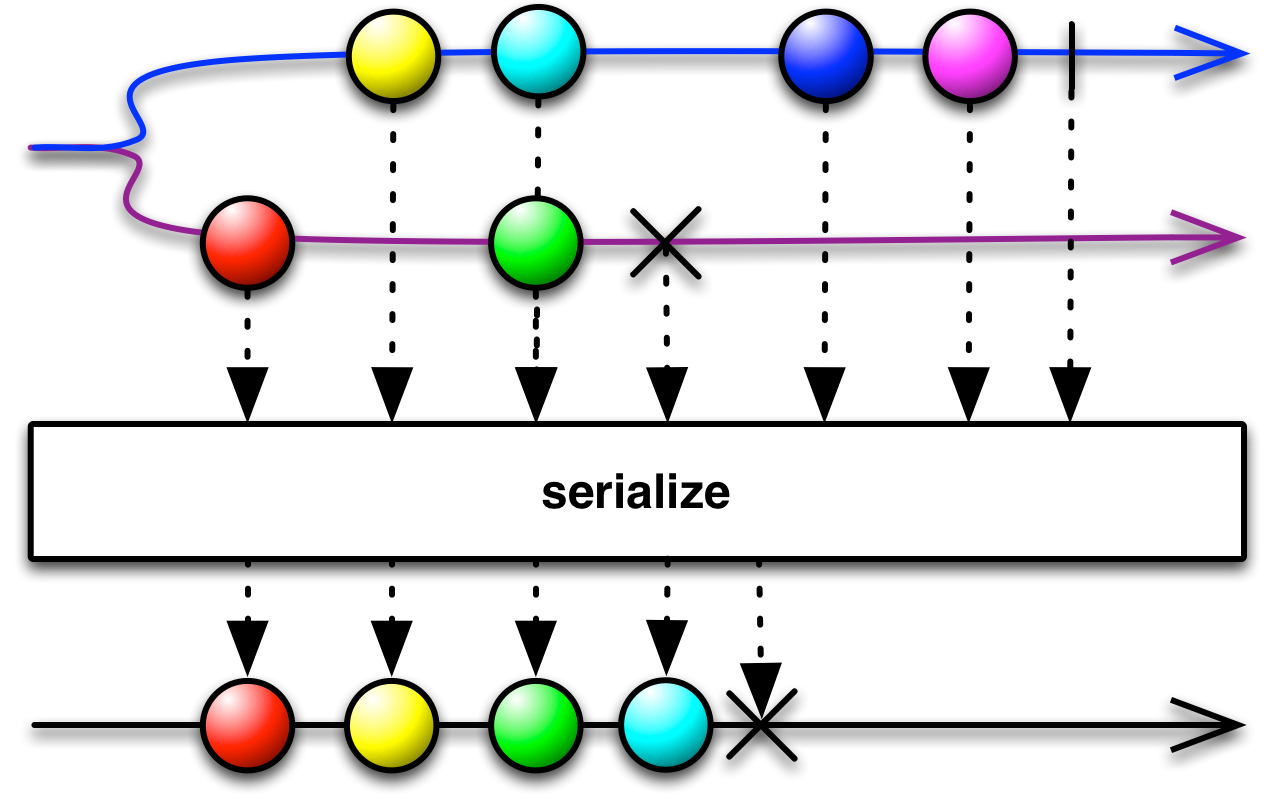
- Scheduler:
-
serializedoes not operate by default on a particularScheduler.
- Returns:
-
an
Observablethat is guaranteed to be well-behaved and to make only serialized calls to its observers - See Also:
- RxJava wiki: serialize
share
public final Observable
<T> share() Returns a newObservablethat multicasts (shares) the originalObservable. As long as there is at least oneSubscriberthisObservablewill be subscribed and emitting data. When all subscribers have unsubscribed it will unsubscribe from the sourceObservable.This is an alias for
publish().ConnectableObservable..refCount() 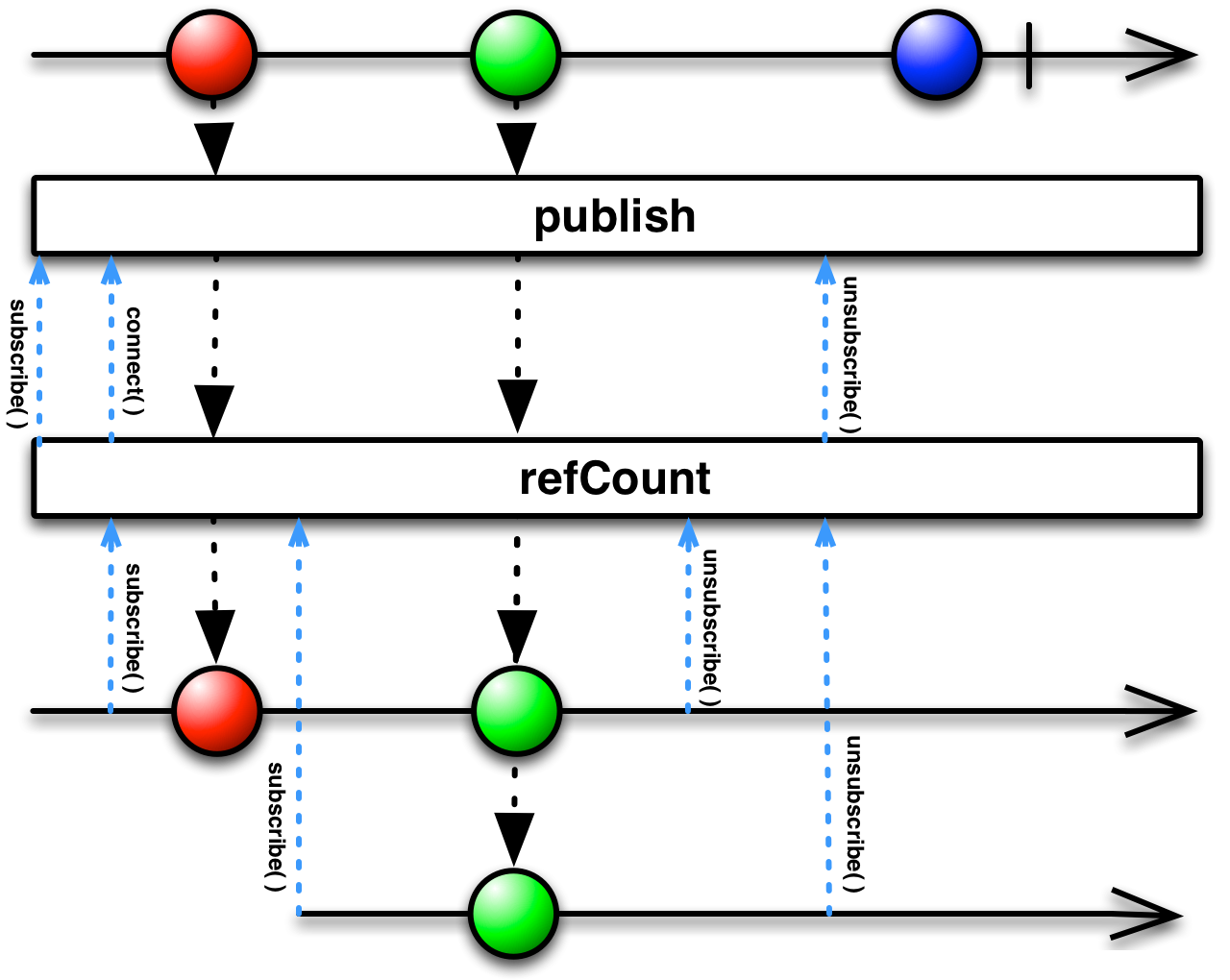
- Backpressure Support:
-
This operator does not support backpressure because multicasting means the stream is "hot" with multiple subscribers. Each child will need to manage backpressure independently using operators such as
onBackpressureDrop()andonBackpressureBuffer(). - Scheduler:
-
sharedoes not operate by default on a particularScheduler.
- Returns:
-
an
Observablethat upon connection causes the sourceObservableto emit items to itsObservers - See Also:
- RxJava wiki: refCount
single
public final Observable
<T> single() Returns an Observable that emits the single item emitted by the source Observable, if that Observable emits only a single item. If the source Observable emits more than one item or no items, notify of anIllegalArgumentExceptionorNoSuchElementExceptionrespectively.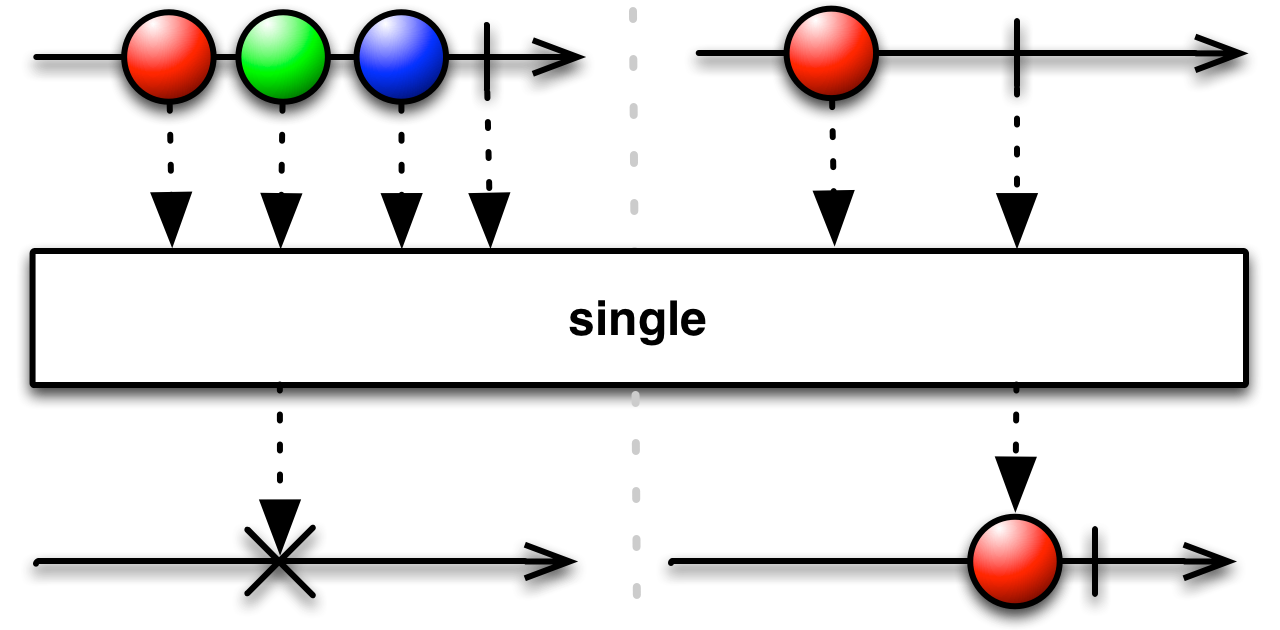
- Scheduler:
-
singledoes not operate by default on a particularScheduler.
- Returns:
- an Observable that emits the single item emitted by the source Observable
- Throws:
-
IllegalArgumentException- if the source emits more than one item -
NoSuchElementException- if the source emits no items - See Also:
- RxJava wiki: single, "MSDN: Observable.singleAsync"
single
public final Observable
<T> single(Func1 <? super T ,Boolean > predicate) Returns an Observable that emits the single item emitted by the source Observable that matches a specified predicate, if that Observable emits one such item. If the source Observable emits more than one such item or no such items, notify of anIllegalArgumentExceptionorNoSuchElementExceptionrespectively.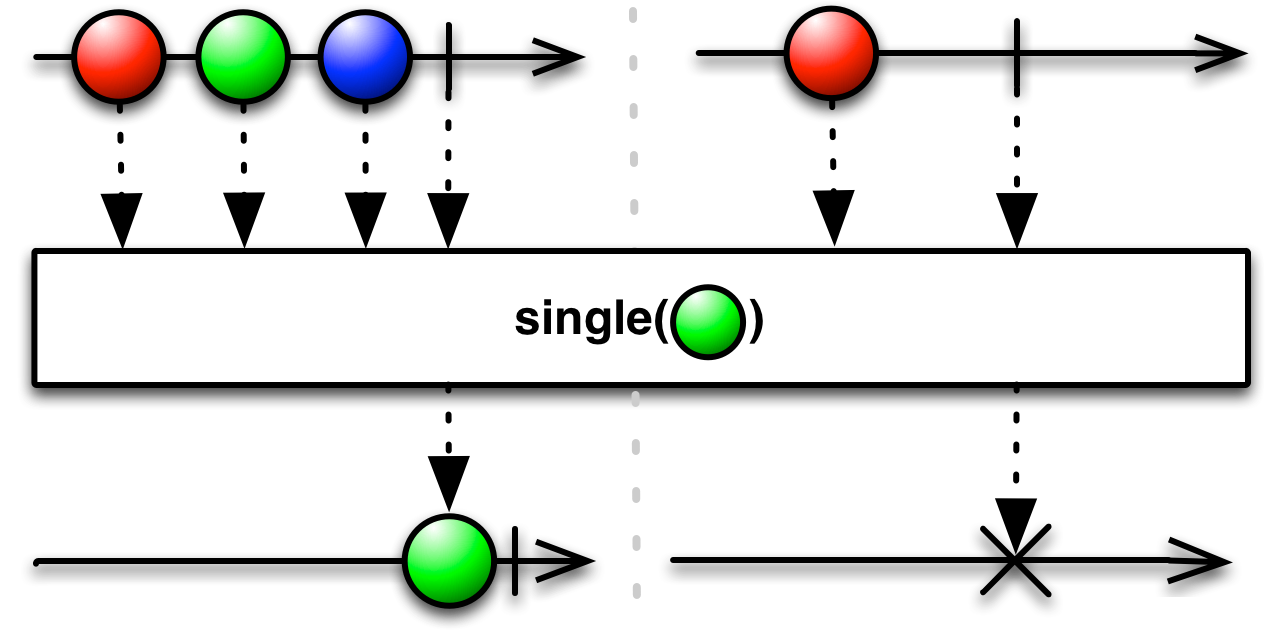
- Scheduler:
-
singledoes not operate by default on a particularScheduler.
- Parameters:
-
predicate- a predicate function to evaluate items emitted by the source Observable - Returns:
- an Observable that emits the single item emitted by the source Observable that matches the predicate
- Throws:
-
IllegalArgumentException- if the source Observable emits more than one item that matches the predicate -
NoSuchElementException- if the source Observable emits no item that matches the predicate - See Also:
- RxJava wiki: single, "MSDN: Observable.singleAsync"
singleOrDefault
public final Observable
<T> singleOrDefault(T defaultValue) Returns an Observable that emits the single item emitted by the source Observable, if that Observable emits only a single item, or a default item if the source Observable emits no items. If the source Observable emits more than one item, throw anIllegalArgumentException.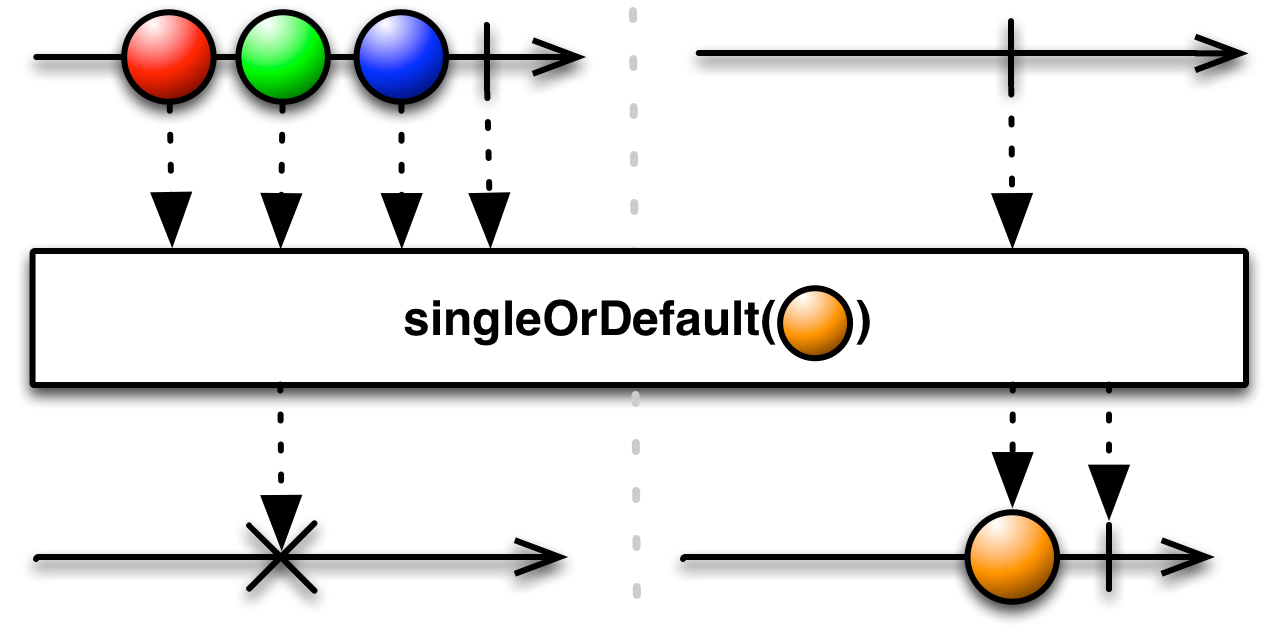
- Scheduler:
-
singleOrDefaultdoes not operate by default on a particularScheduler.
- Parameters:
-
defaultValue- a default value to emit if the source Observable emits no item - Returns:
- an Observable that emits the single item emitted by the source Observable, or a default item if the source Observable is empty
- Throws:
-
IllegalArgumentException- if the source Observable emits more than one item - See Also:
- RxJava wiki: single, "MSDN: Observable.singleOrDefaultAsync"
singleOrDefault
public final Observable
<T> singleOrDefault(T defaultValue, Func1 <? super T ,Boolean > predicate) Returns an Observable that emits the single item emitted by the source Observable that matches a predicate, if that Observable emits only one such item, or a default item if the source Observable emits no such items. If the source Observable emits more than one such item, throw anIllegalArgumentException.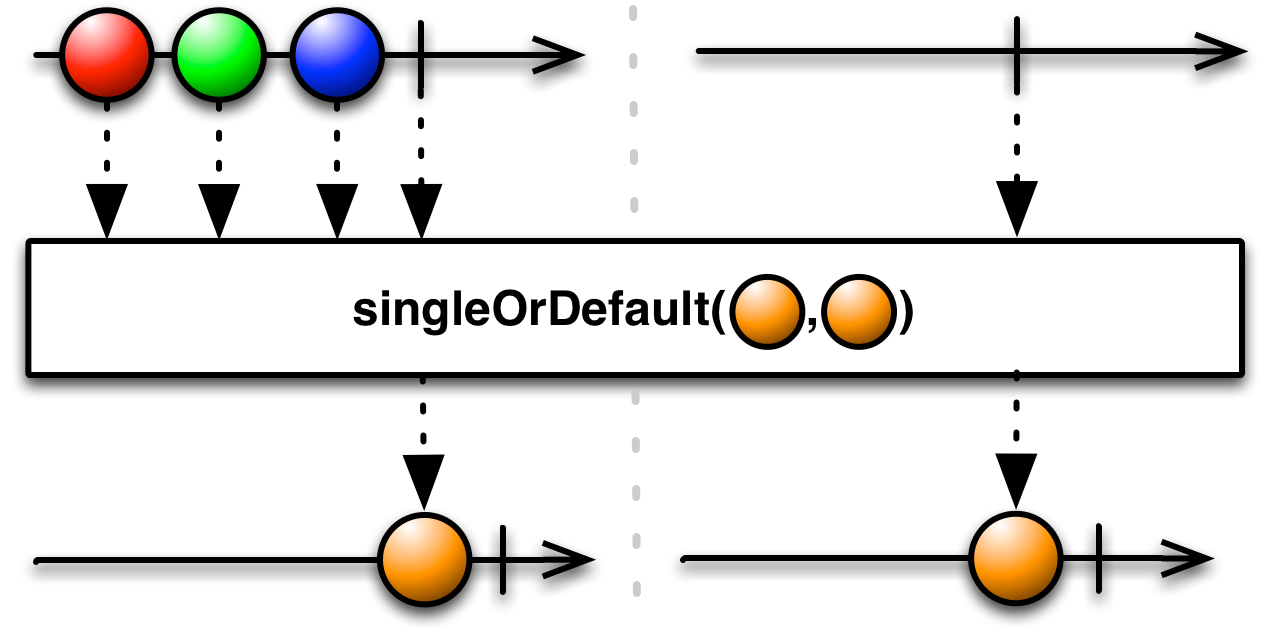
- Scheduler:
-
singleOrDefaultdoes not operate by default on a particularScheduler.
- Parameters:
-
defaultValue- a default item to emit if the source Observable emits no matching items -
predicate- a predicate function to evaluate items emitted by the source Observable - Returns:
- an Observable that emits the single item emitted by the source Observable that matches the predicate, or the default item if no emitted item matches the predicate
- Throws:
-
IllegalArgumentException- if the source Observable emits more than one item that matches the predicate - See Also:
- RxJava wiki: single, "MSDN: Observable.singleOrDefaultAsync"
skip
public final Observable
<T> skip(int num) Returns an Observable that skips the firstnumitems emitted by the source Observable and emits the remainder.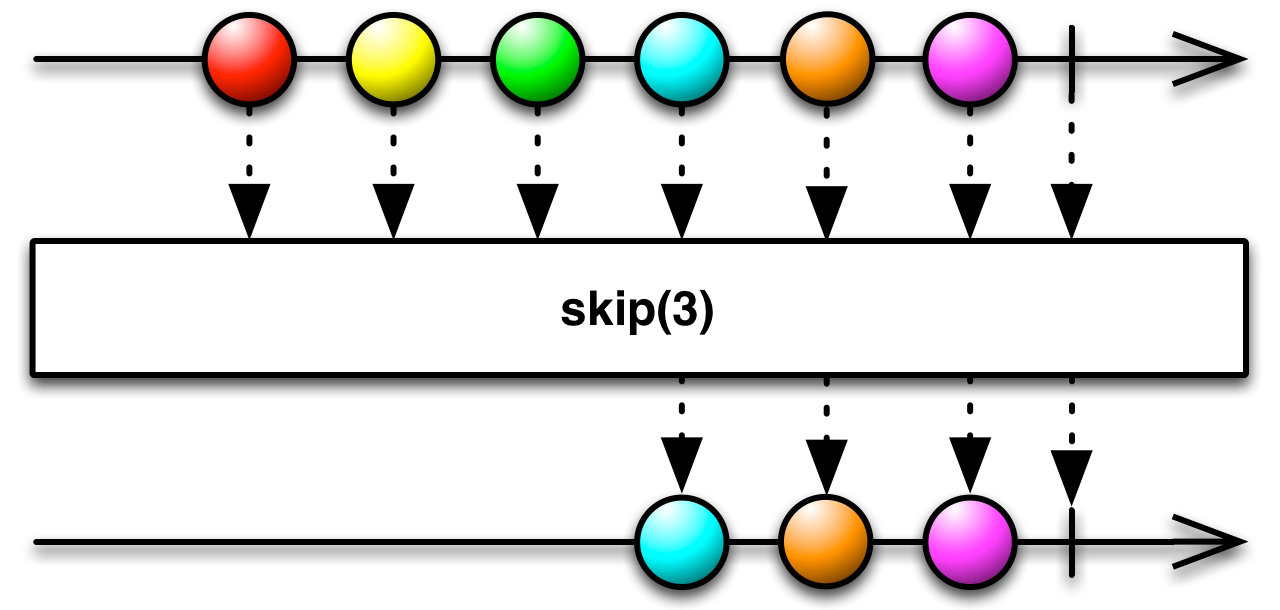
- Scheduler:
-
This version of
skipdoes not operate by default on a particularScheduler.
- Parameters:
-
num- the number of items to skip - Returns:
-
an Observable that is identical to the source Observable except that it does not emit the first
numitems that the source Observable emits - See Also:
- RxJava wiki: skip
skip
public final Observable
<T> skip(long time, TimeUnit unit) Returns an Observable that skips values emitted by the source Observable before a specified time window elapses.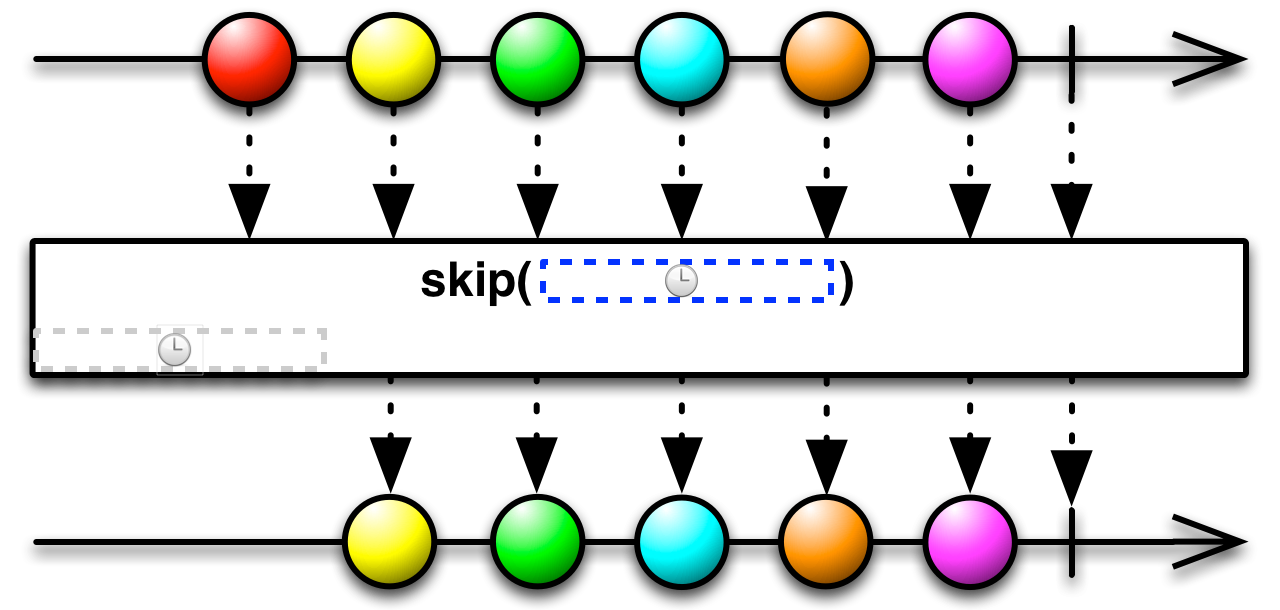
- Scheduler:
-
This version of
skipoperates by default on thecomputationScheduler.
- Parameters:
-
time- the length of the time window to skip -
unit- the time unit oftime - Returns:
-
an Observable that skips values emitted by the source Observable before the time window defined by
timeelapses and the emits the remainder - See Also:
- RxJava wiki: skip
skip
public final Observable
<T> skip(long time, TimeUnit unit, Scheduler scheduler) Returns an Observable that skips values emitted by the source Observable before a specified time window on a specifiedSchedulerelapses.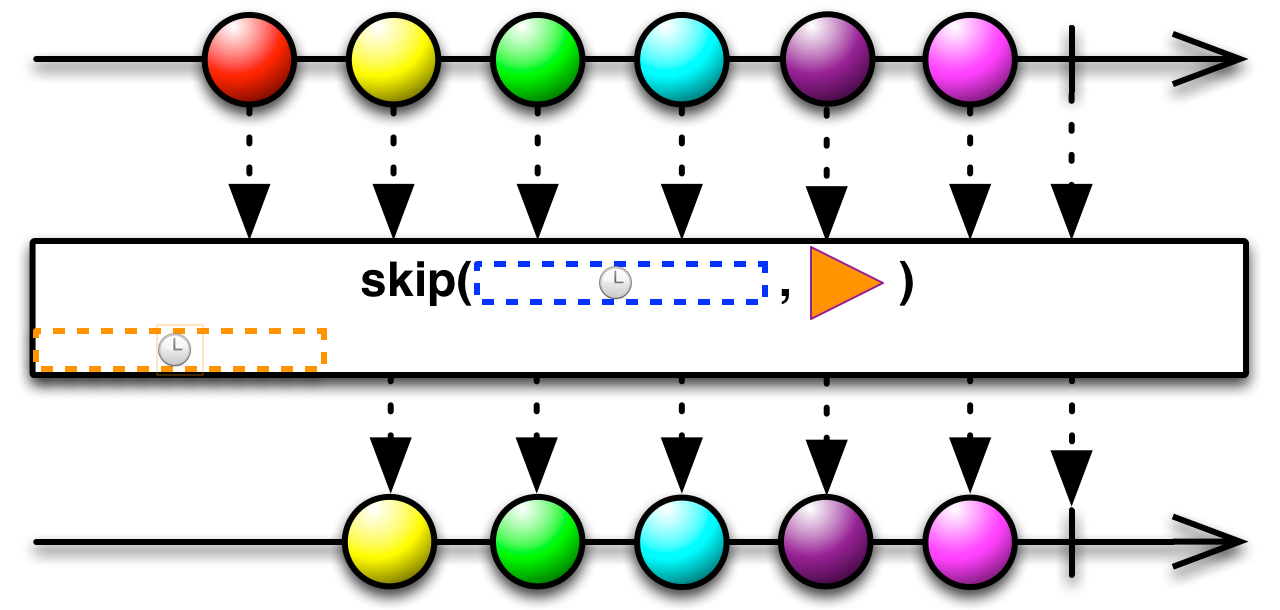
- Scheduler:
-
you specify which
Schedulerthis operator will use
- Parameters:
-
time- the length of the time window to skip -
unit- the time unit oftime -
scheduler- theScheduleron which the timed wait happens - Returns:
-
an Observable that skips values emitted by the source Observable before the time window defined by
timeandschedulerelapses, and then emits the remainder - See Also:
- RxJava wiki: skip
skipLast
public final Observable
<T> skipLast(int count) Returns an Observable that drops a specified number of items from the end of the sequence emitted by the source Observable.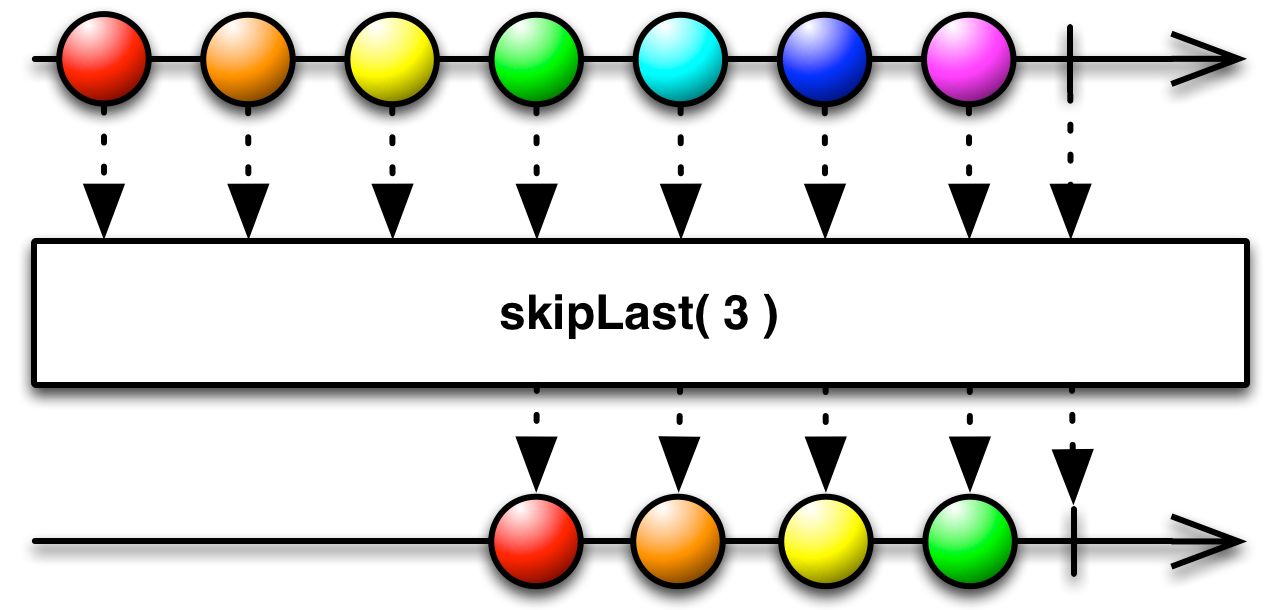
This Observer accumulates a queue long enough to store the first
countitems. As more items are received, items are taken from the front of the queue and emitted by the returned Observable. This causes such items to be delayed.- Scheduler:
-
This version of
skipLastdoes not operate by default on a particularScheduler.
- Parameters:
-
count- number of items to drop from the end of the source sequence - Returns:
- an Observable that emits the items emitted by the source Observable except for the dropped ones at the end
- Throws:
-
IndexOutOfBoundsException- ifcountis less than zero - See Also:
- RxJava wiki: skipLast
skipLast
public final Observable
<T> skipLast(long time, TimeUnit unit) Returns an Observable that drops items emitted by the source Observable during a specified time window before the source completes.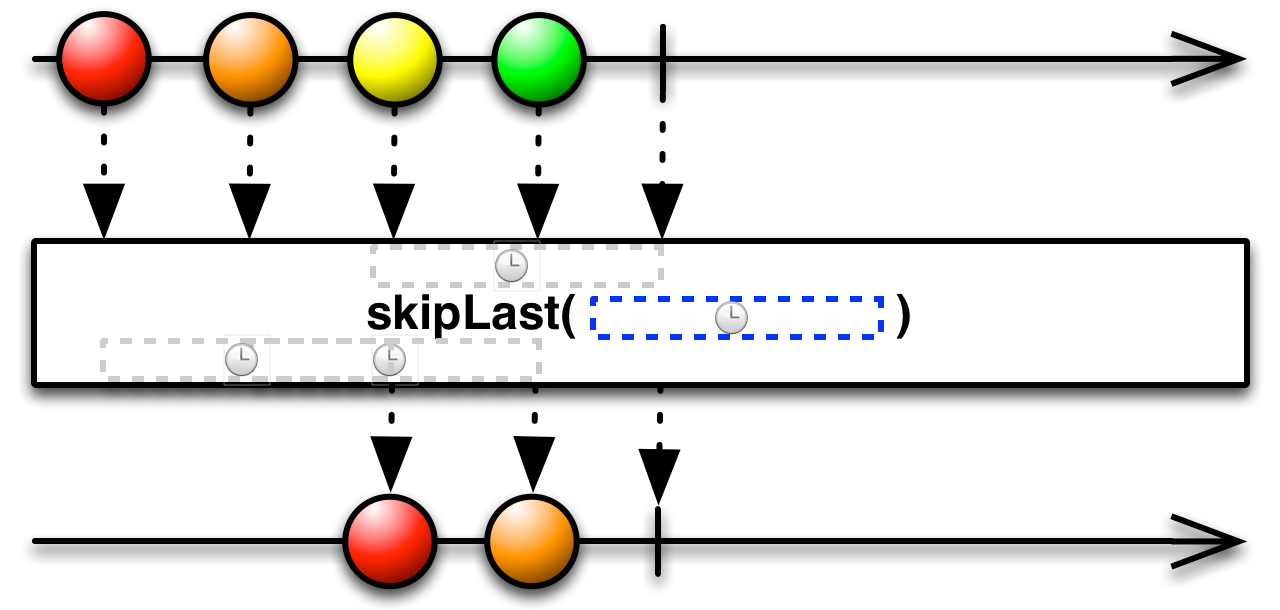
Note: this action will cache the latest items arriving in the specified time window.
- Scheduler:
-
This version of
skipLastoperates by default on thecomputationScheduler.
- Parameters:
-
time- the length of the time window -
unit- the time unit oftime - Returns:
-
an Observable that drops those items emitted by the source Observable in a time window before the source completes defined by
time - See Also:
- RxJava wiki: skipLast
skipLast
public final Observable
<T> skipLast(long time, TimeUnit unit, Scheduler scheduler) Returns an Observable that drops items emitted by the source Observable during a specified time window (defined on a specified scheduler) before the source completes.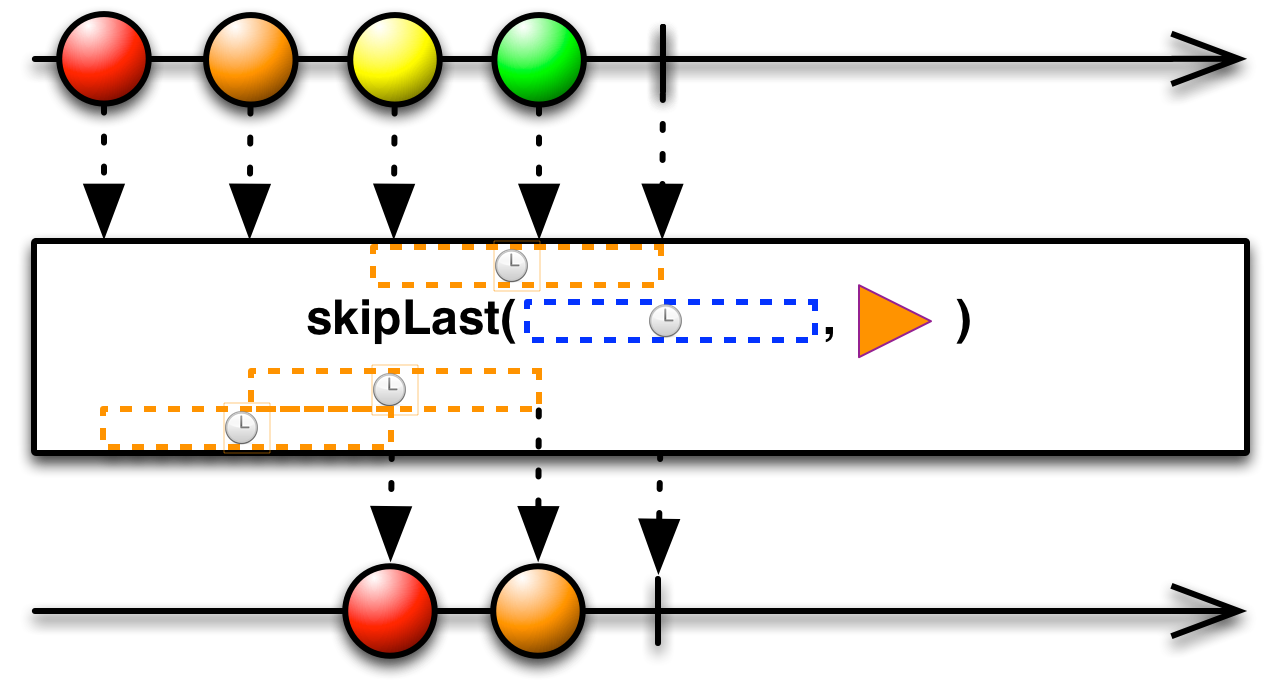
Note: this action will cache the latest items arriving in the specified time window.
- Scheduler:
-
you specify which
Schedulerthis operator will use
- Parameters:
-
time- the length of the time window -
unit- the time unit oftime -
scheduler- the scheduler used as the time source - Returns:
-
an Observable that drops those items emitted by the source Observable in a time window before the source completes defined by
timeandscheduler - See Also:
- RxJava wiki: skipLast
skipUntil
public final <U> Observable
<T> skipUntil(Observable <U> other) Returns an Observable that skips items emitted by the source Observable until a second Observable emits an item.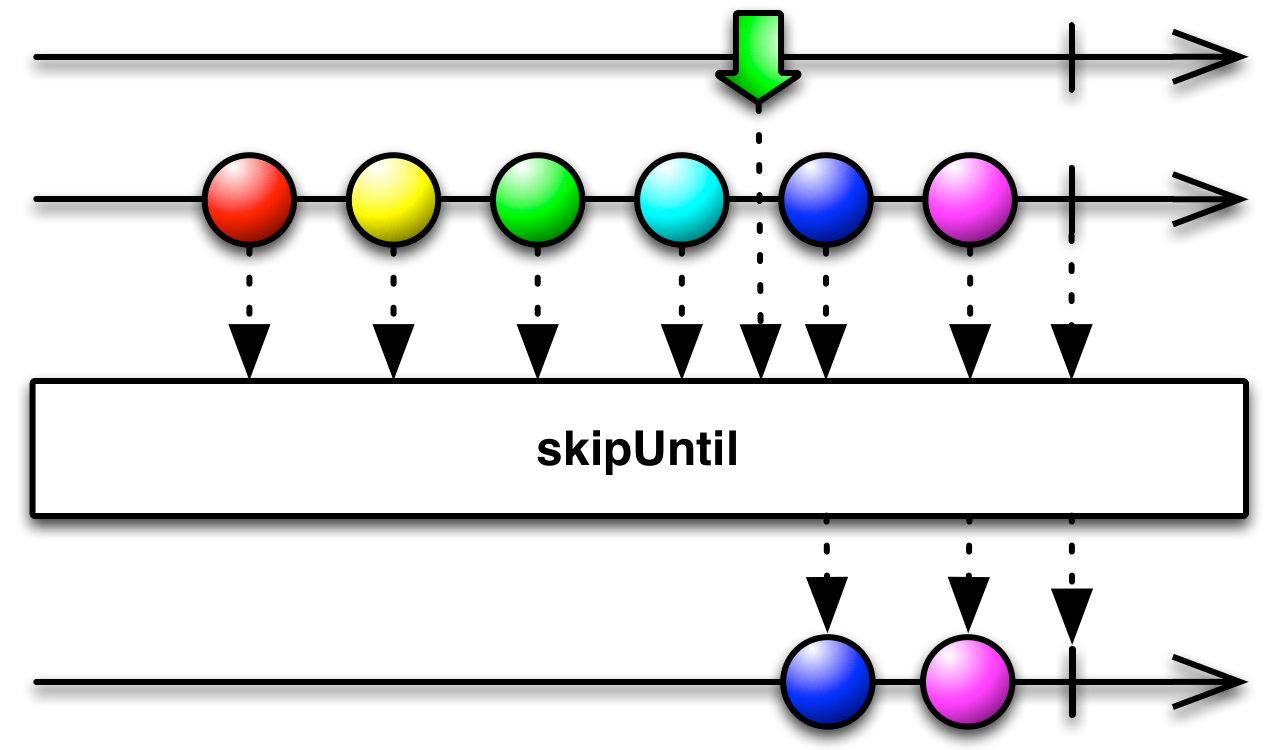
- Scheduler:
-
skipUntildoes not operate by default on a particularScheduler.
- Parameters:
-
other- the second Observable that has to emit an item before the source Observable's elements begin to be mirrored by the resulting Observable - Returns:
- an Observable that skips items from the source Observable until the second Observable emits an item, then emits the remaining items
- See Also:
- RxJava wiki: skipUntil
skipWhile
public final Observable
<T> skipWhile(Func1 <? super T ,Boolean > predicate) Returns an Observable that skips all items emitted by the source Observable as long as a specified condition holds true, but emits all further source items as soon as the condition becomes false.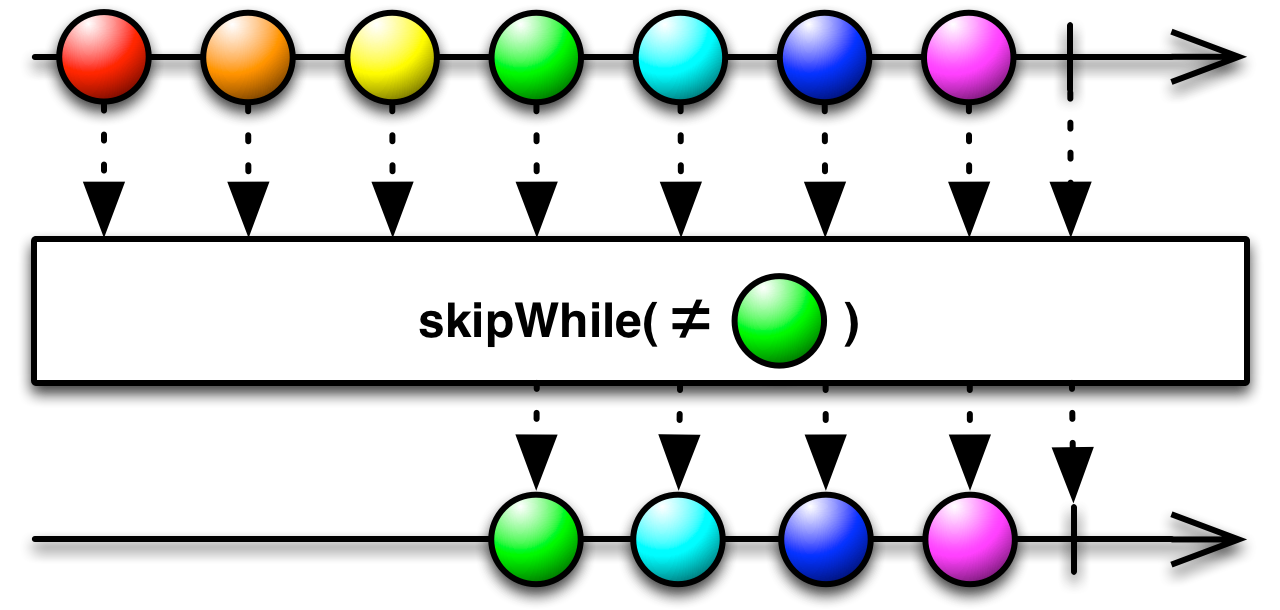
- Scheduler:
-
skipWhiledoes not operate by default on a particularScheduler.
- Parameters:
-
predicate- a function to test each item emitted from the source Observable - Returns:
- an Observable that begins emitting items emitted by the source Observable when the specified predicate becomes false
- See Also:
- RxJava wiki: skipWhile
startWith
public final Observable
<T> startWith(Observable <T> values) Returns an Observable that emits the items in a specifiedObservablebefore it begins to emit items emitted by the source Observable.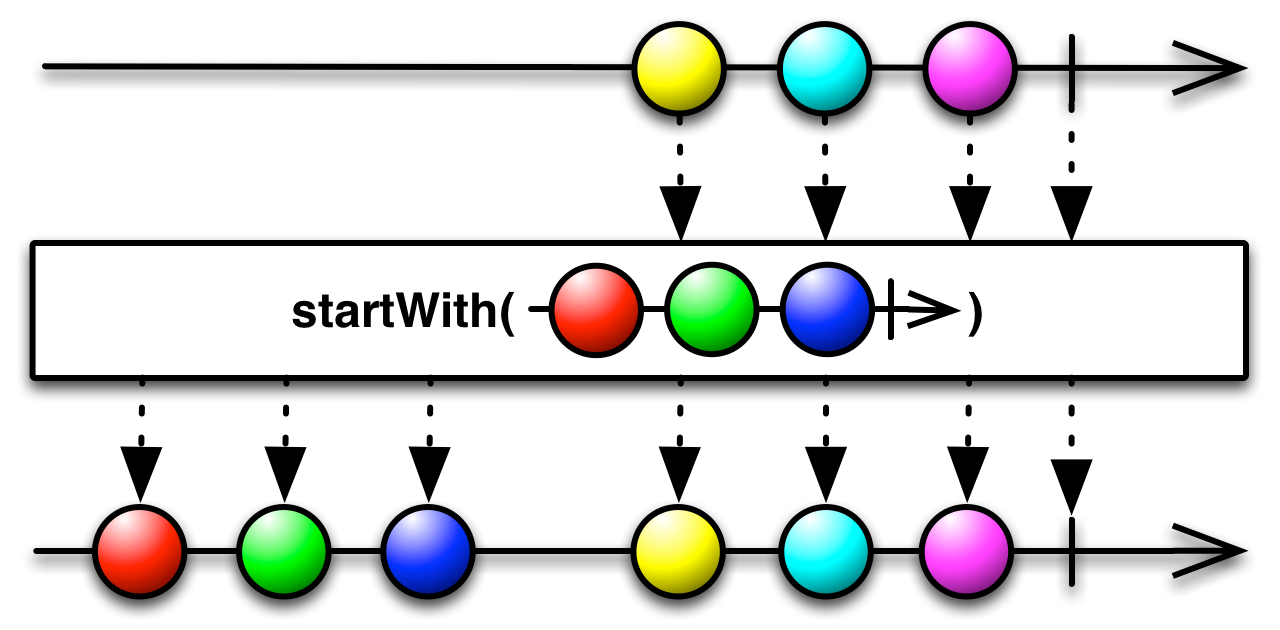
- Scheduler:
-
startWithdoes not operate by default on a particularScheduler.
- Parameters:
-
values- an Observable that contains the items you want the modified Observable to emit first - Returns:
-
an Observable that emits the items in the specified
Observableand then emits the items emitted by the source Observable - See Also:
- RxJava wiki: startWith
startWith
public final Observable
<T> startWith(Iterable <T> values) Returns an Observable that emits the items in a specifiedIterablebefore it begins to emit items emitted by the source Observable.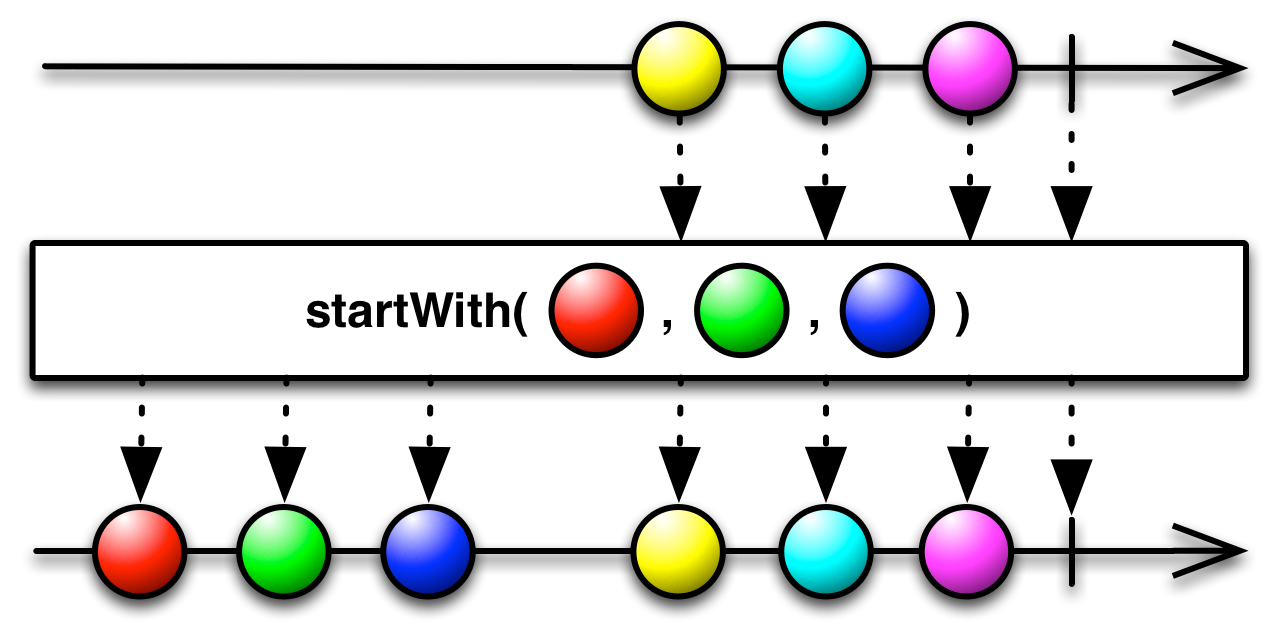
- Scheduler:
-
startWithdoes not operate by default on a particularScheduler.
- Parameters:
-
values- an Iterable that contains the items you want the modified Observable to emit first - Returns:
-
an Observable that emits the items in the specified
Iterableand then emits the items emitted by the source Observable - See Also:
- RxJava wiki: startWith
startWith
public final Observable
<T> startWith(T t1) Returns an Observable that emits a specified item before it begins to emit items emitted by the source Observable. - Scheduler:
-
startWithdoes not operate by default on a particularScheduler.
- Parameters:
-
t1- the item to emit - Returns:
- an Observable that emits the specified item before it begins to emit items emitted by the source Observable
- See Also:
- RxJava wiki: startWith
startWith
public final Observable
<T> startWith(T t1, T t2) Returns an Observable that emits the specified items before it begins to emit items emitted by the source Observable. - Scheduler:
-
startWithdoes not operate by default on a particularScheduler.
- Parameters:
-
t1- the first item to emit -
t2- the second item to emit - Returns:
- an Observable that emits the specified items before it begins to emit items emitted by the source Observable
- See Also:
- RxJava wiki: startWith
startWith
public final Observable
<T> startWith(T t1, T t2, T t3) Returns an Observable that emits the specified items before it begins to emit items emitted by the source Observable. - Scheduler:
-
startWithdoes not operate by default on a particularScheduler.
- Parameters:
-
t1- the first item to emit -
t2- the second item to emit -
t3- the third item to emit - Returns:
- an Observable that emits the specified items before it begins to emit items emitted by the source Observable
- See Also:
- RxJava wiki: startWith
startWith
public final Observable
<T> startWith(T t1, T t2, T t3, T t4) Returns an Observable that emits the specified items before it begins to emit items emitted by the source Observable. - Scheduler:
-
startWithdoes not operate by default on a particularScheduler.
- Parameters:
-
t1- the first item to emit -
t2- the second item to emit -
t3- the third item to emit -
t4- the fourth item to emit - Returns:
- an Observable that emits the specified items before it begins to emit items emitted by the source Observable
- See Also:
- RxJava wiki: startWith
startWith
public final Observable
<T> startWith(T t1, T t2, T t3, T t4, T t5) Returns an Observable that emits the specified items before it begins to emit items emitted by the source Observable. - Scheduler:
-
startWithdoes not operate by default on a particularScheduler.
- Parameters:
-
t1- the first item to emit -
t2- the second item to emit -
t3- the third item to emit -
t4- the fourth item to emit -
t5- the fifth item to emit - Returns:
- an Observable that emits the specified items before it begins to emit items emitted by the source Observable
- See Also:
- RxJava wiki: startWith
startWith
public final Observable
<T> startWith(T t1, T t2, T t3, T t4, T t5, T t6) Returns an Observable that emits the specified items before it begins to emit items emitted by the source Observable. - Scheduler:
-
startWithdoes not operate by default on a particularScheduler.
- Parameters:
-
t1- the first item to emit -
t2- the second item to emit -
t3- the third item to emit -
t4- the fourth item to emit -
t5- the fifth item to emit -
t6- the sixth item to emit - Returns:
- an Observable that emits the specified items before it begins to emit items emitted by the source Observable
- See Also:
- RxJava wiki: startWith
startWith
public final Observable
<T> startWith(T t1, T t2, T t3, T t4, T t5, T t6, T t7) Returns an Observable that emits the specified items before it begins to emit items emitted by the source Observable. - Scheduler:
-
startWithdoes not operate by default on a particularScheduler.
- Parameters:
-
t1- the first item to emit -
t2- the second item to emit -
t3- the third item to emit -
t4- the fourth item to emit -
t5- the fifth item to emit -
t6- the sixth item to emit -
t7- the seventh item to emit - Returns:
- an Observable that emits the specified items before it begins to emit items emitted by the source Observable
- See Also:
- RxJava wiki: startWith
startWith
public final Observable
<T> startWith(T t1, T t2, T t3, T t4, T t5, T t6, T t7, T t8) Returns an Observable that emits the specified items before it begins to emit items emitted by the source Observable. - Scheduler:
-
startWithdoes not operate by default on a particularScheduler.
- Parameters:
-
t1- the first item to emit -
t2- the second item to emit -
t3- the third item to emit -
t4- the fourth item to emit -
t5- the fifth item to emit -
t6- the sixth item to emit -
t7- the seventh item to emit -
t8- the eighth item to emit - Returns:
- an Observable that emits the specified items before it begins to emit items emitted by the source Observable
- See Also:
- RxJava wiki: startWith
startWith
public final Observable
<T> startWith(T t1, T t2, T t3, T t4, T t5, T t6, T t7, T t8, T t9) Returns an Observable that emits the specified items before it begins to emit items emitted by the source Observable. - Scheduler:
-
startWithdoes not operate by default on a particularScheduler.
- Parameters:
-
t1- the first item to emit -
t2- the second item to emit -
t3- the third item to emit -
t4- the fourth item to emit -
t5- the fifth item to emit -
t6- the sixth item to emit -
t7- the seventh item to emit -
t8- the eighth item to emit -
t9- the ninth item to emit - Returns:
- an Observable that emits the specified items before it begins to emit items emitted by the source Observable
- See Also:
- RxJava wiki: startWith
subscribe
public final Subscription
subscribe() Subscribes to an Observable but ignore its emissions and notifications.- Scheduler:
-
subscribedoes not operate by default on a particularScheduler.
- Returns:
-
a
Subscriptionreference with which theObservercan stop receiving items before the Observable has finished sending them - Throws:
-
OnErrorNotImplementedException- if the Observable tries to callonError
subscribe
public final Subscription
subscribe(Action1 <? super T> onNext) Subscribes to an Observable and provides a callback to handle the items it emits.- Scheduler:
-
subscribedoes not operate by default on a particularScheduler.
- Parameters:
-
onNext- theAction1<T>you have designed to accept emissions from the Observable - Returns:
-
a
Subscriptionreference with which theObservercan stop receiving items before the Observable has finished sending them - Throws:
-
IllegalArgumentException- ifonNextis null -
OnErrorNotImplementedException- if the Observable tries to callonError - See Also:
- RxJava wiki: onNext, onCompleted, and onError
subscribe
public final Subscription
subscribe(Action1 <? super T> onNext, Action1 <Throwable > onError) Subscribes to an Observable and provides callbacks to handle the items it emits and any error notification it issues.- Scheduler:
-
subscribedoes not operate by default on a particularScheduler.
- Parameters:
-
onNext- theAction1<T>you have designed to accept emissions from the Observable -
onError- theAction1<Throwable>you have designed to accept any error notification from the Observable - Returns:
-
a
Subscriptionreference with which theObservercan stop receiving items before the Observable has finished sending them - Throws:
-
IllegalArgumentException- ifonNextis null, or ifonErroris null - See Also:
- RxJava wiki: onNext, onCompleted, and onError
subscribe
public final Subscription
subscribe(Action1 <? super T> onNext, Action1 <Throwable > onError, Action0 onComplete) Subscribes to an Observable and provides callbacks to handle the items it emits and any error or completion notification it issues.- Scheduler:
-
subscribedoes not operate by default on a particularScheduler.
- Parameters:
-
onNext- theAction1<T>you have designed to accept emissions from the Observable -
onError- theAction1<Throwable>you have designed to accept any error notification from the Observable -
onComplete- theAction0you have designed to accept a completion notification from the Observable - Returns:
-
a
Subscriptionreference with which theObservercan stop receiving items before the Observable has finished sending them - Throws:
-
IllegalArgumentException- ifonNextis null, or ifonErroris null, or ifonCompleteis null - See Also:
- RxJava wiki: onNext, onCompleted, and onError
subscribe
public final Subscription
subscribe(Observer <? super T> observer) Subscribes to an Observable and provides an Observer that implements functions to handle the items the Observable emits and any error or completion notification it issues.- Scheduler:
-
subscribedoes not operate by default on a particularScheduler.
- Parameters:
-
observer- the Observer that will handle emissions and notifications from the Observable - Returns:
-
a
Subscriptionreference with which theObservercan stop receiving items before the Observable has completed - See Also:
- RxJava wiki: onNext, onCompleted, and onError
unsafeSubscribe
public final Subscription
unsafeSubscribe(Subscriber <? super T> subscriber) Subscribes to an Observable and invokesObservable.OnSubscribefunction without any contract protection, error handling, unsubscribe, or execution hooks.Use this only for implementing an
Observable.Operatorthat requires nested subscriptions. For other purposes, usesubscribe(Subscriber)which ensures the Rx contract and other functionality.- Scheduler:
-
unsafeSubscribedoes not operate by default on a particularScheduler.
- Parameters:
-
subscriber- the Subscriber that will handle emissions and notifications from the Observable - Returns:
-
a
Subscriptionreference with which theSubscribercan stop receiving items before the Observable has completed
subscribe
public final Subscription
subscribe(Subscriber <? super T> subscriber) Subscribes to an Observable and provides a Subscriber that implements functions to handle the items the Observable emits and any error or completion notification it issues.A typical implementation of
subscribedoes the following:- It stores a reference to the Subscriber in a collection object, such as a
List<T>object. - It returns a reference to the
Subscriptioninterface. This enables Subscribers to unsubscribe, that is, to stop receiving items and notifications before the Observable completes, which also invokes the Subscriber'sonCompletedmethod.
An
Observable<T>instance is responsible for accepting all subscriptions and notifying all Subscribers. Unless the documentation for a particularObservable<T>implementation indicates otherwise, Subscriber should make no assumptions about the order in which multiple Subscribers will receive their notifications.For more information see the RxJava wiki.
- Scheduler:
-
subscribedoes not operate by default on a particularScheduler.
- Parameters:
-
subscriber- theSubscriberthat will handle emissions and notifications from the Observable - Returns:
-
a
Subscriptionreference with which Subscribers that areObservers can unsubscribe from the Observable - Throws:
-
IllegalStateException- ifsubscribeis unable to obtain anOnSubscribe<>function -
IllegalArgumentException- if theSubscriberprovided as the argument tosubscribeisnull -
OnErrorNotImplementedException- if theSubscriber'sonErrormethod is null -
RuntimeException- if theSubscriber'sonErrormethod itself threw aThrowable
- It stores a reference to the Subscriber in a collection object, such as a
subscribeOn
public final Observable
<T> subscribeOn(Scheduler scheduler) Asynchronously subscribes Observers to this Observable on the specifiedScheduler.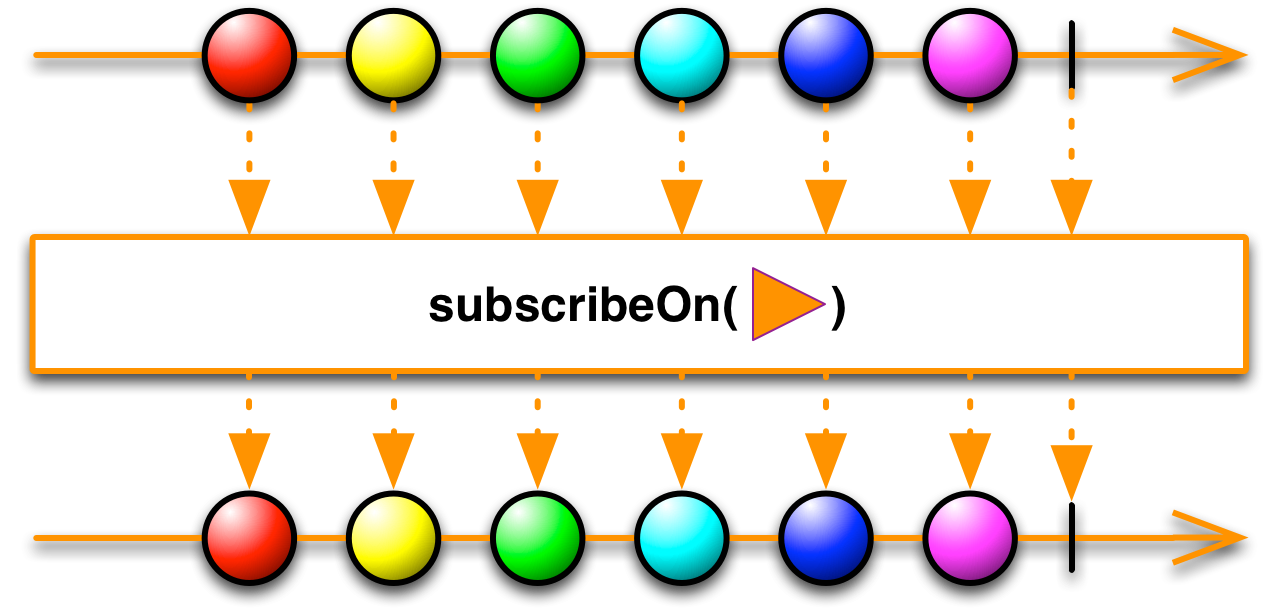
- Scheduler:
-
you specify which
Schedulerthis operator will use
- Parameters:
-
scheduler- theSchedulerto perform subscription actions on - Returns:
-
the source Observable modified so that its subscriptions happen on the specified
Scheduler - See Also:
-
RxJava wiki: subscribeOn,
RxJava Threading Examples,
observeOn(rx.Scheduler)
switchMap
public final <R> Observable
<R> switchMap(Func1 <? super T ,? extends Observable <? extends R>> func) Returns a new Observable by applying a function that you supply to each item emitted by the source Observable that returns an Observable, and then emitting the items emitted by the most recently emitted of these Observables.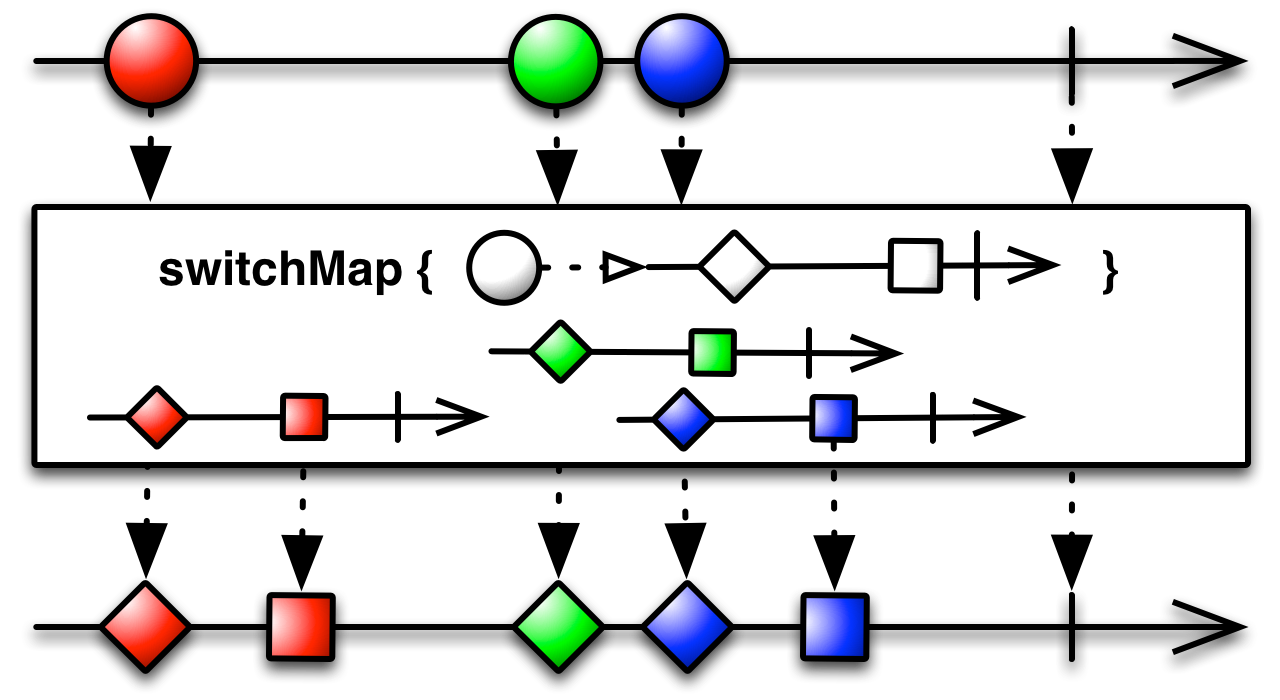
- Scheduler:
-
switchMapdoes not operate by default on a particularScheduler.
- Parameters:
-
func- a function that, when applied to an item emitted by the source Observable, returns an Observable - Returns:
-
an Observable that emits the items emitted by the Observable returned from applying
functo the most recently emitted item emitted by the source Observable - See Also:
- RxJava wiki: switchMap
take
public final Observable
<T> take(int num) Returns an Observable that emits only the firstnumitems emitted by the source Observable. This method returns an Observable that will invoke a subscribing
Observer'sonNextfunction a maximum ofnumtimes before invokingonCompleted.- Scheduler:
-
This version of
takedoes not operate by default on a particularScheduler.
- Parameters:
-
num- the maximum number of items to emit - Returns:
-
an Observable that emits only the first
numitems emitted by the source Observable, or all of the items from the source Observable if that Observable emits fewer thannumitems - See Also:
- RxJava wiki: take
take
public final Observable
<T> take(long time, TimeUnit unit) Returns an Observable that emits those items emitted by source Observable before a specified time runs out.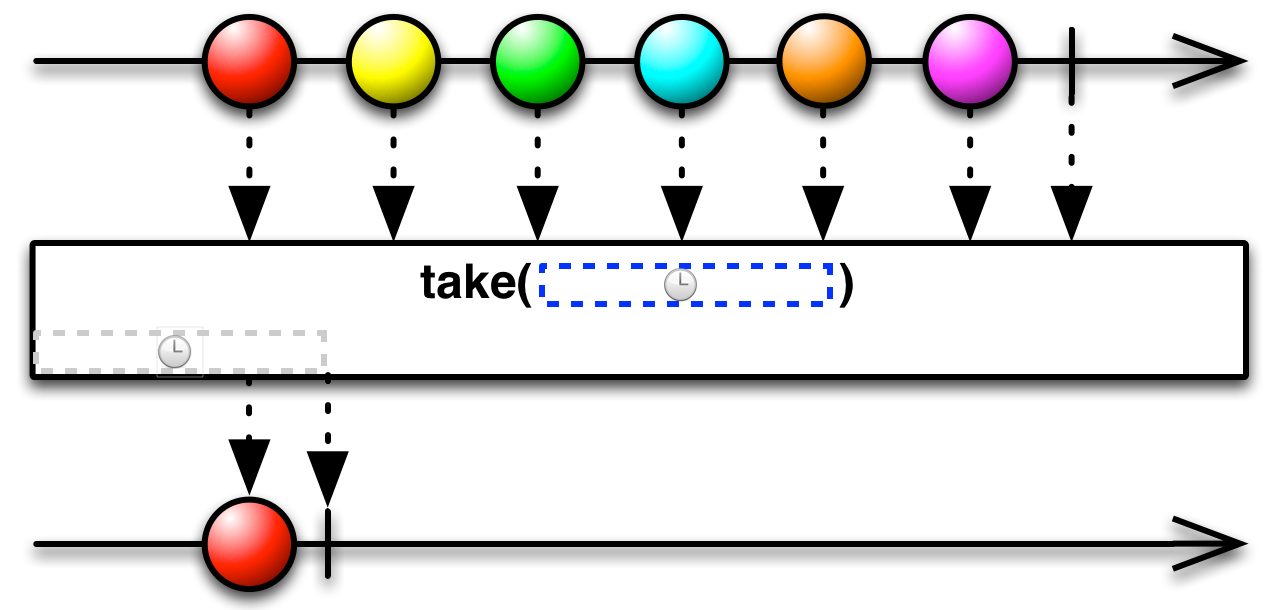
- Scheduler:
-
This version of
takeoperates by default on thecomputationScheduler.
- Parameters:
-
time- the length of the time window -
unit- the time unit oftime - Returns:
- an Observable that emits those items emitted by the source Observable before the time runs out
- See Also:
- RxJava wiki: take
take
public final Observable
<T> take(long time, TimeUnit unit, Scheduler scheduler) Returns an Observable that emits those items emitted by source Observable before a specified time (on a specified Scheduler) runs out.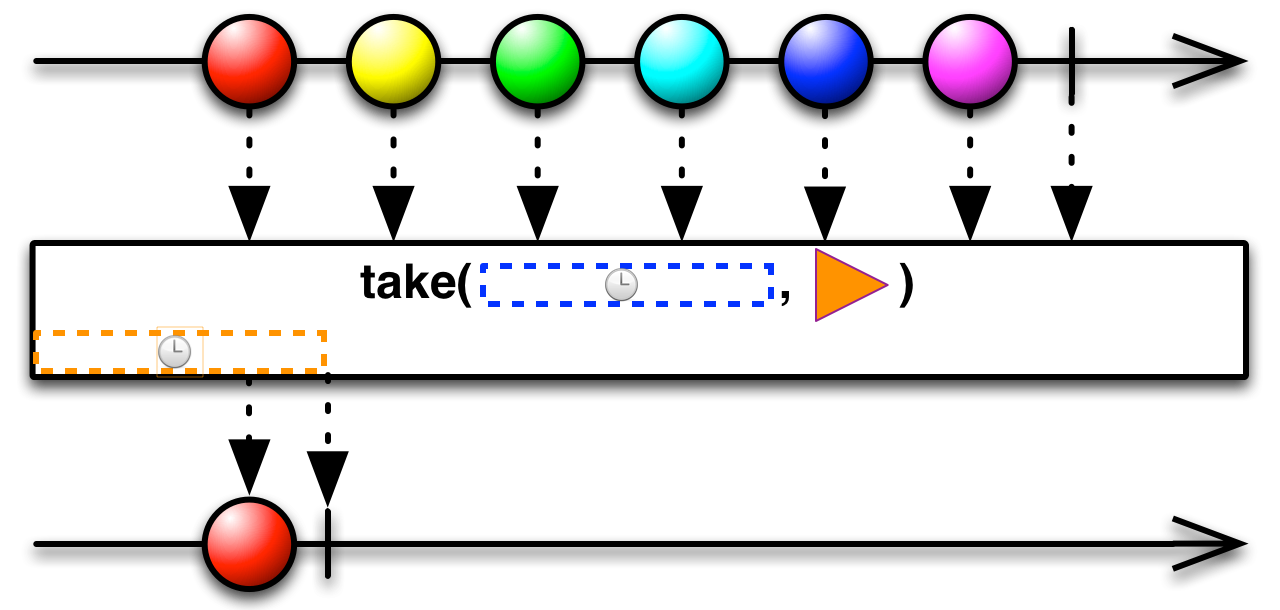
- Scheduler:
-
you specify which
Schedulerthis operator will use
- Parameters:
-
time- the length of the time window -
unit- the time unit oftime -
scheduler- the Scheduler used for time source - Returns:
- an Observable that emits those items emitted by the source Observable before the time runs out, according to the specified Scheduler
- See Also:
- RxJava wiki: take
takeFirst
public final Observable
<T> takeFirst(Func1 <? super T ,Boolean > predicate) Returns an Observable that emits only the very first item emitted by the source Observable that satisfies a specified condition.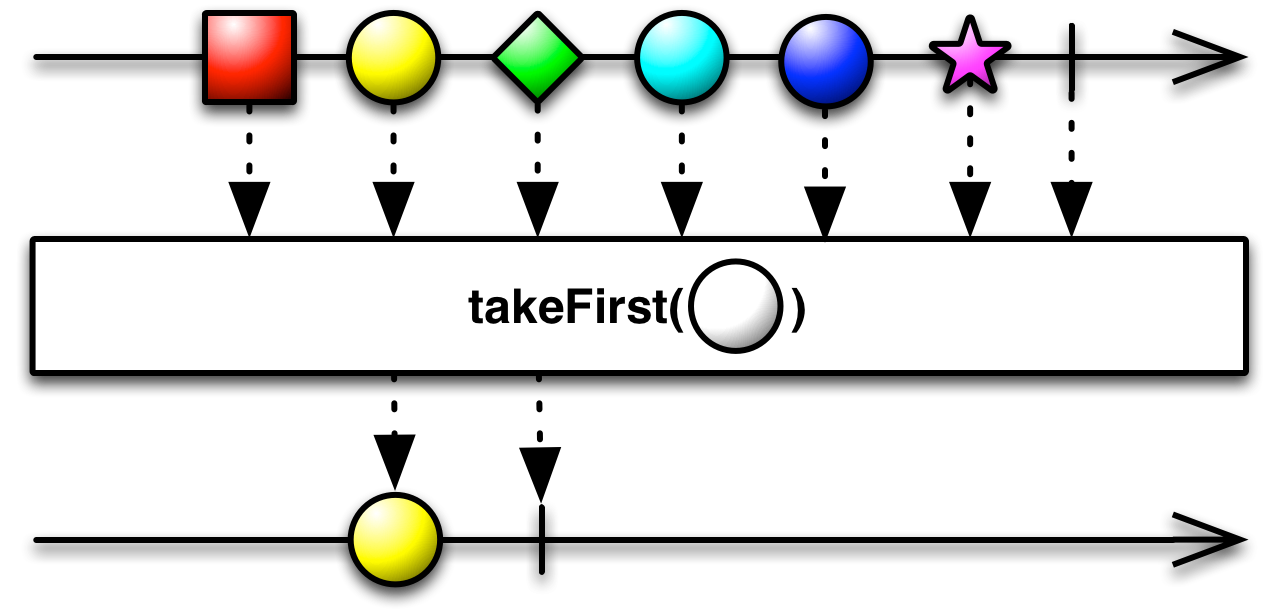
- Scheduler:
-
takeFirstdoes not operate by default on a particularScheduler.
- Parameters:
-
predicate- the condition any item emitted by the source Observable has to satisfy - Returns:
- an Observable that emits only the very first item emitted by the source Observable that satisfies the given condition, or that completes without emitting anything if the source Observable completes without emitting a single condition-satisfying item
- See Also:
- RxJava wiki: takeFirst, "MSDN: Observable.firstAsync"
takeLast
public final Observable
<T> takeLast(int count) Returns an Observable that emits only the lastcountitems emitted by the source Observable.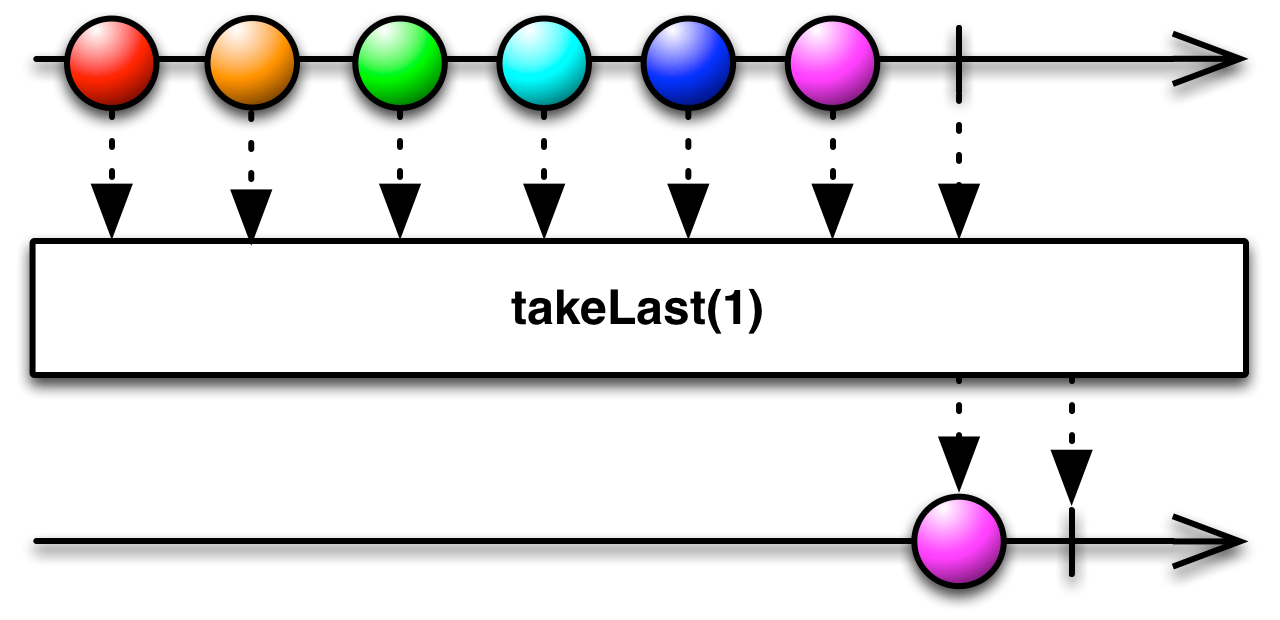
- Scheduler:
-
This version of
takeLastdoes not operate by default on a particularScheduler.
- Parameters:
-
count- the number of items to emit from the end of the sequence of items emitted by the source Observable - Returns:
-
an Observable that emits only the last
countitems emitted by the source Observable - Throws:
-
IndexOutOfBoundsException- ifcountis less than zero - See Also:
- RxJava wiki: takeLast
takeLast
public final Observable
<T> takeLast(int count, long time, TimeUnit unit) Returns an Observable that emits at most a specified number of items from the source Observable that were emitted in a specified window of time before the Observable completed.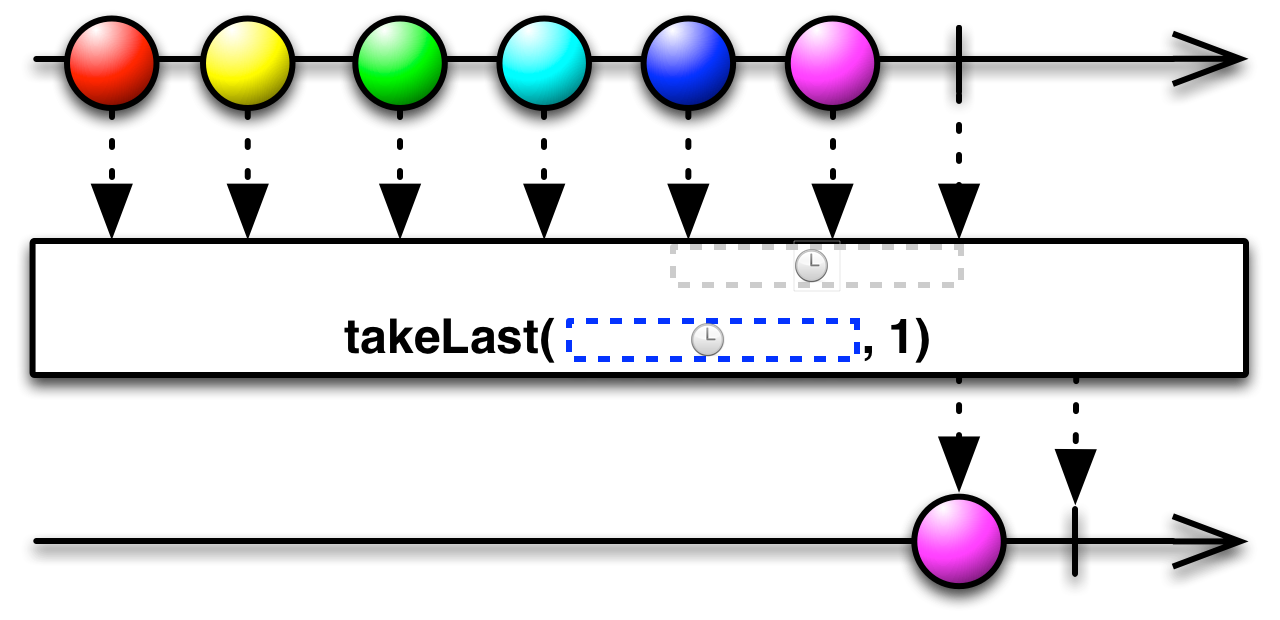
- Scheduler:
-
This version of
takeLastoperates by default on thecomputationScheduler.
- Parameters:
-
count- the maximum number of items to emit -
time- the length of the time window -
unit- the time unit oftime - Returns:
-
an Observable that emits at most
countitems from the source Observable that were emitted in a specified window of time before the Observable completed - See Also:
- RxJava wiki: takeLast
takeLast
public final Observable
<T> takeLast(int count, long time, TimeUnit unit, Scheduler scheduler) Returns an Observable that emits at most a specified number of items from the source Observable that were emitted in a specified window of time before the Observable completed, where the timing information is provided by a given Scheduler.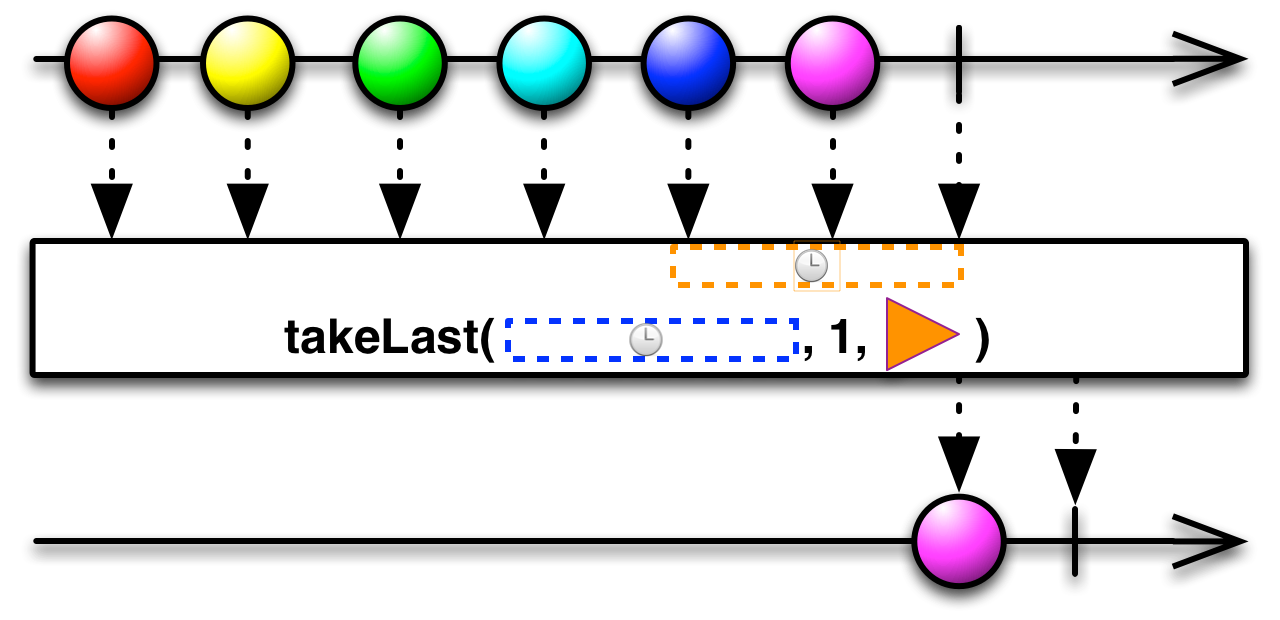
- Scheduler:
-
you specify which
Schedulerthis operator will use
- Parameters:
-
count- the maximum number of items to emit -
time- the length of the time window -
unit- the time unit oftime -
scheduler- theSchedulerthat provides the timestamps for the observed items - Returns:
-
an Observable that emits at most
countitems from the source Observable that were emitted in a specified window of time before the Observable completed, where the timing information is provided by the givenscheduler - Throws:
-
IndexOutOfBoundsException- ifcountis less than zero - See Also:
- RxJava wiki: takeLast
takeLast
public final Observable
<T> takeLast(long time, TimeUnit unit) Returns an Observable that emits the items from the source Observable that were emitted in a specified window of time before the Observable completed.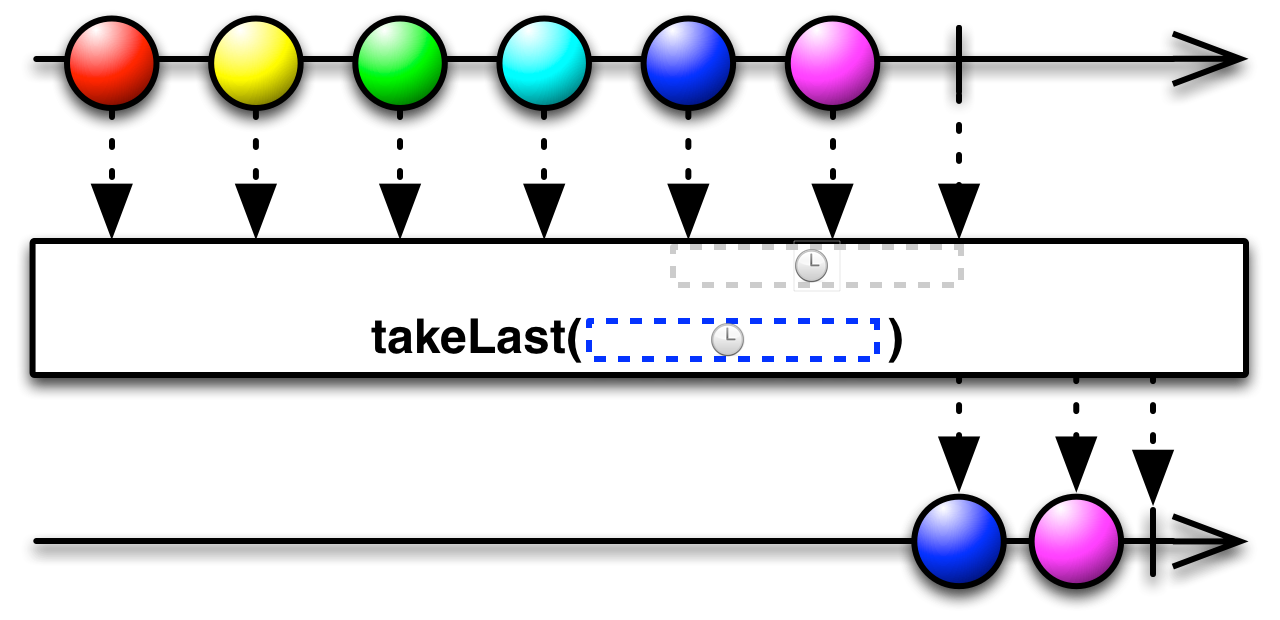
- Scheduler:
-
This version of
takeLastoperates by default on thecomputationScheduler.
- Parameters:
-
time- the length of the time window -
unit- the time unit oftime - Returns:
-
an Observable that emits the items from the source Observable that were emitted in the window of time before the Observable completed specified by
time - See Also:
- RxJava wiki: takeLast
takeLast
public final Observable
<T> takeLast(long time, TimeUnit unit, Scheduler scheduler) Returns an Observable that emits the items from the source Observable that were emitted in a specified window of time before the Observable completed, where the timing information is provided by a specified Scheduler.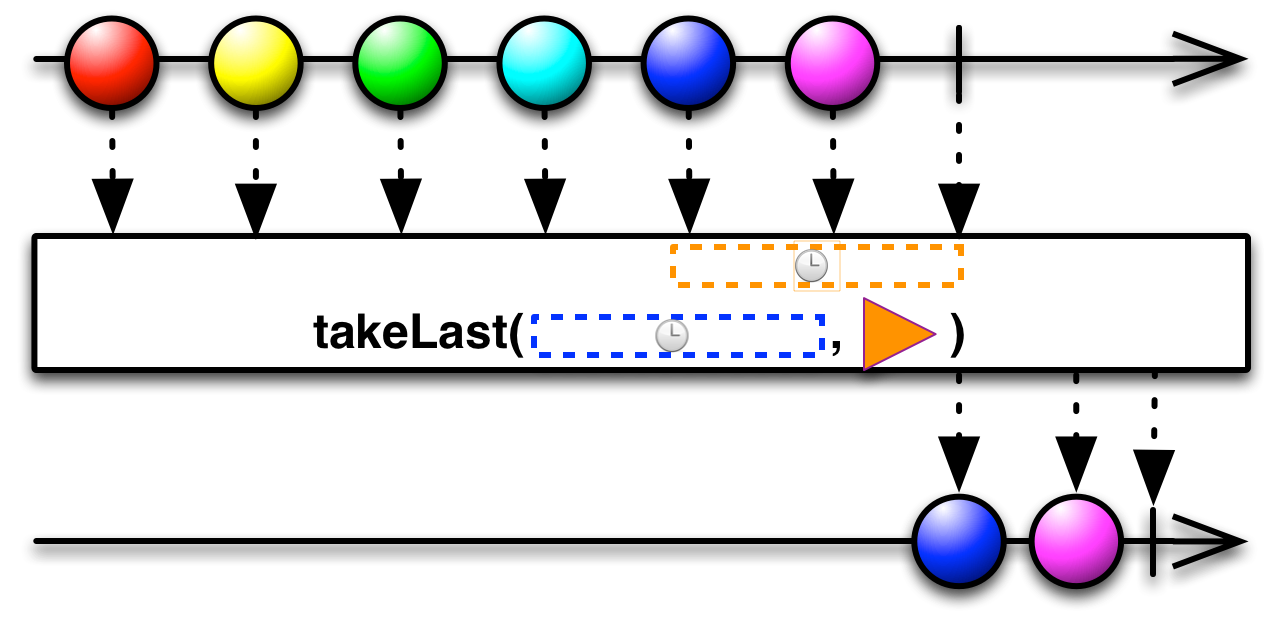
- Scheduler:
-
you specify which
Schedulerthis operator will use
- Parameters:
-
time- the length of the time window -
unit- the time unit oftime -
scheduler- the Scheduler that provides the timestamps for the Observed items - Returns:
-
an Observable that emits the items from the source Observable that were emitted in the window of time before the Observable completed specified by
time, where the timing information is provided byscheduler - See Also:
- RxJava wiki: takeLast
takeLastBuffer
public final Observable
<List <T>> takeLastBuffer(int count) Returns an Observable that emits a single List containing the lastcountelements emitted by the source Observable.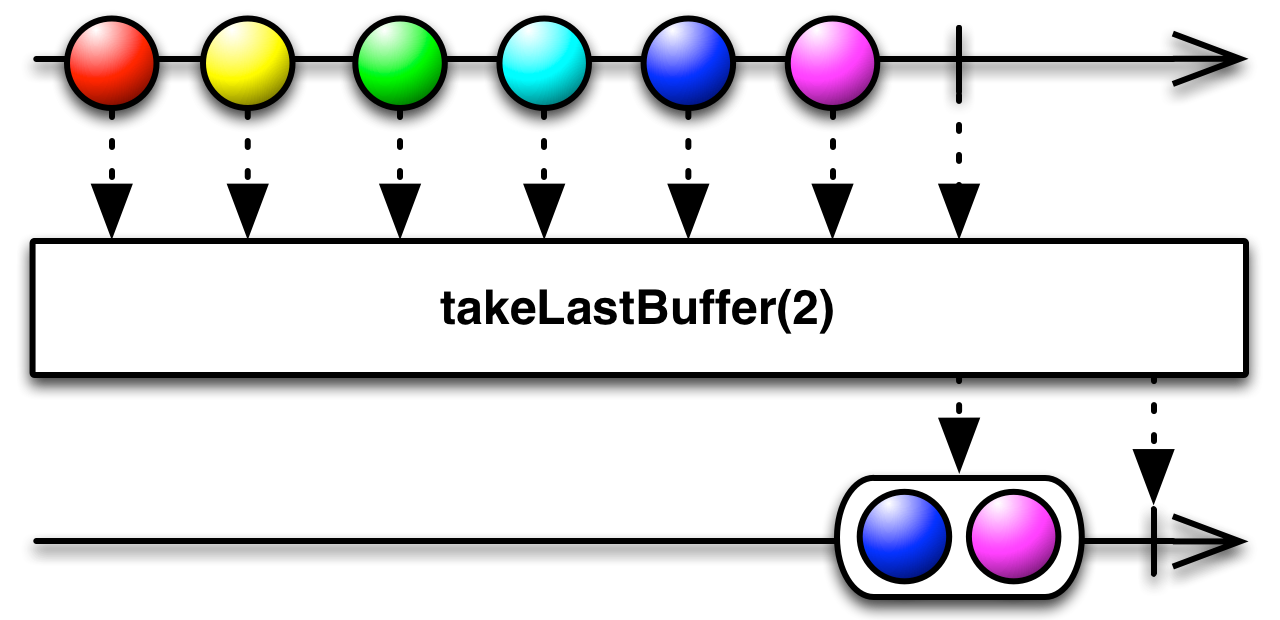
- Scheduler:
-
This version of
takeLastBufferdoes not operate by default on a particularScheduler.
- Parameters:
-
count- the number of items to emit in the list - Returns:
-
an Observable that emits a single list containing the last
countelements emitted by the source Observable - See Also:
- RxJava wiki: takeLastBuffer
takeLastBuffer
public final Observable
<List <T>> takeLastBuffer(int count, long time, TimeUnit unit) Returns an Observable that emits a single List containing at mostcountitems from the source Observable that were emitted during a specified window of time before the source Observable completed.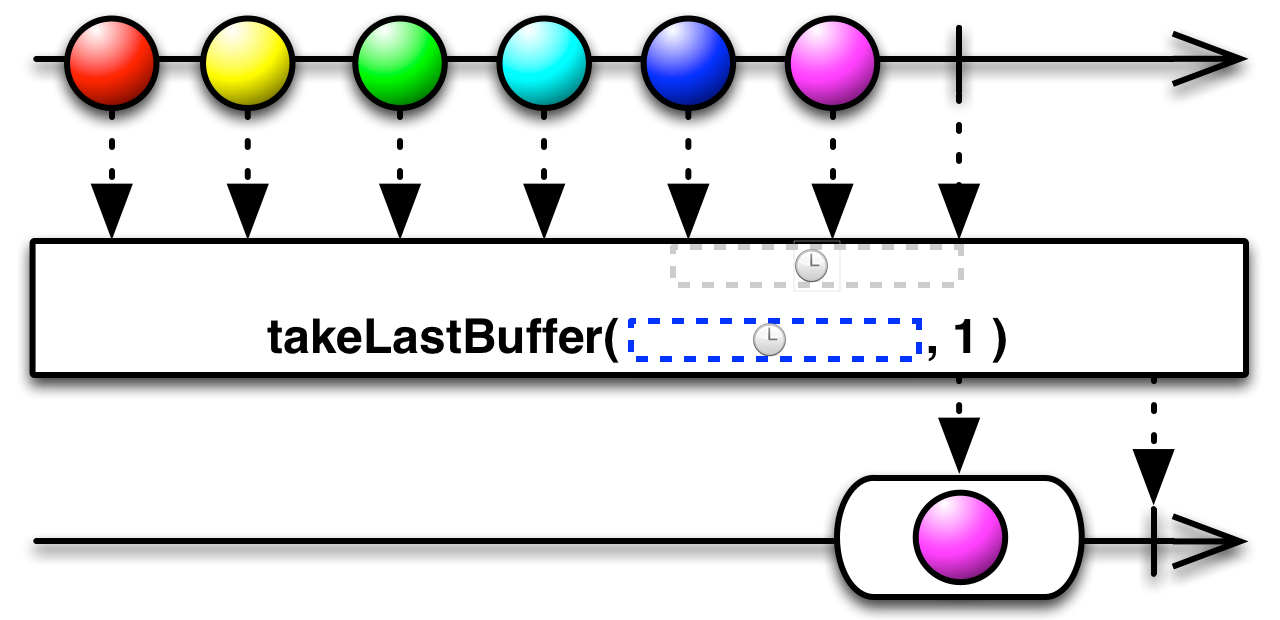
- Scheduler:
-
This version of
takeLastBufferoperates by default on thecomputationScheduler.
- Parameters:
-
count- the maximum number of items to emit -
time- the length of the time window -
unit- the time unit oftime - Returns:
-
an Observable that emits a single List containing at most
countitems emitted by the source Observable during the time window defined bytimebefore the source Observable completed - See Also:
- RxJava wiki: takeLastBuffer
takeLastBuffer
public final Observable
<List <T>> takeLastBuffer(int count, long time, TimeUnit unit, Scheduler scheduler) Returns an Observable that emits a single List containing at mostcountitems from the source Observable that were emitted during a specified window of time (on a specified Scheduler) before the source Observable completed.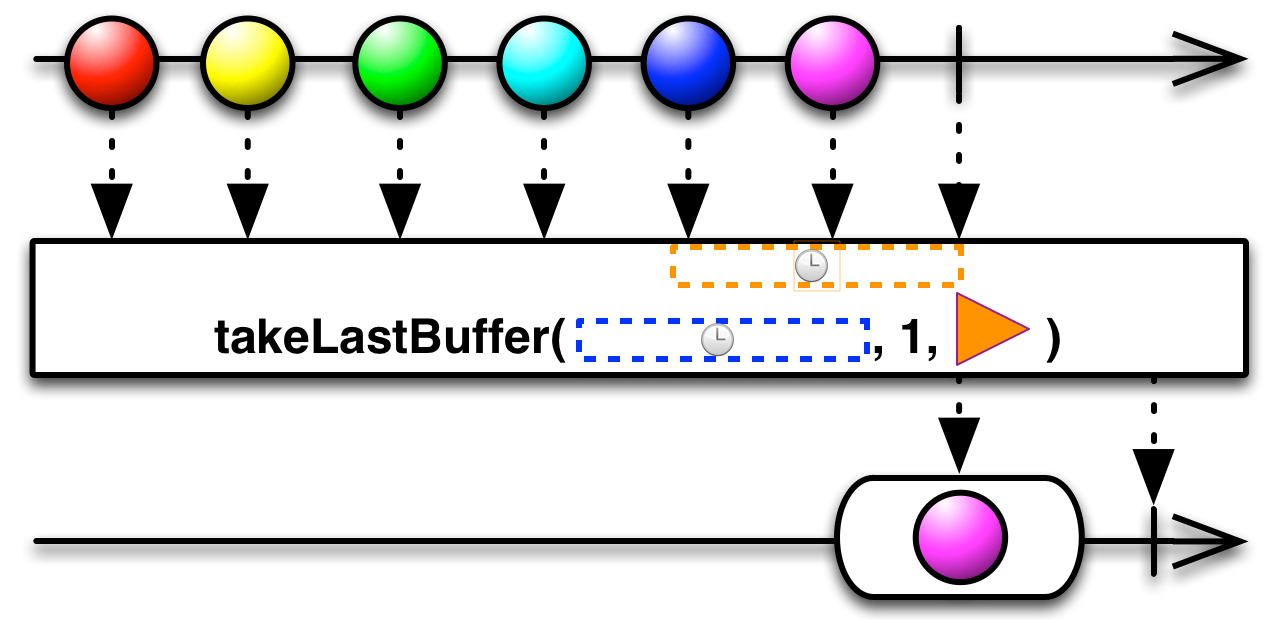
- Scheduler:
-
you specify which
Schedulerthis operator will use
- Parameters:
-
count- the maximum number of items to emit -
time- the length of the time window -
unit- the time unit oftime -
scheduler- the Scheduler that provides the timestamps for the observed items - Returns:
-
an Observable that emits a single List containing at most
countitems emitted by the source Observable during the time window defined bytimebefore the source Observable completed - See Also:
- RxJava wiki: takeLastBuffer
takeLastBuffer
public final Observable
<List <T>> takeLastBuffer(long time, TimeUnit unit) Returns an Observable that emits a single List containing those items from the source Observable that were emitted during a specified window of time before the source Observable completed.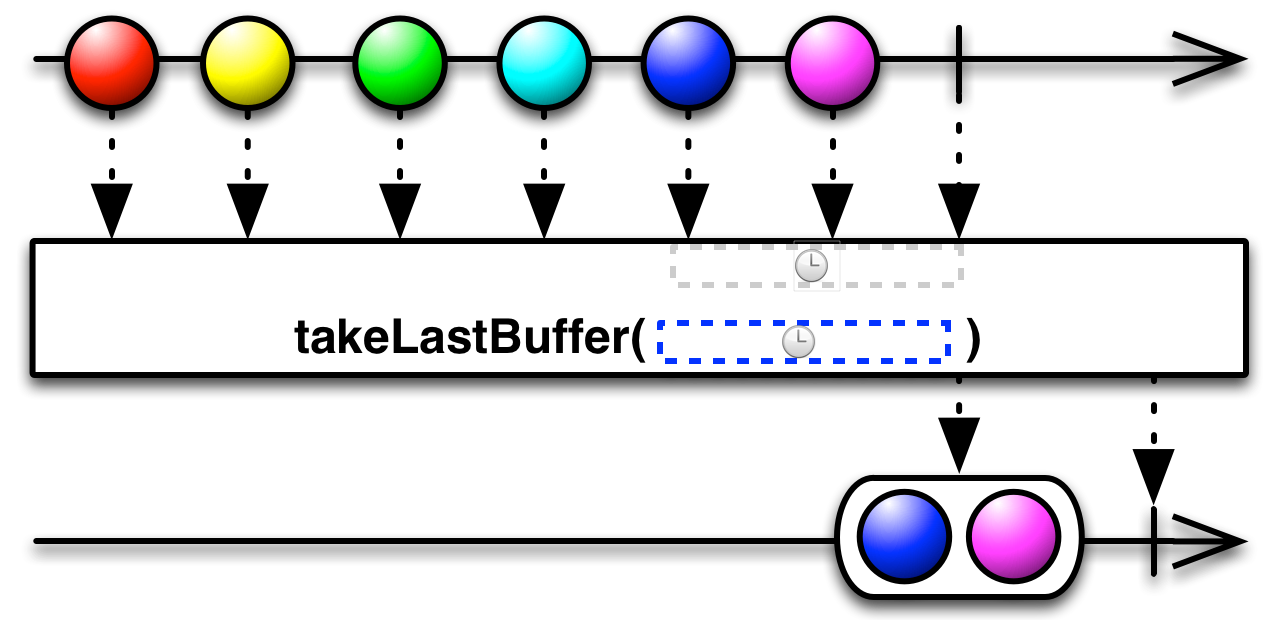
- Scheduler:
-
This version of
takeLastBufferoperates by default on thecomputationScheduler.
- Parameters:
-
time- the length of the time window -
unit- the time unit oftime - Returns:
-
an Observable that emits a single List containing the items emitted by the source Observable during the time window defined by
timebefore the source Observable completed - See Also:
- RxJava wiki: takeLastBuffer
takeLastBuffer
public final Observable
<List <T>> takeLastBuffer(long time, TimeUnit unit, Scheduler scheduler) Returns an Observable that emits a single List containing those items from the source Observable that were emitted during a specified window of time before the source Observable completed, where the timing information is provided by the given Scheduler.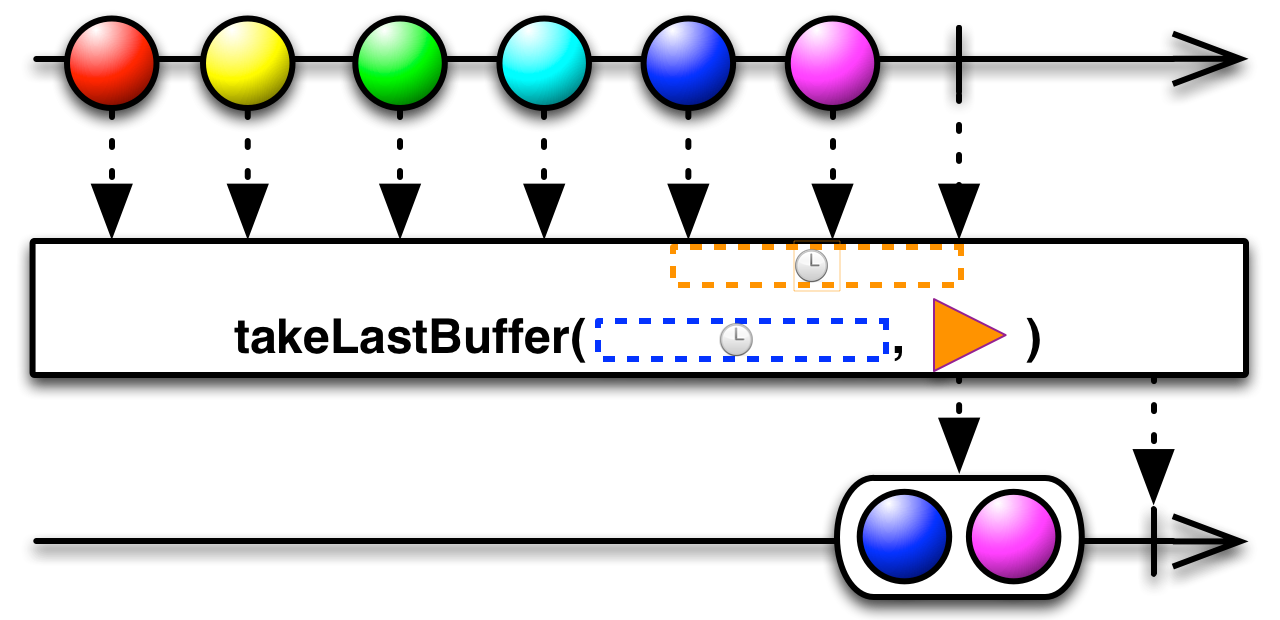
- Scheduler:
-
you specify which
Schedulerthis operator will use
- Parameters:
-
time- the length of the time window -
unit- the time unit oftime -
scheduler- the Scheduler that provides the timestamps for the observed items - Returns:
-
an Observable that emits a single List containing the items emitted by the source Observable during the time window defined by
timebefore the source Observable completed, where the timing information is provided byscheduler - See Also:
- RxJava wiki: takeLastBuffer
takeUntil
public final <E> Observable
<T> takeUntil(Observable <? extends E> other) Returns an Observable that emits the items emitted by the source Observable until a second Observable emits an item.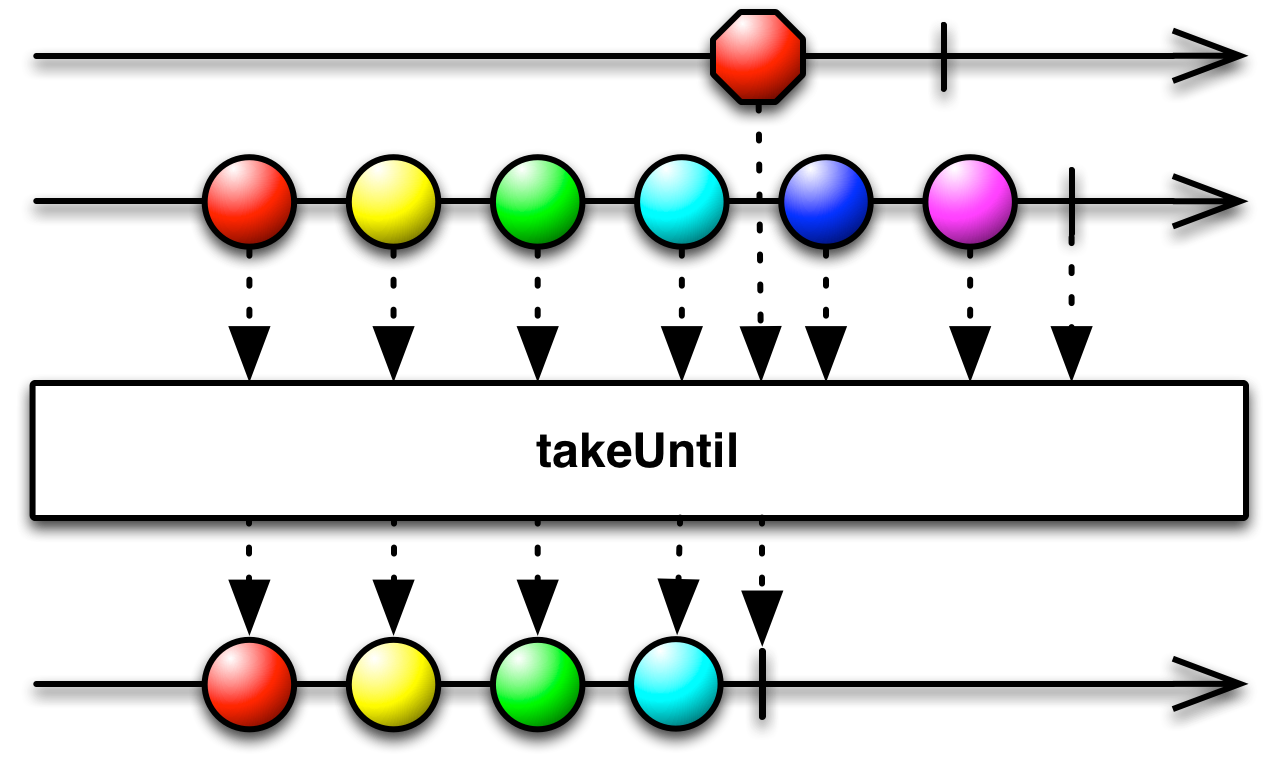
- Scheduler:
-
takeUntildoes not operate by default on a particularScheduler.
- Type Parameters:
-
E- the type of items emitted byother - Parameters:
-
other- the Observable whose first emitted item will causetakeUntilto stop emitting items from the source Observable - Returns:
-
an Observable that emits the items emitted by the source Observable until such time as
otheremits its first item - See Also:
- RxJava wiki: takeUntil
takeWhile
public final Observable
<T> takeWhile(Func1 <? super T ,Boolean > predicate) Returns an Observable that emits items emitted by the source Observable so long as each item satisfied a specified condition, and then completes as soon as this condition is not satisfied.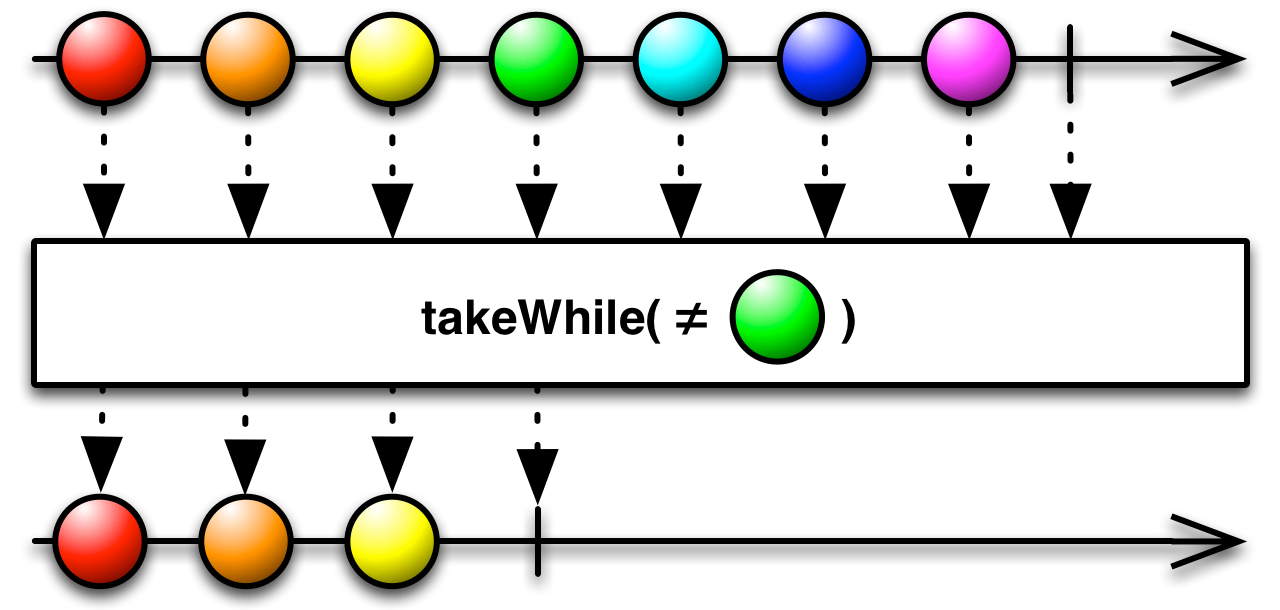
- Scheduler:
-
takeWhiledoes not operate by default on a particularScheduler.
- Parameters:
-
predicate- a function that evaluates an item emitted by the source Observable and returns a Boolean - Returns:
-
an Observable that emits the items from the source Observable so long as each item satisfies the condition defined by
predicate, then completes - See Also:
- RxJava wiki: takeWhile
throttleFirst
public final Observable
<T> throttleFirst(long windowDuration, TimeUnit unit) Returns an Observable that emits only the first item emitted by the source Observable during sequential time windows of a specified duration.This differs from
throttleLast(long, java.util.concurrent.TimeUnit)in that this only tracks passage of time whereasthrottleLast(long, java.util.concurrent.TimeUnit)ticks at scheduled intervals.
- Backpressure Support:
- This operator does not support backpressure as it uses time to control data flow.
- Scheduler:
-
throttleFirstoperates by default on thecomputationScheduler.
- Parameters:
-
windowDuration- time to wait before emitting another item after emitting the last item -
unit- the unit of time ofwindowDuration - Returns:
- an Observable that performs the throttle operation
- See Also:
- RxJava wiki: throttleFirst, RxJava wiki: Backpressure
throttleFirst
public final Observable
<T> throttleFirst(long skipDuration, TimeUnit unit, Scheduler scheduler) Returns an Observable that emits only the first item emitted by the source Observable during sequential time windows of a specified duration, where the windows are managed by a specified Scheduler.This differs from
throttleLast(long, java.util.concurrent.TimeUnit)in that this only tracks passage of time whereasthrottleLast(long, java.util.concurrent.TimeUnit)ticks at scheduled intervals.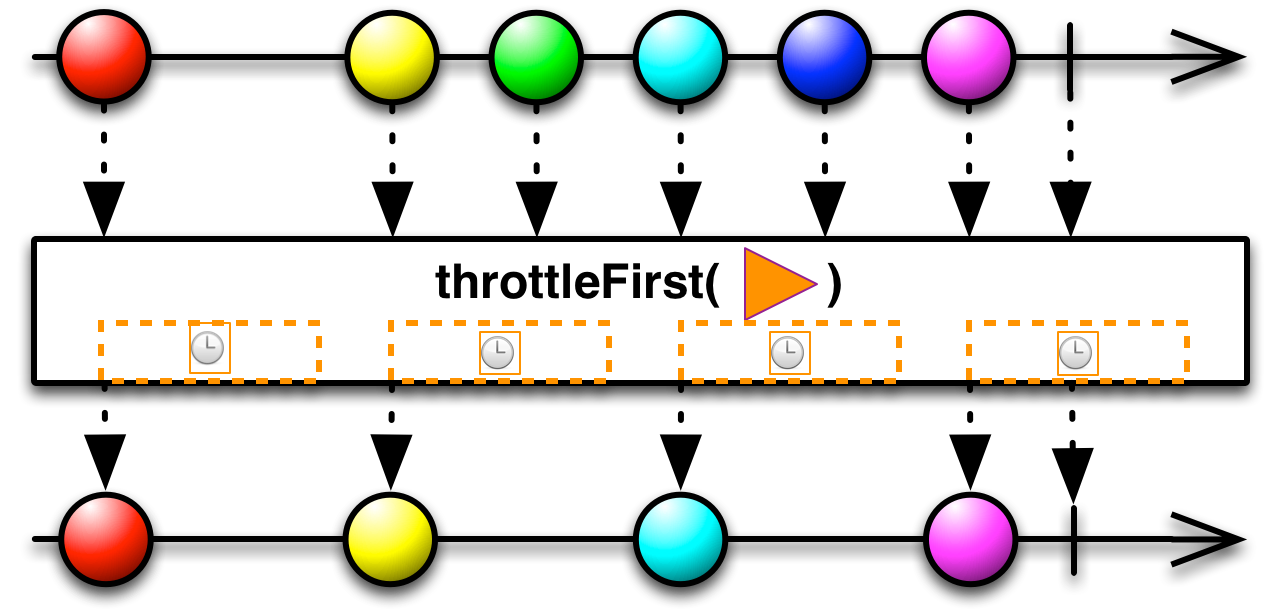
- Backpressure Support:
- This operator does not support backpressure as it uses time to control data flow.
- Scheduler:
-
you specify which
Schedulerthis operator will use
- Parameters:
-
skipDuration- time to wait before emitting another item after emitting the last item -
unit- the unit of time ofskipDuration -
scheduler- theSchedulerto use internally to manage the timers that handle timeout for each event - Returns:
- an Observable that performs the throttle operation
- See Also:
- RxJava wiki: throttleFirst, RxJava wiki: Backpressure
throttleLast
public final Observable
<T> throttleLast(long intervalDuration, TimeUnit unit) Returns an Observable that emits only the last item emitted by the source Observable during sequential time windows of a specified duration.This differs from
throttleFirst(long, java.util.concurrent.TimeUnit)in that this ticks along at a scheduled interval whereasthrottleFirst(long, java.util.concurrent.TimeUnit)does not tick, it just tracks passage of time.
- Backpressure Support:
- This operator does not support backpressure as it uses time to control data flow.
- Scheduler:
-
throttleLastoperates by default on thecomputationScheduler.
- Parameters:
-
intervalDuration- duration of windows within which the last item emitted by the source Observable will be emitted -
unit- the unit of time ofintervalDuration - Returns:
- an Observable that performs the throttle operation
- See Also:
-
RxJava wiki: throttleLast,
RxJava wiki: Backpressure,
sample(long, TimeUnit)
throttleLast
public final Observable
<T> throttleLast(long intervalDuration, TimeUnit unit, Scheduler scheduler) Returns an Observable that emits only the last item emitted by the source Observable during sequential time windows of a specified duration, where the duration is governed by a specified Scheduler.This differs from
throttleFirst(long, java.util.concurrent.TimeUnit)in that this ticks along at a scheduled interval whereasthrottleFirst(long, java.util.concurrent.TimeUnit)does not tick, it just tracks passage of time.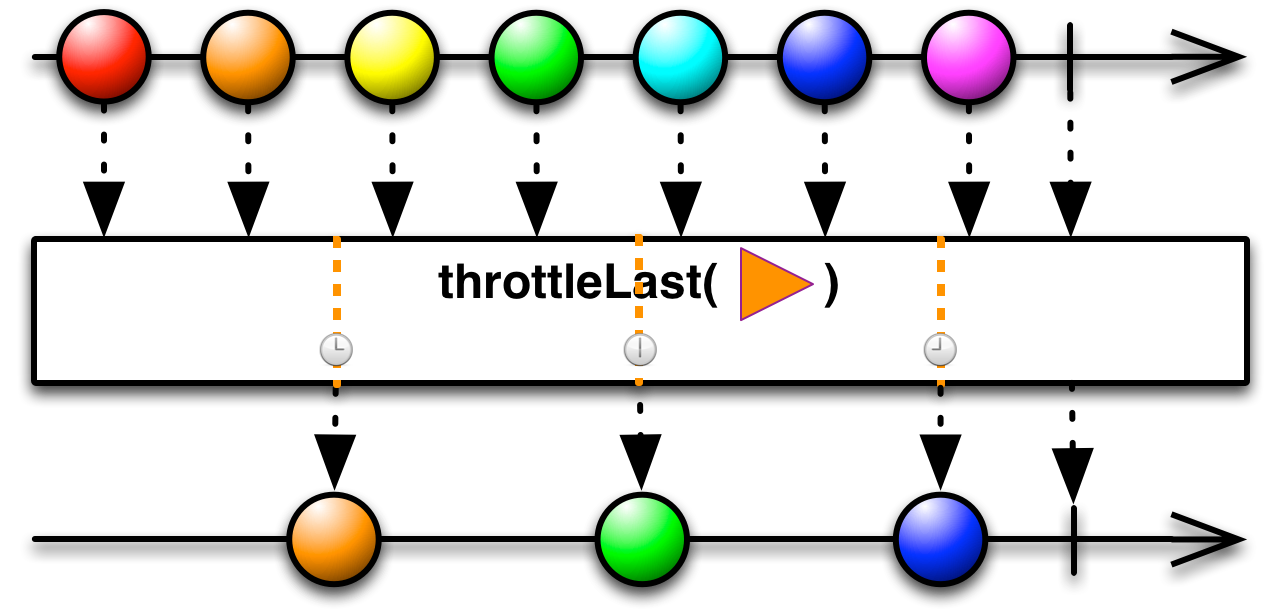
- Backpressure Support:
- This operator does not support backpressure as it uses time to control data flow.
- Scheduler:
-
you specify which
Schedulerthis operator will use
- Parameters:
-
intervalDuration- duration of windows within which the last item emitted by the source Observable will be emitted -
unit- the unit of time ofintervalDuration -
scheduler- theSchedulerto use internally to manage the timers that handle timeout for each event - Returns:
- an Observable that performs the throttle operation
- See Also:
-
RxJava wiki: throttleLast,
RxJava wiki: Backpressure,
sample(long, TimeUnit, Scheduler)
throttleWithTimeout
public final Observable
<T> throttleWithTimeout(long timeout, TimeUnit unit) Returns an Observable that only emits those items emitted by the source Observable that are not followed by another emitted item within a specified time window.Note: If the source Observable keeps emitting items more frequently than the length of the time window then no items will be emitted by the resulting Observable.
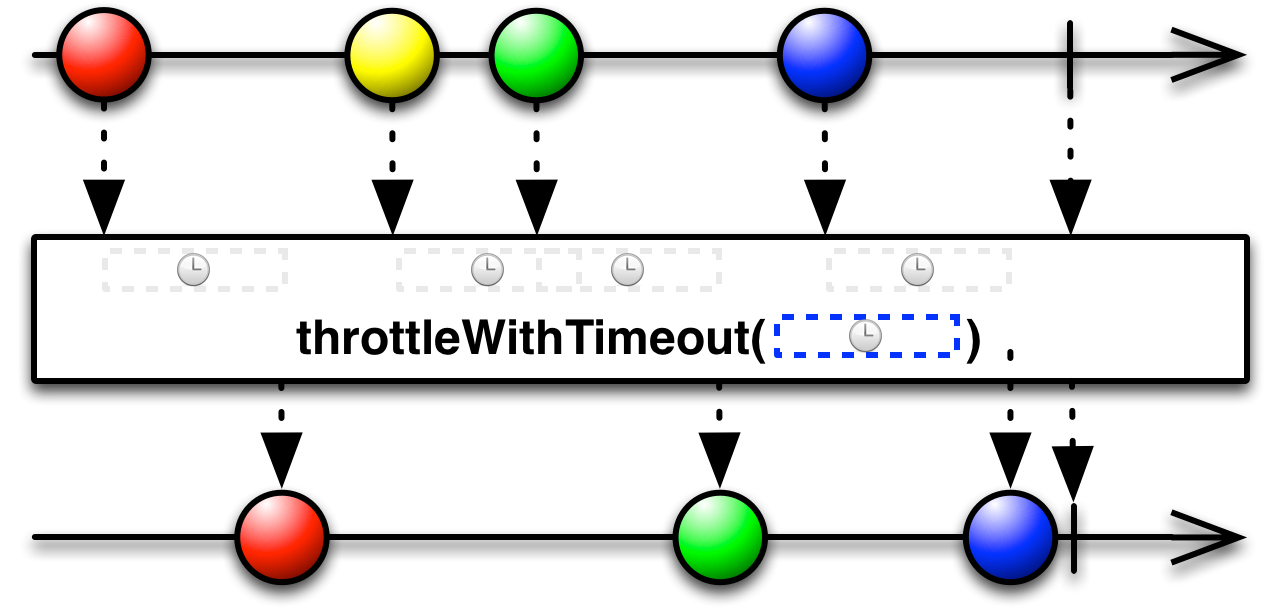
Information on debounce vs throttle:
- Debounce and Throttle: visual explanation
- Debouncing: javascript methods
- Javascript - don't spam your server: debounce and throttle
- Backpressure Support:
- This operator does not support backpressure as it uses time to control data flow.
- Scheduler:
-
throttleWithTimeoutoperates by default on thecomputationScheduler.
- Parameters:
-
timeout- the length of the window of time that must pass after the emission of an item from the source Observable in which that Observable emits no items in order for the item to be emitted by the resulting Observable -
unit- theTimeUnitoftimeout - Returns:
- an Observable that filters out items that are too quickly followed by newer items
- See Also:
-
RxJava wiki: throttleWithTimeout,
RxJava wiki: Backpressure,
debounce(long, TimeUnit)
throttleWithTimeout
public final Observable
<T> throttleWithTimeout(long timeout, TimeUnit unit, Scheduler scheduler) Returns an Observable that only emits those items emitted by the source Observable that are not followed by another emitted item within a specified time window, where the time window is governed by a specified Scheduler.Note: If the source Observable keeps emitting items more frequently than the length of the time window then no items will be emitted by the resulting Observable.
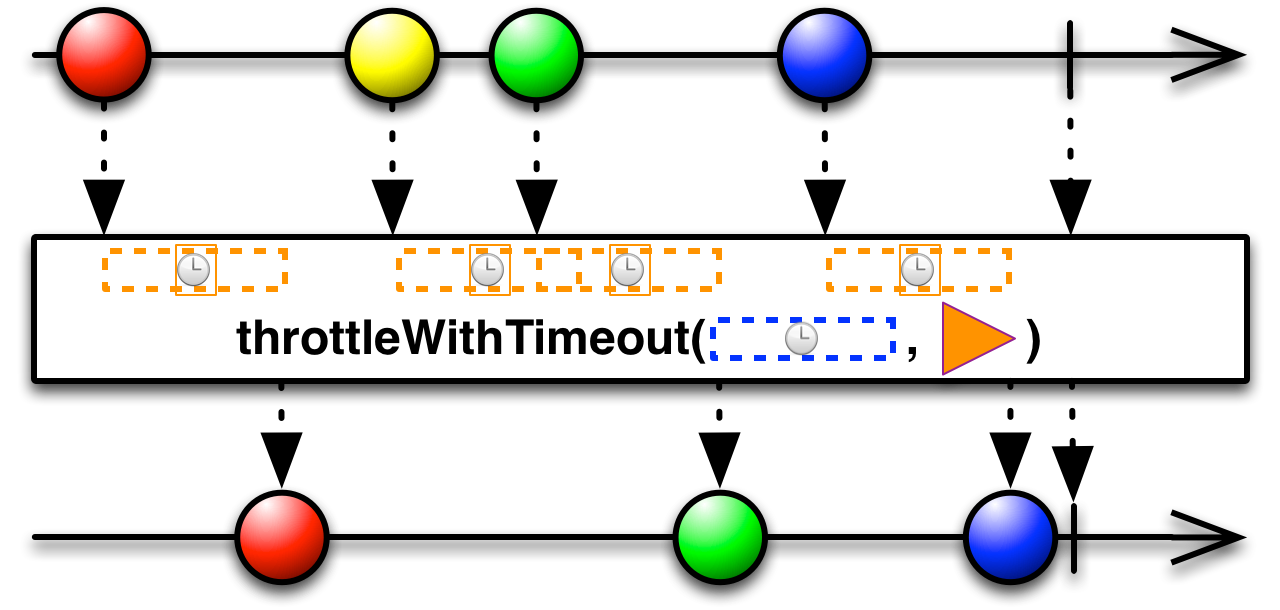
Information on debounce vs throttle:
- Debounce and Throttle: visual explanation
- Debouncing: javascript methods
- Javascript - don't spam your server: debounce and throttle
- Backpressure Support:
- This operator does not support backpressure as it uses time to control data flow.
- Scheduler:
-
you specify which
Schedulerthis operator will use
- Parameters:
-
timeout- the length of the window of time that must pass after the emission of an item from the source Observable in which that Observable emits no items in order for the item to be emitted by the resulting Observable -
unit- theTimeUnitoftimeout -
scheduler- theSchedulerto use internally to manage the timers that handle the timeout for each item - Returns:
- an Observable that filters out items that are too quickly followed by newer items
- See Also:
-
RxJava wiki: throttleWithTimeout,
RxJava wiki: Backpressure,
debounce(long, TimeUnit, Scheduler)
timeInterval
public final Observable
<TimeInterval <T>> timeInterval() Returns an Observable that emits records of the time interval between consecutive items emitted by the source Observable.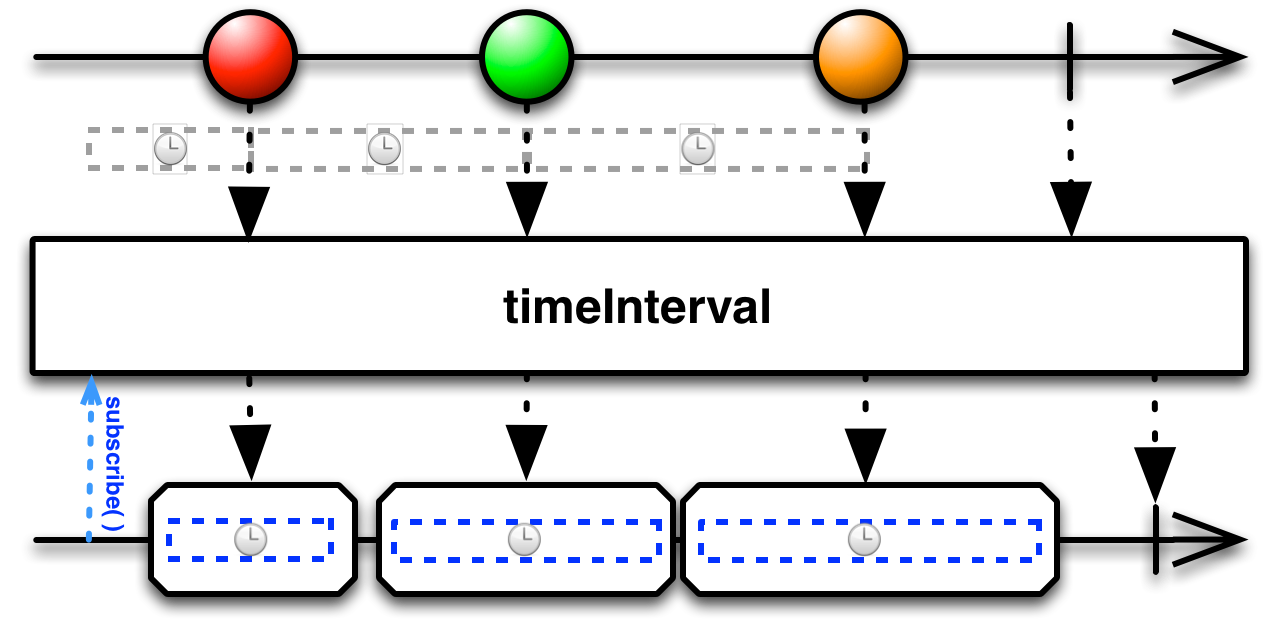
- Scheduler:
-
timeIntervaloperates by default on theimmediateScheduler.
- Returns:
- an Observable that emits time interval information items
- See Also:
- RxJava wiki: timeInterval
timeInterval
public final Observable
<TimeInterval <T>> timeInterval(Scheduler scheduler) Returns an Observable that emits records of the time interval between consecutive items emitted by the source Observable, where this interval is computed on a specified Scheduler.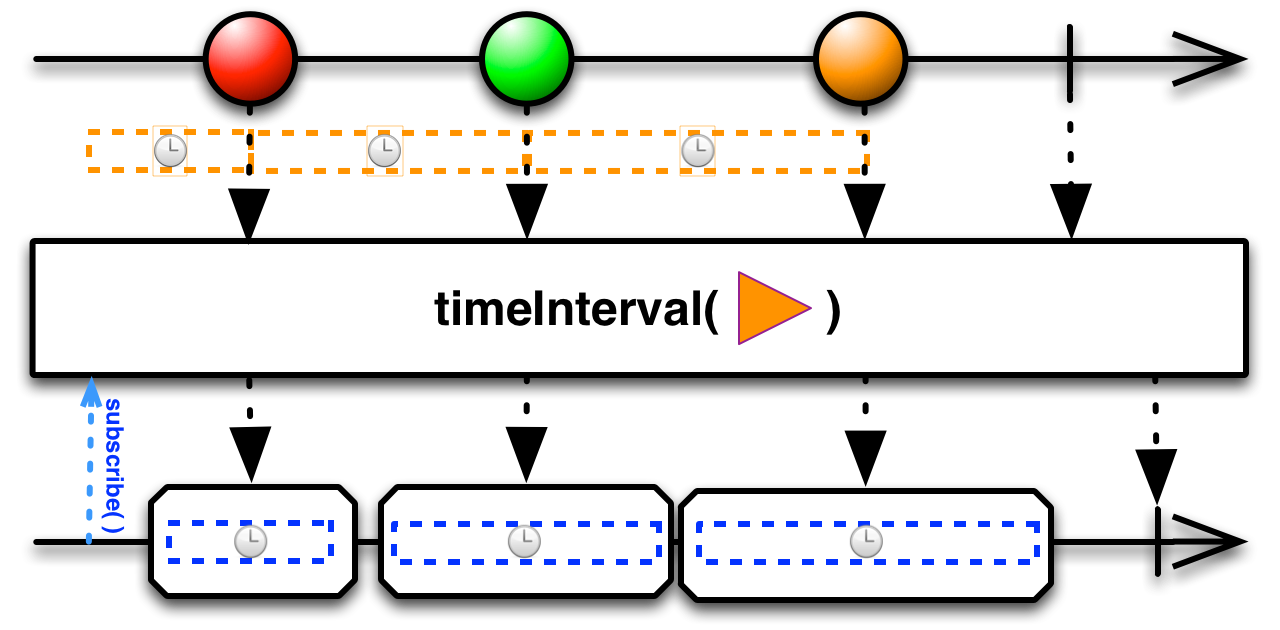
- Scheduler:
-
you specify which
Schedulerthis operator will use
- Parameters:
-
scheduler- theSchedulerused to compute time intervals - Returns:
- an Observable that emits time interval information items
- See Also:
- RxJava wiki: timeInterval
timeout
public final <U
,V> Observable <T> timeout(Func0 <? extends Observable <U>> firstTimeoutSelector, Func1 <? super T ,? extends Observable <V>> timeoutSelector) Returns an Observable that mirrors the source Observable, but notifies observers of aTimeoutExceptionif either the first item emitted by the source Observable or any subsequent item doesn't arrive within time windows defined by other Observables.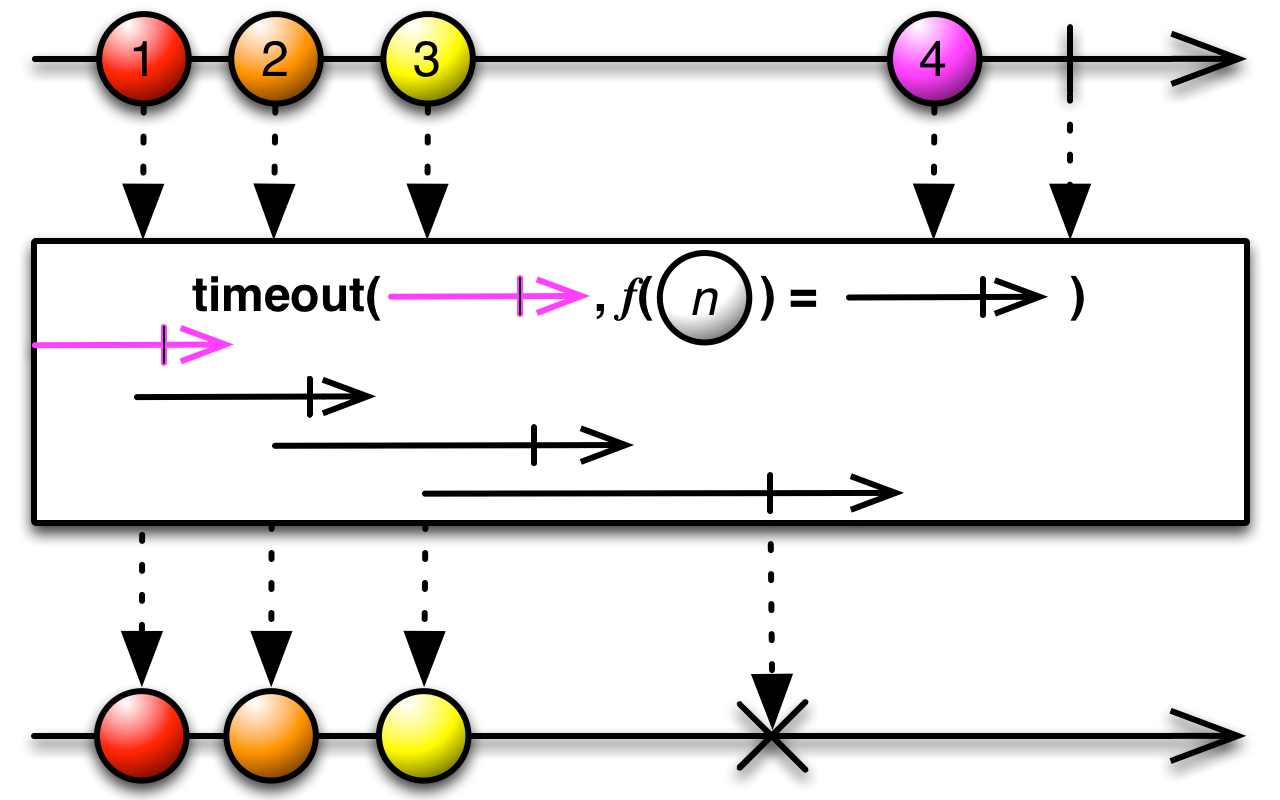
- Scheduler:
-
This version of
timeoutoperates by default on theimmediateScheduler.
- Type Parameters:
-
U- the first timeout value type (ignored) -
V- the subsequent timeout value type (ignored) - Parameters:
-
firstTimeoutSelector- a function that returns an Observable that determines the timeout window for the first source item -
timeoutSelector- a function that returns an Observable for each item emitted by the source Observable and that determines the timeout window in which the subsequent source item must arrive in order to continue the sequence - Returns:
-
an Observable that mirrors the source Observable, but notifies observers of a
TimeoutExceptionif either the first item or any subsequent item doesn't arrive within the time windows specified by the timeout selectors - See Also:
- RxJava wiki: timeout
timeout
public final <U
,V> Observable <T> timeout(Func0 <? extends Observable <U>> firstTimeoutSelector, Func1 <? super T ,? extends Observable <V>> timeoutSelector, Observable <? extends T> other) Returns an Observable that mirrors the source Observable, but switches to a fallback Observable if either the first item emitted by the source Observable or any subsequent item doesn't arrive within time windows defined by other Observables.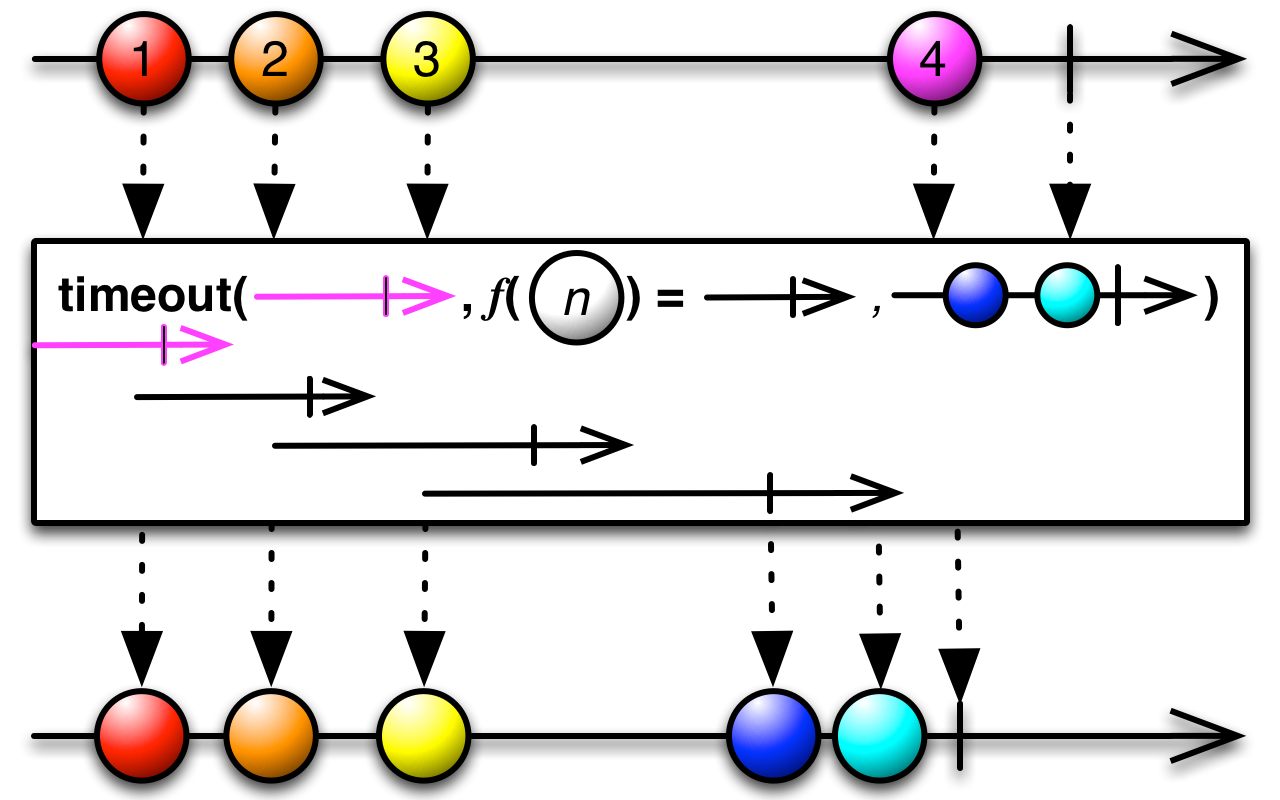
- Scheduler:
-
This version of
timeoutoperates by default on theimmediateScheduler.
- Type Parameters:
-
U- the first timeout value type (ignored) -
V- the subsequent timeout value type (ignored) - Parameters:
-
firstTimeoutSelector- a function that returns an Observable which determines the timeout window for the first source item -
timeoutSelector- a function that returns an Observable for each item emitted by the source Observable and that determines the timeout window in which the subsequent source item must arrive in order to continue the sequence -
other- the fallback Observable to switch to if the source Observable times out - Returns:
-
an Observable that mirrors the source Observable, but switches to the
otherObservable if either the first item emitted by the source Observable or any subsequent item doesn't arrive within time windows defined by the timeout selectors - Throws:
-
NullPointerException- iftimeoutSelectoris null - See Also:
- RxJava wiki: timeout
timeout
public final <V> Observable
<T> timeout(Func1 <? super T ,? extends Observable <V>> timeoutSelector) Returns an Observable that mirrors the source Observable, but notifies observers of aTimeoutExceptionif an item emitted by the source Observable doesn't arrive within a window of time after the emission of the previous item, where that period of time is measured by an Observable that is a function of the previous item.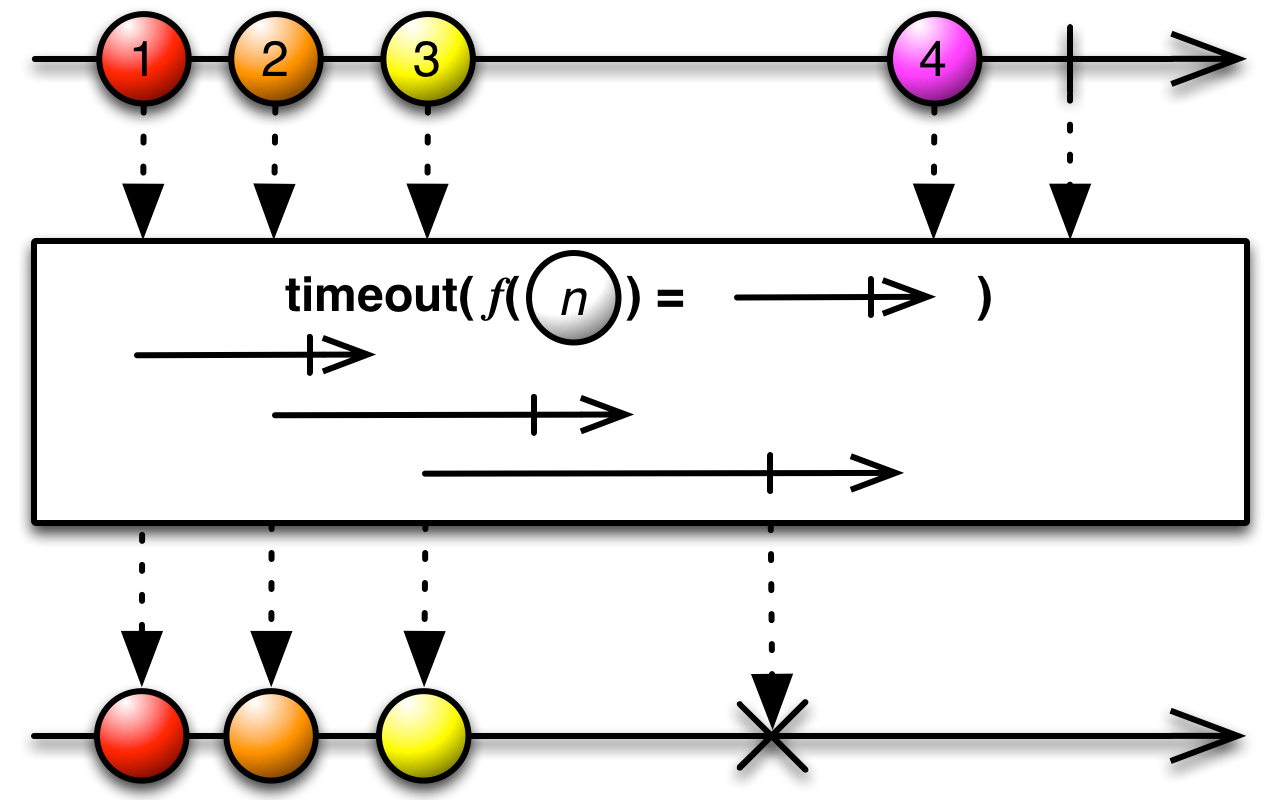
Note: The arrival of the first source item is never timed out.
- Scheduler:
-
This version of
timeoutoperates by default on theimmediateScheduler.
- Type Parameters:
-
V- the timeout value type (ignored) - Parameters:
-
timeoutSelector- a function that returns an observable for each item emitted by the source Observable and that determines the timeout window for the subsequent item - Returns:
-
an Observable that mirrors the source Observable, but notifies observers of a
TimeoutExceptionif an item emitted by the source Observable takes longer to arrive than the time window defined by the selector for the previously emitted item - See Also:
- RxJava wiki: timeout
timeout
public final <V> Observable
<T> timeout(Func1 <? super T ,? extends Observable <V>> timeoutSelector, Observable <? extends T> other) Returns an Observable that mirrors the source Observable, but that switches to a fallback Observable if an item emitted by the source Observable doesn't arrive within a window of time after the emission of the previous item, where that period of time is measured by an Observable that is a function of the previous item.
Note: The arrival of the first source item is never timed out.
- Scheduler:
-
This version of
timeoutoperates by default on theimmediateScheduler.
- Type Parameters:
-
V- the timeout value type (ignored) - Parameters:
-
timeoutSelector- a function that returns an Observable, for each item emitted by the source Observable, that determines the timeout window for the subsequent item -
other- the fallback Observable to switch to if the source Observable times out - Returns:
- an Observable that mirrors the source Observable, but switches to mirroring a fallback Observable if an item emitted by the source Observable takes longer to arrive than the time window defined by the selector for the previously emitted item
- See Also:
- RxJava wiki: timeout
timeout
public final Observable
<T> timeout(long timeout, TimeUnit timeUnit) Returns an Observable that mirrors the source Observable but applies a timeout policy for each emitted item. If the next item isn't emitted within the specified timeout duration starting from its predecessor, the resulting Observable terminates and notifies observers of aTimeoutException.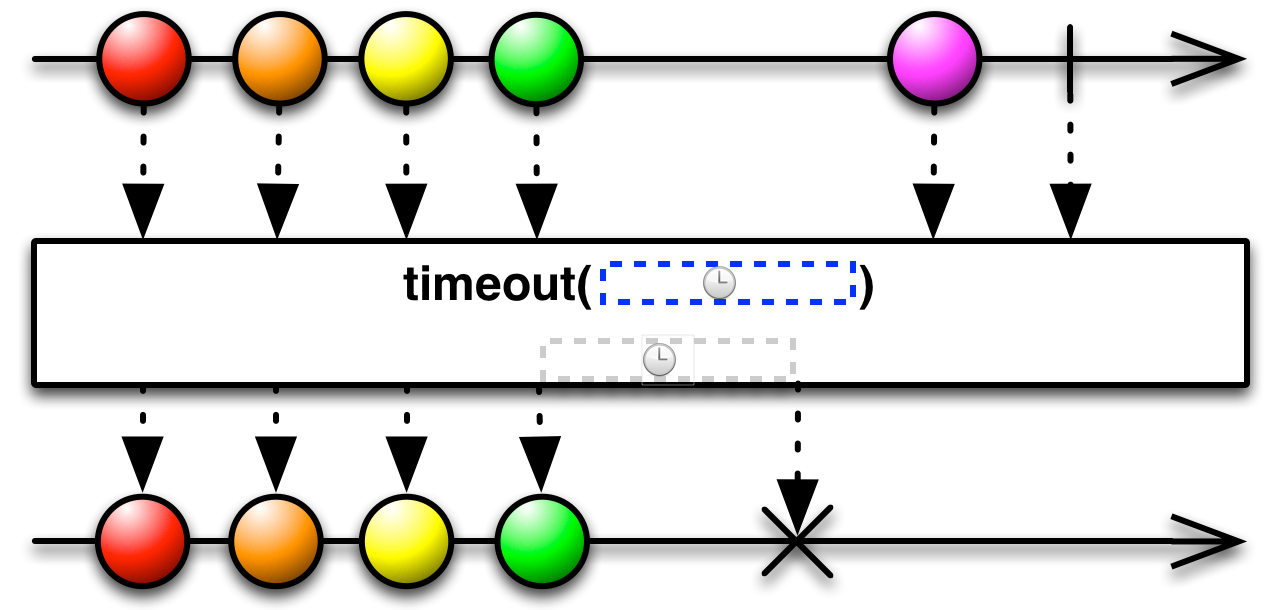
- Scheduler:
-
This version of
timeoutoperates by default on thecomputationScheduler.
- Parameters:
-
timeout- maximum duration between emitted items before a timeout occurs -
timeUnit- the unit of time that applies to thetimeoutargument. - Returns:
-
the source Observable modified to notify observers of a
TimeoutExceptionin case of a timeout - See Also:
- RxJava wiki: timeout
timeout
public final Observable
<T> timeout(long timeout, TimeUnit timeUnit, Observable <? extends T> other) Returns an Observable that mirrors the source Observable but applies a timeout policy for each emitted item. If the next item isn't emitted within the specified timeout duration starting from its predecessor, the resulting Observable begins instead to mirror a fallback Observable.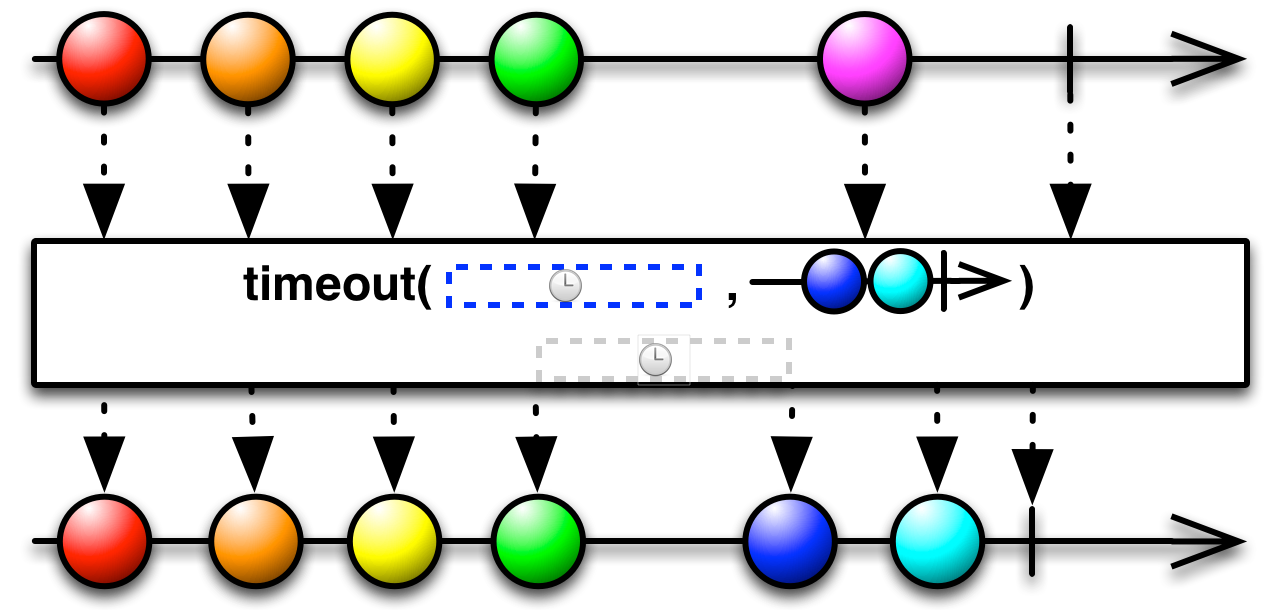
- Scheduler:
-
This version of
timeoutoperates by default on thecomputationScheduler.
- Parameters:
-
timeout- maximum duration between items before a timeout occurs -
timeUnit- the unit of time that applies to thetimeoutargument -
other- the fallback Observable to use in case of a timeout - Returns:
- the source Observable modified to switch to the fallback Observable in case of a timeout
- See Also:
- RxJava wiki: timeout
timeout
public final Observable
<T> timeout(long timeout, TimeUnit timeUnit, Observable <? extends T> other, Scheduler scheduler) Returns an Observable that mirrors the source Observable but applies a timeout policy for each emitted item using a specified Scheduler. If the next item isn't emitted within the specified timeout duration starting from its predecessor, the resulting Observable begins instead to mirror a fallback Observable.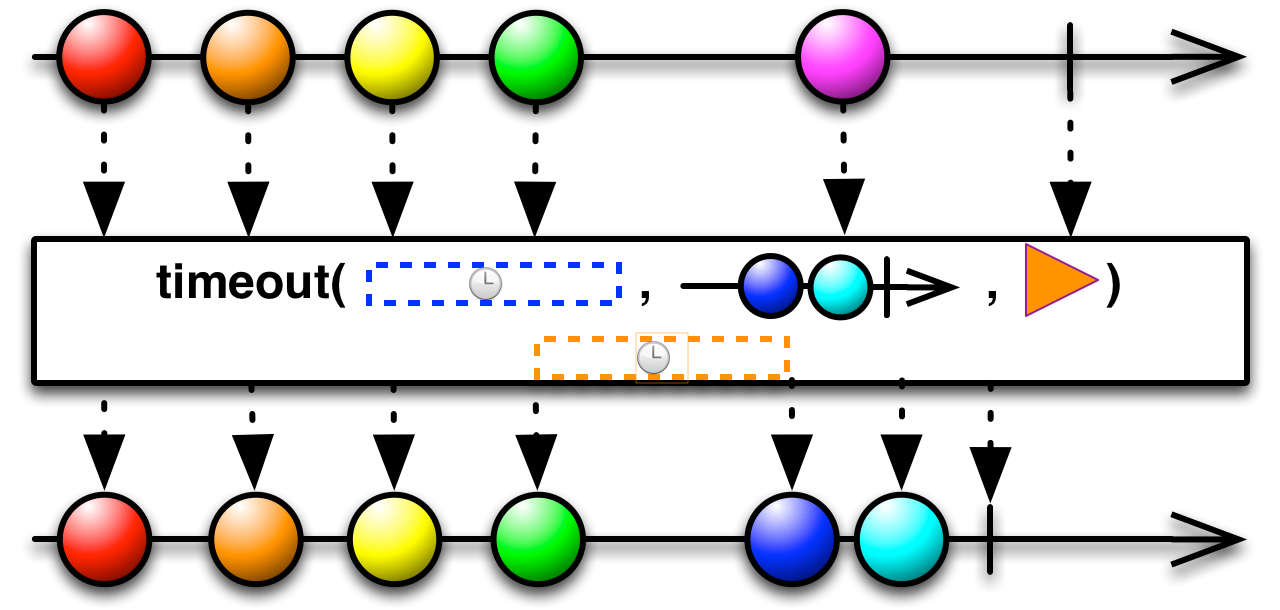
- Scheduler:
-
you specify which
Schedulerthis operator will use
- Parameters:
-
timeout- maximum duration between items before a timeout occurs -
timeUnit- the unit of time that applies to thetimeoutargument -
other- the Observable to use as the fallback in case of a timeout -
scheduler- theSchedulerto run the timeout timers on - Returns:
- the source Observable modified so that it will switch to the fallback Observable in case of a timeout
- See Also:
- RxJava wiki: timeout
timeout
public final Observable
<T> timeout(long timeout, TimeUnit timeUnit, Scheduler scheduler) Returns an Observable that mirrors the source Observable but applies a timeout policy for each emitted item, where this policy is governed on a specified Scheduler. If the next item isn't emitted within the specified timeout duration starting from its predecessor, the resulting Observable terminates and notifies observers of aTimeoutException.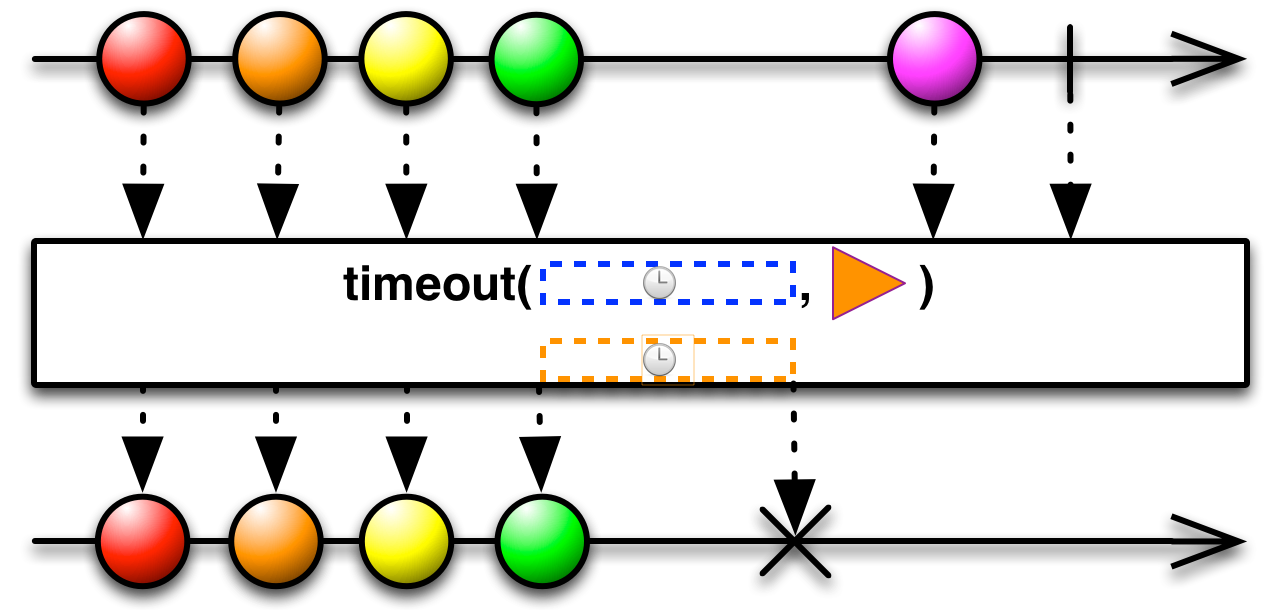
- Scheduler:
-
you specify which
Schedulerthis operator will use
- Parameters:
-
timeout- maximum duration between items before a timeout occurs -
timeUnit- the unit of time that applies to thetimeoutargument -
scheduler- the Scheduler to run the timeout timers on - Returns:
-
the source Observable modified to notify observers of a
TimeoutExceptionin case of a timeout - See Also:
- RxJava wiki: timeout
timestamp
public final Observable
<Timestamped <T>> timestamp() Returns an Observable that emits each item emitted by the source Observable, wrapped in aTimestampedobject.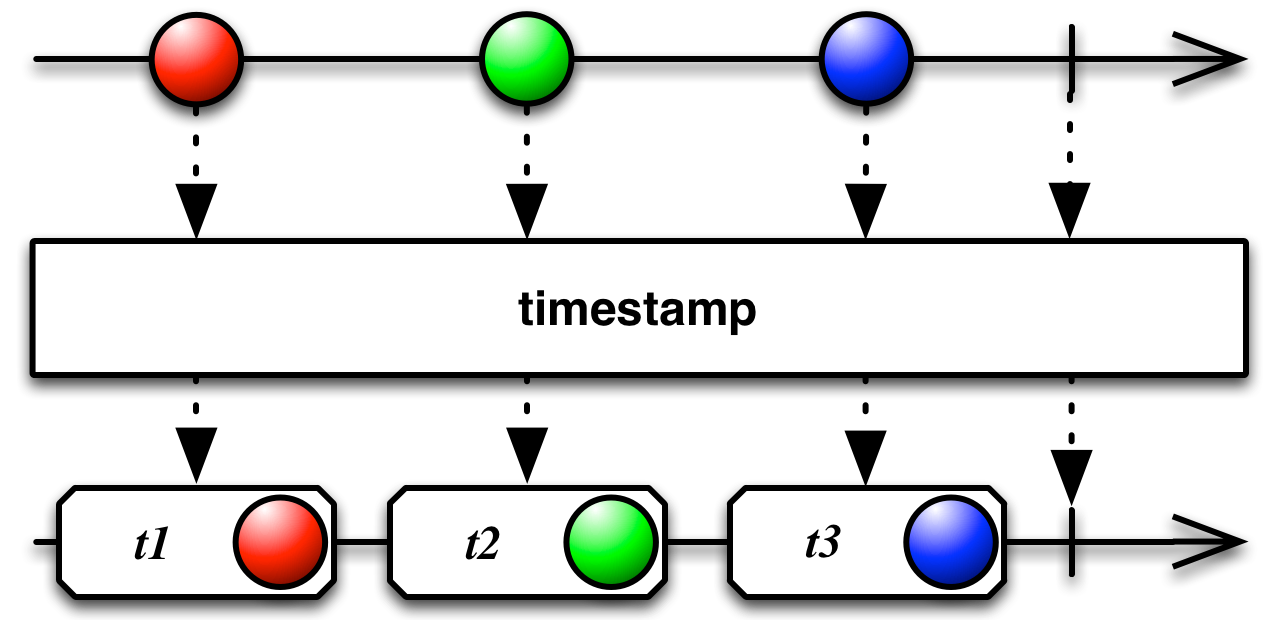
- Scheduler:
-
timestampoperates by default on theimmediateScheduler.
- Returns:
- an Observable that emits timestamped items from the source Observable
- See Also:
- RxJava wiki: timestamp
timestamp
public final Observable
<Timestamped <T>> timestamp(Scheduler scheduler) Returns an Observable that emits each item emitted by the source Observable, wrapped in aTimestampedobject whose timestamps are provided by a specified Scheduler.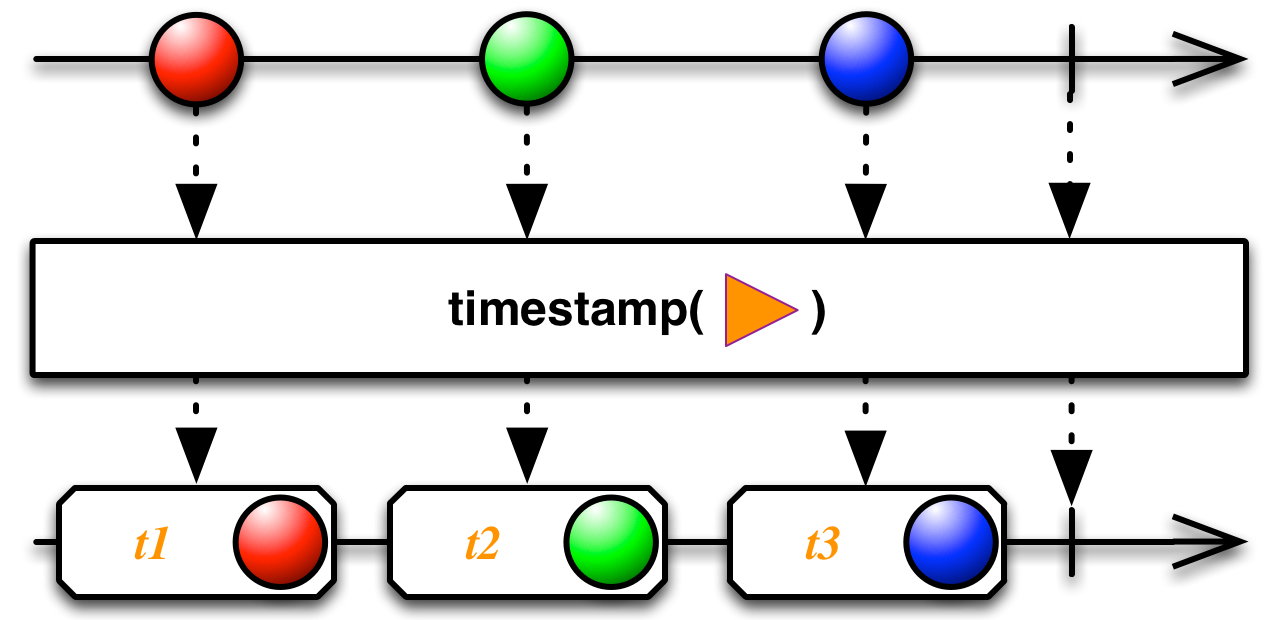
- Scheduler:
-
you specify which
Schedulerthis operator will use
- Parameters:
-
scheduler- theSchedulerto use as a time source - Returns:
-
an Observable that emits timestamped items from the source Observable with timestamps provided by the
scheduler - See Also:
- RxJava wiki: timestamp
toBlocking
public final BlockingObservable
<T> toBlocking() Converts an Observable into aBlockingObservable(an Observable with blocking operators).- Scheduler:
-
toBlockingdoes not operate by default on a particularScheduler.
- Returns:
-
a
BlockingObservableversion of this Observable - See Also:
- RxJava wiki: Blocking Observable Operators
toList
public final Observable
<List <T>> toList() Returns an Observable that emits a single item, a list composed of all the items emitted by the source Observable.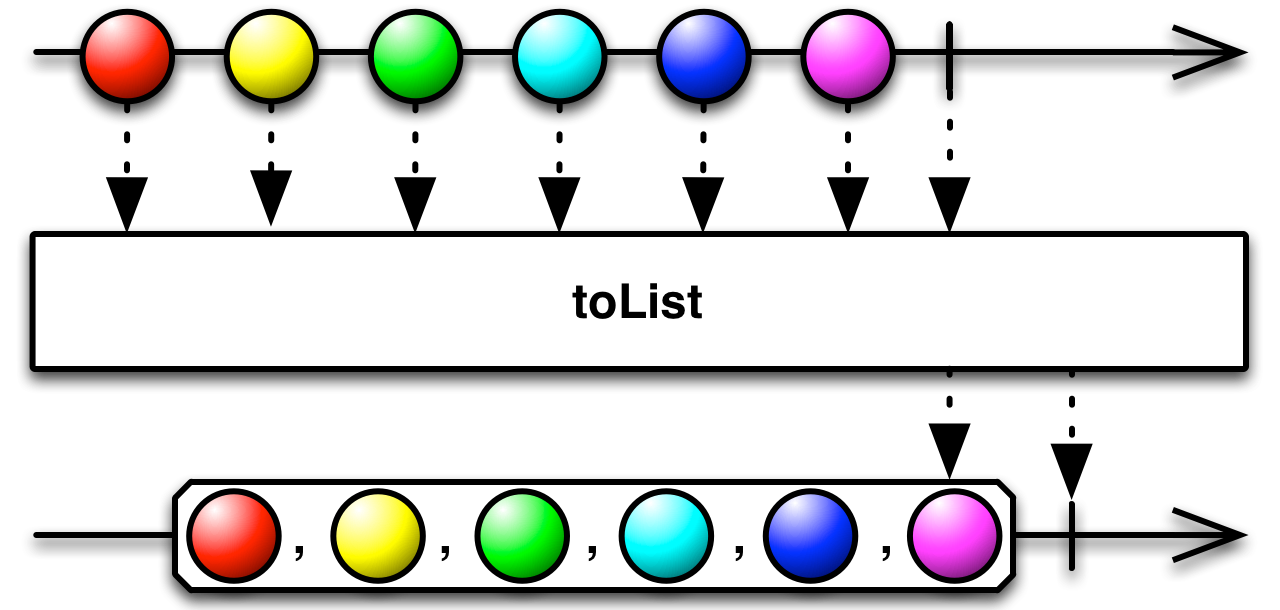
Normally, an Observable that returns multiple items will do so by invoking its
Observer'sonNextmethod for each such item. You can change this behavior, instructing the Observable to compose a list of all of these items and then to invoke the Observer'sonNextfunction once, passing it the entire list, by calling the Observable'stoListmethod prior to calling itssubscribe()method.Be careful not to use this operator on Observables that emit infinite or very large numbers of items, as you do not have the option to unsubscribe.
- Backpressure Support:
- This operator does not support backpressure as by intent it is requesting and buffering everything.
- Scheduler:
-
toListdoes not operate by default on a particularScheduler.
- Returns:
- an Observable that emits a single item: a List containing all of the items emitted by the source Observable
- See Also:
- RxJava wiki: toList
toMap
public final <K> Observable
<Map <K ,T>> toMap(Func1 <? super T ,? extends K> keySelector) Returns an Observable that emits a single HashMap containing all items emitted by the source Observable, mapped by the keys returned by a specifiedkeySelectorfunction.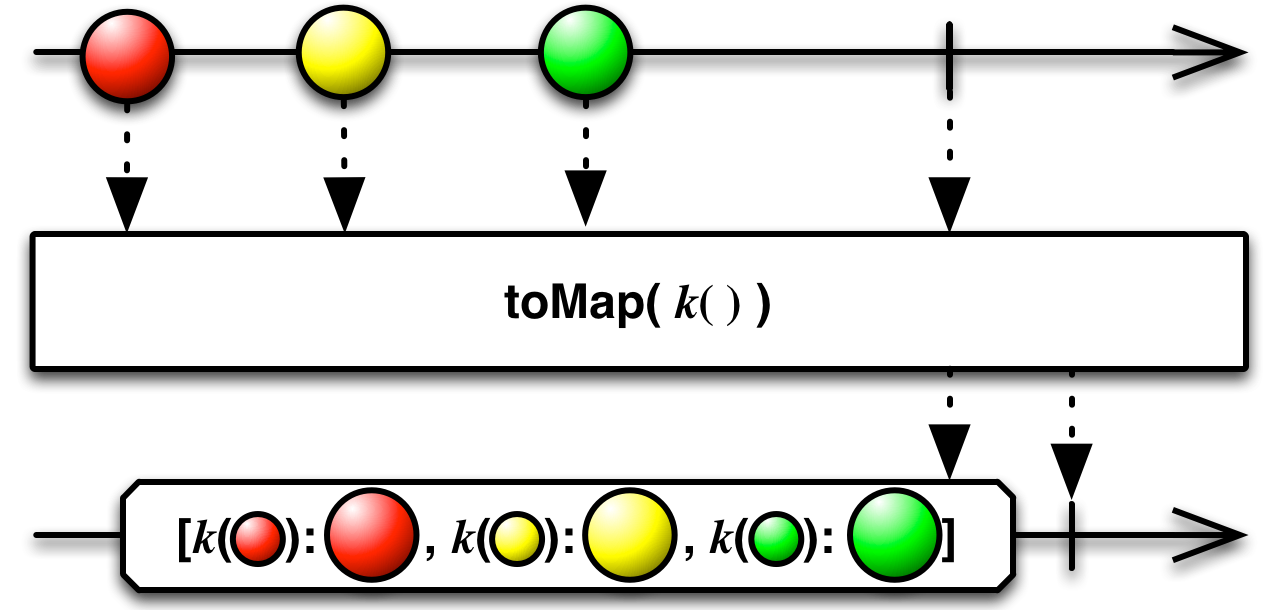
If more than one source item maps to the same key, the HashMap will contain the latest of those items.
- Backpressure Support:
- This operator does not support backpressure as by intent it is requesting and buffering everything.
- Scheduler:
-
toMapdoes not operate by default on a particularScheduler.
- Parameters:
-
keySelector- the function that extracts the key from a source item to be used in the HashMap - Returns:
- an Observable that emits a single item: a HashMap containing the mapped items from the source Observable
- See Also:
- RxJava wiki: toMap
toMap
public final <K
,V> Observable <Map <K ,V>> toMap(Func1 <? super T ,? extends K> keySelector, Func1 <? super T ,? extends V> valueSelector) Returns an Observable that emits a single HashMap containing values corresponding to items emitted by the source Observable, mapped by the keys returned by a specifiedkeySelectorfunction. If more than one source item maps to the same key, the HashMap will contain a single entry that corresponds to the latest of those items.
- Backpressure Support:
- This operator does not support backpressure as by intent it is requesting and buffering everything.
- Scheduler:
-
toMapdoes not operate by default on a particularScheduler.
- Parameters:
-
keySelector- the function that extracts the key from a source item to be used in the HashMap -
valueSelector- the function that extracts the value from a source item to be used in the HashMap - Returns:
- an Observable that emits a single item: a HashMap containing the mapped items from the source Observable
- See Also:
- RxJava wiki: toMap
toMap
public final <K
,V> Observable <Map <K ,V>> toMap(Func1 <? super T ,? extends K> keySelector, Func1 <? super T ,? extends V> valueSelector, Func0 <? extends Map <K ,V>> mapFactory) Returns an Observable that emits a single Map, returned by a specifiedmapFactoryfunction, that contains keys and values extracted from the items emitted by the source Observable. - Backpressure Support:
- This operator does not support backpressure as by intent it is requesting and buffering everything.
- Scheduler:
-
toMapdoes not operate by default on a particularScheduler.
- Parameters:
-
keySelector- the function that extracts the key from a source item to be used in the Map -
valueSelector- the function that extracts the value from the source items to be used as value in the Map -
mapFactory- the function that returns a Map instance to be used - Returns:
- an Observable that emits a single item: a Map that contains the mapped items emitted by the source Observable
- See Also:
- RxJava wiki: toMap
toMultimap
public final <K> Observable
<Map <K ,Collection <T>>> toMultimap(Func1 <? super T ,? extends K> keySelector) Returns an Observable that emits a single HashMap that contains an ArrayList of items emitted by the source Observable keyed by a specifiedkeySelectorfunction.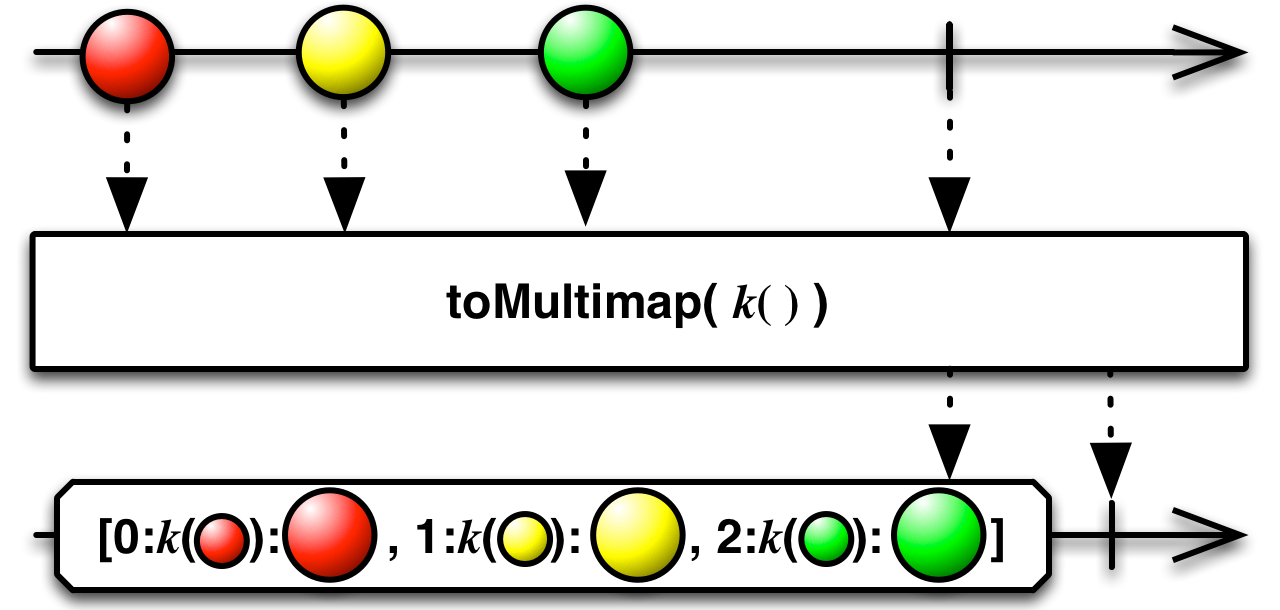
- Backpressure Support:
- This operator does not support backpressure as by intent it is requesting and buffering everything.
- Scheduler:
-
toMultiMapdoes not operate by default on a particularScheduler.
- Parameters:
-
keySelector- the function that extracts the key from the source items to be used as key in the HashMap - Returns:
- an Observable that emits a single item: a HashMap that contains an ArrayList of items mapped from the source Observable
- See Also:
- RxJava wiki: toMap
toMultimap
public final <K
,V> Observable <Map <K ,Collection <V>>> toMultimap(Func1 <? super T ,? extends K> keySelector, Func1 <? super T ,? extends V> valueSelector) Returns an Observable that emits a single HashMap that contains an ArrayList of values extracted by a specifiedvalueSelectorfunction from items emitted by the source Observable, keyed by a specifiedkeySelectorfunction. - Backpressure Support:
- This operator does not support backpressure as by intent it is requesting and buffering everything.
- Scheduler:
-
toMultiMapdoes not operate by default on a particularScheduler.
- Parameters:
-
keySelector- the function that extracts a key from the source items to be used as key in the HashMap -
valueSelector- the function that extracts a value from the source items to be used as value in the HashMap - Returns:
- an Observable that emits a single item: a HashMap that contains an ArrayList of items mapped from the source Observable
- See Also:
- RxJava wiki: toMap
toMultimap
public final <K
,V> Observable <Map <K ,Collection <V>>> toMultimap(Func1 <? super T ,? extends K> keySelector, Func1 <? super T ,? extends V> valueSelector, Func0 <? extends Map <K ,Collection <V>>> mapFactory) Returns an Observable that emits a single Map, returned by a specifiedmapFactoryfunction, that contains an ArrayList of values, extracted by a specifiedvalueSelectorfunction from items emitted by the source Observable and keyed by thekeySelectorfunction. - Backpressure Support:
- This operator does not support backpressure as by intent it is requesting and buffering everything.
- Scheduler:
-
toMultiMapdoes not operate by default on a particularScheduler.
- Parameters:
-
keySelector- the function that extracts a key from the source items to be used as the key in the Map -
valueSelector- the function that extracts a value from the source items to be used as the value in the Map -
mapFactory- the function that returns a Map instance to be used - Returns:
- an Observable that emits a single item: a Map that contains a list items mapped from the source Observable
- See Also:
- RxJava wiki: toMap
toMultimap
public final <K
,V> Observable <Map <K ,Collection <V>>> toMultimap(Func1 <? super T ,? extends K> keySelector, Func1 <? super T ,? extends V> valueSelector, Func0 <? extends Map <K ,Collection <V>>> mapFactory, Func1 <? super K ,? extends Collection <V>> collectionFactory) Returns an Observable that emits a single Map, returned by a specifiedmapFactoryfunction, that contains a custom collection of values, extracted by a specifiedvalueSelectorfunction from items emitted by the source Observable, and keyed by thekeySelectorfunction. - Backpressure Support:
- This operator does not support backpressure as by intent it is requesting and buffering everything.
- Scheduler:
-
toMultiMapdoes not operate by default on a particularScheduler.
- Parameters:
-
keySelector- the function that extracts a key from the source items to be used as the key in the Map -
valueSelector- the function that extracts a value from the source items to be used as the value in the Map -
mapFactory- the function that returns a Map instance to be used -
collectionFactory- the function that returns a Collection instance for a particular key to be used in the Map - Returns:
- an Observable that emits a single item: a Map that contains the collection of mapped items from the source Observable
- See Also:
- RxJava wiki: toMap
toSortedList
public final Observable
<List <T>> toSortedList() Returns an Observable that emits a list that contains the items emitted by the source Observable, in a sorted order. Each item emitted by the Observable must implementComparablewith respect to all other items in the sequence.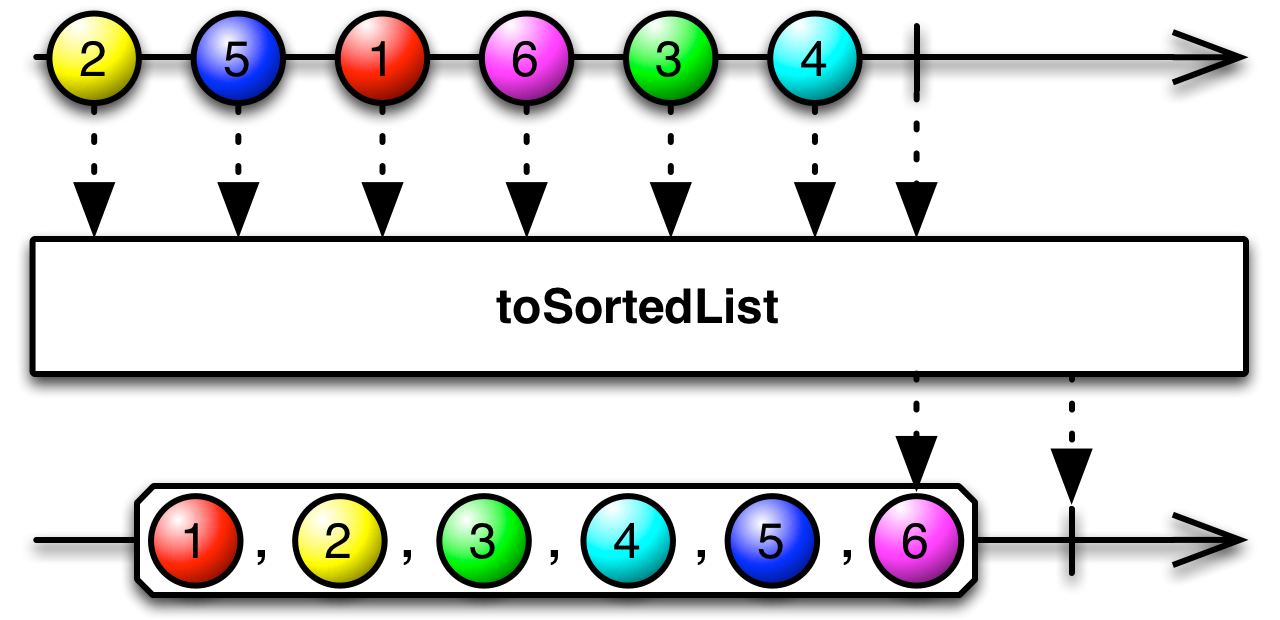
- Backpressure Support:
- This operator does not support backpressure as by intent it is requesting and buffering everything.
- Scheduler:
-
toSortedListdoes not operate by default on a particularScheduler.
- Returns:
- an Observable that emits a list that contains the items emitted by the source Observable in sorted order
- Throws:
-
ClassCastException- if any item emitted by the Observable does not implementComparablewith respect to all other items emitted by the Observable - See Also:
- RxJava wiki: toSortedList
toSortedList
public final Observable
<List <T>> toSortedList(Func2 <? super T ,? super T ,Integer > sortFunction) Returns an Observable that emits a list that contains the items emitted by the source Observable, in a sorted order based on a specified comparison function.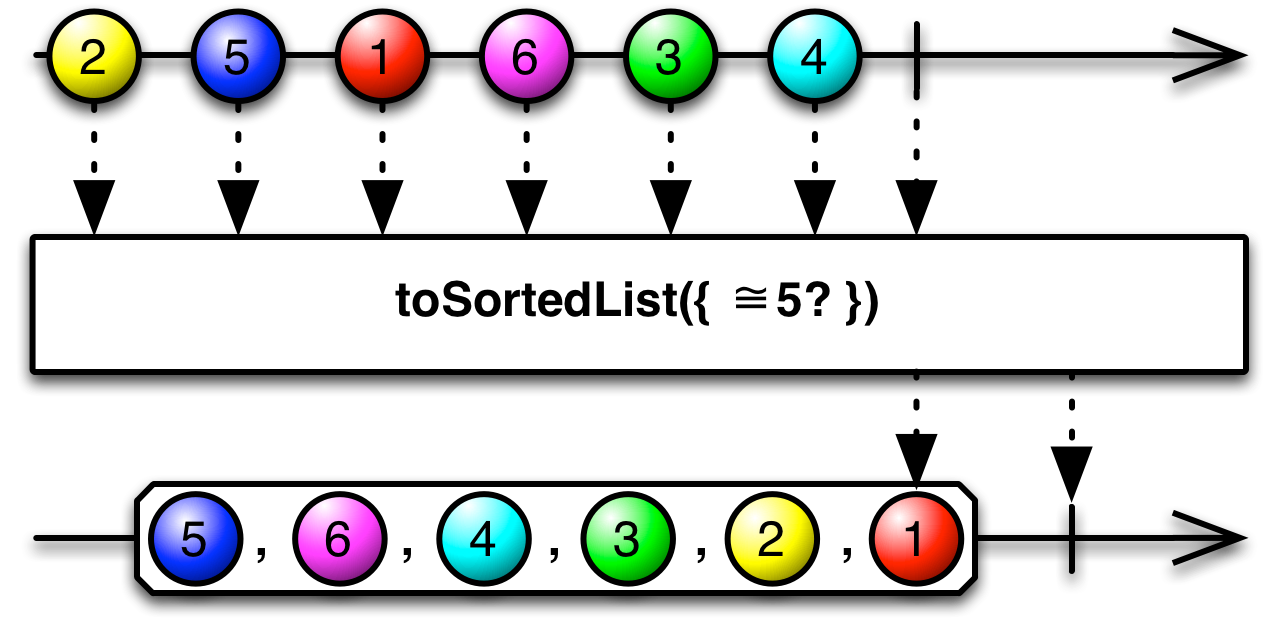
- Backpressure Support:
- This operator does not support backpressure as by intent it is requesting and buffering everything.
- Scheduler:
-
toSortedListdoes not operate by default on a particularScheduler.
- Parameters:
-
sortFunction- a function that compares two items emitted by the source Observable and returns an Integer that indicates their sort order - Returns:
- an Observable that emits a list that contains the items emitted by the source Observable in sorted order
- See Also:
- RxJava wiki: toSortedList
unsubscribeOn
public final Observable
<T> unsubscribeOn(Scheduler scheduler)
window
public final <TClosing> Observable
<Observable <T>> window(Func0 <? extends Observable <? extends TClosing>> closingSelector) Returns an Observable that emits windows of items it collects from the source Observable. The resulting Observable emits connected, non-overlapping windows. It emits the current window and opens a new one whenever the Observable produced by the specifiedclosingSelectoremits an item.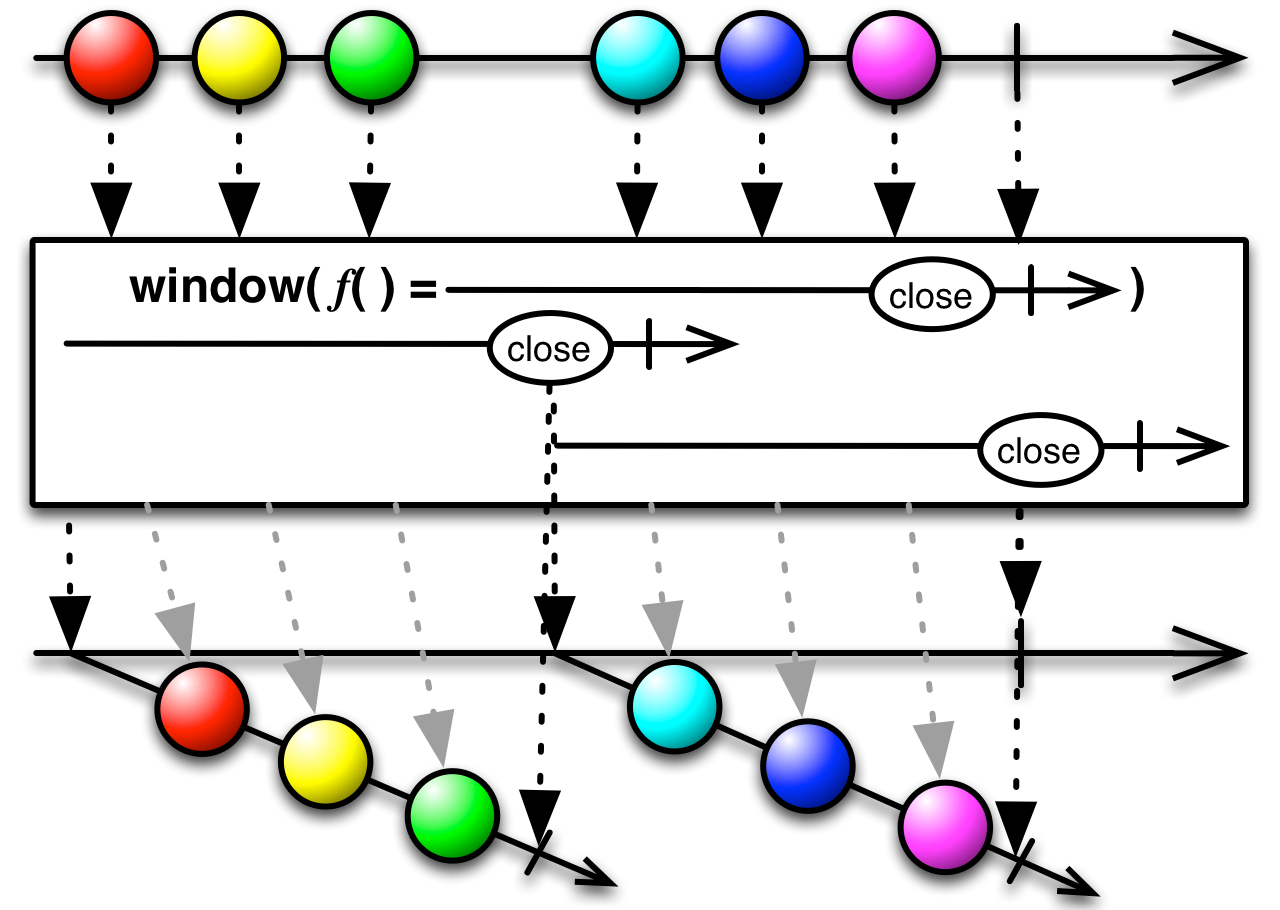
- Backpressure Support:
-
This operator does not support backpressure as it uses the
closingSelectorto control data flow. - Scheduler:
-
This version of
windowdoes not operate by default on a particularScheduler.
- Parameters:
-
closingSelector- aFunc0that returns anObservablethat governs the boundary between windows. When thisObservableemits an item,windowemits the current window and begins a new one. - Returns:
-
an Observable that emits connected, non-overlapping windows of items from the source Observable whenever
closingSelectoremits an item - See Also:
- RxJava wiki: window
window
public final Observable
<Observable <T>> window(int count) Returns an Observable that emits windows of items it collects from the source Observable. The resulting Observable emits connected, non-overlapping windows, each containingcountitems. When the source Observable completes or encounters an error, the resulting Observable emits the current window and propagates the notification from the source Observable.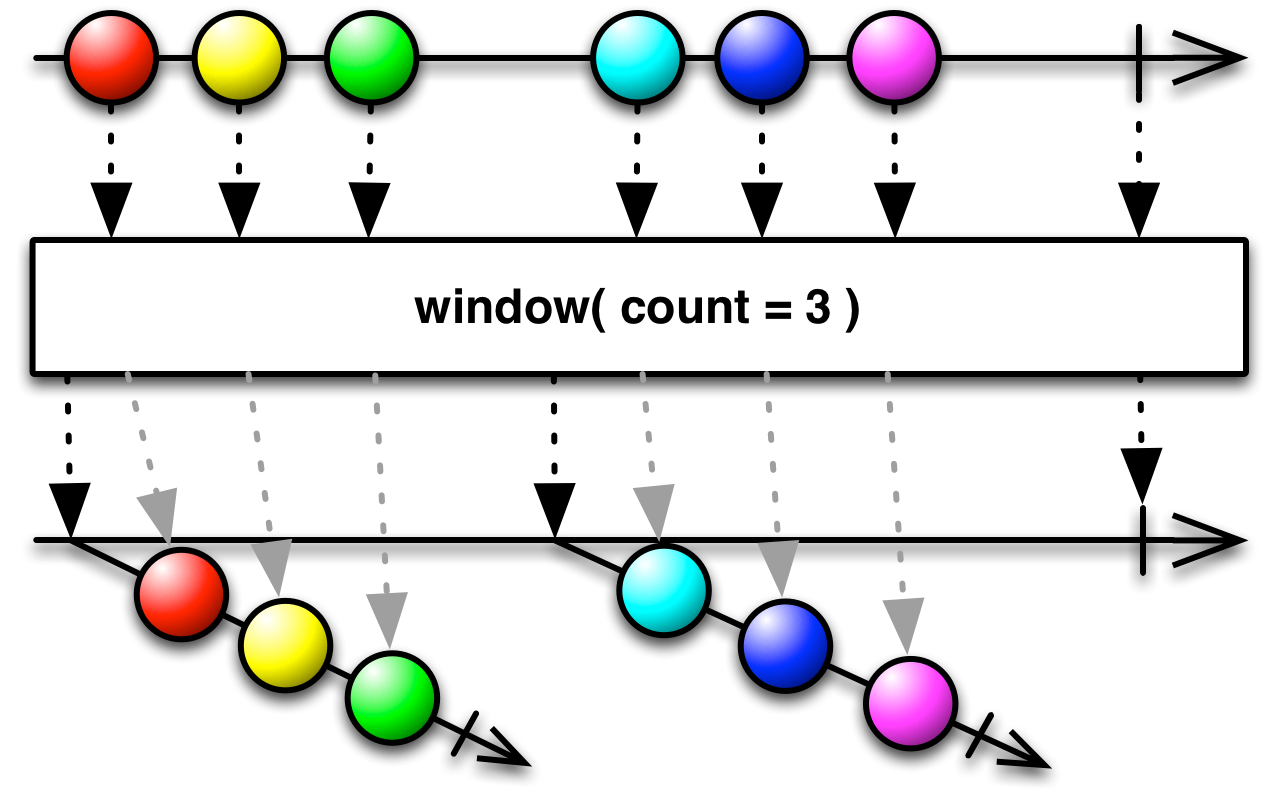
- Backpressure Support:
-
This operator does not support backpressure as it uses
countto control data flow. - Scheduler:
-
This version of
windowdoes not operate by default on a particularScheduler.
- Parameters:
-
count- the maximum size of each window before it should be emitted - Returns:
-
an Observable that emits connected, non-overlapping windows, each containing at most
countitems from the source Observable - See Also:
- RxJava wiki: window
window
public final Observable
<Observable <T>> window(int count, int skip) Returns an Observable that emits windows of items it collects from the source Observable. The resulting Observable emits windows everyskipitems, each containing no more thancountitems. When the source Observable completes or encounters an error, the resulting Observable emits the current window and propagates the notification from the source Observable.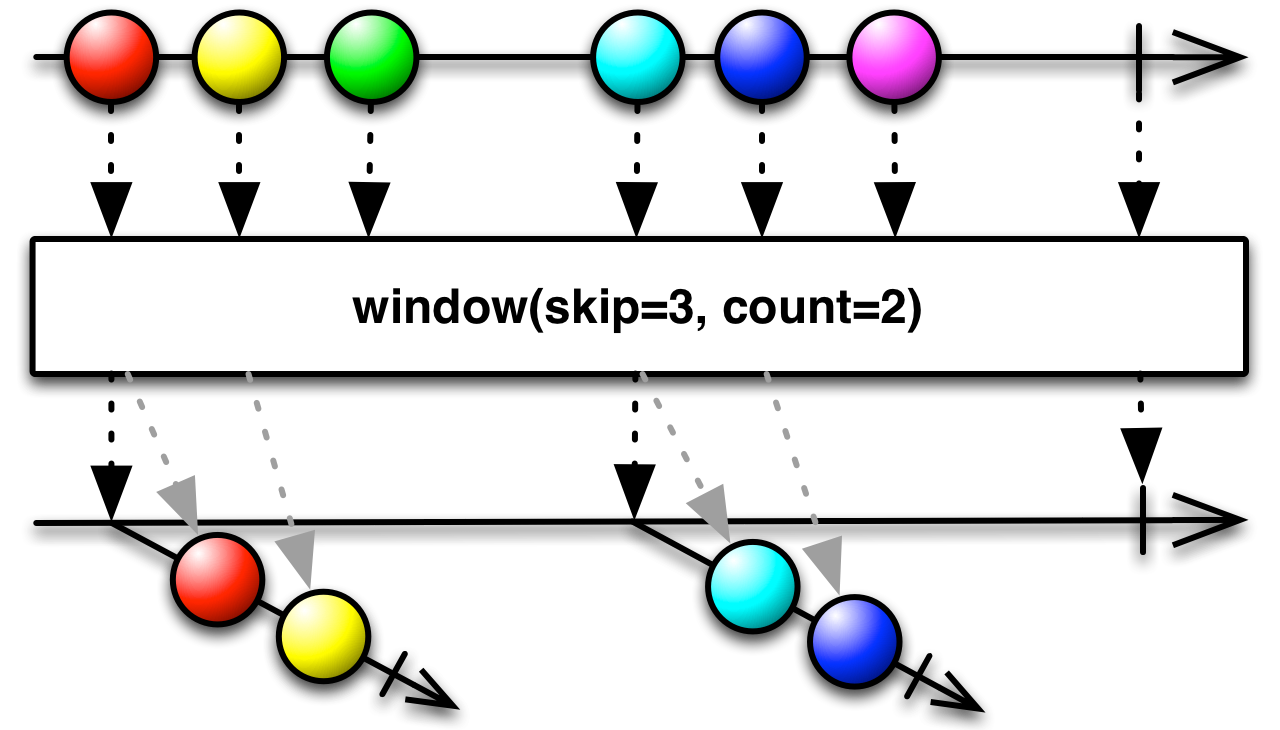
- Backpressure Support:
-
This operator does not support backpressure as it uses
countto control data flow. - Scheduler:
-
This version of
windowdoes not operate by default on a particularScheduler.
- Parameters:
-
count- the maximum size of each window before it should be emitted -
skip- how many items need to be skipped before starting a new window. Note that ifskipandcountare equal this is the same operation aswindow(int). - Returns:
-
an Observable that emits windows every
skipitems containing at mostcountitems from the source Observable - See Also:
- RxJava wiki: window
window
public final Observable
<Observable <T>> window(long timespan, long timeshift, TimeUnit unit) Returns an Observable that emits windows of items it collects from the source Observable. The resulting Observable starts a new window periodically, as determined by thetimeshiftargument. It emits each window after a fixed timespan, specified by thetimespanargument. When the source Observable completes or Observable completes or encounters an error, the resulting Observable emits the current window and propagates the notification from the source Observable.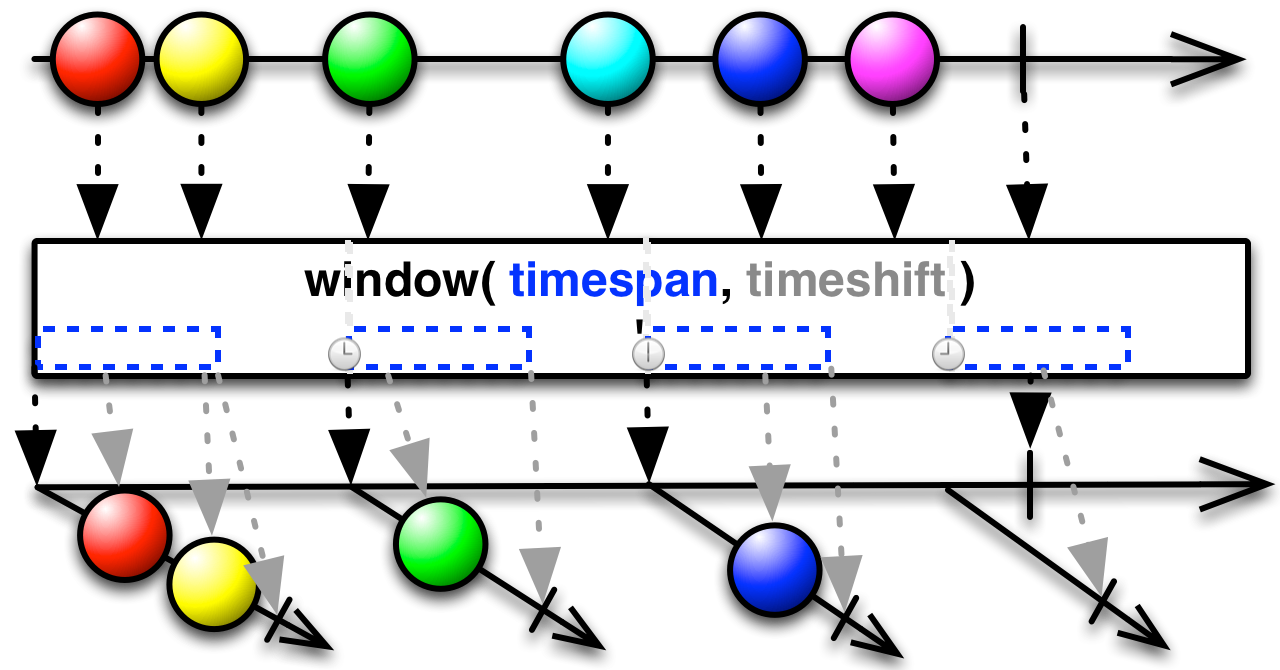
- Backpressure Support:
- This operator does not support backpressure as it uses time to control data flow.
- Scheduler:
-
This version of
windowoperates by default on thecomputationScheduler.
- Parameters:
-
timespan- the period of time each window collects items before it should be emitted -
timeshift- the period of time after which a new window will be created -
unit- the unit of time that applies to thetimespanandtimeshiftarguments - Returns:
- an Observable that emits new windows periodically as a fixed timespan elapses
- See Also:
- RxJava wiki: window
window
public final Observable
<Observable <T>> window(long timespan, long timeshift, TimeUnit unit, Scheduler scheduler) Returns an Observable that emits windows of items it collects from the source Observable. The resulting Observable starts a new window periodically, as determined by thetimeshiftargument. It emits each window after a fixed timespan, specified by thetimespanargument. When the source Observable completes or Observable completes or encounters an error, the resulting Observable emits the current window and propagates the notification from the source Observable.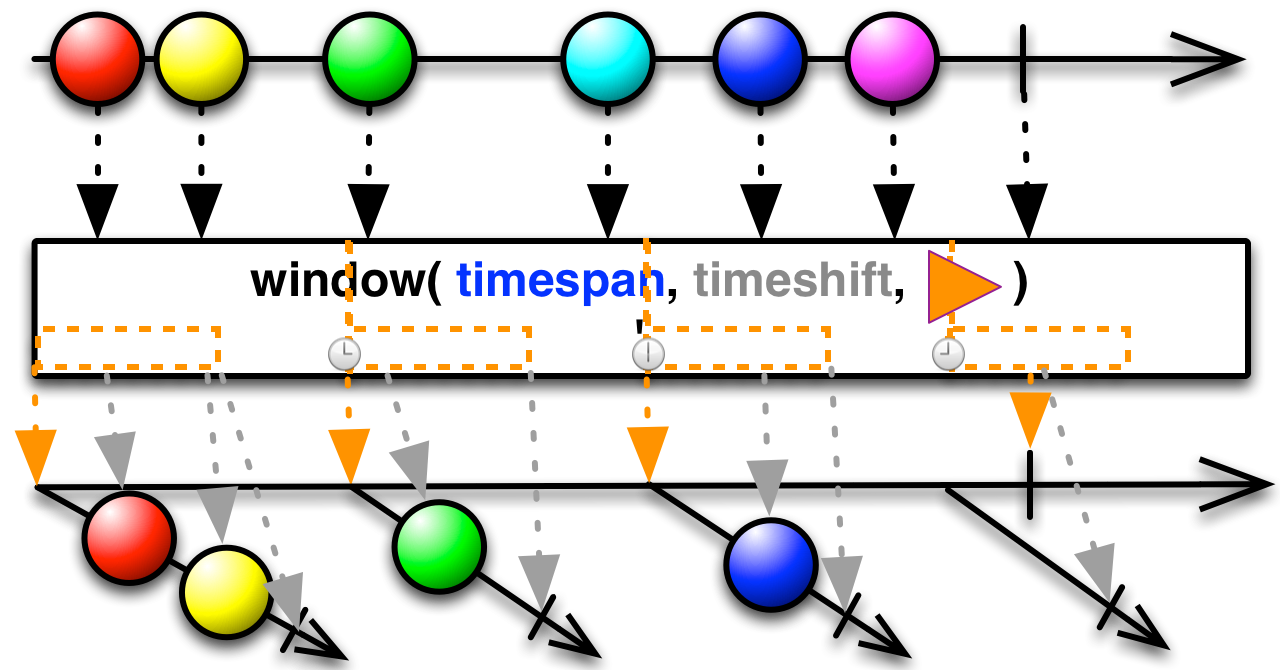
- Backpressure Support:
- This operator does not support backpressure as it uses time to control data flow.
- Scheduler:
-
you specify which
Schedulerthis operator will use
- Parameters:
-
timespan- the period of time each window collects items before it should be emitted -
timeshift- the period of time after which a new window will be created -
unit- the unit of time that applies to thetimespanandtimeshiftarguments -
scheduler- theSchedulerto use when determining the end and start of a window - Returns:
- an Observable that emits new windows periodically as a fixed timespan elapses
- See Also:
- RxJava wiki: window
window
public final Observable
<Observable <T>> window(long timespan, long timeshift, TimeUnit unit, int count, Scheduler scheduler) Returns an Observable that emits windows of items it collects from the source Observable. The resulting Observable starts a new window periodically, as determined by thetimeshiftargument or a maximum size as specified by thecountargument (whichever is reached first). It emits each window after a fixed timespan, specified by thetimespanargument. When the source Observable completes or Observable completes or encounters an error, the resulting Observable emits the current window and propagates the notification from the source Observable. - Backpressure Support:
- This operator does not support backpressure as it uses time to control data flow.
- Scheduler:
-
you specify which
Schedulerthis operator will use
- Parameters:
-
timespan- the period of time each window collects items before it should be emitted -
timeshift- the period of time after which a new window will be created -
unit- the unit of time that applies to thetimespanandtimeshiftarguments -
count- the maximum size of each window before it should be emitted -
scheduler- theSchedulerto use when determining the end and start of a window - Returns:
- an Observable that emits new windows periodically as a fixed timespan elapses
- See Also:
- RxJava wiki: window
window
public final Observable
<Observable <T>> window(long timespan, TimeUnit unit) Returns an Observable that emits windows of items it collects from the source Observable. The resulting Observable emits connected, non-overlapping windows, each of a fixed duration specified by thetimespanargument. When the source Observable completes or encounters an error, the resulting Observable emits the current window and propagates the notification from the source Observable.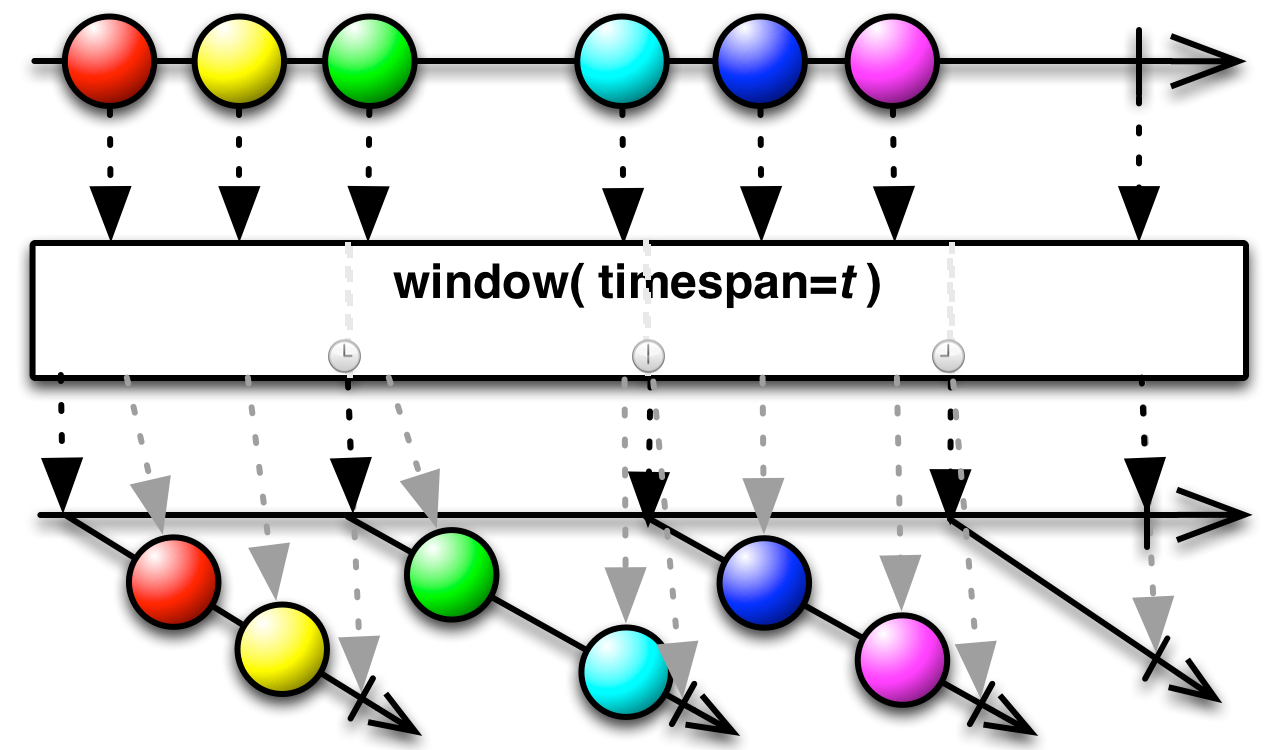
- Backpressure Support:
- This operator does not support backpressure as it uses time to control data flow.
- Scheduler:
-
This version of
windowoperates by default on thecomputationScheduler.
- Parameters:
-
timespan- the period of time each window collects items before it should be emitted and replaced with a new window -
unit- the unit of time that applies to thetimespanargument - Returns:
- an Observable that emits connected, non-overlapping windows represending items emitted by the source Observable during fixed, consecutive durations
- See Also:
- RxJava wiki: window
window
public final Observable
<Observable <T>> window(long timespan, TimeUnit unit, int count) Returns an Observable that emits windows of items it collects from the source Observable. The resulting Observable emits connected, non-overlapping windows, each of a fixed duration as specified by thetimespanargument or a maximum size as specified by thecountargument (whichever is reached first). When the source Observable completes or encounters an error, the resulting Observable emits the current window and propagates the notification from the source Observable.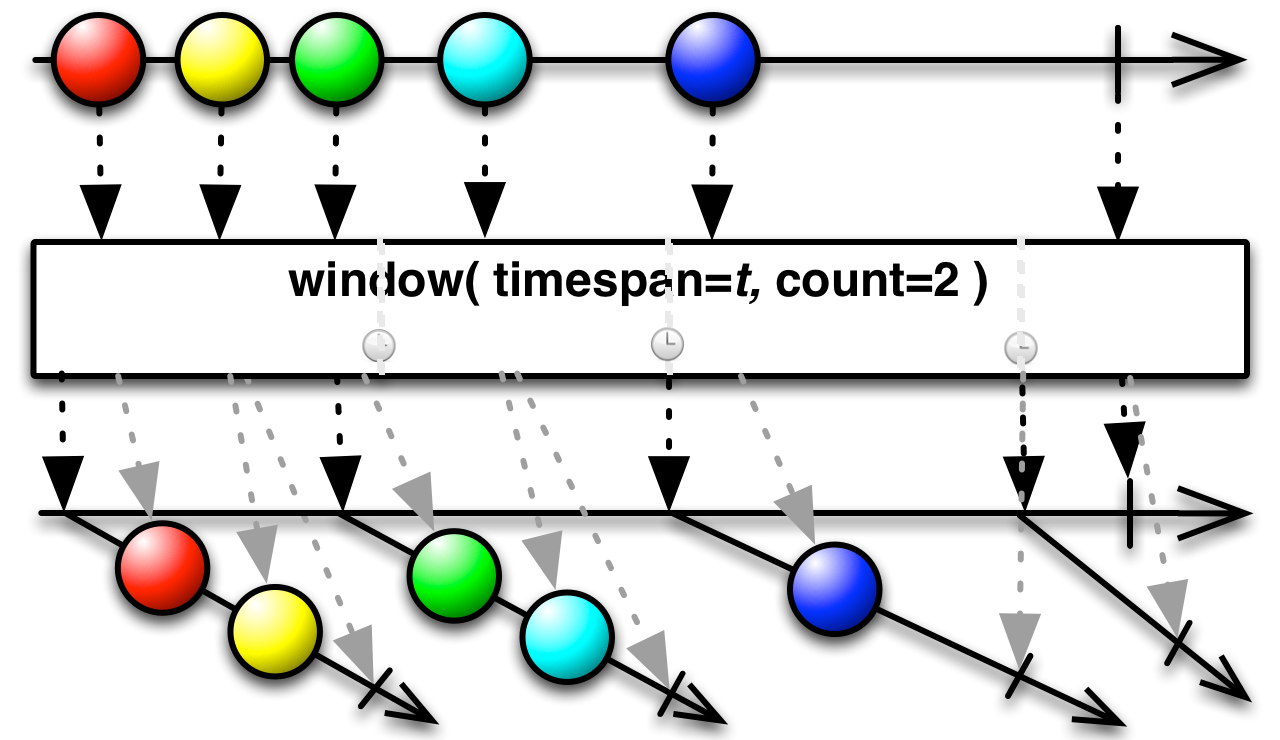
- Backpressure Support:
- This operator does not support backpressure as it uses time to control data flow.
- Scheduler:
-
This version of
windowoperates by default on thecomputationScheduler.
- Parameters:
-
timespan- the period of time each window collects items before it should be emitted and replaced with a new window -
unit- the unit of time that applies to thetimespanargument -
count- the maximum size of each window before it should be emitted - Returns:
- an Observable that emits connected, non-overlapping windows of items from the source Observable that were emitted during a fixed duration of time or when the window has reached maximum capacity (whichever occurs first)
- See Also:
- RxJava wiki: window
window
public final Observable
<Observable <T>> window(long timespan, TimeUnit unit, int count, Scheduler scheduler) Returns an Observable that emits windows of items it collects from the source Observable. The resulting Observable emits connected, non-overlapping windows, each of a fixed duration specified by thetimespanargument or a maximum size specified by thecountargument (whichever is reached first). When the source Observable completes or encounters an error, the resulting Observable emits the current window and propagates the notification from the source Observable.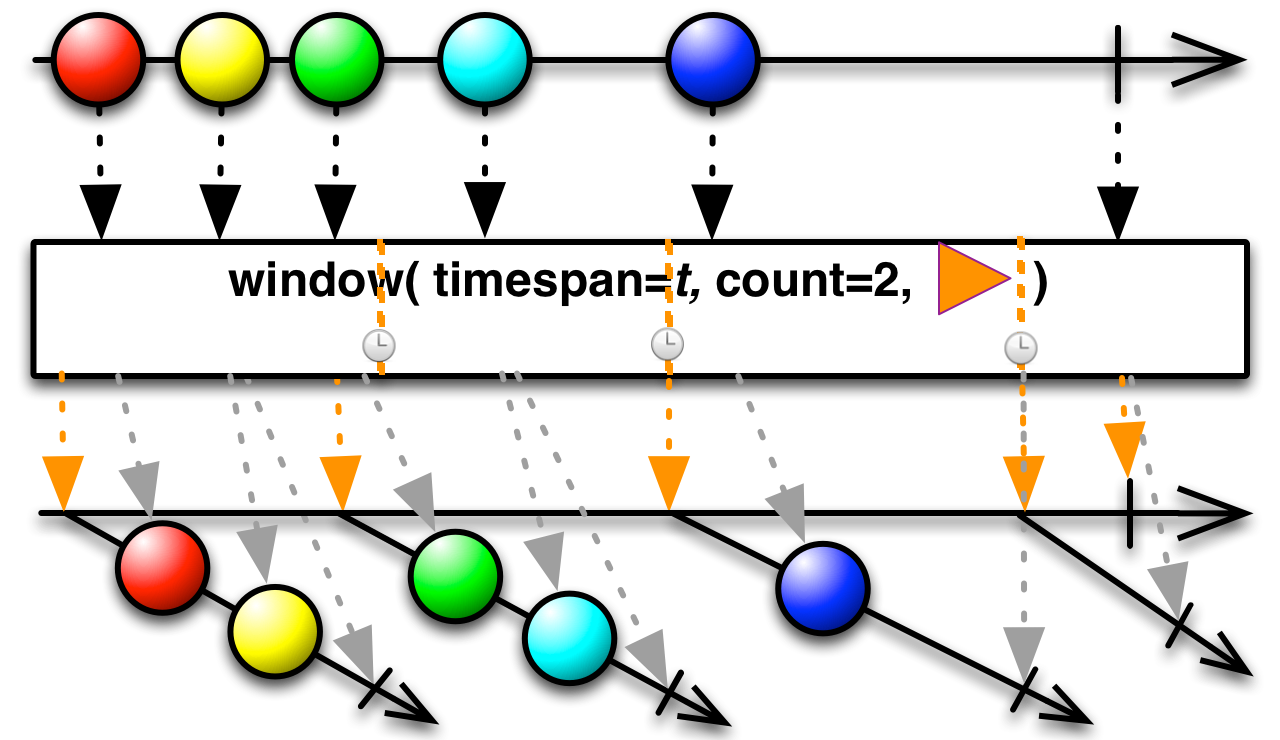
- Backpressure Support:
- This operator does not support backpressure as it uses time to control data flow.
- Scheduler:
-
you specify which
Schedulerthis operator will use
- Parameters:
-
timespan- the period of time each window collects items before it should be emitted and replaced with a new window -
unit- the unit of time which applies to thetimespanargument -
count- the maximum size of each window before it should be emitted -
scheduler- theSchedulerto use when determining the end and start of a window - Returns:
- an Observable that emits connected, non-overlapping windows of items from the source Observable that were emitted during a fixed duration of time or when the window has reached maximum capacity (whichever occurs first)
- See Also:
- RxJava wiki: window
window
public final Observable
<Observable <T>> window(long timespan, TimeUnit unit, Scheduler scheduler) Returns an Observable that emits windows of items it collects from the source Observable. The resulting Observable emits connected, non-overlapping windows, each of a fixed duration as specified by thetimespanargument. When the source Observable completes or encounters an error, the resulting Observable emits the current window and propagates the notification from the source Observable.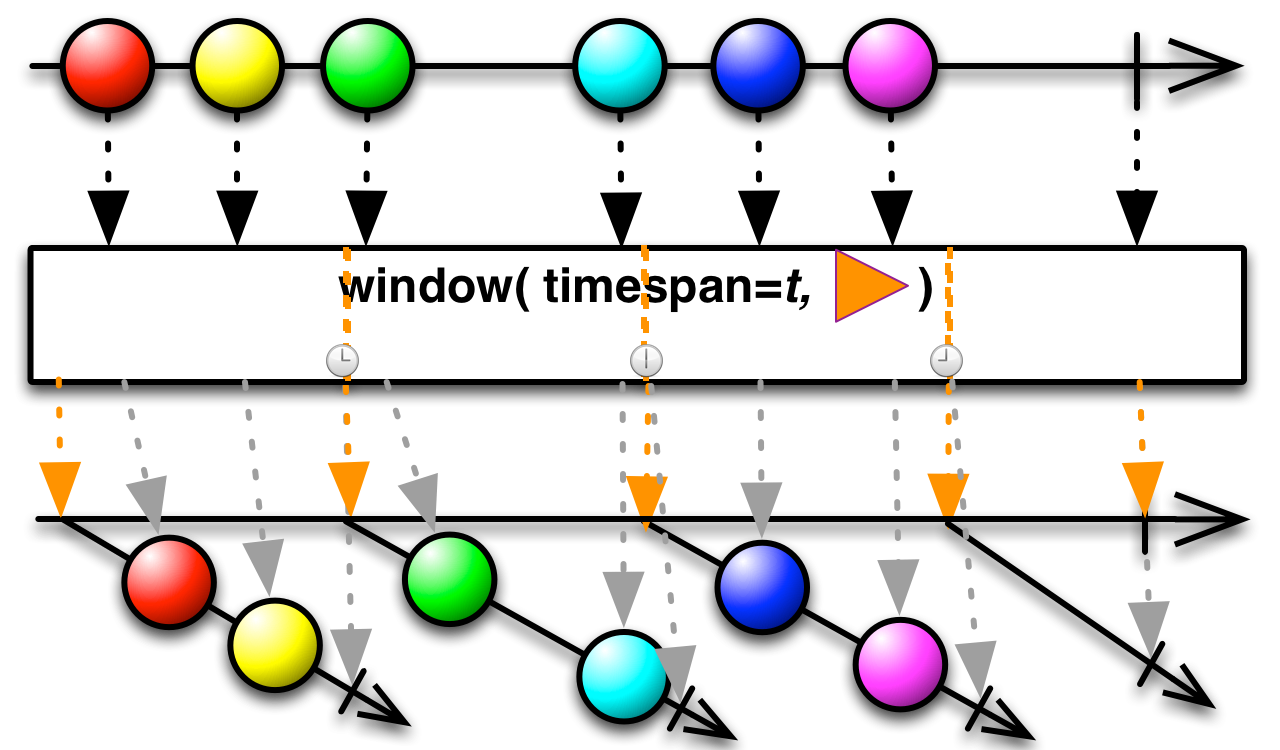
- Backpressure Support:
- This operator does not support backpressure as it uses time to control data flow.
- Scheduler:
-
you specify which
Schedulerthis operator will use
- Parameters:
-
timespan- the period of time each window collects items before it should be emitted and replaced with a new window -
unit- the unit of time which applies to thetimespanargument -
scheduler- theSchedulerto use when determining the end and start of a window - Returns:
- an Observable that emits connected, non-overlapping windows containing items emitted by the source Observable within a fixed duration
- See Also:
- RxJava wiki: window
window
public final <TOpening
,TClosing> Observable <Observable <T>> window(Observable <? extends TOpening> windowOpenings, Func1 <? super TOpening ,? extends Observable <? extends TClosing>> closingSelector) Returns an Observable that emits windows of items it collects from the source Observable. The resulting Observable emits windows that contain those items emitted by the source Observable between the time when thewindowOpeningsObservable emits an item and when the Observable returned byclosingSelectoremits an item.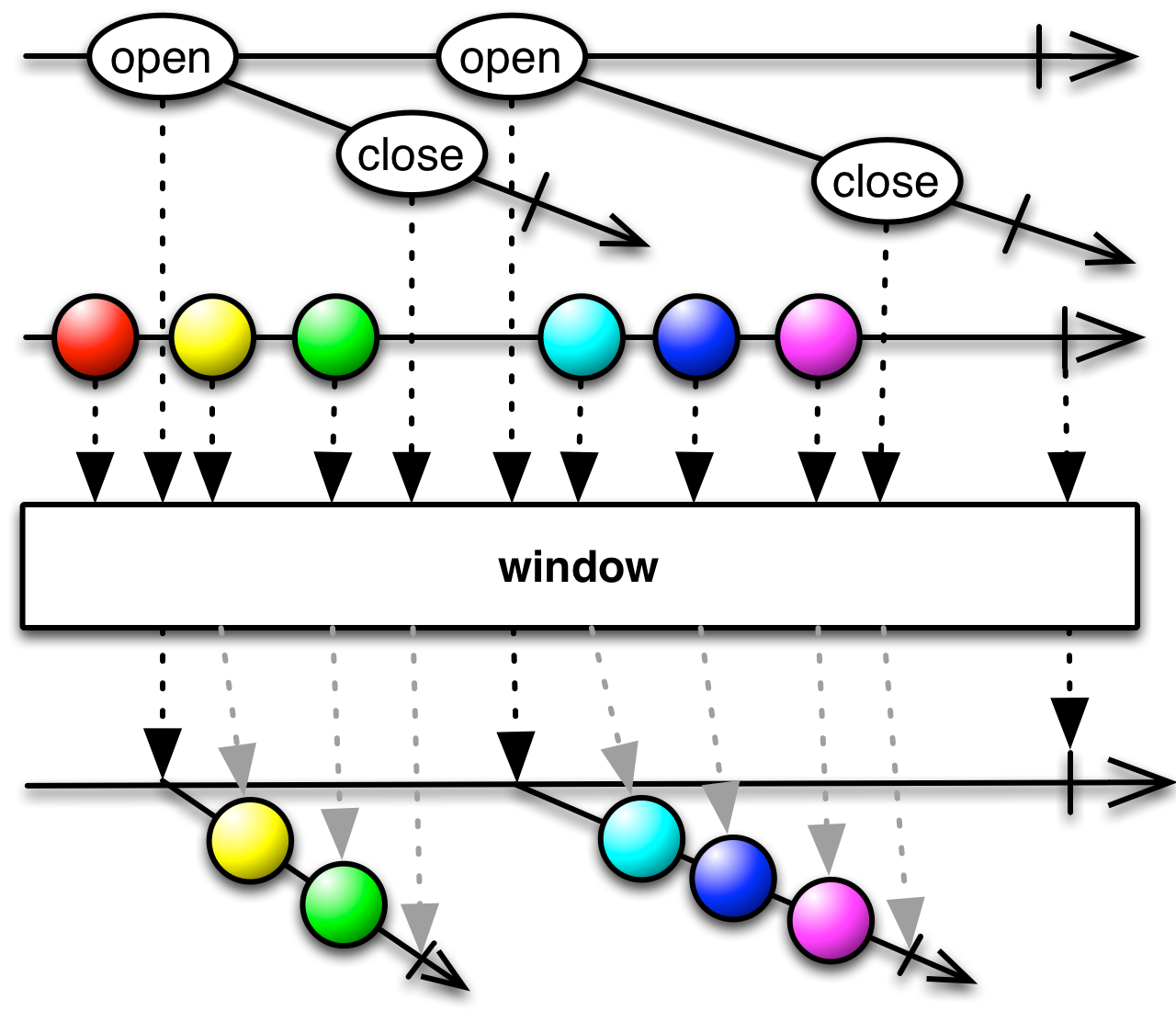
- Backpressure Support:
- This operator does not support backpressure as it uses Observables to control data flow.
- Scheduler:
-
This version of
windowdoes not operate by default on a particularScheduler.
- Parameters:
-
windowOpenings- an Observable that, when it emits an item, causes another window to be created -
closingSelector- aFunc1that produces an Observable for every window created. When this Observable emits an item, the associated window is closed and emitted - Returns:
- an Observable that emits windows of items emitted by the source Observable that are governed by the specified window-governing Observables
- See Also:
- RxJava wiki: window
window
public final <U> Observable
<Observable <T>> window(Observable <U> boundary) Returns an Observable that emits non-overlapping windows of items it collects from the source Observable where the boundary of each window is determined by the items emitted from a specified boundary-governing Observable.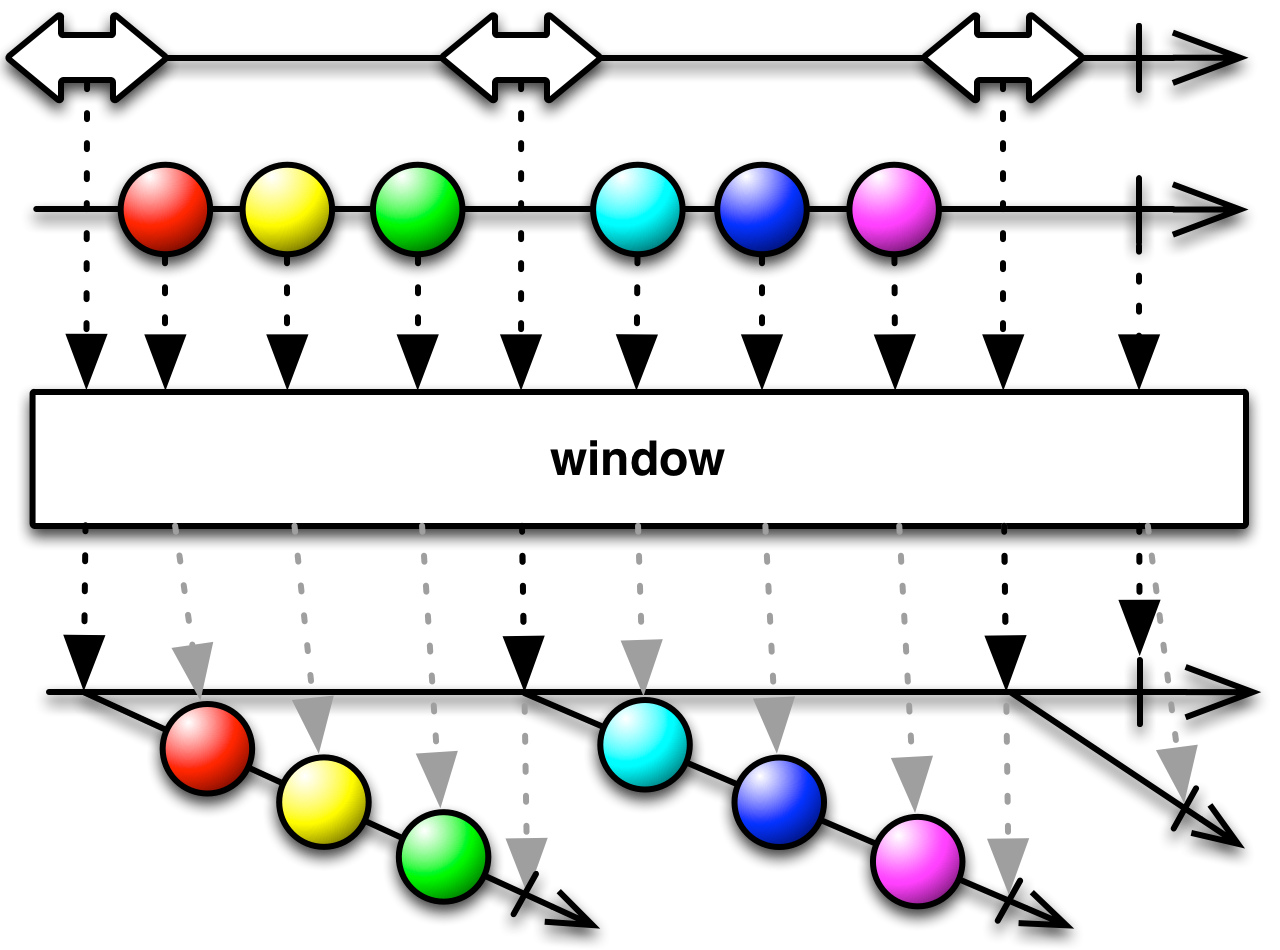
- Backpressure Support:
-
This operator does not support backpressure as it uses a
boundaryObservable to control data flow. - Scheduler:
-
This version of
windowdoes not operate by default on a particularScheduler.
- Type Parameters:
-
U- the window element type (ignored) - Parameters:
-
boundary- an Observable whose emitted items close and open windows - Returns:
-
an Observable that emits non-overlapping windows of items it collects from the source Observable where the boundary of each window is determined by the items emitted from the
boundaryObservable - See Also:
- RxJava wiki: window
zipWith
public final <T2
,R> Observable <R> zipWith(Iterable <? extends T2> other, Func2 <? super T ,? super T2 ,? extends R> zipFunction) Returns an Observable that emits items that are the result of applying a specified function to pairs of values, one each from the source Observable and a specified Iterable sequence.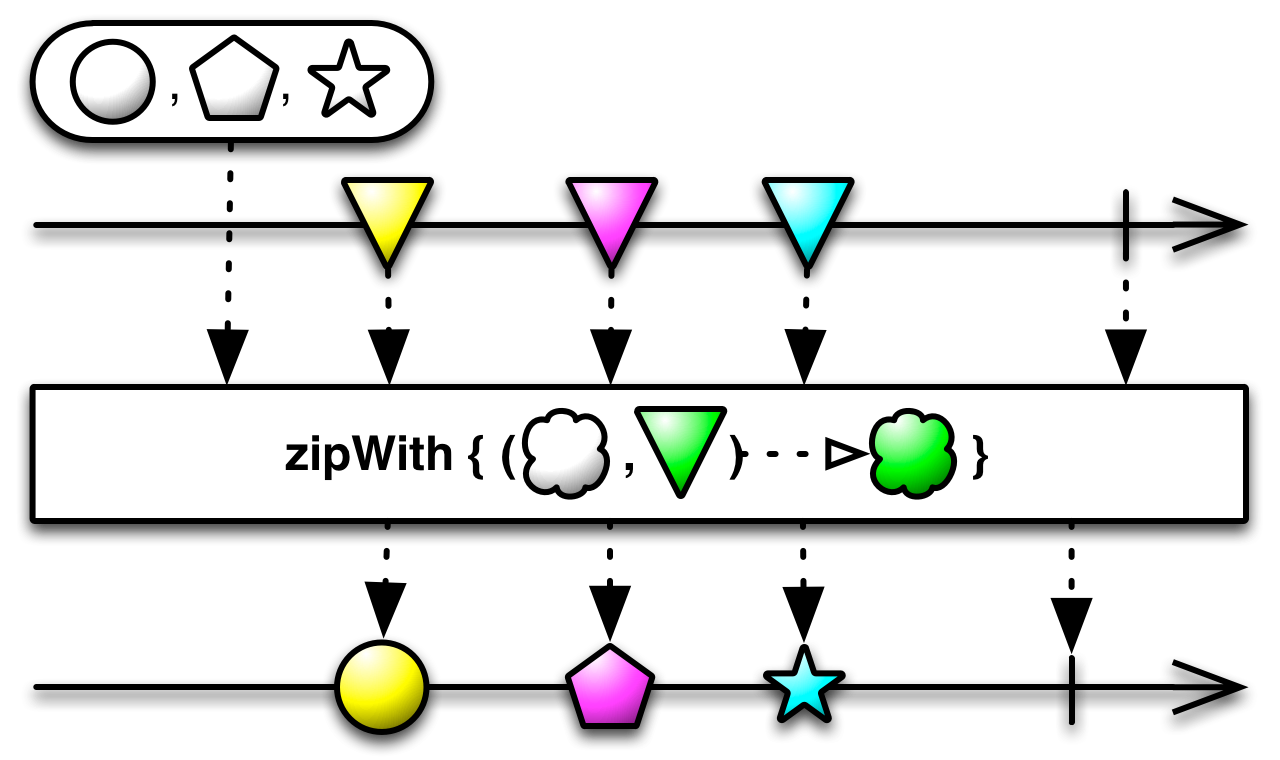
Note that the
otherIterable is evaluated as items are observed from the source Observable; it is not pre-consumed. This allows you to zip infinite streams on either side.- Scheduler:
-
zipWithdoes not operate by default on a particularScheduler.
- Type Parameters:
-
T2- the type of items in theotherIterable -
R- the type of items emitted by the resulting Observable - Parameters:
-
other- the Iterable sequence -
zipFunction- a function that combines the pairs of items from the Observable and the Iterable to generate the items to be emitted by the resulting Observable - Returns:
-
an Observable that pairs up values from the source Observable and the
otherIterable sequence and emits the results ofzipFunctionapplied to these pairs - See Also:
- RxJava wiki: zip
zipWith
public final <T2
,R> Observable <R> zipWith(Observable <? extends T2> other, Func2 <? super T ,? super T2 ,? extends R> zipFunction) Returns an Observable that emits items that are the result of applying a specified function to pairs of values, one each from the source Observable and another specified Observable. - Scheduler:
-
zipWithdoes not operate by default on a particularScheduler.
- Type Parameters:
-
T2- the type of items emitted by theotherObservable -
R- the type of items emitted by the resulting Observable - Parameters:
-
other- the other Observable -
zipFunction- a function that combines the pairs of items from the two Observables to generate the items to be emitted by the resulting Observable - Returns:
-
an Observable that pairs up values from the source Observable and the
otherObservable and emits the results ofzipFunctionapplied to these pairs - See Also:
- RxJava wiki: zip
-